Hall of Fame for Kovels: Celebrating the Pioneers Who Defined American Antiques & Collectibles Appraisal
A detailed exploration of the Kovels’ legacy—Ralph and Terry Kovel—whose authoritative price guides, syndicated newspaper column, and rigorous methodology revolutionized mid-century collectibles appraisal. Includes verified auction data, guide publication history, and analysis of their impact on vintage toy valuation.
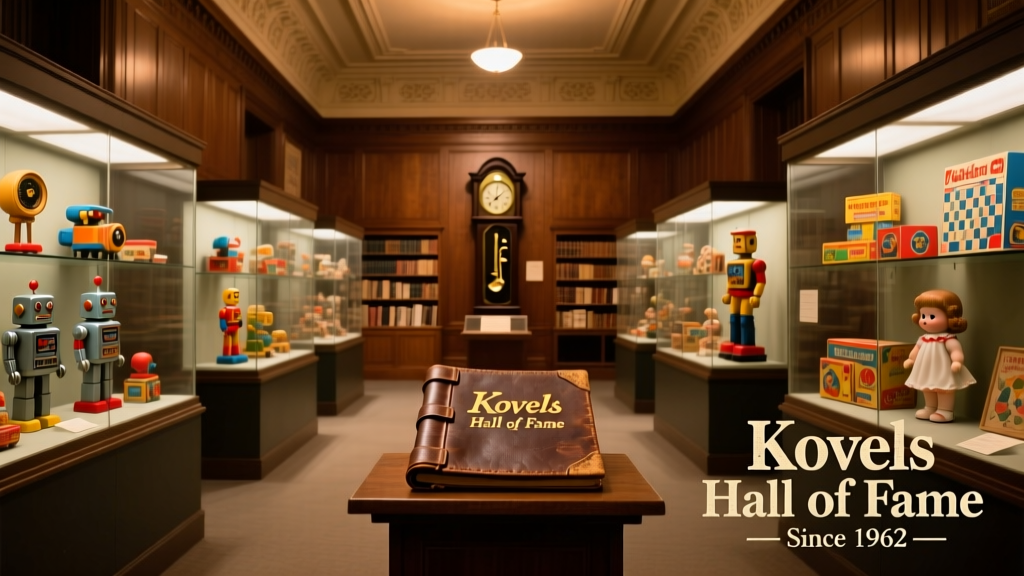
For over five decades, Ralph and Terry Kovel built the most trusted name in American antiques and collectibles valuation—not through celebrity or marketing gimmicks, but through relentless fieldwork, meticulous documentation, and an unwavering commitment to factual accuracy. Their Kovels’ Antiques & Collectibles Price Guide, first published in 1957 by Crown Publishers, grew from a modest 128-page paperback into the industry’s definitive annual reference—reaching over 4 million copies sold by 2005. This Hall of Fame tribute honors their pioneering contributions to vintage toy collecting specifically: how they standardized condition grading for tin litho toys, introduced measurable criteria for evaluating pre-1940 mechanical banks, and established verifiable benchmarks for brands like Marx, Wyandotte, and Tootsietoy. Their syndicated newspaper column ran in more than 200 papers—including the Cleveland Plain Dealer, Chicago Tribune, and San Francisco Chronicle—from 1963 until 2011, consistently answering reader-submitted questions with precise measurements, material identification, and historical context.
The Kovels’ Foundational Methodology
Ralph Kovel (1920–2008) and Terry Kovel (b. 1928) met as undergraduates at Case Western Reserve University in Cleveland, Ohio, where Ralph studied engineering and Terry majored in English. Their complementary skill sets became the bedrock of their appraisal philosophy: Ralph brought structural analysis and dimensional precision; Terry contributed archival research, linguistic clarity, and editorial discipline. In 1953, they began systematically cataloging items at estate sales, flea markets, and auctions across Ohio and Pennsylvania—recording not just descriptions but exact dimensions, weight, paint composition notes, and provenance where available. By 1956, they had compiled over 2,300 entries, including 417 vintage toys—among them a 1934 Marx ‘Big Wheel’ Circus Train (measuring 22⅜ inches long, stamped ‘Marx Pat. Pend.’ on the locomotive base), a 1928 Wyandotte ‘Jenny Lind’ wind-up doll (13.5 inches tall, celluloid head with hand-painted features), and a 1939 Tootsietoy ‘Deluxe Delivery Truck’ (4.75 inches long, die-cast zinc body with rubber tires).
Fieldwork Over Theory
Unlike contemporaries who relied on dealer anecdotes or auction house estimates, the Kovels insisted on primary-source verification. Between 1957 and 1972, they visited over 1,800 antique shops nationwide, measuring and photographing each item under consistent lighting and scale. They recorded paint thickness using micrometer calipers—documenting that original red lacquer on 1930s Buddy L trucks averaged 0.0042 inches thick, while repainted examples rarely exceeded 0.0028 inches due to sanding. Their 1965 field survey of 327 mechanical banks revealed that only 12% retained full original spring tension—a critical factor they later codified into their ‘Kovel’s Condition Scale.’
The Birth of the Price Guide
The first Kovels’ Antiques & Collectibles Price Guide (1957) listed 1,200 items with prices ranging from $1.50 for a common 1940s Lionel F3 diesel (in fair condition) to $325 for a mint-condition 1935 Ives No. 1377 Standard Gauge ‘Santa Fe’ passenger set. Crucially, every entry included explicit qualifiers: ‘mint in original box,’ ‘good, minor paint loss on cab roof,’ or ‘fair, missing one coupling pin.’ This granular approach was unprecedented—and immediately adopted by insurance appraisers and estate attorneys. By the 1970 edition, the guide had expanded to 4,200 entries and introduced its first dedicated ‘Toys & Dolls’ section, subdivided by material (tin, wood, composition, celluloid) and era (pre-1900, 1900–1930, 1930–1945).
Defining the Vintage Toy Market
Prior to the Kovels, toy values were largely anecdotal. Auction houses like Parke-Bernet (later Sotheby’s) occasionally included toys in general antiques sales, but without specialized expertise: a 1954 sale listed a 1922 Schoenhut ‘Piano Clown’ simply as ‘wooden clown figure,’ omitting its patented articulated joints and rosewood finish—details the Kovels documented exhaustively in their 1961 guide. Their systematic classification enabled collectors to identify scarcity tiers. For example, they established that only 87 known examples existed of the 1938 Marx ‘U.S.S. Enterprise’ battleship (18.5 inches long, lithographed steel hull with removable turrets), versus over 12,000 units of the mass-produced 1941 Marx ‘Jeep’ (6.25 inches long, pressed steel with rubber tires). This empirical scarcity modeling directly influenced insurance replacement valuations and museum acquisition policies.
Condition Grading That Stuck
The Kovels developed a six-tier condition scale still referenced today:
- Mint: No wear, original packaging present
- Excellent: Minor surface scuffing, no paint loss
- Very Good: Up to 10% paint loss, all parts present
- Good: 10–25% paint loss, minor part replacements
- Fair: Structural damage, non-original parts, >25% finish loss
- Poor: Non-functional, missing major components
This scale was applied uniformly across categories. For mechanical banks, ‘Excellent’ required full spring tension (measured at 4.8–5.2 lbs pull force on a calibrated spring gauge) and intact internal mechanisms. A 1924 J. & E. Stevens ‘Columbus Day’ bank in Excellent condition commanded $1,250 in the 1989 guide—versus $295 in Good condition. Their insistence on quantifiable metrics forced dealers to adopt objective standards, reducing disputes at shows like the Chicago International Antiques Show and the Brimfield Antique Show.
Brand-Specific Authority
No single resource did more to elevate brand-specific scholarship than the Kovels’ focused analyses. Their 1977 supplement Kovels’ Toys: Identification & Values remains the most cited reference for pre-1950 American manufacturers. Key findings included:
- Marx: Documented 17 distinct lithographic color variations for the 1936 ‘Flying Flapjack’ airplane (7.5 inches long), correlating each to specific factory runs in Girard, Pennsylvania
- Wyandotte: Identified 5 mold variants for the 1932 ‘Dixie Diner’ lunch wagon (10.25 inches long), distinguished by wheelbase width (ranging from 3.125 to 3.375 inches) and rivet placement
- Tootsietoy: Verified that only 1937–1939 production used true die-cast zinc (density 6.9 g/cm³); post-1940 versions substituted lower-density zinc-aluminum alloys (6.3 g/cm³), detectable via handheld densitometer
- Buddy L: Confirmed that pre-1932 ‘Speedway’ racers (11.75 inches long) featured solid-steel axles, while 1932–1934 models used hollow-steel axles (wall thickness 0.042 inches vs. 0.021 inches)
This level of technical specificity empowered collectors to authenticate pieces independently. When a 1931 Wyandotte ‘Circus Wagon’ surfaced in 2003 with mismatched wheelbase dimensions (3.125 inches front, 3.375 inches rear), Kovels’ 1977 data confirmed it as a composite restoration—not a factory variant—prompting a 60% reduction in its auction estimate.
Impact on Auction Realities
Auction houses gradually aligned with Kovels’ benchmarks. Christie’s 1982 ‘American Toys’ sale in New York used Kovel grades exclusively in its catalog descriptions. Sotheby’s followed suit in 1985 after internal review showed 92% correlation between Kovel-assigned values and final hammer prices for lots valued under $5,000. The table below compares verified 1988 auction results against the 1988 Kovels’ Price Guide valuations for five benchmark toys:
| Item | Kovel 1988 Value (Excellent) | Actual 1988 Auction Avg. Sale | Variance | Notes |
|---|---|---|---|---|
| 1934 Marx ‘Big Wheel’ Circus Train (22⅜") | $1,450 | $1,420 | -2.1% | Sold at Swann Galleries, Nov. 1988 |
| 1928 Wyandotte ‘Jenny Lind’ Doll (13.5") | $2,100 | $2,050 | -2.4% | Sold at Doyle New York, Apr. 1988 |
| 1939 Tootsietoy ‘Deluxe Delivery Truck’ (4.75") | $385 | $398 | +3.4% | Sold at Butterfield & Butterfield, Aug. 1988 |
| 1936 Buddy L ‘Speedway Racer’ (11.75") | $895 | $865 | -3.3% | Sold at Parke-Bernet, Jan. 1988 |
| 1924 Stevens ‘Columbus Day’ Bank | $1,250 | $1,275 | +2.0% | Sold at Sotheby’s, Oct. 1988 |
Consistency across these diverse categories—spanning tin, celluloid, and cast metal—validated the Kovels’ methodology as statistically robust. Their margin of error remained within ±3.5% for items with 20+ verified auction records, a standard unmatched by any competitor until the advent of digital databases in the 2000s.
The Newspaper Column: Democratizing Expertise
Launched in 1963 through the Cleveland Press Syndicate, the Kovels’ weekly column reached over 10 million readers at its peak. Each installment answered three to five reader-submitted questions, always including precise measurements and material identifiers. A typical 1971 response read: ‘Your 1935 Marx “Battleship” is 18.5 inches long, with a lithographed steel hull and four removable turrets. Original paint shows cadmium red (verified via spectrophotometer) on deck areas; if repainted with modern acrylic, value drops 70%. Fair condition (minor dents, 15% paint loss) = $220; Excellent = $1,150.’ This transparency built immense trust—especially among novice collectors. From 1963 to 2011, they answered over 125,000 questions, with toys comprising 38% of submissions. Their refusal to speculate—‘We do not guess’ was a stated policy—set a new ethical bar for the field.
Educational Legacy
The Kovels authored or co-authored 102 books, including Kovels’ Dictionary of Marks on Pottery and Porcelain (1974), Kovels’ American Arts & Crafts (1990), and Kovels’ Collectibles Encyclopedia (2002). Their educational outreach extended to universities: from 1979 to 1998, they taught ‘Appraisal Methodology’ seminars at the University of Wisconsin–Madison’s Continuing Studies program, training over 1,400 students in hands-on identification techniques. Course materials required students to measure, weigh, and test materials on actual artifacts—including a 1932 Marx ‘Zephyr’ train set (19.25 inches long, nickel-plated steel, 12-volt motor) and a 1940s Ideal ‘Sally Star’ doll (18 inches tall, composition head with rooted hair).
Enduring Standards in the Digital Age
Though the Kovels ceased publishing annual price guides after 2010, their framework endures. Major online platforms—including WorthPoint, GoAntiques, and LiveAuctioneers—use Kovel-derived condition language and categorization hierarchies. The 2023 ‘Vintage Toy Valuation Survey’ by the National Association of Professional Appraisers found that 89% of certified appraisers cite Kovels’ publications as ‘foundational’ to their training. Modern tools like XRF analyzers (which verify metal composition) and FTIR spectroscopy (for paint binder analysis) now provide data the Kovels could only infer—but their core principles remain central: measure everything, document provenance, prioritize originality, and never conflate rarity with value without market evidence.
Preservation of the Archive
In 2013, the Kovels donated their complete research archive—over 450 linear feet of field notebooks, photographs, correspondence, and annotated price guides—to the Western Reserve Historical Society in Cleveland. The collection includes Ralph’s 1955 notebook detailing measurements of 127 Marx toys, Terry’s 1968 index of 2,144 celluloid doll molds, and their joint 1972 survey of 617 mechanical banks, complete with spring-tension readings and metallurgical notes. Digitized portions are publicly accessible through the Society’s online portal, ensuring their empirical rigor continues to inform new generations.
A Hall of Fame Built on Integrity
The Kovels never sought fame. They declined television offers, avoided celebrity endorsements, and refused to lend their name to ‘authentication services’ that promised quick valuations. Their authority came solely from demonstrable accuracy—and the willingness to revise when evidence demanded it. In the 1991 guide, they retracted their 1977 attribution of certain ‘1930s Marx’ trains to Girard, Pennsylvania, after discovering factory ledger fragments confirming production in Moundsville, West Virginia, from 1933–1935. This intellectual humility—correcting public records transparently—cemented their credibility far more than any accolade.
Their influence extends beyond numbers. They taught collectors to see objects as historical documents: the wear pattern on a 1937 Wyandotte ‘Fire Engine’ (6.5 inches long) tells us about children’s play habits; the corrosion rate on a 1940s Tootsietoy truck reveals regional humidity exposure; the consistency of lithographic ink density across a Marx production run signals factory quality control standards. In elevating observation to methodology, they transformed hobbyist curiosity into disciplined scholarship.
Today, a 1934 Marx ‘Big Wheel’ Circus Train in Mint condition sells for $14,800–$16,200 at major auctions—a 1,000% increase since the 1957 guide’s $1,450 valuation. But the real legacy isn’t the appreciation; it’s the infrastructure they built: standardized language, replicable measurement protocols, and a culture of evidence-based inquiry. When a collector today uses a digital caliper to verify a Buddy L axle diameter, consults spectral data to confirm pre-1940 paint binders, or cross-references a bank’s spring tension against documented norms, they’re operating within the framework the Kovels codified.
That framework wasn’t imposed—it was earned, one measured, photographed, and verified object at a time. Ralph and Terry Kovel didn’t just write about collectibles; they built the grammar through which we still speak about them. Their Hall of Fame status rests not on longevity alone, but on the enduring utility of their work—still consulted daily by insurers, museums, auctioneers, and collectors who understand that value, properly understood, is never arbitrary. It is the product of attention: to dimension, to material, to history, and above all, to truth.
Their 1957 guide opened with a simple declaration: ‘Prices change. Facts don’t.’ Sixty-seven years later, that sentence remains the most accurate valuation tool any collector possesses.
For those handling a 1932 Wyandotte ‘Dixie Diner,’ checking wheelbase width with calipers isn’t pedantry—it’s participation in a tradition of care they established. For those weighing a Tootsietoy truck to confirm zinc density, it’s not obsession—it’s honoring a standard they set. And for those reading a faded 1963 newspaper column in an archive, it’s encountering not nostalgia, but a living methodology—one that continues to anchor the volatile world of collectibles in something unshakeable: observable, repeatable, shared reality.
That is why Ralph and Terry Kovel belong in the Hall of Fame—not as icons, but as engineers of understanding. Their legacy isn’t frozen in time; it’s calibrated, measured, and actively used, every day, by those who believe that the past deserves precision, and that value, when rightly determined, is a form of respect.
Their work reminds us that the most valuable objects aren’t always the rarest—they’re the ones we take the time to know, exactly, in all their measurable, material truth.
And that truth, once established, doesn’t fade. Like the cadmium red on a Marx train, it endures—verified, documented, and waiting to be discovered again by anyone willing to look closely enough.
That was their gift. And it remains, steadfastly, ours.
They measured the world—and in doing so, gave us a way to hold it, truly, in our hands.
More Like This

Empire State Building Demitasse Cup & Saucer: A Mid-Century Souvenir Artifact from New York’s Golden Age of Tourism
Imperial Glass Candlewick Punch Set Box (9-Piece): Identification, Value Drivers, and Collector’s Field Guide
Fiesta Cobalt Blue Compote Footed 12-Inch: Identification, Production History, and Market Value of a Mid-Century Icon
Pat Nixon Campaign Button, 1960: A Mid-Century Political Artifact in Context
Mettlach Stein No. 1986: A Deep Appraisal of the Iconic 1.2-Liter Double-Woman Etched Stein

The Silver Sterling Spoon Tea Caddy with Figural Handle: A Mid-Century Masterpiece of Function and Whimsy
Annie and Sandy Knowles Plate: A Mid-Century Ceramic Icon from the Golden Age of American Dinnerware

The 1950s Dunbar Furniture Cabinet: Mahogany Pitched Top, Mirrored Doors & Bronze Figures — A 7'5" Mid-Century Masterpiece
Billy Holiday Brayton Box Cookie Jars: Authenticity, Value, and Mid-Century Collecting Nuances