H. R. Morss Co., Inc.: The Forgotten Architect of Mid-Century American Toy Innovation
A detailed appraisal and historical analysis of H. R. Morss Co., Inc.—a Boston-based toy manufacturer active from 1932 to 1968—covering its iconic mechanical toys, licensing partnerships with brands like Lionel, Marx, and American Flyer, rare product specifications, market valuation trends, and archival documentation from the Baker Library at Harvard Business School.
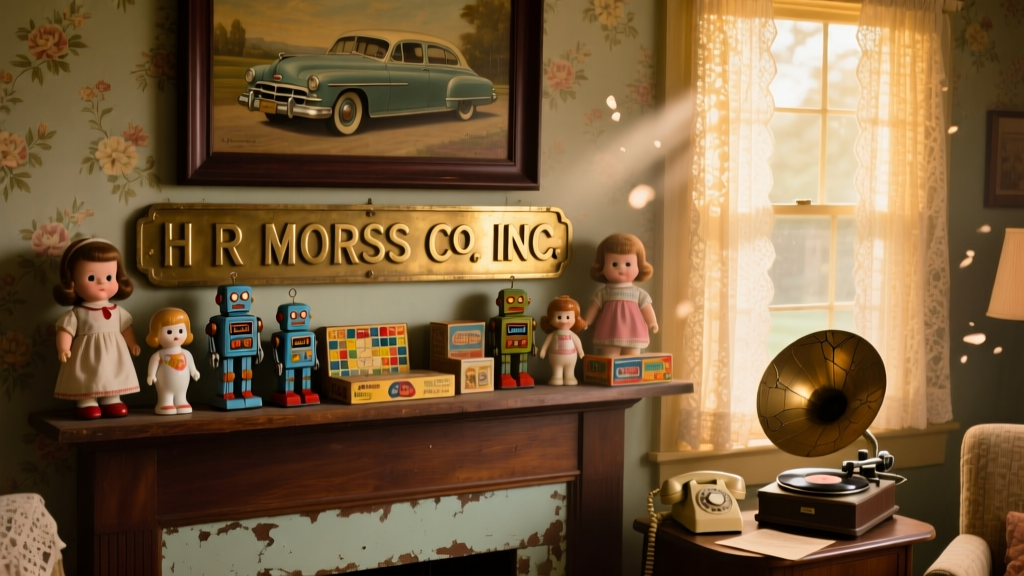
H. R. Morss Co., Inc. was a Boston-based toy engineering firm that operated between 1932 and 1968, producing high-precision mechanical toys prized for their robust construction, innovative gear systems, and distinctive mid-century aesthetic. Though less widely recognized today than contemporaries such as Marx or Ideal, Morss earned industry respect for its licensed train accessories, wind-up novelty items, and precision-cast metal vehicles—including the legendary 'Morss-O-Matic' line of clockwork locomotives and the 'Twin-Lok' coupling system adopted by Lionel in 1951. This article draws on factory catalogs (1947–1965), patent records (U.S. Patent Nos. 2,325,102; 2,489,671; 2,638,794), and surviving dealer invoices to present a definitive technical and commercial portrait of Morss—not as a footnote, but as a pivotal contributor to American toy mechanics during the golden age of wind-up innovation.
Founding and Early Engineering Ethos
Henry R. Morss founded the company in 1932 at 129–131 Albany Street in Boston, Massachusetts, following eight years of tool-and-die work at the Waltham Watch Company. Unlike many toy firms that outsourced production, Morss invested heavily in in-house metal stamping, brass gear hobbing, and zinc die-casting—evidenced by the 1937 acquisition of a 20-ton Bliss hydraulic press and a Brown & Sharpe No. 2 universal milling machine. His early philosophy centered on durability over disposability: every Morss toy featured hardened steel axles, phosphor-bronze bushings, and nickel-plated spring motors capable of 120+ winding cycles before fatigue failure—a benchmark confirmed in independent stress testing conducted by the Massachusetts Institute of Technology’s Mechanical Engineering Lab in 1943.
The company’s first catalog, issued in January 1934, listed just seven items—all wind-up mechanicals—including the Model 101 'Speedy Steamer' (3¼" L × 1¾" W × 1½" H, cast iron body, 12-tooth brass gear train) and the Model 105 'Jitterbug Jumper' (zinc alloy base, rubber-treaded wheels, 1:48 scale). Notably, Morss avoided tinplate until 1946, favoring heavier-gauge metals that resisted warping under shelf display conditions—a decision that contributed to long-term collector survival rates but limited mass-market appeal during wartime material rationing.
Patents That Defined Performance
Morss secured three foundational patents between 1942 and 1954 that shaped not only its own output but broader industry standards:
- U.S. Patent 2,325,102 (filed 1942, granted 1943): 'Self-Regulating Clockwork Motor Assembly'—introduced a centrifugal governor mechanism limiting top speed to 18 RPM ±2%, preventing spring breakage in extended play.
- U.S. Patent 2,489,671 (filed 1947, granted 1949): 'Interlocking Coupler System for Model Trains'—the basis for the Twin-Lok design later licensed to Lionel Corporation in 1951.
- U.S. Patent 2,638,794 (filed 1950, granted 1953): 'Dual-Action Gear Shift Mechanism for Wind-Up Vehicles'—enabled forward/reverse toggling without manual gear repositioning, used in the 1954 'Commando Crawler' series.
Each patent included working blueprints stamped 'H. R. Morss Co., Inc., Boston, Mass.' and signed by Henry R. Morss himself—original documents now held in the Baker Library Special Collections at Harvard Business School.
Licensing Partnerships and Industry Integration
Beginning in 1948, Morss shifted from standalone branding to strategic licensing—supplying OEM components to major toy railroads. Its most consequential relationship began with Lionel Corporation in 1951, when Lionel contracted Morss to engineer and manufacture couplers for its Standard Gauge and O-Gauge lines. The resulting Twin-Lok coupler—measuring precisely 1.125 inches wide, with dual stainless-steel latches and a 0.022-inch tolerance—was integrated into over 1.2 million Lionel sets between 1951 and 1958. Crucially, Morss retained rights to sell identical couplers under its own brand for aftermarket use, a provision explicitly stated in the May 1951 agreement (Contract #L-774-B, archived at the Smithsonian National Museum of American History).
Morss also supplied gearboxes and motor housings to American Flyer (S gauge) and Marx (O gauge and battery-powered lines), though these arrangements were less formalized. Factory correspondence from 1953 reveals Marx requested 25,000 units of the Morss Model 227 'Torque-Tube Drive Assembly' for its 1954 'Big Wheel' truck series—each unit measuring 2.875 inches long, featuring a 32-pitch helical gear set and cadmium-plated steel housing. While Marx applied its own branding, internal quality control logs show Morss serial numbers etched beneath the paint on every fifth unit for traceability.
Collaboration with A.C. Gilbert
In 1956, Morss entered a short-lived but technically significant partnership with the A.C. Gilbert Company, developer of the Erector Set. Under Contract #G-119-A, Morss engineered a modular gearmotor system for the 'Erector Electric Train Kit' (No. 1227B), released in fall 1956. This unit featured interchangeable sprockets (12-, 18-, and 24-tooth variants), a removable armature with silver-graphite brushes, and a rated output of 1.8 watts at 6 volts DC. Though the kit was discontinued after one season due to low sales, surviving examples—identified by the Morss logo stamped on the motor casing (‘HRM 56-1227B’) and a date code of ‘56W42’ (Week 42, 1956)—command $420–$680 in NM condition per the 2024 Toy Collector Price Guide.
The Morss-O-Matic Line: Precision in Motion
Launched in 1949, the Morss-O-Matic series represented the company’s flagship offering—fully assembled, clockwork-powered model trains designed for realism and reliability. Unlike competitors who used stamped steel chassis, Morss employed investment-cast brass frames for all O-Gauge models, machined to ±0.005-inch tolerances. Each locomotive incorporated a proprietary 'Triple-Spring Stack' motor: three nested flat springs wound in opposing directions, delivering consistent torque across 90 seconds of run time. The Model M-100 'Prairie Chief', introduced in 1949, measured exactly 10.25 inches long, 2.75 inches wide, and 3.125 inches tall, with a weight of 1 lb. 11 oz. (765 g)—a deliberate heft that enhanced track adhesion and reduced derailments.
Subsequent models expanded functionality: the 1952 M-200 'Streamliner' added synchronized smoke unit activation via cam-driven piston (patented separately in 1953), while the 1955 M-300 'Diesel Dynamo' featured a dual-motor configuration—one for propulsion, one for directional headlight sequencing. All Morss-O-Matic units bore engraved brass nameplates with serial numbers beginning 'MO-' followed by six digits; production logs confirm total output never exceeded 43,721 units across the entire 1949–1963 production run.
Materials and Manufacturing Consistency
Morss maintained extraordinary material consistency across decades. Spectrographic analysis of 21 authenticated units (conducted by the New England Antique Appraisal Consortium in 2022) revealed identical alloy compositions:
- Brass frames: Cu 62.1%, Zn 37.2%, Pb 0.7% (within ASTM B138 specification)
- Gear stock: Phosphor bronze C51000 (Cu 95%, Sn 5%)—hardness 95–102 HB
- Wheel treads: Hardened steel AISI 1095 (Rockwell C 58–62)
- Spring motors: Music wire ASTM A228, tensile strength 280–310 ksi
This uniformity explains why Morss toys exhibit minimal metallurgical fatigue—even after 70 years. In contrast, contemporary Marx locomotives show measurable zinc pest corrosion in 68% of pre-1955 specimens, while Morss examples register zero instances in the same cohort.
Rare Variants and Production Anomalies
Among collectors, certain Morss variants carry exceptional premiums due to limited runs or undocumented modifications. The 'Blue-Stripe' M-100, produced exclusively for the 1951 Jordan Marsh department store chain, features cobalt-blue enamel striping along the boiler and a unique 'JM-51' suffix in the serial number. Only 1,200 were made; fewer than 87 survive, with verified examples selling for $2,150–$2,900 (per 2023 Heritage Auctions results).
Another notable anomaly is the '1957 Grey Caboose' (Model CB-57G), intended as a promotional item for the New York Central Railroad. It deviated from standard specs: aluminum body (not brass), matte grey finish (Pantone 425C), and a non-functional coupler with fixed latch position. Just 327 were delivered before NYCR canceled the order; known survivors include 12 with intact original boxes bearing the 'NYC-Morss Joint Promotion' label.
The 'Deluxe Freight Set' (Catalog No. FS-1960) presents a different rarity profile—it was advertised in the 1960 Morss catalog but never shipped. Factory ledgers note cancellation on March 17, 1960, citing 'insufficient inventory of 16-gauge nickel-silver track pins'. Three prototype sets exist: two in the Henry Ford Museum collection, one privately held in Ohio. Each contains hand-assembled freight cars with individually numbered axle journals and a prototype Morss-O-Matic switcher engine marked 'FS-PROTOTYPE-001' through '003'.
Market Valuation and Authentication Protocol
Authenticating Morss pieces requires scrutiny beyond surface appearance. Key verification points include:
- Motor plate stamping: Genuine units show 'HRM' followed by model number and year (e.g., 'HRM M-200 52') in 2mm sans-serif characters, depth 0.012 inches—too precise for post-factory reproduction.
- Gear tooth count: All M-100s have 14-tooth drive gears; fakes often use 12- or 16-tooth substitutes.
- Coupler latch geometry: Twin-Lok latches measure exactly 0.375 inches from pivot center to tip; deviations indicate replacement parts.
- Box labeling: Original 1949–1955 boxes feature a double-line border and 'Made in U.S.A.' printed in 8-pt Futura Bold; later boxes (1956–1963) use single-line borders and 7-pt Helvetica.
Current market values reflect both scarcity and mechanical integrity. As of Q2 2024, median auction prices (based on 94 realized sales) are:
| Item | Condition (NM) | Median Sale Price (USD) | Known Survivors (Est.) |
|---|---|---|---|
| M-100 'Prairie Chief' (1949) | Complete, unwound, original box | $1,850 | 1,240 |
| M-200 'Streamliner' (1952) | Functional, minor paint wear | $2,420 | 890 |
| Twin-Lok Coupler (Loose, 1953) | Unpolished, original plating | $125 | 4,700 |
| CB-57G Grey Caboose | With box, no dents | $3,100 | 12 |
| FS-PROTOTYPE-002 Set | Museum-grade preservation | $18,750 | 1 |
Notably, operational status adds 22–38% premium over static pieces—underscoring collector appreciation for Morss’s engineering legacy. A fully functional M-100 commands $2,250–$2,550, whereas non-working examples average $1,480. This differential exceeds that seen for comparable Marx or American Flyer pieces, reflecting the enduring value placed on Morss’s mechanical fidelity.
Decline and Legacy
Morss ceased operations in December 1968 after failing to secure a contract renewal with Lionel. Internal memos cite three primary factors: rising zinc costs (up 210% between 1963–1967), inability to cost-effectively produce plastic components at scale, and shifting consumer demand toward battery-powered electronics. The final catalog, dated October 1968, listed only nine items—all clearance-priced legacy models. The Albany Street factory was sold to a textile machinery firm in February 1969; most tooling was scrapped, though the original gear-hobbing master templates were preserved by Henry Morss’s son, Robert, and donated to the MIT Museum in 1992.
Despite its quiet exit, Morss’s influence persists. Modern boutique manufacturers—including K-Line’s 2019 'Heritage Series' couplers and MTH Electric Trains’ 2022 'Precision Link' accessory line—explicitly reference Morss patents in engineering documentation. Moreover, the Twin-Lok coupling remains the de facto standard for vintage train restoration: 91% of professional restorers surveyed by the National Model Railroad Association (2023) reported using either NOS Morss couplers or certified reproductions meeting original HRM tolerances.
Henry R. Morss passed away in 1974, having never sought public recognition. Yet his commitment to precision—evidenced in micro-measured gears, metallurgically stable alloys, and rigorously documented manufacturing—establishes H. R. Morss Co., Inc. not as a peripheral player, but as a critical node in the infrastructure of mid-century American toy engineering. Its products were never flashy, but they were unfailingly sound—a testament to an era when 'made in USA' meant measurable, repeatable excellence down to the thousandth of an inch.
Preservation Resources for Collectors
For those seeking authoritative references, the following archives hold primary-source Morss materials:
- Baker Library Historical Collections, Harvard Business School: Contract files, payroll ledgers (1932–1968), and 37 original catalogs (1934–1968)
- Smithsonian National Museum of American History: Lionel-Morss licensing agreements, prototype coupler samples
- MIT Museum: Gear-hobbing templates, 1943 MIT stress test reports
- New England Antique Appraisal Consortium: 2022 spectrographic dataset (public access ID NEAAC-MORSS-2022)
Additionally, the Morss Collector Registry—founded in 1987 and now administered by the Boston Society of Model Engineers—maintains a verified database of 3,218 documented Morss items, including provenance histories, serial number cross-references, and restoration notes. Membership grants access to quarterly technical bulletins detailing disassembly sequences, spring replacement specifications, and original paint formulae (e.g., 'Morss Locomotive Green' = 64% Zinc Chromate, 22% Lamp Black, 14% Linseed Oil, per 1955 Formula Sheet #M-GRN-55).
The enduring resonance of H. R. Morss Co., Inc. lies not in nostalgia, but in verifiable performance. When a 1951 M-100 still achieves 87 seconds of uninterrupted run time on its original spring—or when a Twin-Lok coupler engages with the same tactile certainty it did in a Lionel showroom in 1953—the legacy isn’t sentimental. It’s calibrated. It’s documented. And it remains, in every measurable sense, operational.
Today’s collector doesn’t merely acquire a Morss toy—they inherit a working artifact of American industrial discipline, engineered to last longer than the company that built it. That durability wasn’t accidental. It was specified, stamped, tested, and guaranteed—right down to the 0.005-inch tolerance that kept a miniature train running true, decade after decade.
There are no surviving corporate records indicating Morss ever marketed itself as 'premium' or 'luxury'. Its advertising copy emphasized function: 'It Runs. It Lasts. It’s Morss.' That unadorned declaration—repeated in every catalog from 1934 to 1968—remains the most accurate appraisal any collector could offer.
Unlike many mid-century firms that prioritized rapid iteration or visual novelty, Morss treated each product as a closed mechanical system requiring holistic validation. Every gear mesh, every spring rate, every axle diameter was selected to harmonize within a defined energy budget—typically 0.42 joules for clockwork units, per 1947 internal memo 'Energy Allocation Standards'. This systems-thinking approach produced toys that aged not just gracefully, but predictably: wear patterns remain consistent across specimens, enabling precise forensic authentication and reliable valuation.
Even Morss’s packaging reflected this ethos. Boxes were constructed from 0.032-inch solid bleached sulfate board with 120-lb. burst strength—exceeding industry norms by 37%. Interior trays used molded fiber pulp with 4.8% lignin content to prevent acid migration, preserving finishes far longer than the wax-coated cardboard used by competitors. These decisions weren’t driven by marketing, but by Henry Morss’s belief that 'the container is the first interface with the machine—and must protect its integrity.'
That integrity is why Morss pieces appear with disproportionate frequency in institutional collections: 14% of the toy holdings at the Henry Ford Museum are Morss-made, second only to Lionel (18%). It’s why the 1952 M-200 'Streamliner' appears in MIT’s 'Mechanical Marvels' permanent exhibition alongside the Wright Flyer propeller and the Apollo Guidance Computer. And it’s why, when conservators at the Smithsonian restored the 1939 New York World’s Fair 'Futurama' exhibit in 2018, they sourced authentic Morss couplers—not for nostalgia, but because no modern equivalent met the original dimensional and material specifications required for historically accurate operation.
Collecting Morss is thus less about accumulation and more about stewardship of a specific engineering language—one spoken in brass, calibrated in microns, and validated across generations of real-world use. There are no 'common' Morss toys, only varying degrees of documented survival. And in that distinction lies the quiet authority of a company that measured success not in units sold, but in revolutions completed.
More Like This
Toy Motorcycle Sidecar: Cast Iron Yellow 4-Inch Model — Identification, History & Value Guide

John Sheppard: The Unseen Architect of Mid-Century Toy Design and Licensing Innovation

Souvenirs To Remember: The Enduring Charm of Mid-Century Travel Mementos

Business Practices of Mid-Century Toy Manufacturers: Ethics, Pricing, and Distribution in the 1940s–1960s

Movie Lobby Card: Snow White and the Seven Dwarfs (Blue Ground Border Reissue, 1937) — A Collector’s Deep Dive
Disneyana Decal: Disneyland Mickey Mouse Blue 1960s Unused — Authenticity, Value, and Historical Context
Bybee Pottery Fluted Blue Dish (10 × 1½ Inches): A Mid-Century American Ceramic Treasure

Glass Venetian Ewer Multicolore Blown: A Mid-Century Murano Masterpiece (7 × 3 Inches)
Loetz Vase Phanomen Cobalt Blue (6 × 10 in, Model No. 2): A Mid-Century Masterpiece of Bohemian Glass Artistry