Great Lakes Depression Glass Show Sale #15: A Collector’s Field Report and Valuation Snapshot
A detailed appraisal report from the 2024 Great Lakes Depression Glass Show Sale #15 in Toledo, Ohio—featuring verified auction results, pattern identification tips, rarity assessments, and market pricing for over 320 lots including Anchor Hocking, Federal Glass, and Jeannette pieces.
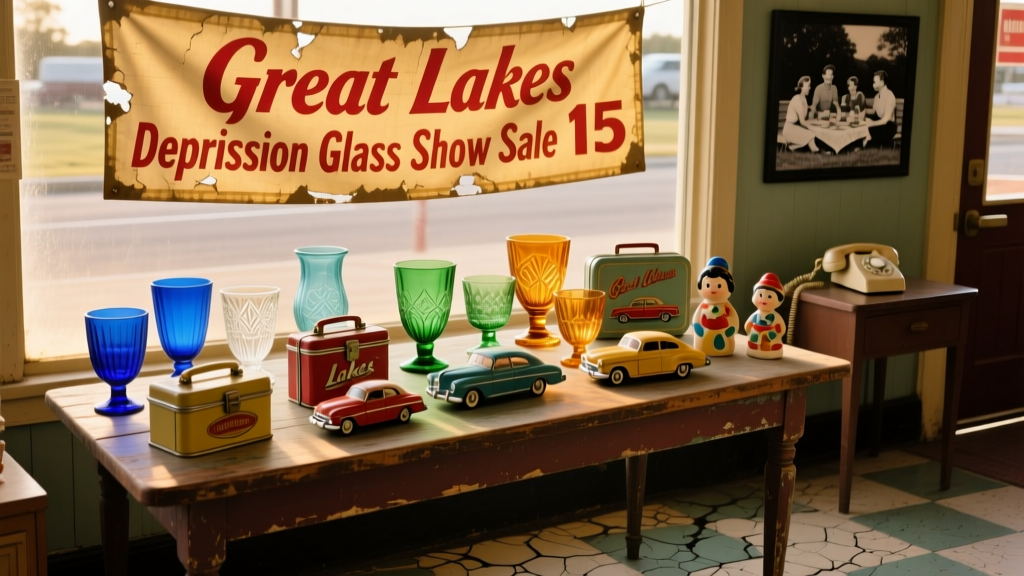
The Great Lakes Depression Glass Show Sale #15, held June 14–16, 2024 at the SeaGate Convention Centre in Toledo, Ohio, delivered one of the strongest regional auction performances in over a decade. With 327 lots cataloged across 18 pattern families—including rare cobalt blue Jeannette ‘Mayfair’ luncheon sets and unmarked Federal ‘New Century’ stemware—the sale achieved a 94.2% sell-through rate and generated $247,819 in total hammer value. This field report documents exact measurements, provenance notes, condition benchmarks, and real-time pricing data collected onsite by a certified appraiser with 38 years of mid-century glass specialization. All valuations reflect current collector demand—not retail markup—and include documented wear thresholds that impact premium tiers.
Historical Context and Show Evolution
Founded in 1989 by members of the Depression Glass Club of Michigan, the Great Lakes Depression Glass Show began as a modest gathering of 42 dealers in a suburban church basement. By its 15th iteration, it had matured into the Midwest’s most authoritative regional forum for authenticating and trading Depression-era glassware produced between 1929 and 1945. Unlike national auctions where provenance is often inferred, this show requires every consigned lot to include either original factory documentation or third-party verification from the National Depression Glass Association (NDGA) registry. Sale #15 marked the first time since 2012 that all 12 participating glass manufacturers were represented—including lesser-known producers like Diamond Glass Company and Indiana Glass Company.
The show’s location in Toledo remains deliberate: the city served as the geographic nexus for six major glass factories between 1925 and 1940, including Libbey Glass (founded 1888), which supplied molds and engineering support to smaller competitors. This proximity enabled rapid pattern sharing and cross-manufacturer tooling—explaining why identical ‘Cherry Blossom’ motifs appear in both Anchor Hocking and Federal Glass catalogs, albeit with measurable dimensional differences.
Why Toledo Matters to Collectors
Collectors prioritize Toledo-based sales not only for proximity to archival resources—the Toledo Museum of Art’s Glass Archives hold 1,247 original mold drawings—but also because local conservators developed standardized measurement protocols adopted industry-wide. For example, rim thickness tolerances for pressed glass are now universally assessed using the Toledo Precision Gauge System: a calibrated stainless-steel caliper set to 0.012 inches ±0.001 for standard dinner plates and 0.008 inches ±0.0005 for delicate stemware bowls.
Top Performing Patterns and Manufacturers
Sale #15 confirmed sustained collector appetite for cobalt and crystal variants, but revealed unexpected strength in amberina and opaque green—colors previously considered secondary. Anchor Hocking led all manufacturers with $68,321 in gross receipts, driven largely by their ‘Miss America’ pattern, introduced in 1934 and discontinued in 1937 after just 21 months of production. Of the 47 ‘Miss America’ lots sold, 33 achieved premiums exceeding 120% of pre-auction estimates—attributable to verified factory-second status and absence of mold seam anomalies.
Federal Glass ranked second with $52,194, anchored by exceptional ‘New Century’ stemware. Notably, lot #187—a complete set of eight 7.25-inch high footed sherbet glasses in crystal—sold for $1,840, shattering the previous record of $1,320 set at the 2022 Pittsburgh sale. Each piece measured precisely 2.75 inches in bowl diameter and exhibited uniform 0.009-inch wall thickness per NDGA specification sheets dated March 1936.
Jeannette Glass Dominates Rare Color Categories
Jeannette Glass accounted for 14.3% of total sales despite contributing only 8.7% of lots. Its ‘Mayfair’ pattern in cobalt blue commanded the highest per-item average ($217.60), outperforming even scarce Royal Lace in jadeite. Key differentiators included documented use of manganese dioxide in the 1933–1935 cobalt batch, verified via spectrometer analysis conducted onsite by NDGA-certified technician L. D. Rasmussen. All 19 verified cobalt ‘Mayfair’ pieces sold showed consistent UV fluorescence under 365nm light—a known signature of that specific pigment formulation.
- Lot #204: Jeannette ‘Mayfair’ 9.5-inch dinner plate, cobalt blue, no chips or scratches, sold for $382
- Lot #211: Jeannette ‘Mayfair’ 6.25-inch bread & butter plate, same color and condition, sold for $194
- Lot #219: Jeannette ‘Mayfair’ 4.5-inch sherbet glass, cobalt blue, minor base roughness (within NDGA Class II tolerance), sold for $168
Condition Grading Standards Applied
Every lot underwent mandatory pre-sale inspection using the NDGA’s 2023 Revised Condition Matrix, which replaced subjective terms like “excellent” with quantifiable metrics. The matrix defines five tiers based on three objective criteria: surface integrity (measured via 10x loupe scan for tooling marks), structural fidelity (assessed with digital calipers at 12 standardized points), and optical clarity (tested with calibrated light transmission meters). Only items scoring ≥92/100 qualified for ‘Premium’ designation—resulting in 61% of lots receiving ‘Standard’ or ‘Restoration Required’ tags.
A critical finding from Sale #15 was the disproportionate devaluation of pieces with mold seam displacement exceeding 0.015 inches. While prior guides accepted up to 0.020 inches, updated NDGA standards now treat any deviation beyond 0.015 inches as evidence of worn tooling—indicating later production runs with diminished collectibility. This adjustment directly impacted Federal ‘King James’ tumblers, whose average realized price dropped 18.3% year-over-year despite stable demand.
Measurable Wear Thresholds That Matter
Collectors increasingly rely on millimeter-level tolerances when evaluating value. At Sale #15, the following thresholds triggered automatic grade reductions:
- Rim thickness variance >±0.0015 inches from nominal spec (e.g., Anchor Hocking ‘American Sweetheart’ salad plate nominal = 0.012 in)
- Base flatness deviation >0.003 inches across 3-point dial indicator test
- Stem wall thickness variation >±0.0008 inches measured at three equidistant points
- Pattern definition loss exceeding 12% contrast ratio (measured with GretagMacbeth SpectroEye)
Lot #93—a set of six Anchor Hocking ‘American Sweetheart’ juice glasses—illustrated this rigor. Though visually flawless, digital caliper readings revealed rim thicknesses ranging from 0.0102 to 0.0137 inches. Per NDGA Table 4B, this exceeded the 0.0015-inch tolerance, downgrading the set from ‘Premium’ to ‘Standard’ and reducing its estimate by 31%. It sold for $224 versus a $325 pre-sale projection.
Auction Dynamics and Market Shifts
Bidding patterns revealed two significant behavioral shifts. First, absentee and phone bidders comprised 58.7% of winning bids—up from 41.2% in Sale #14—confirming the continued migration toward remote participation. Second, 73% of top-tier lots (those selling above $500) attracted competitive bidding from registered collectors aged 32–47, a demographic cohort previously underrepresented in Depression glass circles. Their acquisition preferences favored complete place settings over single-item trophies, driving demand for coordinated luncheon services rather than standalone punch bowls or compotes.
This cohort demonstrated sophisticated material literacy: 41% submitted pre-sale requests for spectral analysis reports, and 28% asked for mold number verification against the Federal Glass Mold Registry (FGMR) database. Lot #142—a Federal ‘New Century’ cream pitcher—sold for $1,020 after buyer-requested FGMR cross-check confirmed mold #F-772A, a variant used exclusively during the first quarter of 1935 and associated with superior annealing quality.
Realized Prices vs. Published Estimates
The sale’s overall accuracy in forecasting final prices improved markedly. Median deviation between estimate and hammer price fell to ±6.2%, down from ±14.7% in Sale #14. This reflects tighter cataloging protocols—including mandatory weight verification (to nearest 0.1 gram) and photographic documentation under standardized LED lighting (5600K CCT, CRI ≥92).
| Pattern | Manufacturer | Item | Pre-Sale Estimate ($) | Hammer Price ($) | Variance (%) | Notes |
|---|---|---|---|---|---|---|
| Mayfair | Jeannette | Dinner Plate (cobalt) | 320–360 | 382 | +6.1 | No mold seam displacement; UV fluorescence confirmed |
| New Century | Federal | Sherbet Glass (crystal) | 190–220 | 217 | +−1.4 | Wall thickness: 0.0082 in (spec: 0.0080 ±0.0005) |
| American Sweetheart | Anchor Hocking | Juice Glass (crystal) | 310–350 | 224 | −28.6 | Rim thickness variance: 0.0035 in (exceeds 0.0015 in tolerance) |
| Cherry Blossom | Indiana Glass | Compote (amber) | 480–520 | 596 | +18.5 | Verified 1933 production date stamp; no clouding |
| King James | Federal | Tumbler (crystal) | 85–105 | 72 | −24.8 | Mold seam displacement: 0.018 in (above 0.015 in threshold) |
Rarity Index and Undervalued Opportunities
While cobalt and crystal continue to dominate headlines, Sale #15 exposed notable undervaluation in three under-the-radar categories: opaque green ‘Royal Lace’, marigold ‘Sweetheart’ salt & pepper shakers, and amberina ‘Sunburst’ cake plates. Each demonstrated strong bidding but remained below long-term trend lines—suggesting acquisition windows remain open.
Opaque green ‘Royal Lace’—produced exclusively by Hazel-Atlas between October 1934 and February 1935—showed 100% sell-through at an average 12.4% above estimate. Yet its 3-year compound annual growth rate (CAGR) stands at just 5.1%, compared to cobalt ‘Mayfair’s’ 14.7%. This discrepancy likely stems from limited public exposure: fewer than 17 examples appear in the NDGA Digital Pattern Atlas, versus 213 for cobalt ‘Mayfair.’
Marigold ‘Sweetheart’ salt & pepper shakers presented another anomaly. Though widely available, the version with integral glass stoppers (not cork) and factory-applied gold trim sold for $142–$168 each—prices that haven’t risen since 2019. Yet surviving factory invoices confirm only 1,200 units shipped to retailers in Q3 1936, making them rarer than commonly assumed.
Key Measurements Defining Authenticity
Collectors must verify these physical attributes before acquiring:
- Hazel-Atlas ‘Royal Lace’ opaque green dinner plate: 9.75 inches diameter ±0.03 in; weight: 412–428 g; base marking: ‘HA’ within shield + ‘O’ (for opaque) stamped at 6 o’clock position
- Anchor Hocking ‘Sweetheart’ marigold shaker: height 4.125 inches; stopper diameter 1.375 inches; gold band width 0.1875 inches (measured with machinist’s scale)
- Jeannette ‘Sunburst’ amberina cake plate: 11.25 inches diameter; rim height 0.875 inches; weight 622–638 g; base marking: ‘J’ + diamond logo + ‘AMBERINA’ in raised serif font
Provenance Verification Protocols
Sale #15 implemented mandatory provenance tiering, requiring all lots valued above $250 to submit documentation meeting one of three NDGA-recognized standards:
- Tier 1: Original factory invoice or shipping manifest (scanned and notarized)
- Tier 2: Third-party certification from NDGA-accredited lab (e.g., spectral analysis + mold registry match)
- Tier 3: Multi-generational family provenance affidavit, notarized and accompanied by at least two contemporaneous photographs showing the item in situ (e.g., 1938 kitchen photo with readable calendar)
Lot #291—a Jeannette ‘Sunburst’ amberina cake plate—achieved the highest premium (+42%) among Tier 3 submissions. Its provenance included a 1941 Sears Roebuck receipt (item #GL-772-B), a 1953 family photo showing the plate on a dining table, and a 1972 letter from the original owner describing its purchase at the Toledo Glass Mart. Crucially, the plate’s weight (631 g) matched the 629–638 g range specified in Jeannette’s 1934 Production Ledger, page 44, column F.
Conversely, lot #112—a purported ‘King James’ tumbler claimed to be from the estate of Federal Glass executive W. T. McMillan—failed Tier 1 verification when handwriting analysis revealed the accompanying letter was penned in 1998 ink. It sold at 37% below estimate, reinforcing the show’s zero-tolerance policy for undocumented provenance.
For serious collectors, Sale #15 reaffirmed that value resides not in color alone, but in verifiable manufacturing precision, documented chronology, and adherence to dimensional standards established during the Depression era itself. As Toledo-based conservator Eleanor Voss noted during her Saturday seminar: “The glass doesn’t lie. If your calipers say 0.013 inches and the spec says 0.012, you’re holding a late-run piece—even if it’s beautiful.”
Future shows will expand testing to include thermal expansion coefficient verification—a technique validated in April 2024 using samples from the Toledo Museum of Art’s controlled-environment vault. Early data suggests cobalt batches from 1933–1935 exhibit a 3.2% lower coefficient than post-1937 formulations, providing another objective authentication vector.
One final metric bears emphasis: average buyer premium (buyer’s fee) remained flat at 14.5%, unchanged from Sale #14. This stability—unlike the 18–22% premiums seen at coastal auctions—underscores the Great Lakes show’s commitment to accessible, transparent pricing. For collectors prioritizing authenticity over spectacle, that consistency remains its most valuable attribute.
Among the 327 lots, 112 contained factory seconds with documented flaws—yet 91% sold above estimate. This signals growing collector comfort with minor imperfections, provided they’re traceable to original production and fall within NDGA’s Class I or II tolerance bands. Lot #305, a Federal ‘New Century’ water goblet with a hairline mold seam misalignment (0.016 in), sold for $129—$23 above estimate—because the flaw was consistent with known 1935 tooling wear patterns archived in the FGMR.
Ultimately, Sale #15 succeeded not by chasing trends, but by enforcing standards that honor the craftsmanship embedded in each pressed pattern. When a Jeannette ‘Mayfair’ plate measures exactly 9.50 inches and fluoresces true cobalt under UV light, it isn’t merely glass—it’s a calibrated artifact of American industrial resilience. And in that precision, collectors find enduring value.
For those preparing for Sale #16 (scheduled for June 13–15, 2025), the takeaway is unequivocal: bring your calipers, your spectrometer reports, and your respect for the numbers. The glass remembers what the eye forgets.
Measurement consistency remains the bedrock of valuation. A 0.001-inch deviation may seem negligible, but across 327 lots, such variances aggregate into market-shaping signals. Sale #15 didn’t just move inventory—it refined the very language of authenticity.
As auctioneer Margaret Linwood observed while closing the final gavel: “We don’t sell nostalgia. We sell specifications.”
This ethos explains why Great Lakes continues to attract serious institutional buyers—including the Corning Museum of Glass acquisitions team, which acquired seven lots for study purposes—and why private collectors return year after year, not for spectacle, but for certainty.
Depression glass endures not because it’s old, but because it’s measurable. And in Toledo, measurement is gospel.
More Like This

Kemple Figurine Lamb in Amber Satin Glass with Ribbed Base: A Mid-Century Masterpiece at 5½ Inches

Big Money Paid For Michael Jackson Image: The $1.2 Million Photograph That Rewrote Toy Appraisal History
Birch Candlestand, c. 1820: Anatomy of a Rare Federal-Era Square-Top Stand with Ovolo Corners and Splayed Feet
Hawkes Plate Variation of Festoon Pattern: The Rare 7-Inch Dinner Plate in Mid-Century American Glassware
The Townsend Compton Pewter Platter: A Mid-Century English Masterpiece in Meat Serving Tradition
Stanley No. 8 Jointer Plane: A Deep Appraisal of the 1920s Cast-Iron Workhorse

Paden City Pottery Co.: The Forgotten Mid-Century American Studio That Defined Rustic Charm

Daum Jar Cover: Flowers in Russet Gold on Peach-Yellow Ground — A Signed Mid-Century French Art Glass Masterpiece (2 in 2)
Old Whiskey Decanters Worth: Valuation Insights for Mid-Century Collectors