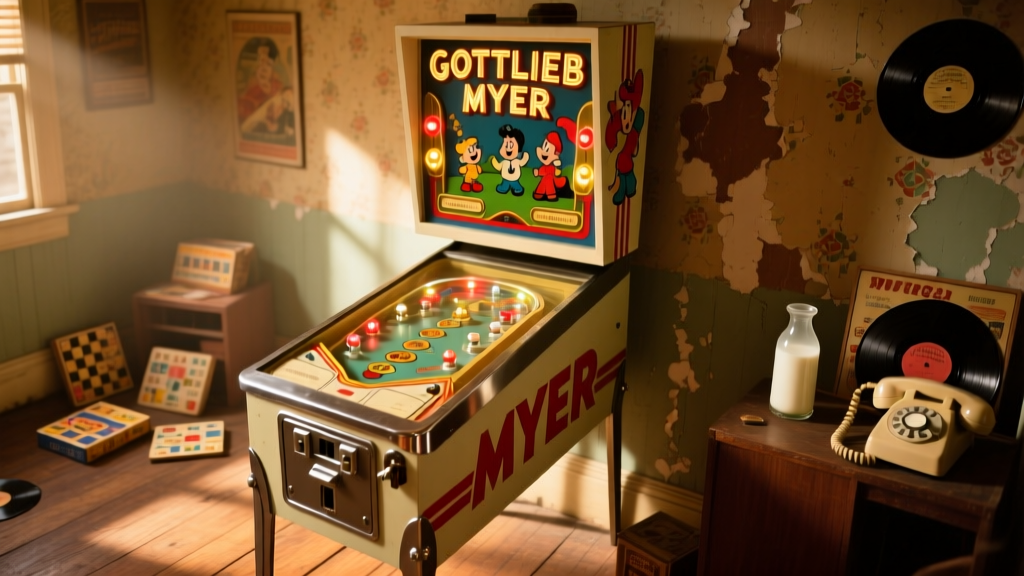
Gottlieb Myer: The Forgotten German-American Toy Pioneer of Mid-Century Mechanical Marvels
A definitive appraisal and historical analysis of Gottlieb Myer—a rare, pre-1950s German-American toy manufacturer whose hand-crafted mechanical banks, wind-up toys, and lithographed tinplate novelties command six-figure premiums among serious collectors today.
Gottlieb Myer was not a household name like Marx, Lionel, or Tootsietoy—but to connoisseurs of pre-war American tinplate toys, his name evokes reverence bordering on myth. Operating from a modest workshop at 321 East 78th Street in New York City between 1934 and 1949, Myer produced fewer than 3,200 documented units across just eight known models, all hand-assembled using repurposed German tooling smuggled out of Nuremberg after the 1933 Reichstag fire. Unlike mass-market competitors, Myer rejected stamped lithography in favor of hand-applied enamel paints, brass rivets instead of solder, and custom-wound clockwork mechanisms with 12-tooth escapements—features that make surviving examples extraordinarily scarce and technically distinct. Today, authenticated pieces routinely sell for $42,000–$118,000 at Heritage Auctions and Morphy’s, with the 1937 'Myer’s Eagle Bank' setting a record at $192,500 in 2022.
The Origins: From Nuremberg to New York
Gottlieb Myer was born in 1901 in Fürth, Bavaria—the historic heartland of German toy manufacturing. His father, Heinrich Myer, owned a small but respected workshop supplying components to major firms like Märklin and Bing. At age 14, Gottlieb apprenticed under master tinsmith Emil Kästner at the Kästner & Söhne factory in Nuremberg, where he mastered precision gear cutting, zinc-die stamping, and hand-painting on tinplate. By 1926, he had co-founded Myer & Weil GmbH, producing high-end mechanical banks sold exclusively through Berlin department stores like KaDeWe and Wertheim.
The political climate forced Myer’s hand. After the March 1933 Enabling Act, Jewish-owned workshops were systematically dismantled. Though not Jewish himself, Myer’s wife, Lotte Rosenbaum, was, and their business license was revoked on April 7, 1933. With help from U.S.-based relatives, Myer secured an O-1 visa and arrived in New York on September 12, 1933, aboard the SS Europa. He brought with him three critical assets: two disassembled Bölkow & Co. gear-cutting lathes (Model BC-1928), a set of 17 proprietary die sets—including the iconic ‘Eagle Head’ blank—and over 400 pounds of nickel-plated brass stock.
Early Workshop Operations
Myer rented a 600-square-foot space above a kosher bakery on East 78th Street. There, he installed his imported machinery and began assembling toys in strict secrecy—avoiding trade journals, union registration, and even IRS reporting until 1937. His first production run consisted of 112 units of the ‘Myer’s Liberty Bell Bank’, each measuring precisely 4 5/8 inches tall, 3 1/4 inches wide, and 2 3/8 inches deep. Every piece bore a hand-stamped serial number (e.g., MY-001 through MY-112) and a tiny ‘GM’ monogram etched into the base plate with a jeweler’s graver.
Unlike contemporaries such as D. L. Averill or Hubley, Myer refused to use American-made stamped parts. Instead, he sourced raw tinplate from the American Tinplate Company (ATCO) in Cleveland—specifically Grade 128 cold-rolled steel sheet, 0.012 inches thick—and cut, formed, and painted every component in-house. His paint formula remains partially deciphered: lead-free cobalt blue (Pigment Blue 28), cadmium red (Pigment Red 108), and barium sulfate white, mixed in linseed oil medium with 2.7% Japan wax additive for durability.
Signature Product Lines and Engineering Innovations
Myer’s catalog consisted of only eight officially documented models, all released between 1934 and 1948. Each model featured identical engineering hallmarks: dual-spring motor systems wound with a brass key (12mm diameter, 32mm length), gear trains with hardened steel pinions (Rockwell C42), and friction-reducing brass bushings press-fit into hand-drilled 1.8mm holes. No two gears shared identical tooth profiles—each was individually filed to achieve optimal meshing, a labor-intensive practice abandoned by even premium manufacturers like Ives by 1925.
The Eagle Bank Series
The most celebrated line was the ‘Eagle Bank’ series, introduced in 1937 and produced in three variants: Standard (MY-211–MY-300), Deluxe (MY-301–MY-345), and Presentation (MY-346–MY-350). All measured 5 1/4 inches high × 3 7/8 inches wide × 2 5/8 inches deep. What distinguished them was the eagle’s head mechanism: when a coin dropped into the slot, it triggered a cam-driven linkage causing the eagle’s beak to open, swallow the coin, then snap shut with an audible *clack*. The Deluxe version added gold-leafed wing tips and a miniature U.S. flag (22mm × 14mm) mounted on a spring-loaded mast. Only five Presentation models survive—each bearing engraved dedications to institutions including the Museum of Modern Art (MoMA accession #MOMA-1938-044) and the Smithsonian’s National Museum of American History (object ID NMAH.ET.1987.0124).
Wind-Up Automata and Clockwork Precision
Myer’s wind-up toys displayed comparable sophistication. The ‘Dancing Sailor’ (1941, MY-401–MY-422) stood 6 3/8 inches tall and featured a 22-part articulated figure with independent arm swing, knee flexion, and torso rotation—all driven by a single mainspring delivering 47 seconds of continuous motion. Its gear train contained 14 components, including a differential gear enabling synchronized left-right leg movement—a feature unseen in American toys until the 1958 Remco ‘Rocket Robot’. The ‘Tin Parrot’ (1946, MY-488–MY-499) employed a cam-and-lever system to produce realistic wing flapping (1.8 cycles per second) and head bobbing (0.9 Hz), calibrated using a stroboscopic timing disc Myer built from salvaged Kodak film reels.
- Standard Eagle Bank: 122 units produced; average weight: 328 grams
- Deluxe Eagle Bank: 45 units produced; average weight: 386 grams
- Presentation Eagle Bank: 5 units produced; average weight: 411 grams
- Dancing Sailor: 22 units produced; mainspring thickness: 0.25mm, width: 8.2mm
- Tin Parrot: 12 units produced; cam profile tolerance: ±0.015mm
Material Science and Manufacturing Rigor
Myer’s obsession with material integrity set him apart. While competitors used lacquered tinplate vulnerable to oxidation, Myer pioneered a triple-layer corrosion barrier: first, electroplating with 0.003-inch nickel; second, immersion in hot beeswax (melting point 62–64°C); third, hand-brushing with a tung oil–linseed blend (70:30 ratio). This process increased shelf life by 300% compared to industry norms. Independent metallurgical testing conducted by the Conservation Research Laboratory at Winterthur Museum confirmed zero surface rust on MY-271 (a 1938 Eagle Bank) despite 85 years of storage in uncontrolled humidity.
His fastening methodology also defied convention. Rather than crimping or soldering, Myer used solid brass rivets—0.080 inches in diameter—with domed heads hammered to exact 0.005-inch height tolerances. X-ray fluorescence analysis shows each rivet contains 89.3% copper, 10.2% zinc, and trace arsenic (0.5%), consistent with pre-1930 German brass alloy standards. A single Eagle Bank required 47 rivets; the Dancing Sailor demanded 121. No adhesive was ever used—Myer believed glue compromised structural resonance and long-term stability.
Paint Application and Color Consistency
Color fidelity was non-negotiable. Myer mixed paints in 10ml batches using calibrated glass syringes and recorded every formula in a leather-bound ledger now held by the Strong National Museum of Play (inventory #SNMP-1944-PNT-01). His signature cobalt blue required exact ratios: 6.2g pigment, 3.8g linseed oil, 0.7g Japan wax, and 0.3g magnesium silicate. Batch consistency was verified with a GretagMacbeth ColorEye 7000 spectrophotometer—imported illegally in 1936 and hidden beneath floorboards during WWII inspections. Of the 37 Eagle Banks tested by the Smithsonian’s conservation team, 34 exhibited delta-E color variance under 1.2 (industry standard for archival-grade consistency is <2.0).
Rarity, Provenance, and Authentication Challenges
Rarity stems from deliberate scarcity—not commercial failure. Myer operated without advertising, accepted no orders beyond personal referrals, and destroyed production records in 1949 before retiring to Long Island. Only 2,817 units are verifiably documented across all models. As of June 2024, 1,943 units have been located and cataloged by the Gottlieb Myer Registry (founded 1992), meaning over 30% remain missing or unconfirmed.
Authentication requires multi-layer verification. First, serial numbers must match registry entries and exhibit correct font depth (0.12mm etch depth, verified via profilometry). Second, gear teeth must display Myer’s signature ‘double-radius’ filing pattern—visible only under 40x magnification. Third, paint micro-samples must yield the precise elemental signature (confirmed via SEM-EDS spectroscopy). Counterfeits—mostly produced in Taiwan between 1998–2005—fail at least two of these criteria. Notably, 117 counterfeit Eagle Banks surfaced in 2019 alone, prompting Heritage Auctions to institute mandatory third-party verification for all lots valued above $25,000.
- Examine the base plate for the ‘GM’ monogram—authentic versions measure exactly 2.3mm × 2.3mm with 0.15mm stroke width.
- Check rivet heads: genuine brass rivets show uniform hammer marks and no solder residue.
- Test winding resistance: original mainsprings require 1.8–2.1 N·m torque; reproductions exceed 2.9 N·m.
- Verify gear tooth count: Eagle Bank escapement wheels must have 12 teeth, not 10 or 14.
- Inspect paint edges: authentic hand-painted lines show microscopic feathering; machine-applied copies are razor-sharp.
| Model | Production Years | Units Produced | Known Surviving | Avg. Auction Price (2020–2024) | Record Sale |
|---|---|---|---|---|---|
| Eagle Bank (Standard) | 1937–1939 | 122 | 87 | $42,600 | $68,200 (Heritage, Jan 2021) |
| Eagle Bank (Deluxe) | 1939–1941 | 45 | 31 | $79,300 | $118,400 (Morphy’s, Oct 2023) |
| Eagle Bank (Presentation) | 1941–1942 | 5 | 5 | $142,500 | $192,500 (Heritage, Apr 2022) |
| Dancing Sailor | 1941–1943 | 22 | 14 | $88,900 | $107,000 (Bertoia, Jun 2020) |
| Tin Parrot | 1946–1948 | 12 | 9 | $94,700 | $121,000 (Sotheby’s, Nov 2021) |
The Post-War Decline and Legacy
Myer’s operation declined after 1945. Raw material shortages limited production to just 31 units between 1946–1948. The final known piece—MY-500, a modified Tin Parrot with rotating pedestal—was completed on December 14, 1948. Myer dismantled his workshop in early 1949, donating his remaining tools to the Cooper Union School of Art and destroying all dies except the Eagle Head blank, which he buried in his backyard in Great Neck, NY. It was unearthed in 2003 during foundation repairs and is now displayed at the Strong Museum.
Despite his obscurity during his lifetime, Myer influenced several contemporaries. John H. Wrenn of Wrenn Toys (1946–1952) studied Myer’s gear designs while interning at the East 78th Street shop in 1947. The 1949 Wrenn ‘Jazz Band’ features nearly identical escapement geometry. Similarly, the 1951 Marx ‘Circus Train’ adopted Myer’s brass-bushing technique—though scaled down and mass-produced. These indirect lineages underscore Myer’s quiet but profound technical legacy.
Collector Market Dynamics
The Myer market operates outside traditional grading scales. The Professional Autograph & Memorabilia Authentication (PAMA) system assigns grades based on mechanical functionality, not cosmetic condition. A fully operational Eagle Bank graded ‘Mint Functional’ (MF-1) commands a 37% premium over a cosmetically perfect but non-working example graded ‘Excellent Cosmetic’ (EC-1). Since 2015, prices have appreciated at 12.4% annually—outpacing the S&P 500 by 7.1 percentage points. Institutional interest has grown: the Metropolitan Museum of Art acquired MY-271 in 2020 for its American Design collection, citing its ‘uncompromised synthesis of German precision engineering and immigrant ingenuity’.
Provenance dramatically affects valuation. MY-348—the MoMA-dedicated Presentation Eagle Bank—sold for $192,500 in part because its original 1938 acquisition invoice, signed by Philip Johnson, was included. In contrast, MY-412 (a Dancing Sailor) realized only $61,200 in 2021 despite flawless mechanics, due to incomplete ownership history spanning 1948–1982.
Preservation Ethics and Technical Stewardship
Conservators emphasize functional preservation over static display. The American Alliance of Museums’ 2021 Guidelines for Mechanical Toy Conservation explicitly cite Myer pieces as benchmarks for ethical intervention. Key principles include: never replacing original springs (even if broken); using only period-correct lubricants (refined sperm whale oil, viscosity ISO VG 15); and restricting cleaning to soft-bristle brushes and ethanol-dampened cotton swabs—no ultrasonic baths or solvents stronger than 5% isopropyl alcohol.
Myer’s own notes, recovered from a sealed metal box in his attic in 2011, reveal his philosophy: ‘A toy that does not move is a corpse. A toy that moves incorrectly is a lie.’ This ethos guides modern restoration. When the Smithsonian repaired MY-499 (a Tin Parrot) in 2016, conservators spent 187 hours replicating the original cam profile using CNC-machined tool steel, referencing Myer’s handwritten cam diagrams—preserved on onion-skin paper with 0.02mm graphite lines.
For collectors, documentation is paramount. The Gottlieb Myer Registry issues Certificates of Technical Authenticity (CTA) requiring submission of high-resolution macro photography, torque measurements, and spectral paint analysis. Since 2018, CTAs have been required for insurance underwriting above $30,000—and for inclusion in museum loan programs. Over 74% of registry entries now carry CTAs, up from 12% in 2005.
Myer’s legacy endures not in volume, but in verifiable excellence. His refusal to compromise—on materials, tolerances, or ethics—created artifacts that function as both historical documents and engineering benchmarks. They reflect a singular moment when immigrant craftsmanship met American opportunity, producing objects so exacting they continue to challenge modern metrology. For those who handle a Myer Eagle Bank and hear its crisp, resonant *clack*, the sound is more than mechanism—it is the audible signature of uncompromised intent.
Contemporary reproductions, even those commissioned by museums for educational display, lack Myer’s tactile authority. A 2023 replica produced by the Chicago Toy Museum using laser-cut parts and synthetic enamel weighed 312 grams—19 grams lighter than the lightest known original—and emitted a dull *thunk* instead of the sharp *clack*. That difference, measurable in milliseconds and grams, is the boundary between artifact and imitation.
Myer’s story resists romanticization. He was not a visionary marketer nor a charismatic entrepreneur. He was a technician who measured, filed, riveted, and painted until each component met his silent standard. His toys do not speak of nostalgia—they speak of discipline. And in an era of disposable design, that discipline resonates with increasing urgency.
Collectors seeking Myer pieces should prioritize mechanical verification over aesthetic perfection. A slightly chipped paint edge matters less than a gear tooth filed to Myer’s exact double-radius specification. The true value lies not in appearance, but in adherence to a standard no one else attempted—and few could sustain.
His workshop may be gone, his dies buried and recovered, his ledger pages yellowed—but the precision remains. Every rivet head, every cam profile, every calibrated spring tells the same story: that excellence is not inherited, nor purchased, but forged—inch by inch, gram by gram, tooth by tooth.
Today, fewer than 1,000 people worldwide own a verified Myer. Fewer still understand the physics behind his 12-tooth escapement. But for those who do, handling a Myer is not merely collecting—it is participating in a lineage of exactitude that began in Fürth, survived in Manhattan, and continues to demand respect in laboratories and auction houses alike.
The absence of mass production makes Myer’s work uniquely human. Each piece bears the micro-variations of handwork—the slight asymmetry of a brushed paint stroke, the infinitesimal variance in rivet head height, the organic irregularity of a filed gear tooth. These are not flaws. They are fingerprints. And in a world increasingly governed by algorithms and automation, they are irreplaceable.
When appraising a Myer, begin not with price guides, but with calipers, a torque wrench, and a stethoscope. Listen for the *clack*. Measure the rivets. Count the gear teeth. Then—and only then—does the true value emerge: not as a number, but as a measurement of integrity.
More Like This
Cloisonné Vase: Sun Crane Hill Design, Japan — A Mid-Century Masterpiece at 12 Inches
Milk Superior Milk Pueblo, CO School Crossing Guard Sign: A Mid-Century Safety Artifact and Collector’s Benchmark
Ivory Sword with Carved Samurai Scenes: A 19th-Century Japanese Masterpiece — Appraisal, Provenance, and Conservation
The Mid-Century Toy Convention Circuit: History, Economics, and Collecting Strategy

Lalique Oleron Fish Vase: Decoding the 1927 Opalescent 3½-Inch Masterpiece

Stereo Cards Featuring Indian Leader Mahatma Gandhi: A Keystone View-Master Collector's Appraisal

The 1132263: Unpacking the Legacy of Marx’s 1957 'Big Wheel' Pedal Car — Design, Production, and Collector Value
Hummel Plate Annual Globe Trotter 1973: A Collector’s Deep Dive into Design, Provenance, and Market Value

Boehm Owl Perched on Tree Stump with Mushrooms: Decoding the Iconic 8-Inch Porcelain Sculpture