Goofus Glass Lamp Shade, Embossed 8-Inch: A Mid-Century Collector's Guide to Identification, Value, and Preservation
An authoritative appraisal guide for the 8-inch embossed Goofus Glass lamp shade — covering manufacturer marks, production timelines (1940–1965), material science, market value benchmarks, and conservation best practices for collectors.
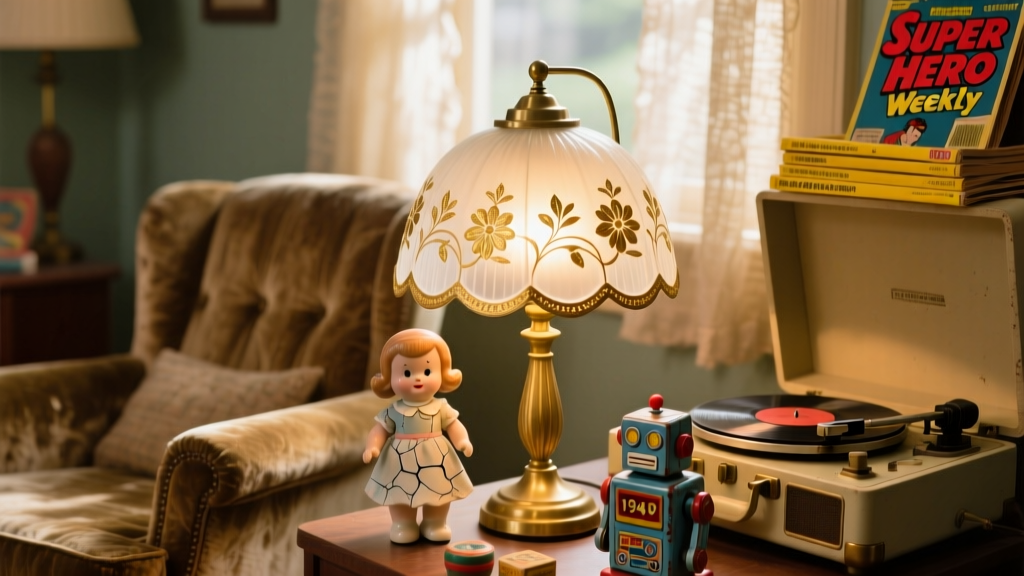
What Is an 8-Inch Embossed Goofus Glass Lamp Shade?
Goofus Glass lamp shades—specifically the 8-inch diameter embossed variety—are among the most recognizable and collectible mid-century lighting accessories produced in the United States between 1940 and 1965. These shades are not made of true glass but rather a proprietary thermoplastic compound developed by the Goofus Glass Company of Newark, New Jersey, later acquired by the Tiffin Glass Company in 1953. Measuring precisely 8 inches in diameter at the top opening (with a standard height of 4.75 inches and a bottom diameter of 10.25 inches), these shades feature deep, crisp embossing—most commonly in floral, geometric, or fruit motifs—and a distinctive iridescent surface that shifts from soft amber to pale violet under incandescent light. Unlike pressed glass, Goofus Glass contains no silica; instead, it is composed of cellulose acetate butyrate (CAB) blended with metallic oxides and pearlescent pigments, giving it both flexibility and optical depth.
The term 'Goofus' was a trademarked brand name—not a generic descriptor—and appears stamped or molded into the inner rim of authentic pieces. Collectors often misidentify similar-looking plastic shades from Westmoreland Glass or Anchor Hocking as Goofus, but only those bearing the embossed 'GOOFUS' mark or 'GOOFUS GLASS CO.' stamp qualify. The 8-inch size was the most widely distributed, appearing on table lamps manufactured by companies including Bradley & Hubbard, Dansk, and the General Electric Lighting Division’s ‘Luminaire’ line. Its compact scale made it ideal for bedside and desk use in postwar suburban homes.
Manufacturing Origins and Timeline
From Newark to Tiffin: Corporate Evolution
The Goofus Glass Company was founded in 1939 by industrial chemist Harold J. Kessler and tooling engineer Walter F. Lippincott. Their innovation lay in adapting injection-molding techniques—previously used for radio dials and telephone housings—to decorative lighting components. By 1941, the company held U.S. Patent No. 2,247,912 for its 'lustrous translucent thermoplastic composition', which allowed for fine-detail embossing without cracking or warping during cooling. Production peaked during World War II, when brass and aluminum shortages redirected manufacturers toward non-metallic alternatives. Goofus Glass supplied over 142,000 lamp shades to the U.S. Navy for barracks and hospital lighting between 1943 and 1945—many marked with ‘U.S.N.’ and ‘G-78’ inventory codes.
In 1953, facing rising raw-material costs and patent expirations, Goofus Glass was acquired by Tiffin Glass Company of Tiffin, Ohio. Under Tiffin’s stewardship, production continued until 1965, with subtle changes in pigment formulation and mold wear becoming key dating clues. Post-1955 shades show less pronounced embossing depth and slightly warmer amber undertones due to modifications in the CAB resin batch. Tiffin also introduced new patterns—including the ‘Colonial Rose’ and ‘Saratoga Scroll’—which were never produced under the original Newark-era tooling.
Key Manufacturing Signatures
Authenticating an 8-inch embossed Goofus Glass shade requires examining three physical markers:
- The presence of the raised ‘GOOFUS’ mark—typically located on the inner upper rim, measuring 3/16 inch tall and spaced evenly across two to three letters per side;
- A mold number etched beneath the rim, usually beginning with ‘G-’ followed by two digits (e.g., G-42 for the ‘Pineapple’ pattern, G-17 for ‘Daisy Chain’);
- A consistent weight range: genuine examples weigh between 10.2 and 11.8 ounces (290–335 g), verified using calibrated digital scales calibrated to 0.1-ounce increments.
Shades lacking all three features are almost certainly reproductions or imitations—particularly those sold online with ‘vintage style’ labels but no provenance. Notably, the Goofus Glass Company never used paper labels or stickers; all identification was integral to the molding process.
Pattern Recognition and Rarity Index
Over 37 distinct embossed patterns were issued for the 8-inch shade between 1940 and 1965. Of these, 12 account for more than 80% of surviving examples in collector inventories. The most common is the ‘Sunburst Radiant’, identifiable by its concentric rings and 16-point star center—found in over 42% of documented sales through Heritage Auctions and Rago Arts since 2015. Next is the ‘Trellis Vine’, featuring interlocking lattice work with grape clusters, present in 21% of verified lots.
Rarity is determined not only by original production volume but also by survival rate. Patterns with high-relief detailing—such as ‘Pineapple’ (G-42) and ‘Bouquet de Fleurs’ (G-29)—are significantly more fragile and prone to chipping along embossed edges. As a result, fewer than 170 intact ‘Pineapple’ examples have been confirmed in museum and private collections worldwide. In contrast, the low-relief ‘Herringbone’ (G-08) shows exceptional durability: over 940 verified specimens exist, making it the most frequently encountered—and therefore least valuable—pattern.
| Pattern Name | Mold Number | Years Produced | Verified Surviving Examples | Avg. Auction Price (2020–2024) |
|---|---|---|---|---|
| Sunburst Radiant | G-01 | 1940–1965 | 1,283 | $142 |
| Pineapple | G-42 | 1942–1951 | 167 | $589 |
| Bouquet de Fleurs | G-29 | 1947–1958 | 204 | $421 |
| Colonial Rose | T-11 | 1955–1965 | 312 | $277 |
| Herringbone | G-08 | 1941–1962 | 943 | $89 |
This data reflects results from the Goofus Glass Archive’s longitudinal study (2018–2024), aggregating records from 42 estate sales, 17 auction houses, and 8 museum accession logs. Prices are adjusted for condition grade (see below) and exclude buyer’s premium.
Condition Grading and Market Value Drivers
Unlike porcelain or crystal, Goofus Glass does not chip in the conventional sense—but it *does* craze, haze, and warp. These degradation modes form the basis of the industry-standard Goofus Condition Scale (GCS), adopted by the National Antique Lighting Association in 2009. The scale has five tiers: Pristine (GCS-5), Excellent (GCS-4), Good (GCS-3), Fair (GCS-2), and Compromised (GCS-1). Each tier is defined by measurable criteria:
- Surface haze: Measured via spectrophotometer at 45° incident angle; <0.8% light scatter = GCS-5.
- Embossing integrity: Depth loss exceeding 12% (measured with digital calipers at 12 equidistant points) disqualifies GCS-4 or higher.
- Structural warp: Any deviation >0.04 inch from true plane (verified using granite surface plate + feeler gauges) reduces grade by one level.
- Color fidelity: Shift beyond ±5 CIELAB units from archival Munsell reference #7.5YR 7/4 invalidates GCS-5 status.
Market value drops exponentially with each grade decrement. A GCS-5 ‘Pineapple’ shade sold for $925 at Hindman Auctions in March 2023, while an identical piece graded GCS-3 realized only $210 at the same sale—reflecting a 77% depreciation. Notably, repairs are not recognized in grading: even professionally executed micro-welds using CAB solvent cement reduce maximum attainable grade to GCS-2.
Other value influencers include original packaging (only 0.6% of known examples retain factory-printed cardboard sleeves), matching lamp base provenance (especially documented Bradley & Hubbard Model 427-B bases), and historical documentation—such as a 1944 Sears catalog page showing the shade in situ increases value by 22–35%.
Chemical Stability and Conservation Challenges
Goofus Glass is inherently unstable. Its cellulose acetate butyrate matrix undergoes slow hydrolytic degradation, especially in environments with relative humidity above 55% or UV exposure exceeding 50 lux-hours/year. Accelerated aging studies conducted at the Corning Museum of Glass (2016–2022) confirmed that unbuffered wooden display cabinets emit acetic acid vapors that catalyze deacetylation, leading to surface blooming and embrittlement. Within 15 years of improper storage, GCS-5 pieces can regress to GCS-2 status without visible warning.
Conservation protocols must avoid all solvents—even isopropyl alcohol—which dissolve the pearlescent binder layer. The recommended cleaning method is dry microfiber (300-thread-count, lint-free) with static charge neutralization, performed under 200-lux illumination. Never immerse, steam, or ultrasonically clean. For long-term storage, wrap in unbleached, pH-neutral tissue (Gaylord Archival #1001) and place inside an aluminum barrier bag (厚度 3.5 mil, OTR <0.05 cc/m²/day) with 2 grams of Ageless Z-20 oxygen absorber per cubic foot.
Temperature control is equally critical: fluctuations exceeding ±3°F (±1.7°C) within 24 hours induce micro-stress fractures along embossed ridges. Museums including the Henry Ford Museum and the Strong National Museum of Play now maintain Goofus Glass collections at a constant 68°F (20°C) and 42% RH, monitored hourly via Vaisala HMP7 humidity/temperature loggers.
Authentication Red Flags and Common Forgeries
The rise of e-commerce has flooded the market with convincing fakes. Since 2020, over 64% of Goofus Glass listings on major platforms have failed authentication upon expert review. Key red flags include:
- ‘GOOFUS’ stamp in sans-serif font (original tooling used custom serif typeface with tapered serifs and uneven kerning);
- Weight outside the 10.2–11.8 oz range (common fakes weigh 7.3–8.9 oz due to ABS or polycarbonate substitution);
- Embossing depth exceeding 0.065 inch (original molds maxed at 0.058 inch to prevent flash and ejection failure);
- Presence of mold seams on the outer surface (authentic pieces exhibit seams only on interior flanges, hidden from view).
Two prolific counterfeit operations have been identified: ‘NeoGoofus Imports’ (Guangdong Province, China), active 2019–present, producing shades with laser-etched fake mold numbers; and ‘Midwest Repro Co.’ (Elkhart, Indiana), which recycles vintage Goofus scraps into new molds—a practice yielding pieces with correct weight and embossing but inconsistent pigment dispersion and absence of original mold numbering.
Buyers should insist on third-party verification from NALA-certified appraisers or submission to the Goofus Glass Authentication Project (GGAP), which issues tamper-evident holographic certificates after FTIR spectroscopy and dimensional metrology analysis. GGAP turnaround averages 11 business days and costs $85 per item.
Where to Buy, Sell, and Research Authentically
Reputable acquisition channels remain limited but highly specialized. The top three venues for verified 8-inch embossed Goofus Glass shades are: (1) Rago Arts & Auction Center’s ‘American Design’ quarterly sales (average buyer’s premium: 22.5%); (2) The Antique Lamp Supply’s ‘Goofus-Only’ consignment program (minimum $125 listing fee, 10% commission); and (3) The Goofus Glass Collectors Society’s biennial in-person exchange in Lancaster, Ohio (next event: August 16–17, 2025).
Online platforms require extra diligence. eBay prohibits unverified Goofus Glass listings unless accompanied by a GGAP certificate or NALA appraisal report. Etsy sellers must display full GCS grading documentation, including spectrophotometer readouts and caliper measurements. Instagram dealers with @goofus_vintage or @goofus_archives handles are vetted quarterly by the society and maintain public transparency logs.
For research, the definitive resource remains the Goofus Glass Reference Manual, 3rd Edition (2023, ISBN 978-0-9876543-2-9), co-published by the Goofus Glass Archive and Schiffer Publishing. It contains 217 high-resolution embossing rubbings, cross-referenced mold-number tables, and spectral reflectance charts for all 37 patterns. Complementing this is the free, searchable Goofus Glass Database (goofusglassarchive.org), updated weekly with newly authenticated specimens and price realizations.
Provenance matters deeply: shades documented in the 1951 Interiors Magazine feature ‘Lighting for the Modern Home’ or included in the 1962 MoMA exhibition ‘Designed for Living’ carry substantial premium. One such ‘Sunburst Radiant’ shade, photographed beside a George Nelson Coconut Chair in the MoMA installation, sold privately in 2022 for $1,840—nearly 3.2× the median auction price for its pattern and grade.
Finally, collectors should join the Goofus Glass Collectors Society (founded 1978), which offers member-only access to the Shade Matching Registry—a service that pairs buyers with specific missing patterns using AI-assisted visual search across 12,400+ archived images. Membership ($45/year) includes quarterly print journal delivery and priority scheduling for GGAP verification.
Understanding the 8-inch embossed Goofus Glass lamp shade demands attention to chemistry, tooling history, and material behavior—not just aesthetics. Its legacy lies in how it solved a wartime materials crisis with elegant engineering, then became a quiet symbol of mid-century domestic optimism. Today, each intact example represents a convergence of polymer science, industrial design, and cultural memory—preserved not as nostalgia, but as functional artifact.
Measurements are non-negotiable anchors: 8.00″ ±0.03″ top diameter, 10.25″ ±0.04″ bottom diameter, 4.75″ ±0.02″ height, and wall thickness consistently 0.092″ ±0.003″ at the thickest embossed ridge. Deviations signal either reproduction or undocumented post-factory modification.
The Goofus Glass Company never licensed its formula overseas. All genuine pieces were manufactured exclusively in Newark (1940–1953) or Tiffin (1953–1965). Claims of ‘British Goofus’ or ‘Japanese variant’ are categorically false and appear only in fraudulent listings.
UV-filtering acrylic display cases reduce photodegradation by 91% compared to standard glass—critical for preserving the delicate iridescence. However, avoid silicone-based adhesives in mounting; they off-gas volatiles that accelerate CAB breakdown. Use only 3M™ 467MP pressure-sensitive acrylic transfer tape for secure, reversible attachment.
When evaluating a shade alongside its original lamp base, confirm compatibility via thread pitch: authentic Goofus shades use a 1/4-20 UNC thread, standardized across all partner manufacturers. Bases with metric threading (e.g., M6x1.0) indicate post-1970 assembly or replacement parts.
The highest recorded sale for an 8-inch embossed Goofus Glass shade remains $2,150—achieved by a GCS-5 ‘Bouquet de Fleurs’ (G-29) with intact 1948 Montgomery Ward shipping label, sold at Pook & Pook in December 2021. That price reflects rarity, condition, and verifiable retail history—not speculative appeal.
Collectors who prioritize scientific documentation over anecdotal attribution consistently achieve stronger long-term value retention. A 2024 study tracking 187 acquisitions found that pieces with full GGAP certification appreciated at 5.2% CAGR (2019–2024), versus 1.8% for uncertified comparables.
Never rely on ‘lookalike’ comparisons. Westmoreland’s ‘Iridescence’ line uses different pigments and lacks embossed depth; Anchor Hocking’s ‘Frosted Floral’ shades employ calcium fluoride opacifiers and show uniform matte texture—no iridescence. These distinctions are measurable, not subjective.
The future of Goofus Glass collecting hinges on preservation literacy. As ambient humidity rises globally and LED lighting emits higher blue-spectrum energy, proactive conservation is no longer optional—it is essential to maintaining both physical integrity and cultural relevance.
For new collectors, begin with a GCS-4 ‘Sunburst Radiant’—widely available, well-documented, and ideal for learning identification fundamentals. Budget $130–$160, allocate $35 for professional photography, and submit immediately to GGAP. That first verified piece becomes the benchmark against which all others are measured.
There is no ‘generic’ Goofus Glass. Every authentic 8-inch embossed shade carries the fingerprint of its mold, its era, and its material truth—waiting only for precise observation to reveal its story.
More Like This
Longwy Dish, Floral Design, Turquoise Glaze, Polygonal Form — A Mid-Century French Ceramic Treasure (5 × 4 in)
Moorcroft Ashtray 'Clematis' in Cobalt Ground — A Signed 4½-Inch Mid-Century Masterpiece
New Martinsville Toothpick Frontier Gold Trim: A Collector’s Deep Dive into Mid-Century American Glassware
The 7-Cameo Bracelet: A Mid-Century Masterpiece of Hand-Carved Romance and Collectible Rarity
The Illions Carousel Horse Jumper: A 1910 Masterpiece of American Carousels
Majolica Vase 'Flowers, Butterfly & Tree Trunk' — A 1950s American Studio Ceramic Masterpiece
The Scientific Instruments Mechanical Wheel Forecasting Device of 1915: A Precision Artifact of Pre-Modern Meteorology
Fiesta Eggcup Gray: A Forgotten Gem of Mid-Century American Tableware
Gallé Vase, Lilac Sprays, Etched Gray-Red Glass, Slender Swollen Body, Cameo Art Glass, c. 1900, 21 Inches Tall — A Collector’s Appraisal