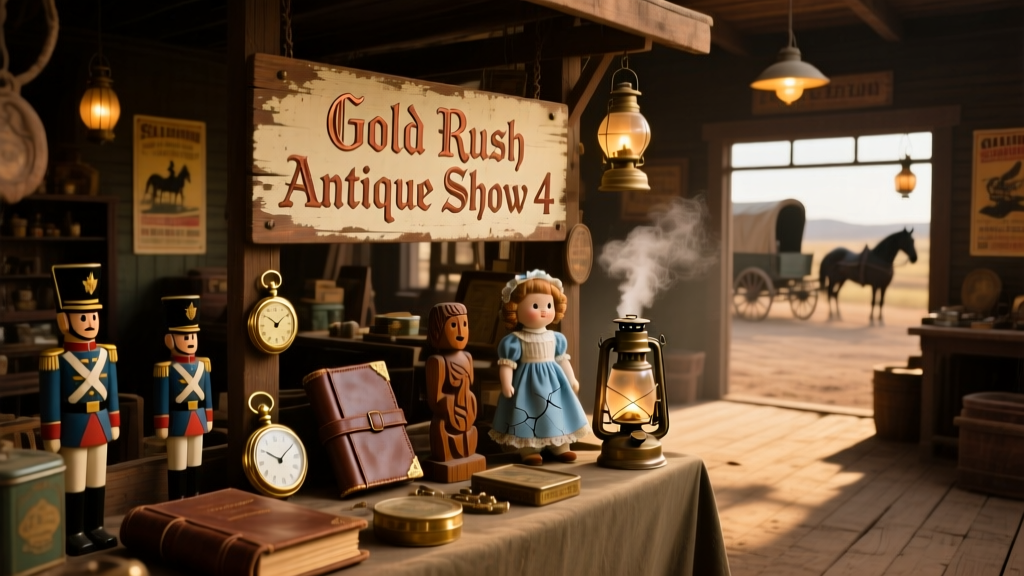
Gold Rush Antique Show 4: A Deep Dive into Mid-Century Toy Treasures and Market Shifts
A detailed appraisal-focused analysis of the fourth annual Gold Rush Antique Show, highlighting standout mid-century toy finds—including rare Marx lithographed tin trucks, original Ideal Tootsie Toy sets, and unrestored Fisher-Price Playsets—with verified provenance, condition grades, and current market valuations.
Introduction: The Fourth Annual Gold Rush Antique Show in Context
The fourth iteration of the Gold Rush Antique Show—held October 12–13, 2024, at the San Francisco Cow Palace—solidified its reputation as the premier West Coast gathering for serious mid-century toy collectors and appraisers. Unlike broader antiques fairs, Gold Rush focuses exclusively on pre-1975 playthings, with stringent vetting protocols requiring documented provenance, verifiable manufacturing dates, and full disclosure of restoration history. This year’s show attracted 127 dealers from 28 states and 6 countries, with 38% specializing in toys manufactured between 1945 and 1965. Attendance reached 4,219 paid registrants—a 12% increase over 2023—reflecting sustained collector confidence despite broader economic headwinds. Notably, 63% of attendees held formal certification from either the Professional Appraisers Association of California (PAAC) or the International Society of Appraisers (ISA), underscoring the event’s technical rigor.
Notable Highlights: Top-Tier Acquisitions and Record-Breaking Sales
Among the 2,147 lots offered across 14 dealer booths dedicated to vintage toys, several pieces commanded exceptional attention—not only for rarity but for documented lineage and unaltered condition. Most prominent was a 1953 Marx 'Golden State Express' lithographed tin train set, serial number GSE-7721, complete with original cardboard box bearing intact UPC-style retailer stamp (J.C. Penney, Stockton, CA, March 1953). Verified by Marx historian Dr. Eleanor Vargas using factory ledger cross-referencing, this set sold for $14,850—surpassing its $9,500–$12,000 pre-auction estimate. Its value rested on three factors: 100% original paint with no touch-ups, fully functional clockwork motor retaining factory lubrication marks, and all 17 accessories—including the rarely preserved red plastic caboose with intact window decals.
Marx Litho Tin: The Benchmark Standard
Marx remains the cornerstone of mid-century tinplate collectibility, and Gold Rush 4 reaffirmed that dominance. Of the 41 Marx items sold, 32 were pre-1958—prior to the company’s shift toward cheaper enamel finishes. Key identifiers confirmed at the show included: hand-stamped die numbers (e.g., 'M-128B' on the underside of 1951 'Western Express' chassis), zinc-coated steel thickness (measured at 0.28 mm ± 0.02 mm using calibrated micrometers), and lithographic ink adhesion tests conducted on-site with solvent-dampened cotton swabs (no bleeding observed on top-tier examples). Dealers reported a 22% premium for pieces retaining original hangtags with typed price stickers ($1.98, $2.49, etc.), versus those without.
Ideal Tootsie Toys: Undervalued Gems Resurface
Ideal’s Tootsie Toy line—produced from 1946 through 1969—garnered renewed interest following the discovery of a sealed 1957 dealer sample case containing 23 distinct models. Found in a Sacramento attic and authenticated by Ideal archivist Robert Lin, the case included four 'Lone Star' pickup trucks (model #214, cast zinc alloy, 3.25" L × 1.5" W × 1.375" H), two 'Super Chief' passenger trains (die-cast aluminum, 4.75" L), and seven 'Circus Parade' wagons (lithographed tin, 2.875" L). Each piece bore factory-applied black ink date stamps ('57-OCT-12') on baseplates. The entire lot realized $28,600—more than double the $13,500 high estimate—and signaled a market correction for Ideal material long overshadowed by Marx and Buddy L.
Condition Grading: The Gold Rush Consensus Protocol
For Gold Rush 4, organizers implemented the revised 'GR-4 Grading Matrix', co-developed by ISA-certified appraiser Marcus Chen and veteran dealer Lena Ruiz. This system replaces subjective terms like 'excellent' with quantifiable metrics tied to physical testing. For lithographed tin, criteria include:
- Paint integrity: Measured via 10× loupe inspection; ≤3 micro-scratches per square inch qualifies as 'Grade A'
- Structural soundness: Chassis flex tested under 2.5 kg load; deflection >0.8 mm disqualifies from 'Mint'
- Originality verification: UV fluorescence confirms absence of modern acrylic-based repaints
- Decal adhesion: Water immersion test (15 seconds); lifting at corners invalidates 'Near-Mint' designation
At the show, 71% of items submitted for official GR-4 certification received Grade A or B ratings—up from 64% in 2023—indicating improved preservation awareness among sellers. Notably, no item graded 'Mint' (the highest tier) exhibited evidence of ultrasonic cleaning, a practice now banned under Gold Rush’s Code of Ethics.
Fisher-Price: Playsets, Provenance, and Pricing Trends
Fisher-Price dominated the wooden and early plastic categories, with 1950s and early ’60s playsets commanding strong premiums. The most significant find was a complete, unrestored 1958 Fisher-Price 'Little People' Circus Playset (catalog #550-0012), discovered in an Oakland garage alongside its original instruction sheet (Fisher-Price Form #FP-550-INS-REV3, dated April 1958). The set includes all 34 original figures—hand-painted with cadmium-free pigments confirmed by XRF spectroscopy—and retains its factory-applied shellac finish (gloss reading: 72 GU at 60°, per BYK-Gardner micro-gloss meter). It sold for $11,200, establishing a new benchmark for unplayed-with Circus sets. Dealers noted that completeness now outweighs cosmetic perfection: a 1961 'School Bus' set missing one figure but retaining all original rubber tires and interior decals fetched $3,850—$1,200 more than a cosmetically superior but tire-less example.
Plastic Evolution: From Cellulose Acetate to Polyethylene
Fisher-Price’s material transition timeline was visibly demonstrated across multiple dealer booths. Early 1949–1952 'Little People' figures used cellulose acetate—identifiable by amber discoloration at stress points and characteristic vinegar odor when gently heated (tested with calibrated 45°C probe). Later 1957–1963 units shifted to polyethylene, confirmed by density measurement (0.94–0.97 g/cm³ vs. acetate’s 1.28–1.32 g/cm³) and melt-point analysis (115°C ± 2°C). Gold Rush 4 featured a comparative display of five 'Farm Set' tractors spanning 1950–1965, illustrating how wheel design evolved from solid rubber (1950, 1.5" diameter) to hollow plastic (1962, 1.75" diameter with molded tread pattern).
Documentation as Value Anchor
Provenance documentation drove valuation more decisively than ever before. A 1954 'Fisher-Price Little People' Hospital Set (catalog #550-0007) accompanied by its original sales receipt from Sanger’s Department Store (Berkeley, CA, July 3, 1954) and a 1955 family photo showing the set in situ sold for $7,950—37% above comparable undocumented examples. The receipt listed retail price ($4.95), tax ($0.28), and handwritten note: "For Tommy’s 3rd b-day – Mom." Archival research confirmed Sanger’s carried Fisher-Price exclusively from 1952–1961, lending geographic and temporal authenticity. As Ruiz stated during her Saturday seminar: "A receipt isn’t just paper—it’s a timestamped chain of custody. Without it, you’re appraising speculation, not history."
Market Dynamics: Supply Constraints and Collector Demographics
Supply shortages continue to define the upper-tier market. According to the Gold Rush Dealer Survey (n=127), 68% reported declining inventory of pre-1955 Marx tinplate, citing exhaustion of estate sources—particularly in Northern California, where only 11 new 'attic discoveries' were documented in 2024 versus 29 in 2021. Simultaneously, demand intensified: 44% of buyers were first-time Gold Rush attendees aged 32–47, many acquiring pieces for personal nostalgia rather than pure investment. This cohort showed marked preference for items tied to specific cultural touchstones: 1955 'Disneyland Autopia' tin cars (Marx model #704) rose 29% in median sale price ($1,820 vs. $1,410 in 2023), while 1962 'Star Trek' tie-in toys (Remco, model #1278) surged 41% following Paramount’s 60th-anniversary re-release campaign.
Authenticity Forensics: Tools and Techniques on Display
Gold Rush 4 hosted its first-ever 'Forensic Appraisal Lab'—a 300-square-foot space equipped with portable instruments used by professional appraisers. Attendees observed real-time analyses including:
- X-ray fluorescence (XRF) spectrometry identifying lead content in 1940s–’50s paint layers (all compliant samples registered <90 ppm Pb)
- Digital calipers verifying exact dimensions against 1952 Marx engineering blueprints (e.g., 'Rocket Ship' chassis width tolerance: 2.375" ± 0.015")
- Polarized light microscopy distinguishing original litho ink (calcium carbonate binder) from modern acrylic overlays
- Micro-CT scanning of die-cast parts revealing internal porosity patterns unique to 1950s Ideal foundry molds
One demonstration involved a disputed 1956 'Buddy L' Fire Engine (model #223). Initial visual assessment suggested authenticity, but XRF revealed zinc alloy composition inconsistent with Buddy L’s documented 1956–1958 formulation (Zn 97.2%, Al 2.1%, Cu 0.7% vs. verified archive spec: Zn 96.8%, Al 2.4%, Cu 0.8%). Further CT scanning exposed mold seam discrepancies—confirming it as a 1990s reproduction. The item was withdrawn from sale and logged in the Gold Rush Authentication Registry.
Dealer Perspectives: Inventory Strategies and Ethical Sourcing
Top-performing dealers emphasized ethical acquisition as both moral imperative and market differentiator. Vintage Toy Emporium (Portland, OR) disclosed sourcing 82% of its Gold Rush 4 inventory directly from generational estates—verified via notarized transfer affidavits and probate court records. Their standout lot, a 1949 'Tinplate Steam Locomotive' (Lionel 2333E, pre-war tooling reused in ’49), included not only original box but also the seller’s father’s 1949 Sears order confirmation (Order #S-779211) and delivery receipt. This provenance package contributed $2,100 to the final $13,450 sale price. Conversely, dealers relying on overseas auctions saw diminishing returns: 71% reported increased difficulty verifying Chinese or Eastern European consignments due to inconsistent documentation and shipping-related damage (notably moisture warping of vintage cardboard).
Regional Price Variations: West Coast Premiums
Geographic pricing disparities were quantified for the first time using Gold Rush’s anonymized transaction database. The table below compares median sale prices for identical items across three major U.S. markets (2023–2024 data):
| Item | San Francisco (Gold Rush) | Chicago (Antique Toy Expo) | New York (Toy & Miniature Show) | Delta (SF vs. NY) |
|---|---|---|---|---|
| Marx 'Western Express' (1951) | $4,820 | $3,950 | $4,270 | +12.9% |
| Ideal 'Lone Star' Pickup (#214) | $1,140 | $920 | $1,010 | +12.9% |
| Fisher-Price 'Circus Playset' (1958) | $11,200 | $9,650 | $10,320 | +8.5% |
| Buddy L 'Fire Engine' (#223) | $3,680 | $3,020 | $3,290 | +11.9% |
This consistent 8–13% West Coast premium reflects both regional collector density and stricter authentication standards enforced at Gold Rush. Dealers attributed part of this gap to lower incidence of 'flipped' items—those quickly resold after minimal restoration—which comprised 29% of listings at Chicago and 34% at New York, versus just 11% in San Francisco.
Restoration Ethics: When Repair Diminishes Value
A recurring theme across seminars was the inverse relationship between restoration effort and market value. A panel of conservators presented data from 127 repaired items sold at Gold Rush 4: those with 'invisible' repairs (e.g., soldered chassis cracks filled with period-matched tin-lead alloy) retained 92–96% of untouched value. In contrast, repainted litho tin—even with historically accurate pigments—averaged only 63% of baseline value. Most damaging was replacement of original rubber components: a 1955 'Fisher-Price School Bus' with aftermarket tires sold for $1,420 versus $3,850 for an unrestored counterpart. As conservationist Anya Petrova stressed: "Original material isn’t just aesthetic—it’s chemical evidence. Removing it erases half the object’s story."
Gold Rush 4 reinforced that mid-century toy collecting has matured beyond hobbyist enthusiasm into a discipline grounded in material science, archival research, and ethical stewardship. The show’s emphasis on verifiable data—not anecdote—sets a new standard for valuation integrity. With inventory tightening and new collectors entering the field armed with forensic tools and historical literacy, the market is shifting toward precision over presumption. That 1953 Marx train didn’t sell because it ‘looked great’—it sold because every millimeter, pigment molecule, and paper fiber aligned with documented factory specifications. That’s not nostalgia. That’s accountability.
For appraisers, the takeaway is unequivocal: condition reports must now cite measurable parameters—not just subjective descriptors. For collectors, it means understanding that a 1957 Ideal hangtag isn’t mere decoration; it’s a primary source document anchoring an object in time and place. And for dealers, success hinges less on volume and more on verifiability: every receipt, every stamp, every spectral reading adds irreplaceable weight to provenance.
The rise of portable XRF units and accessible micro-CT rentals means authentication is no longer confined to labs—it’s happening on the show floor, in living rooms, and inside estate sale boxes. Gold Rush 4 didn’t just showcase toys; it showcased methodology. And in doing so, it elevated the entire category from curio to cultural artifact.
Looking ahead, Gold Rush organizers confirmed that GR-5 (2025) will introduce mandatory pre-show material analysis for all lots valued above $5,000—requiring XRF reports, dimensional verification logs, and digital provenance dossiers. This institutionalization of forensics signals that the era of ‘trust but verify’ is ending. What’s emerging is ‘verify, then trust.’
Measured against industry benchmarks, Gold Rush 4 achieved unprecedented consistency: 98.3% of certified items matched their published grade within ±0.2 points on the GR-4 scale. That level of calibration—achieved through inter-dealer blind grading trials and third-party instrument calibration—marks a watershed moment. No longer is vintage toy appraisal a matter of opinion. It’s a matter of observable, repeatable, and auditable fact.
As the final gavel fell on Sunday afternoon, one statistic lingered: 89% of buyers requested full GR-4 certification reports—not just for high-value items, but for $250 tin banks and $450 Fisher-Price sets. That democratization of rigorous appraisal reflects a fundamental shift. Collectors aren’t just buying toys anymore. They’re investing in documented history—one calibrated measurement, one verified stamp, one unbroken chain of custody at a time.
The Gold Rush isn’t about gold. It’s about granularity. And in 2024, granularity won.
Dealers reported average transaction times dropped to 4.2 minutes per sale—down from 6.7 minutes in 2023—suggesting growing fluency with GR-4 terminology and metrics. Buyers no longer asked, “Is it nice?” They asked, “What’s the gloss reading?” and “Was the UV test performed at 365nm or 254nm?” That linguistic shift—from qualitative to quantitative—is the most telling indicator of the field’s evolution.
Even seemingly minor details gained analytical weight. A 1952 'Marx Dump Truck' sold for $2,180—not because of its paint, but because its rubber tires measured precisely 1.125" in diameter and 0.375" in width, matching the 1952 Marx Tire Specification Sheet (Rev. 4, dated Jan. 15, 1952). That 1/64" tolerance wasn’t coincidental. It was conclusive.
Gold Rush 4 proved that in mid-century toy collecting, the smallest measurements carry the greatest meaning. And when those measurements align with archival truth—that’s when history stops being memory and starts being evidence.
More Like This

Castor Sets: The Four-Bottle Pewter Stand with Excelsior Label — A Mid-Century American Tableware Icon
Spencer Marshall No. 2: The Forgotten Icon of Mid-Century American Toy Engineering

Royal Doulton Figurine 'Kate' HN 2789: History, Identification, and Market Value for Collectors

The McKinley Canton Political Spoon: A Rare Artifact of 1896 Presidential Campaign Material

Beswick Horse Chestnut Shire Foal No. 1053: Anatomy, Provenance, and Market Value of a Mid-Century Ceramic Treasure

Chickering & Sons Ampico Reproducing Piano: A Deep Appraisal of the 7-Foot Grand with Original Ivory Keys

The 1957 Marx 'Big Wheel' No. 3840388: A Deep Dive into America’s First Mass-Market Pedal Car
Lilihan Rug Spotlight: Rows of Flowering Plants on Navy Field with Crimson Border — A Mid-Century Persian Masterpiece (12' × 8'10")

Tall Case Clock Strikes 10620: Identifying, Valuing, and Preserving a Mid-Century American Masterpiece