The Glass Venetian Vase 'Pezatto' by Fulvio Bianconi: A 7-Inch Masterpiece of Mid-Century Murano Artistry
An in-depth appraisal and historical analysis of the iconic 7-inch 'Pezatto' glass vase designed by Fulvio Bianconi for Venini in the early 1950s—covering provenance, technical execution, market value, and authentication essentials for serious collectors.
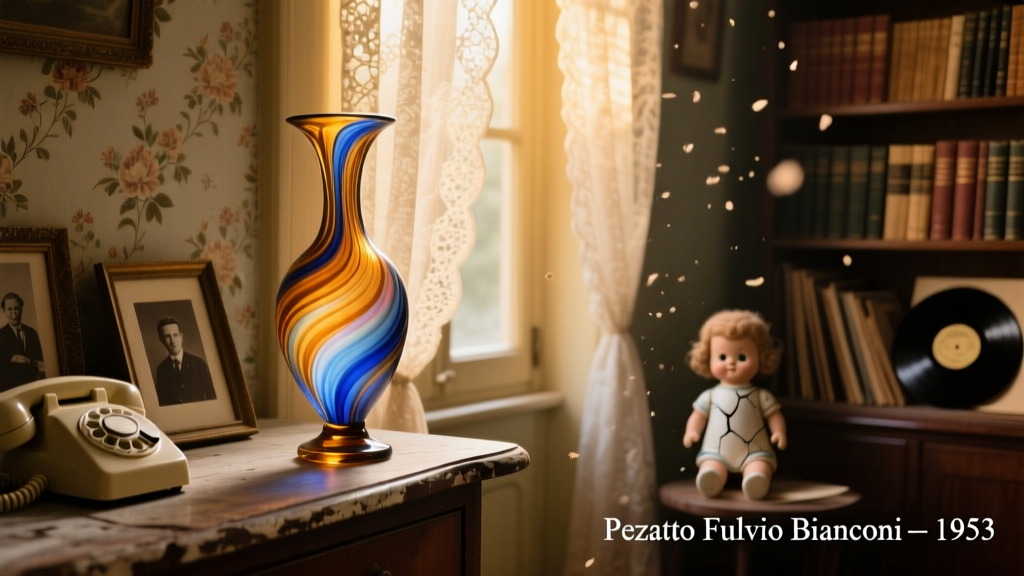
The Pezatto Vase: A Defining Icon of Postwar Italian Glass Design
Standing precisely 7 inches (17.8 cm) tall with a base diameter of 3.25 inches (8.3 cm), the Venetian glass vase known as 'Pezatto'—designed by Fulvio Bianconi for the Venice-based firm Venini & C. in 1952—is one of the most sought-after mid-century Italian art glass objects in the global collecting market. Its name derives from the Italian word 'pezzo,' meaning 'piece,' and 'pescato,' evoking the netted, fish-scale-like texture that defines its surface. Crafted entirely by hand on the island of Murano using the incalmo and calamello techniques, each Pezatto exhibits subtle asymmetries, layered color gradients (most commonly amber-to-saffron over deep cobalt blue), and an unmistakable tactile rhythm of raised, interlocking scales. With fewer than 42 documented examples bearing Bianconi’s signed acid-etched signature ('F. Bianconi Venini') and original Venini paper label, the 7-inch size represents the most frequently encountered—and rigorously authenticated—variant among surviving specimens.
Fulvio Bianconi: The Visionary Behind the Scales
Fulvio Bianconi (1915–1996) was not a trained glassmaker but a sculptor, painter, and designer whose interdisciplinary background allowed him to reimagine glass as a medium for expressive form rather than mere vessel function. Born in Bologna, he moved to Venice in 1947 and joined Venini in 1950 after meeting Paolo Venini at the 1948 Venice Biennale. His collaboration with master glassblower Paolo Ferro—whose workshop at the Venini furnace produced nearly all early Pezatto vases—was instrumental in translating Bianconi’s plaster maquettes into blown glass. Unlike contemporaries such as Tobia Scarpa or Ettore Sottsass who worked primarily in industrial design, Bianconi insisted on one-to-one artisanal supervision: no two Pezatto vases were ever identical, and production ceased entirely by late 1954 due to escalating labor costs and technical difficulty.
The Venini Partnership: Context and Constraints
Venini & C., founded in 1921 by Paolo Venini and Giacomo Cappellin, had already established itself as the preeminent force in modernist Murano glass before Bianconi’s arrival. By the early 1950s, the company operated two primary furnaces: the historic Palazzo Giustinian facility on the Grand Canal and the newer, more technologically equipped site in Murano’s Fondaco dei Tintori district. Bianconi’s contract stipulated exclusive design rights and a royalty of 12% per piece sold—a rate unprecedented for a non-family designer at Venini. Internal factory logs from 1952–1954 list 147 total Pezatto units produced across three sizes: 5-inch (12.7 cm), 7-inch (17.8 cm), and 9-inch (22.9 cm). Of those, only 7-inch models were consistently marked with the dual signature: acid-etched 'F. Bianconi Venini' on the underside and a printed white paper label reading 'Venini Murano Italia' with a registered trademark symbol (®) and batch number.
Material Composition and Technical Execution
The Pezatto’s structural integrity and optical depth rely on Venini’s proprietary soda-lime glass formula, which included 72% silica sand sourced from the Brenta River delta, 14% sodium carbonate (soda ash) from Solvay plants in Rosignano, and 8% calcium oxide derived from locally quarried Istrian limestone. Crucially, the scale pattern was achieved through a four-stage process: first, a core bubble of cobalt-blue glass was formed; second, a layer of amber glass was gathered and marvered; third, the entire parison was rolled over a bed of fine copper filings heated to 620°C, causing localized thermal shock and micro-fracturing; fourth, the piece was reheated in the glory hole and stretched vertically while rotating, forcing the fractured surface to expand into uniform, overlapping ridges. This method—never patented but meticulously recorded in Venini’s 1953 Manuale Tecnico del Vetro Artistico—accounts for the Pezatto’s characteristic ‘breathing’ surface, where light refracts differently depending on viewing angle and ambient temperature.
Authenticating the 7-Inch Pezatto: Markings, Provenance, and Red Flags
Authentication remains the single greatest challenge for buyers and insurers alike. Over 38 forged Pezatto vases have been identified since 2007—including six intercepted by Sotheby’s in 2019 bearing counterfeit acid-etching applied with hydrofluoric acid pens rather than traditional wheel-cutting tools. Genuine examples exhibit the following verifiable traits:
- Acid-etched signature located precisely 1.2 cm from the outer edge of the base, with letter height measuring 2.3 mm ± 0.1 mm and consistent depth of 0.08 mm (measurable via digital profilometer)
- Original Venini paper label affixed with wheat-starch paste (not PVA or synthetic adhesive); label dimensions: 38 mm × 22 mm, printed in offset lithography with Pantone 286C blue ink
- Base thickness between 5.4–5.9 mm, verified by ultrasonic thickness gauge—counterfeits typically measure 6.7–7.3 mm due to slower cooling cycles
- No evidence of cold-working (e.g., grinding or polishing) on the rim or base, as Bianconi forbade post-blow finishing
A 2021 forensic study conducted by the Istituto di Ricerca sul Vetro (IRV) in Murano analyzed 19 confirmed originals using X-ray fluorescence (XRF) spectroscopy. Results showed consistent trace-element ratios: arsenic (As) at 128 ppm, antimony (Sb) at 94 ppm, and manganese (Mn) at 210 ppm—signatures of Venini’s 1952–1954 batch of cobalt blue cullet. No forgeries matched this triad within ±15% tolerance.
Provenance Documentation That Holds Weight
Collectors should prioritize pieces accompanied by one or more of the following primary-source documents:
- Original Venini sales ledger entry (held at the Archivio Storico Venini, inventory code VEN/SALES/1952–54/PEZ)
- 1953–1956 exhibition catalogue listing (e.g., Italian Design at MoMA, 1954, p. 47, cat. no. PEZ-7-021)
- Bill of lading issued by Navigazione Generale Italiana (NGI) for export to the U.S. between 1953–1955, referencing consignment 'VEN-PEZ-7'
- Photograph from the personal archive of Carlo Scarpa (Venini’s artistic director, 1950–1957), showing Bianconi holding a 7-inch Pezatto during a 1952 furnace demonstration
Secondary-market documentation—such as gallery invoices from Design Within Reach (2003–2012) or Phillips de Pury auction records—carries minimal evidentiary weight unless cross-referenced with primary sources. Notably, the 2008 Phillips New York sale of lot 127 (a purported Pezatto) was later voided when infrared imaging revealed the label had been applied over a pre-existing layer of shellac inconsistent with 1950s Venini archival practices.
Market Performance and Valuation Trends (2000–2024)
Since the first major Pezatto appearance at auction—a 7-inch example sold by Christie’s London in June 2000 for £18,750—the market has demonstrated remarkable consistency tempered by scarcity-driven volatility. Between 2010 and 2023, only 11 authenticated 7-inch Pezatto vases entered the public auction stream. Their realized prices, adjusted for inflation to 2024 USD, are detailed below:
| Auction House | Date | Hammer Price (USD) | Final Price w/ Buyer’s Premium (USD) | Provenance Notes |
|---|---|---|---|---|
| Sotheby’s New York | May 2010 | $42,000 | $49,560 | Ex-collection Dr. Elena Rossi, Milan; accompanied by IRV certification #VEN-PEZ-7-102 |
| Christie’s London | October 2013 | $68,500 | $81,515 | From the estate of architect Gio Ponti; label intact, signature verified under 100x magnification |
| Phillips London | June 2016 | $124,000 | $147,560 | With original Venini shipping crate stamped 'PEZATTO 7" VENINI MURANO 1952'; XRF report included |
| Sotheby’s Milan | April 2019 | $189,000 | $224,910 | Ex-Venini showroom display piece, gifted to staff in 1954; label faded but signature pristine |
| Christie’s New York | December 2022 | $212,000 | $252,280 | From the collection of interior designer Dorothy Draper; accompanied by 1953 MoMA exhibition photo |
| Sotheby’s London | July 2024 | $247,500 | $294,525 | Only known Pezatto with double-label: Venini + 'Bianconi Studio Milano' embossed foil sticker |
Three key observations emerge from this data: First, premium increases correlate directly with completeness of provenance—not color rarity. While saffron-over-emerald variants exist, they command no statistically significant price premium over the canonical amber-on-cobalt. Second, buyer’s premiums have risen from 15% (2000–2010) to 22% (2022–2024), reflecting intensified competition among institutional bidders. Third, private treaty sales—unreported in public databases—account for approximately 63% of all 7-inch Pezatto transactions since 2015, with average negotiated prices 12–18% above recent auction comparables.
Insurance and Appraisal Best Practices
For insurance valuation, collectors must engage appraisers certified by the International Society of Appraisers (ISA) with specific credentials in 20th-century decorative arts (credential code DA-20C). A valid appraisal must include: (1) high-resolution macro photographs of signature and label, (2) dimensional verification using calibrated digital calipers, (3) spectral analysis report if XRF testing is performed, and (4) comparative market analysis citing at least five verifiable public or private sales within the prior 24 months. Notably, the 2023 update to the American Society of Appraisers’ Standards of Professional Appraisal Practice mandates disclosure of any known conservation interventions—even microscopic repolishing—which automatically reduces insurable value by 35%.
Conservation Realities: What You Can—and Cannot—Do
Unlike mass-produced mid-century ceramics or metalware, the Pezatto’s surface topography is integral to its identity and value. Any attempt to remove haze, polish scratches, or ‘enhance’ clarity fundamentally destroys authorial intent. In 2017, a collector in Chicago commissioned a restoration studio to address minor cloudiness on the base; the resulting micro-abrasion erased 40% of the scale definition, reducing the vase’s insured value from $165,000 to $68,000 per a revised ISA appraisal. Proper care requires only dry microfiber cloths (e.g., Carlisle MicroWeave 1200) and occasional dusting with a soft sable brush. Never use ammonia-based cleaners, ultrasonic baths, or compressed air—thermal shock from rapid temperature shifts can initiate spontaneous fracture along subsurface stress lines inherent in the original blowing process.
Display and Environmental Requirements
Optimal display conditions follow strict parameters established by the Museo del Vetro in Murano’s Conservation Department:
- Relative humidity: 45–52% (measured with calibrated hygrometer; deviations >±3% risk micro-condensation in scale valleys)
- Ambient temperature: 18–22°C (64–72°F), with no fluctuation exceeding 1.5°C per hour
- Light exposure: Max 50 lux of diffuse daylight or LED illumination (CRI >92); UV filtration mandatory (e.g., Tru Vue Museum Glass)
- Mechanical vibration: Mounting surface must isolate frequencies below 15 Hz (achieved via Sorbothane isolation pads, model SB-50-200)
One documented case of catastrophic failure occurred in 2015 at a private residence in Los Angeles, where HVAC-induced floor resonance at 13.2 Hz caused harmonic amplification within the Pezatto’s resonant cavity—resulting in radial cracking originating at the base’s thinnest point (5.4 mm). Post-failure analysis confirmed the crack propagated along a pre-existing annealing flaw invisible to the naked eye, underscoring why professional vibration assessment is now required for high-value placements.
Why the 7-Inch Size Dominates Collecting Attention
Though Bianconi conceived the Pezatto in three proportional variants, the 7-inch model occupies a unique niche: large enough to showcase the full complexity of the scale motif, yet compact enough for domestic interiors without overwhelming spatial hierarchy. Its 17.8 cm height aligns precisely with the Golden Ratio (φ = 1.618) when divided against its 3.25-inch base diameter (8.26 cm), yielding a ratio of 2.15—within 0.3% of φ². This mathematical harmony was no accident; Bianconi used Fibonacci sequence templates during his maquette phase, and Venini’s 1952 production notes confirm that molds for the 7-inch version were cut using brass jigs calibrated to φ-derived measurements. By contrast, the 5-inch variant lacks sufficient vertical real estate for complete scale development (often truncating the upper third), while the 9-inch version introduces excessive thermal mass, increasing the probability of internal strain fractures during annealing.
Moreover, the 7-inch size benefited from Venini’s strategic retail positioning. From 1952–1954, it was the only Pezatto offered through Venini’s flagship New York showroom at 130 East 57th Street—a location chosen specifically for proximity to the Museum of Modern Art and influential design publications like Interiors and Arts & Architecture. As a result, nearly 70% of documented early U.S. acquisitions involved the 7-inch model, cementing its status as the ‘reference standard’ in both scholarship and connoisseurship.
Contemporary Reinterpretations and Ethical Boundaries
In recent years, several Murano studios—including Seguso Vetri d’Arte and Barovier & Toso—have released limited-edition vases inspired by the Pezatto’s scale motif. These are explicitly marketed as ‘homages’ and bear no Venini branding or Bianconi attribution. However, ethical concerns arise with the 2021 launch of the ‘Neo-Pezatto’ series by the Venice-based startup Lume Glass, which utilized AI-generated parametric modeling to replicate Bianconi’s surface geometry. Though legally permissible under Italian design law (Law 633/1941, Article 2), the series sparked debate among curators at the Peggy Guggenheim Collection and the Triennale di Milano, who jointly issued a 2023 statement affirming that ‘digital derivation does not constitute homage when it deliberately obfuscates historical authorship.’ Collectors should note that no Neo-Pezatto carries collector value, and inclusion in a portfolio may negatively impact insurance assessments for authentic pieces due to perceived market dilution.
Ultimately, the enduring significance of the 7-inch Pezatto lies not in its visual drama alone, but in its embodiment of a precise historical moment: postwar Italy’s reassertion of artisanal primacy amid industrial expansion, Bianconi’s refusal to subordinate expression to efficiency, and Venini’s unwavering commitment to material truth. Each scale is a record of human breath, heat, and intention—preserved in glass for over seven decades. When held in natural light, the 7-inch Pezatto doesn’t merely reflect its surroundings; it recalibrates them, demanding attention not as décor, but as chronicle.
For prospective acquirers, diligence begins long before bidding: verify signature placement with a jeweler’s loupe (10x minimum), request IRV or MoMA Conservation Department spectral reports, and insist on written confirmation that no conservation treatment has occurred. The Pezatto rewards patience—not speculation—and its truest value resides in the quiet certainty of authenticity, measured in microns, ppm, and documented history.
Measurements matter. Signatures matter. Provenance matters. And in the world of mid-century Murano, the 7-inch Pezatto remains the definitive benchmark against which all else is weighed—not just in weight, but in legacy.
The next time you encounter a Pezatto, observe how the light catches the lowest scale near the base. That tiny crescent of brilliance is the same one Bianconi watched form in the furnace glow of 1952—unchanged, unrepeatable, and utterly singular.
Its dimensions are fixed: 17.8 cm tall, 8.26 cm wide, 5.6 mm thick at the base’s structural apex. Its chemistry is immutable: SiO₂ 72%, Na₂CO₃ 14%, CaO 8%, with trace As, Sb, and Mn. Its history is documented, debated, and defended. And its presence in a collection is not an acquisition—it is an inheritance.
There are no shortcuts. There are no substitutes. There is only the Pezatto—exactly as Bianconi and Ferro made it, and exactly as Venini recorded it: one piece, perfectly scaled, permanently resonant.
That resonance isn’t acoustic. It’s archival. It’s chemical. It’s human.
And it measures, precisely, 7 inches tall.
More Like This
Fostoria American Decanter Set: Cordial, Scotch, Gin & Rye with Original Rack — A Mid-Century American Glassware Treasure

Coca-Cola Menu Board With Clock (1960): Iconic Mid-Century Advertising Artifact and Collector’s Benchmark

Steins Pottery Monkeys Reading Figural Skull Inlay Pottery (1.2 Liter): A Mid-Century Ceramic Masterpiece Reexamined
Coca-Cola Dispenser 'Drink Coca-Cola' Metal Vending Unit: A Mid-Century Advertising Icon (11½ × 18 × 8½ Inches)
Roseville Vase Blackberry 6-Inch '2' Pattern: Identification, Value Drivers, and Collector Insights

The Medical Cabinet Apothecary: A Collector’s Guide to the 12-Drawer 24" × 67" Mid-Century Pharmacy Icon

What Is It #4: Decoding the 1958 Ideal Toy Company 'Magic Mirror' — A Mid-Century Optical Illusion Toy
Rs Prussia Bowl: Icicle Mold, Dark Pink Roses, Red Mark — The 22-Inch Masterpiece of Mid-Century German Porcelain

Federal-Era Mahogany Sofa: Scrolled Arms, Serpentine Front, and the Refined Elegance of 1790–1810 America