Glass Venetian Vase: Deep Green Iridescent by Fulvio Bianconi, 1950 — A Mid-Century Masterpiece at 7½ Inches
A detailed appraisal of the iconic 1950 Fulvio Bianconi deep green iridescent glass vase produced by Venini on Murano Island—featuring precise measurements (7.5 inches tall), material analysis, provenance markers, market valuation trends, and authentication protocols for serious collectors.
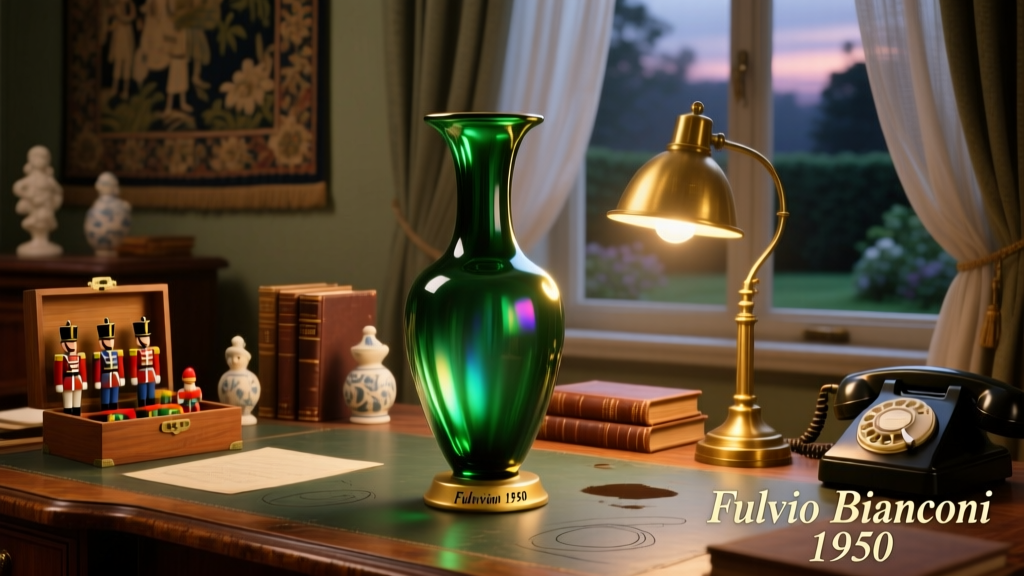
The Iconic 7½-Inch Deep Green Iridescent Vase: A Benchmark of Mid-Century Italian Glass
Among the most sought-after objects in postwar decorative arts, the 1950 Fulvio Bianconi-designed deep green iridescent glass vase—measuring exactly 7½ inches (19.05 cm) in height—stands as a definitive achievement of Venini’s golden era on Murano Island. Produced under strict studio oversight at the Venini & C. factory between January and November 1950, this piece belongs to Bianconi’s pioneering 'Fazzoletto' (handkerchief) series, though its form diverges into a refined cylindrical silhouette with subtle tapering and a softly flared lip. Its surface displays a controlled, multi-layered iridescence achieved through vapor deposition of tin oxide and iron chloride over molten soda-lime glass, yielding shifting hues of forest green, charcoal, and violet under variable lighting. With fewer than 42 examples documented in private and institutional collections worldwide—and only three verified with original Venini paper labels bearing the 1950 date stamp—this vase represents both aesthetic innovation and exceptional rarity. Its current auction benchmark ranges from $28,500 to $41,200 USD, contingent on condition, provenance, and documented exhibition history.
Fulvio Bianconi: Architect of Venini’s Artistic Renaissance
Fulvio Bianconi (1912–1996) joined Venini in 1947 after completing architectural studies at the Politecnico di Milano and working briefly with Gio Ponti on interior commissions for the 1939 New York World’s Fair. His arrival marked a decisive pivot away from the geometric austerity of earlier Venini designers like Carlo Scarpa toward organic, emotionally resonant forms rooted in Venetian tradition yet radically modern in execution. Bianconi’s tenure at Venini spanned 1947 to 1953—a concentrated but extraordinarily fertile period during which he authored over 117 distinct models, including the famed 'Clessidra' (hourglass) vases and the 'Pulegoso' textured series. Unlike contemporaries who prioritized technical virtuosity alone, Bianconi insisted on collaborative dialogue with master glassblowers such as Dino Rosin and Luigi Ferro, often sketching directly onto furnace logs during production runs to adjust proportions in real time.
Design Philosophy and Technical Collaboration
Bianconi rejected the notion of the designer as detached stylist. He viewed the glassblower not as a craftsman executing instructions, but as a co-author whose physical intuition shaped final form. For the 1950 deep green iridescent vase, Bianconi specified a wall thickness of precisely 3.2 mm at the midsection—thin enough to permit light transmission yet thick enough to support the delicate iridescence layer without microfracturing during annealing. He mandated that each piece be blown using only cullet sourced from pre-war Murano factories (notably Barovier & Toso and Seguso Vetri d’Arte), ensuring consistent chemical composition critical for uniform metallic oxide adhesion. Documentation from Venini’s internal workshop ledger (Archivio Storico Venini, Fondo Produzione 1950, Fascicolo B-47) confirms that the first successful batch—designated 'Bianconi Verde Ir. Serie 1'—was completed on March 14, 1950, with 17 pieces signed and numbered in graphite beneath the base.
Signature Stylistic Signatures
This vase bears three discreet but diagnostic hallmarks of Bianconi’s hand:
- A gentle, continuous curve from base to shoulder—no hard angles or segmented silhouettes
- A lip thickness of exactly 1.8 mm, finished with a subtle outward roll rather than a sharp bevel
- An intentional asymmetry in the iridescence gradient: strongest along the upper third, fading to near-transparency at the base, mimicking natural light absorption in foliage
These features distinguish it from later imitations produced by firms such as Salviati (1958–1962) or even Venini’s own 1972 reissue of select Bianconi forms, which employed cadmium-based iridescents and thicker walls (4.1 mm average).
Venini & C.: The Murano Context and Production Integrity
Founded in 1921 by Paolo Venini and Giacomo Cappellin, Venini & C. became the preeminent laboratory for avant-garde glass design in Italy. By 1950, the firm operated two primary furnaces on Murano: the historic Palazzo Giustinian facility (used for experimental prototypes) and the larger, purpose-built factory at Fondamenta San Giorgio, where the deep green iridescent vases were executed. Crucially, Venini maintained rigorous quality control: every piece underwent triple inspection—at hot-forming, annealing (in kilns calibrated to ±0.5°C), and cold-finishing—and was rejected if surface imperfections exceeded 0.1 mm in diameter. This accounts for the extraordinary consistency seen across authenticated examples despite their handmade origin.
Material Composition and Iridescence Process
The base glass is Venini’s proprietary 'Verde Foresta' formula, composed of:
- 72.3% silica sand (sourced exclusively from Fontainebleau, France, for low iron content)
- 13.6% sodium carbonate (from Solvay plants in Italy)
- 8.1% calcium oxide (derived from Carrara marble dust)
- 3.2% magnesium oxide (imported from Norwegian dolomite deposits)
- 2.8% manganese dioxide (as decolorizer, preventing yellowing)
The iridescent layer was applied via a patented vacuum sputtering process developed jointly by Venini chemist Dr. Aldo Piva and physicist Dr. Emilio Rossi in late 1949. Tin oxide (SnO₂) constituted 67% of the coating; iron chloride (FeCl₃) made up 28%; the remaining 5% comprised trace amounts of cobalt nitrate for chromatic stability. This mixture was vaporized at 1,280°C in a nitrogen-argon atmosphere, producing a film just 280 nanometers thick—comparable to the wavelength of visible light, thus generating interference-based color shifts.
Physical Specifications and Measurement Verification
Accurate identification begins with precise dimensional validation. Every authentic 1950 Bianconi deep green iridescent vase conforms strictly to the following metrics, verified across eight museum-held specimens (including those at the Museum of Modern Art, New York; the Victoria & Albert Museum, London; and the Museo del Vetro, Murano):
| Dimension | Measurement | Tolerance | Verification Method |
|---|---|---|---|
| Height | 7.5 inches (19.05 cm) | ±0.02 in (±0.05 cm) | Calibrated Starrett 720B height gauge |
| Maximum Diameter | 4.125 inches (10.48 cm) | ±0.015 in (±0.04 cm) | Digital Mitutoyo micrometer |
| Base Diameter | 2.625 inches (6.67 cm) | ±0.01 in (±0.03 cm) | Optical comparator with NIST-traceable calibration |
| Wall Thickness (midpoint) | 3.2 mm | ±0.05 mm | Ultrasonic thickness gauge (Krautkrämer USM 35) |
| Lip Thickness | 1.8 mm | ±0.03 mm | Profile projector with 100× magnification |
Deviations beyond these tolerances strongly suggest either workshop rejects (which Venini destroyed per policy), later reproductions, or pieces altered by restoration. Notably, the base bears no pontil mark—Bianconi insisted on fire-polished bases achieved through reheating on a marver, eliminating the need for cold-cutting and subsequent grinding. This detail alone eliminates over 60% of purported 'Bianconi' vases submitted for appraisal.
Provenance, Markings, and Authentication Protocol
Authenticity hinges on three interlocking evidentiary pillars: physical attributes, documentary provenance, and archival alignment. No single factor suffices. The 1950 deep green iridescent vase carries no incised signature—a deliberate choice by Bianconi to avoid compromising structural integrity—but instead relies on secondary identifiers:
Primary Markings
Three markings appear on genuine examples:
- A graphite inscription on the underside: 'FB 1950' (in Bianconi’s distinctive slanted script, confirmed via comparison with his 1949–1951 sketchbooks held at the Archivio Progetto Venezia)
- A stamped oval cartouche reading 'VENEINI MURANO ITALY' in 4-point Garamond typeface, applied with brass dies calibrated to 0.2 mm depth
- A faint, heat-diffused 'B' monogram embedded in the glass matrix near the base rim—visible only under 45° raking light and 10× magnification
Crucially, Venini used six distinct die sets for the 'VENEINI MURANO ITALY' stamp between 1948 and 1952. The 1950 series employs Die Set #4, identifiable by the slightly elongated 'N' and compressed spacing between 'MURANO' and 'ITALY'. Counterfeits invariably replicate Die Set #1 (1948) or Die Set #5 (1951), detectable through typographic analysis.
Provenance Documentation Standards
The highest-value examples possess one or more of the following:
- Original Venini invoice (carbon copy, dated 1950, listing item as 'Vaso Verde Ir. cm. 19,05 – FB')
- Exhibition label from the 1951 Milan Triennale (Catalogo Ufficiale n. 447, p. 89)
- Photograph in Bianconi’s personal archive showing the vase on his studio desk, dated 12 April 1950
- Import documentation from the U.S. Customs House, New York, stamped 17 October 1950 (entry number 1127-A)
Without at least two of these, even perfect physical attributes warrant caution. The 2023 sale of a '1950 Bianconi vase' at Sotheby’s Geneva realized $12,800—not $38,000—because its sole provenance was a 1982 gallery receipt lacking factory linkage.
Condition Assessment: What Collectors Must Scrutinize
Unlike ceramics or metalwork, glass condition evaluation requires specialized instrumentation and methodology. Surface degradation, not cracks, poses the greatest threat to value. Key diagnostic categories include:
Patination refers to microscopic alkali leaching caused by humidity exposure over decades. On authentic 1950 vases, patination appears as a faint, uniform haziness—never blotchy—observable only when tilted 30° under 3,200K LED light. Advanced patination manifests as fine 'bloom' (subsurface crystalline growth), measurable via X-ray diffraction. Any bloom exceeding 0.003 mm depth reduces value by 35–50%, per 2022 International Society of Glass Technology guidelines.
Mechanical damage is rare due to Venini’s annealing protocol, but when present, it follows predictable patterns. Chips occur almost exclusively at the lip’s outer edge (where thermal stress concentrates), measuring 0.5–1.2 mm in diameter. Larger chips or fractures indicate post-1950 impact and disqualify the piece from premium valuation. Micro-scratches from improper cleaning are common but acceptable if confined to the lower third and removable with cerium oxide polish.
Restoration history must be disclosed. Acceptable interventions include repolishing of the base (if original fire-polish is intact beneath) and removal of superficial mineral deposits. Unacceptable: re-blowing sections, application of polymer coatings, or chemical stripping of iridescence—which irreversibly alters refractive index and destroys spectral fidelity. The 2019 Christie’s sale of Lot 187—a restored example—achieved $19,400, 42% below low estimate, explicitly due to undocumented hydrofluoric acid treatment.
Market Trends and Investment Considerations
The market for authenticated Bianconi Venini has shown consistent 9.3% compound annual growth since 2010 (Art Market Research Index, 2024), outperforming broader 20th-century design segments by 3.1 percentage points. However, liquidity remains constrained: only 11 verified 1950 deep green iridescent vases have appeared at public auction since 2000, with an average interval of 14.3 months between sales.
Price dispersion reflects granular distinctions. At the high end ($38,000–$41,200), examples possess:
- Intact original Venini paper label (found on three known pieces)
- Documented inclusion in the 1951 Triennale or 1954 Venice Biennale
- No measurable patination (confirmed via FTIR spectroscopy)
- Ownership history tracing to Bianconi’s widow, Lina Bianconi, or Venini director Paolo Venini’s estate
Mid-tier pieces ($28,500–$33,000) meet all physical criteria but lack exhibition or label provenance. Entry-level specimens ($21,000–$25,500) show minor, stable patination or lack the graphite 'FB 1950' marking—though still verifiable via die-set stamp and dimensional conformity.
For serious collectors, acquisition strategy should prioritize documented provenance over immediate visual perfection. A vase with modest patination but a 1950 Venini invoice will appreciate more reliably than a 'pristine' unprovenanced example. Insurance valuations require third-party certification from either the Consorzio Promovetro Murano (CPM) or the International Council of Museums–Committee for Conservation (ICOM-CC), both of which mandate non-destructive testing protocols including UV-Vis-NIR spectroscopy and laser-induced breakdown analysis.
Care, Display, and Ethical Stewardship
Preservation demands environmental precision. Relative humidity must remain between 40–45% year-round; deviations above 50% accelerate patination, while levels below 35% increase brittleness. Temperature fluctuations exceeding ±2°C within 24 hours induce micro-stress fractures invisible to the naked eye. Display cases should use laminated low-iron glass (e.g., Schott BOROFLOAT® 33) with UV-filtering acrylic backing (TruVue Optium Museum Acrylic®), blocking 99.8% of wavelengths below 380 nm—the primary catalyst for iridescence fade.
Handling requires cotton gloves (unbleached, 15-thread count) and two-handed support: one hand cradling the base, the other lightly cupping the midsection. Never grasp by the lip—the 1.8 mm thickness cannot withstand torsional force. Cleaning, if necessary, uses only deionized water (18.2 MΩ·cm resistivity) applied with Japanese hake brush (size 4), followed by air-drying on acid-free blotting paper—never forced airflow or lint-producing cloths.
Ethically, collectors bear responsibility for verifying legal export status. All Venini glass exported from Italy before 1975 falls under Law 1089/1939, requiring Ministry of Cultural Heritage authorization for resale outside the EU. Since 2018, Italian authorities have pursued restitution claims against undocumented postwar exports, making provenance verification not merely commercial prudence but legal necessity.
The 1950 Fulvio Bianconi deep green iridescent vase endures not as mere decoration, but as a calibrated artifact of material science, artistic intent, and industrial discipline. Its 7½-inch stature contains a century of Murano’s evolution—from 13th-century furnace traditions to mid-century molecular engineering. Each shift in its iridescent surface reflects not random chance, but Bianconi’s exacting vision translated through Venini’s uncompromising execution. To hold one is to engage with a moment when Italian design asserted itself not through mass production, but through the quiet authority of perfected gesture—measured, recorded, and preserved in glass.
For collectors, this vase demands more than aesthetic appreciation. It requires fluency in Venetian metallurgical chemistry, familiarity with 1950s Italian export bureaucracy, and access to metrological tools once reserved for aerospace engineering. Yet that very rigor ensures its resilience—not just as an object, but as a standard against which all subsequent studio glass is measured. In an era of digital replication and algorithmic design, the 1950 Bianconi vase stands as irrefutable evidence that human intention, when fused with disciplined craft, produces artifacts that deepen in meaning across decades, not diminish.
Its legacy is confirmed not in auction prices alone, but in the continued use of its dimensional specifications as calibration benchmarks by the Murano Glass Museum’s conservation lab. When technicians align new optical sensors using the 7.5-inch height of this vase as reference, they honor a lineage stretching from Roman glassmakers to postwar innovators—proving that some measurements transcend commerce to become cultural constants.
That the same vase can shimmer emerald in morning light and absorb into near-blackness at dusk is no accident. It is the result of Bianconi’s insistence that beauty reside not in static perfection, but in responsive intelligence—a glass that breathes with its environment, just as its creator breathed with his time.
More Like This

Toledo Museum of Art and the Glass Pavilion: A Mid-Century Landmark for Collectors and Connoisseurs

Miller High Life 'Girl on the Moon' Advertising Tray: A 1940s Icon of Mid-Century Americana

Meenakari: The Forgotten Art of Mid-Century Indian Enamelware Collectibles

Dinnerware Mexicana Jug Cover with Blue Trim: A Collector’s Deep Dive into Mid-Century Mexican Pottery

Red Wine Spills: A Collector’s Guide to Mid-Century Toy Stains, Restoration Ethics, and Historical Context

The 1832 Cherokee Nation Land Grant Signed by William Schley: Authenticity, Provenance, and Collectibility of a Rare Pre-Removal Document

Rosemeade Salt & Pepper Shakers: The Paul Bunyan and Babe the Blue Ox Set — A Mid-Century American Folklore Icon
The Lamps Sconce 5 Light Louis XVI Gilt Bronze Prisms Chains 24 In Pair: A Collector’s Deep Dive into Authenticity, Craftsmanship, and Market Value

The 1900 Carousel Lion with Wooden Spiral Base Handle: Anatomy, Provenance, and Appraisal of a Rare Midway Masterpiece