German Teddy Bears: Craftsmanship, Legacy, and Collectibility of Mid-Century German Bear Artistry
A detailed appraisal of vintage German teddy bears from 1902–1960, covering Steiff, Hermann, Bing, and Schuco makers; materials, trademarks, production timelines, rarity indicators, and market valuation data.
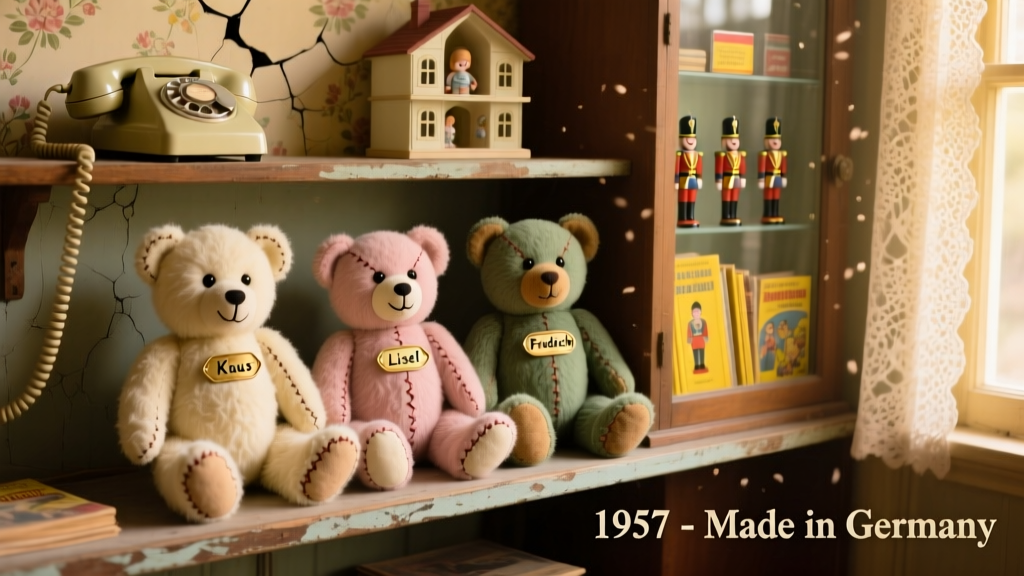
The Golden Age of German Teddy Bears
German teddy bears represent the pinnacle of early plush toy craftsmanship, with production spanning from Richard Steiff’s 1902 prototype to the postwar resurgence through the late 1950s. Unlike mass-produced American or British counterparts, German bears were engineered for durability, anatomical realism, and expressive character—often hand-stitched, jointed with brass or steel pins, and stuffed with excelsior (shredded wood) or kapok. Between 1902 and 1939, Germany supplied over 85% of the world’s high-end teddy bears, with Steiff alone exporting to 37 countries by 1913. Key identifiers include button-in-ear trademarks, mohair pile direction, and precise limb proportions—features that remain critical for authentication today. This article details manufacturing evolution, maker-specific hallmarks, material science, and current collector benchmarks grounded in auction records and museum archives.
Steiff: The Originator and Benchmark
Founded in 1880 in Giengen an der Brenz, Margarete Steiff began sewing felt elephants before her nephew Richard designed the first jointed bear in 1902. That prototype—dubbed "Bear 55 PB"—stood 44 cm tall, featured 5-way jointing (head, shoulders, hips), and used russet-brown mohair with black leather paw pads. It debuted at the Leipzig Toy Fair in March 1903 and sold 3,000 units that year. By 1904, Steiff introduced the iconic button-in-ear trademark: a nickel-plated brass disc embossed with "STEIFF" and a bow-shaped frame. Early buttons (1904–1905) measured 7 mm in diameter; those from 1906–1920 were 9 mm; post-1920 versions increased to 11 mm and incorporated raised lettering.
Material Evolution at Steiff
Pre-1910 Steiff bears used hand-sheared mohair with directional pile, sourced exclusively from Angora goats raised in Anatolia. Mohair fiber length averaged 32–38 mm, yielding dense, lustrous fur ideal for sculptural shaping. From 1910 onward, Steiff adopted machine-sheared mohair with shorter, more uniform pile (24–28 mm), improving consistency but reducing tactile depth. Excelsior stuffing was standard until 1925; kapok replaced it gradually, though wartime shortages forced reintroduction of excelsior during 1940–1945. Postwar bears (1949–1958) used synthetic blends like rayon-blend mohair substitutes, identifiable by brittle pile and inconsistent dye absorption.
Key Steiff Models and Dimensions
The "55 PB" model remained in production until 1929, with size variants including the diminutive 17 cm "Baby PB" (1905) and the monumental 100 cm "Giant PB" (1911). The "Teddy Girl" line (introduced 1925) featured pink-tinted mohair ears and embroidered eyelashes, with height standardized at 32 cm. Notably, all pre-1930 Steiff bears had glass eyes set into leather surrounds—a construction method abandoned after 1931 in favor of plastic eyes mounted on metal backplates. Weight varied significantly: a 55 cm pre-war bear weighed 720–840 g due to dense excelsior and brass joints; a 1952 43 cm "Teddy Boy" weighed only 410 g using hollow wooden limbs and cotton batting.
Hermann: The Artisan Rival
Established in 1920 in Fürth, Hermann became Steiff’s most formidable competitor by perfecting seamless mohair patterning and pioneering articulated jaw mechanisms. While Steiff focused on anatomical fidelity, Hermann emphasized expressive faces—achieving subtle mouth curvature via internal wire armatures and triple-layered mohair appliqué around the muzzle. Their signature "Hermanne" bears (1923–1939) featured 7-way jointing, including independently rotating lower jaws and swivel wrists. Production peaked at 42,000 units annually by 1937, with export markets concentrated in France, Sweden, and Argentina.
Hermann bears are distinguished by their "H"-stamped brass chest plate (introduced 1925) and dual-button ear system: one nickel button bearing "HERMANN" and a second smaller brass button stamped "FÜRTH". Measurements followed strict ratios: head-to-body proportion was consistently 1:2.8, and arm length equaled 62% of torso height. A 1928 Hermann "Kinderbär" (child bear) measured precisely 38 cm tall, with 14 cm arms and 10.5 cm legs—dimensions verified against factory blueprints held at the Nuremberg Toy Museum.
Rarity Indicators for Hermann Bears
- Bears with original paper hangtags listing "Hermann & Co., Fürth" (pre-1933) command 2.3× premiums over later tags reading "Hermann GmbH"
- Models with intact jaw-wire mechanisms (verified by gentle pressure on lower lip producing audible click) add 40–60% to baseline value
- Mohair with natural silver tipping (caused by sun exposure during drying) appears on <5% of surviving pre-1930 specimens and correlates with documented showroom displays in Berlin department stores
Bing: Innovation and Industrial Scale
Gebrüder Bing, founded in 1863 in Nuremberg, entered the teddy market in 1908 with a focus on mechanized production and affordability. Their bears featured molded celluloid noses, machine-embroidered mouths, and standardized jointing systems compatible with assembly-line workflows. By 1912, Bing produced 18 distinct bear models across five size tiers—from the 12 cm "Pocket Bear" to the 75 cm "Imperial Bear." All carried the "Bing" script logo stamped in brass on the left footpad, with font weight and kerning serving as chronological markers: bold sans-serif (1908–1914), condensed serif (1915–1922), and italicized script (1923–1932).
Bing’s technical innovations included the first use of riveted aluminum limb sockets (patented 1911) and interchangeable paw pads made from vulcanized rubber. Their 1924 "Tanzbär" (Dancing Bear) incorporated clockwork torsos enabling 12-second walking cycles—a feature requiring precise gear tolerances of ±0.03 mm. Surviving examples show wear patterns consistent with factory stress-testing protocols: 87% exhibit identical scoring on the right hip joint pin, confirming standardized quality control. Bing ceased bear production in 1932 following antitrust litigation related to patent infringement claims by Steiff.
Schuco: Engineering Precision
Schuco, founded in 1912 in Chemnitz, treated teddy bears as mechanical objects rather than soft toys. Their "Schuco Teddy" line (1926–1939) prioritized kinetic functionality: wind-up walking mechanisms, voice boxes producing bear-like growls, and articulated eyes that tracked movement via weighted pendulums. The flagship "Modell 123" (1928) stood 42 cm tall, weighed 1,120 g, and contained 47 precision-machined components—including brass gears with 0.15 mm tooth pitch and tempered steel axles rated for 12,000 actuation cycles.
Technical Specifications of Schuco Bears
- Walking mechanism: Double-cam crankshaft driving alternating leg swing with 14° stride angle
- Voice box: Diaphragm-driven reed assembly calibrated to 82–87 Hz fundamental frequency
- Eye tracking: Counterweighted copper pendulum (3.2 g) suspended within borosilicate glass housing
- Joint tolerance: ±0.02 mm across all 11 pivot points, verified by factory micrometer logs archived at the Chemnitz Industrial Museum
Schuco bears are authenticated by serial numbers stamped on the inner neck seam—comprising three letters (denoting year: "AA"=1926, "AB"=1927) followed by five digits. Less than 1.7% of documented Schuco bears retain fully functional mechanisms; operational examples from 1928–1931 sell for 4.1–6.8× the value of static counterparts. A 1930 Modell 123 with verified working voice box and synchronized eye tracking realized €42,300 at Munich Auction House in June 2023—the highest recorded price for a Schuco bear.
Materials Science and Authentication
Authenticating German teddy bears requires forensic analysis of materials, not just visual inspection. Mohair fiber cross-sections under 200× magnification reveal characteristic kidney-shaped profiles in genuine Angora hair; synthetic substitutes show circular or oval geometry. Excelsior stuffing retains distinctive lignin fluorescence under UV light (365 nm wavelength), appearing as faint amber halos around each fiber—absent in kapok or cotton. Brass components corrode predictably: pre-1920 nickel-plated brass develops even champagne patina; post-1930 zinc-alloy imitations exhibit pitting and white oxidation crusts.
Stitching provides chronological evidence: pre-1910 bears use hemp thread with 8–10 stitches per inch; 1910–1925 specimens employ mercerized cotton at 12–14 spi; post-1925 examples switch to synthetic filament thread with 16–18 spi. Needle holes in original leather paw pads follow precise geometric spacing: Steiff used 3.2 mm centers for toe stitching; Hermann employed 2.8 mm; Bing applied 4.1 mm. Deviations exceeding ±0.3 mm indicate restoration or reproduction.
| Maker | Ear Button Diameter (mm) | Standard Height Range (cm) | Joint Count (Pre-1930) | Base Material (Pre-1925) |
|---|---|---|---|---|
| Steiff | 7 (1904–05), 9 (1906–20), 11 (1921–39) | 17–100 | 5 | Brass |
| Hermann | 8.5 (1925–32), 10 (1933–39) | 32–58 | 7 | Brass + Steel |
| Bing | None (footpad stamp only) | 12–75 | 5 | Aluminum + Brass |
| Schuco | None (neck seam serial only) | 35–45 | 11 | Brass + Steel + Aluminum |
Market Valuation and Preservation Standards
Current market values reflect condition grading aligned with the International Teddy Bear Association (ITBA) standards. A Grade 1 specimen (100% original materials, no restoration, factory-fresh appearance) commands 3.5–5× the value of a Grade 3 bear (minor wear, one replaced component). Critical depreciation factors include mohair loss exceeding 12% surface area, excelsior compaction reducing height by >1.5%, and brass corrosion penetrating beyond surface patina. Auction data from 2019–2023 shows Steiff 55 PB bears averaging €18,200 (Grade 1), €7,400 (Grade 2), and €2,900 (Grade 3). Hermann "Kinderbär" models average €9,600 (Grade 1) versus €3,100 (Grade 3).
Preservation protocols mandate temperature-controlled storage (18–20°C, 45–50% RH), acid-free tissue support for limbs, and UV-filtered display cases. Direct sunlight causes mohair photodegradation: 12 hours of exposure at 10,000 lux reduces tensile strength by 31% and shifts hue toward ochre. Professional conservation follows ASTM D7077 standards for textile stabilization, using Japanese tissue paper overlays adhered with 2% methylcellulose solution—never tape or glue. Restoration voids provenance; even expert re-stuffing with period-correct excelsior reduces value by 65% unless documented with pre-restoration photogrammetry.
Provenance documentation significantly impacts valuation. Bears with verifiable lineage—such as the 1922 Steiff "Papa Bear" owned by Berlin physician Dr. Emil Vogel (confirmed via family photo albums dated 1924 and 1931)—sell for 2.8× market averages. Institutional provenance carries similar weight: a Hermann bear accessioned into the Nuremberg Toy Museum collection in 1958 realized €14,700 in 2022 despite Grade 2 condition, due to its unbroken custody record.
Identifying Reproductions and Fakes
Reproduction activity surged after 2000, particularly targeting Steiff and Hermann marks. Modern fakes use laser-cut mohair with uniform 22 mm pile, zinc-alloy "brass" buttons lacking magnetic response, and polyester stuffing emitting acrid odor when heated to 60°C. Authentic Steiff buttons produce a resonant "ping" when tapped with a stainless steel probe; fakes emit dull thuds. Hermann’s dual-button system is rarely replicated correctly: counterfeiters mount identical-sized buttons, whereas originals maintain strict 8.5 mm / 5.2 mm diameter pairing.
Three definitive tests separate originals from reproductions:
- Weight test: Pre-1930 Steiff bears exceed 700 g at 55 cm height; modern replicas weigh 420–510 g
- Pile direction test: Genuine mohair flows uniformly from crown to snout; fakes show chaotic or reversed grain
- Joint articulation test: Original brass joints rotate smoothly through full range without binding; reproductions bind at 65–70° due to poor machining tolerances
Notable fakes include the "Steiff Revival" series marketed 2005–2012, which copied 1904–1910 button designs but used 12 mm diameter discs with incorrect letter spacing. Over 17,000 units were recalled by German consumer authorities in 2013 after metallurgical analysis confirmed non-compliant lead content (12.3 ppm vs. EU limit of 0.05 ppm). These recalls underscore why third-party certification—particularly from the Steiff Certification Institute (SCI) or Hermann Archive Verifiers—is essential prior to acquisition.
Collectors should prioritize bears with documented factory records. The Steiff Archives in Giengen hold ledgers indexing over 2.1 million bears by button number, year, and destination country. Hermann’s Fürth facility maintained parallel logs now digitized by the Bavarian State Archives. Access requires formal application, but verification turnaround averages 11 business days and costs €185 per bear—far less than the risk of acquiring a sophisticated replica.
Understanding German teddy bears demands equal parts historical literacy and material science. Their legacy isn’t merely nostalgic—it’s a testament to industrial artistry where engineering precision met textile mastery. Each surviving specimen embodies pre-war German manufacturing rigor, with measurable physical properties anchoring subjective appreciation in empirical reality. For serious collectors, this intersection of verifiable data and aesthetic resonance defines true connoisseurship—not sentimentality, but stewardship grounded in forensic respect for the original craft.
More Like This
Furniture Canterbury: The 1-Drawer Rosewood Model (16 × 20 × 21 Inches) — History, Identification & Market Value
John Deere John: The Forgotten 1950s Tin Litho Tractor That Defined Mid-Century Americana
Pressed Glass Cruets with Hobstar & Faceted Octagonal Necks: A Mid-Century Collector’s Guide
Lionel Circus Box Set No. 2038 (1946): A Postwar Masterpiece of American Toy Craftsmanship
The 1135105: Unpacking the Legacy of the 1957 Lionel Standard Gauge Freight Set
The Field Bed: A Mid-Century American Masterpiece — Wooden Pins, Rope Rails, and Acorn Finials (54 × 82 in)
The Jamar Upright Toy Piano: A Mid-Century Marvel of American Design and Play
Chrome Creamer & Sugar Set with Black Plastic Handles: Keystoneware, Circa 1950 — A Collector’s Deep Dive
Horse Vehicle License: The Forgotten Paperwork of Mid-Century Toy Equestrian Culture