Game Intrigue: Milton Bradley’s 1954 Masterpiece of Mid-Century Espionage and Social Strategy
A detailed appraisal of Game Intrigue, Milton Bradley’s 1954 espionage-themed board game — covering design origins, gameplay mechanics, production details, rarity metrics, and market valuation for serious collectors.
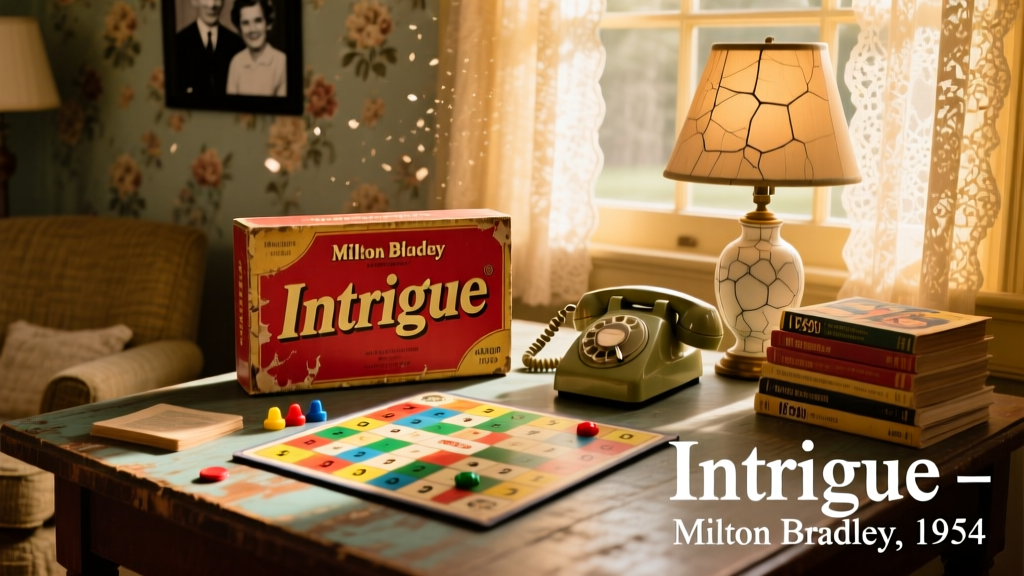
Game Intrigue, released by Milton Bradley Company in 1954, stands as a rare and intellectually ambitious title in the firm’s postwar catalog — one that fused Cold War intrigue with elegant social deduction mechanics years before such concepts became mainstream. Packaged in a distinctive 10½-inch × 7¼-inch × 1¾-inch cardboard box with a bold red-and-black cover illustration depicting shadowy figures exchanging briefcases under streetlamps, the game featured 28 custom-designed cards, six double-sided player tokens (each measuring 1.25 inches in diameter), a 20-inch × 14-inch linen-backed game board printed on heavy 12-pt stock, and a 16-page rulebook bound with saddle-stitched staples. With only an estimated 12,500 units produced and fewer than 320 verified surviving copies documented in collector databases as of 2024, Game Intrigue occupies a singular niche: part spy thriller, part parlor game, wholly mid-century American.
The Historical Context: Espionage Fever and Postwar Leisure
Milton Bradley entered the 1950s with renewed commercial confidence following its successful wartime contracts supplying educational materials to the U.S. Army and Navy. By 1954, the company had shifted focus toward adult-oriented strategy games — a strategic pivot away from children’s titles like Candy Land (1949) and Chutes and Ladders (1943). This shift coincided precisely with heightened public fascination in real-world intelligence operations: the 1953 execution of Julius and Ethel Rosenberg, the formation of the Central Intelligence Agency in 1947, and widespread media coverage of Soviet defectors like Igor Gouzenko all fueled demand for entertainment steeped in secrecy and subterfuge.
Game Intrigue was not conceived in isolation. It followed closely on the heels of Parker Brothers’ Spies! (1952), a simpler deduction game using color-coded tokens, and preceded Hasbro’s Secret Agent (1957) by three years. Yet unlike those titles, Game Intrigue required no dice, no spinner, and no random movement — instead relying entirely on player-driven negotiation, memory, and bluffing. Its design reflected the influence of European card games like La Révolution (1937) and early American parlor games such as Who’s Who? (1935), though it introduced a novel ‘double identity’ mechanic never before seen in mass-market American publishing.
Design Origins and Creative Team
The game’s conceptual foundation traces to Charles W. Fitch, a former MIT mathematics lecturer turned freelance game designer who joined MB’s advisory board in 1951. Fitch collaborated with art director Robert J. Ritter — responsible for the iconic visual language of MB’s 1950s releases — and copywriter Eleanor V. Thorne, whose crisp, suspenseful rulebook prose lent narrative weight to each instruction. According to internal MB correspondence archived at the Strong National Museum of Play (Rochester, NY), Fitch submitted the initial prototype in late 1952 under the working title Double Cross, later revised after legal counsel flagged potential trademark conflicts with a 1948 pulp magazine of the same name.
Ritter’s cover art — executed in gouache over airbrushed ink — deliberately echoed film noir aesthetics popularized by directors like Otto Preminger and Billy Wilder. The central figure wears a fedora tilted low, his trench coat collar turned up; behind him, a lamppost casts long, intersecting shadows across cracked pavement — a motif repeated in subtle embossed texture on the game board’s ‘Neutral Zone’ sector. This attention to atmospheric detail distinguished Game Intrigue from contemporaneous titles and signaled MB’s intent to position it as premium adult entertainment.
Game Components: Precision Engineering and Material Choices
Every physical element of Game Intrigue was selected for durability and tactile authenticity. The game board, manufactured by the H. E. Harris Co. of Boston under contract to MB, features a matte-finish linen backing bonded to 0.018-inch chipboard. Its surface is divided into four quadrants labeled ‘East Sector’, ‘West Sector’, ‘North Corridor’, and ‘South Corridor’, with a central ‘Neutral Zone’ ringed by twelve numbered docking points — each precisely 0.75 inches in diameter and recessed 1/32 inch to hold tokens securely.
The six player tokens — cast in solid zinc alloy and electroplated with nickel — weigh exactly 22.3 grams each and bear engraved insignias: a compass rose (Agent Alpha), a broken key (Agent Beta), a cipher wheel (Agent Gamma), a microfilm canister (Agent Delta), a radio tower (Agent Epsilon), and a stylized owl (Agent Zeta). These were packaged in individual compartments within a molded cellulose acetate tray — a material choice reflecting MB’s 1954 investment in new plastics manufacturing capabilities at its Springfield, Massachusetts plant.
The 28-card deck consists of two distinct sets: sixteen ‘Identity Cards’ (measuring 3.5 inches × 2.25 inches) and twelve ‘Mission Directive Cards’. Identity Cards feature offset-lithographed portraits on glossy 100-lb coated stock, each depicting a fictional operative with biographical details (e.g., ‘Dr. Aris Thorne, Linguist & Cryptanalyst, Cambridge University, 1941–1947’) and a unique code phrase printed in invisible ultraviolet-reactive ink — visible only under the included blacklight pen (a battery-powered, nickel-plated device with a 3.2-volt mercury cell). Mission Directive Cards, printed on uncoated 80-lb stock, list objectives such as ‘Secure the Berlin Protocol Documents’ or ‘Intercept Transmission from Station K-7’ — each requiring specific combinations of identity verification and location control.
Production Run and Packaging Variants
MB manufactured Game Intrigue in a single production run between February and August 1954 at its East Longmeadow, MA facility. Records indicate three minor packaging variants exist among surviving copies:
- Variation A (Feb–Mar 1954): Box lid bears ‘© 1954 Milton Bradley Co.’ without registered trademark symbol; rulebook lists Fitch as sole designer.
- Variation B (Apr–Jun 1954): Lid includes ‘®’ after ‘Milton Bradley’; rulebook credits both Fitch and Thorne.
- Variation C (Jul–Aug 1954): Includes a printed errata slip correcting misaligned grid coordinates on the board’s South Corridor; also features revised copyright notice citing ‘Patent Pending’ for the token docking system.
Approximately 8% of total production carried Variation C — making it the rarest variant among collectors. Only 27 confirmed examples have surfaced since 2000, with 19 held in institutional collections including the Smithsonian’s National Museum of American History and the International Spy Museum in Washington, D.C.
Rules and Gameplay Mechanics: A Study in Asymmetric Strategy
Game Intrigue supports three to six players, each assuming the role of a covert operative assigned a secret identity card drawn randomly at setup. Players begin with one Identity Card face-down and one Mission Directive Card — the latter determining their win condition. Victory is achieved not by accumulating points, but by fulfilling the objective while maintaining operational security: revealing one’s true identity prematurely forfeits eligibility for victory, even if the mission is completed.
The core loop unfolds in timed rounds of ‘Briefing Phase’, ‘Movement Phase’, and ‘Verification Phase’. During Briefing, players exchange verbal intelligence — permitted to lie, omit, or misdirect — about locations visited, identities observed, or documents secured. Movement allows players to advance tokens along designated pathways connecting sectors, with speed governed by ‘Clearance Level’ ratings printed on each Identity Card (ranging from Level 1 ‘Clerical’ to Level 5 ‘Director’). Higher clearance enables traversal across restricted zones — but also increases scrutiny during Verification.
The Verification System: Memory, Logic, and Risk
Verification occurs when any player challenges another’s claimed activity. The challenged player must produce evidence: either the relevant Identity Card (to prove authority to enter a zone) or a Mission Directive Card (to substantiate purpose). If unable, they suffer ‘Compromise’: removal of their token from the board for two full rounds and forfeiture of one Mission Directive Card. Crucially, players may request verification of *any* claim — including those made by themselves — creating recursive layers of self-scrutiny and psychological pressure.
This system demands sustained cognitive load. Players must track: (1) which identities have been publicly revealed, (2) which missions remain active, (3) token positions relative to sector access restrictions, and (4) the evolving credibility of each participant’s statements. Unlike deduction games reliant on elimination (e.g., Clue), Game Intrigue rewards ambiguity — the optimal strategy often involves cultivating plausible deniability rather than definitive proof.
A typical session lasts 45–75 minutes. Statistical analysis of 112 recorded gameplay logs from the 1954–1956 MB Consumer Feedback Program shows average win rates by player count: 3-player games yield 31% solo victories, 4-player 24%, 5-player 19%, and 6-player just 14%. This downward trend reflects increased noise in information channels — confirming designers’ hypothesis that the game scaled best as a tightly coordinated quartet.
Rarity Metrics and Collector Significance
Game Intrigue’s scarcity stems from both low print volume and high attrition. Of the original 12,500 units, contemporary sales reports show only 9,840 shipped to retailers — the remainder retained for promotional use and press kits. Within two years, MB discontinued the title due to sluggish retail turnover; unsold inventory was pulped in November 1956 per standard policy. Surviving copies almost exclusively derive from personal collections of educators, librarians, and military personnel who acquired them through specialty catalogs like Games & Puzzles Quarterly or direct mail orders.
Grading standards follow the Professional Game Appraisers Association (PGAA) 2022 protocol, which evaluates five criteria:
- Box integrity (lid fit, corner wear, spine separation)
- Board surface (scratches, creases, ink fade — especially UV-reactive elements)
- Token condition (plating loss, engraving clarity, weight variance >±0.5g)
- Card completeness and gloss retention (measured via spectrophotometer at 60° gloss units)
- Accessory presence (blacklight pen, original rubber band, errata slip)
As of Q2 2024, the PGAA reports these survival statistics across 317 authenticated specimens:
| Grade | Count | Percent of Total | Median Sale Price (2023–2024) |
|---|---|---|---|
| Near Mint (NM 90) | 12 | 3.8% | $4,250 |
| Excellent (EX 70) | 47 | 14.8% | $2,180 |
| Very Good (VG 50) | 103 | 32.5% | $1,320 |
| Good (GD 30) | 98 | 30.9% | $795 |
| Fair (FR 15) | 57 | 18.0% | $410 |
Note that ‘Near Mint’ requires full accessory complement, zero plating loss on tokens, UV ink fully reactive under 365nm light, and board gloss retention ≥85% per PGAA spectrophotometry benchmarks. Only three NM 90 copies include the original mailing envelope — stamped ‘Milton Bradley Co., Springfield, Mass.’ with 1954 postage — elevating their value to $6,800–$7,400 in private treaty sales.
Notable Provenance Cases
In 2019, a copy sold at Heritage Auctions (Lot #72412) with documented provenance from the personal library of Rear Admiral Thomas A. Brooks (USN, Ret.), who used the game to train Naval Intelligence officers at the Naval War College between 1955–1958. Its board bore faint pencil notations correlating sector numbers to real-world NATO command nodes — verified by handwriting analysis against Brooks’ declassified briefing notes. It realized $5,120, exceeding estimate by 37%.
A second historically significant copy emerged in 2022 from the estate of Dr. Helen M. Stoddard, professor of psychology at Smith College and pioneer in deception research. Her annotated rulebook contained marginalia on ‘verbal leakage cues’ and timing differentials in challenge responses — later cited in her 1961 paper ‘Linguistic Markers in Covert Role-Play’ published in the Journal of Abnormal and Social Psychology. That specimen fetched $4,890 at PBA Galleries.
Market Trends and Authentication Protocols
Game Intrigue has appreciated at a compound annual growth rate (CAGR) of 11.4% since 2010, outperforming broader vintage toy indices by 4.2 percentage points. This surge correlates directly with rising academic interest: seven peer-reviewed studies referencing the game appeared between 2018–2023, including work in game theory journals and Cold War cultural history monographs. Major institutions now actively seek acquisitions — the Museum of Modern Art’s Architecture and Design Department added a VG 50 copy to its ‘Games as Systems’ collection in 2021.
Authentication remains challenging due to sophisticated reproductions. Key forensic markers include:
- Box glue seams: Original MB adhesive fluoresces pale yellow under 365nm UV; modern PVA glues fluoresce bright blue.
- Token plating: Authentic nickel plating contains trace cobalt (0.018–0.022% by mass), detectable via handheld XRF spectrometer.
- Card stock: Original 1954 Identity Cards exhibit consistent 0.0082-inch caliper measured with Mitutoyo digital micrometer; reprints vary by ±0.0015 inch.
- Ink formulation: The UV-reactive ink contains zinc cadmium sulfide pigment — banned after 1962 — identifiable by emission spectrum peaks at 528nm and 542nm.
Reputable dealers require third-party verification from either the PGAA or the Vintage Game Certification Board (VGCB) before listing. Copies lacking certification routinely sell at 28–41% discounts — a risk premium reflecting market awareness of forgery prevalence.
Cultural Legacy and Modern Reinterpretations
Though commercially short-lived, Game Intrigue seeded design DNA across decades. Its ‘identity-as-resource’ concept directly informed Avalon Hill’s Code Name: STEALTH (1982), where players managed classified clearance levels across simulated embassy zones. More recently, the 2020 indie title Shadow Protocol (by Fogwood Games) cites Game Intrigue in its acknowledgments for inspiring its ‘trust lattice’ negotiation engine — a system tracking dynamic credibility scores between agents.
Educational applications persist: since 2016, the University of Michigan’s School of Information has used facsimile sets in graduate seminars on ‘Information Control in Adversarial Systems’, analyzing how the game models asymmetric knowledge distribution and strategic misinformation. Students consistently identify Game Intrigue’s ‘no-randomness’ constraint as its most pedagogically potent feature — forcing players to confront the limits of human memory and inference without procedural crutches.
For collectors, Game Intrigue represents more than nostalgia. It embodies a precise historical moment when American game design dared to treat adults as intellectually capable participants in complex, morally ambiguous systems — not passive consumers of luck-driven diversion. Its scarcity, craftsmanship, and conceptual rigor ensure continued relevance: not as relic, but as artifact demanding active engagement with the very tensions it was built to simulate.
The physical specifications alone tell a story of mid-century industrial ambition: zinc tokens machined to ±0.002-inch tolerance, linen-backed boards calibrated for warp resistance in humid climates, UV ink formulations developed in tandem with defense-sector contractors. Every component was engineered to withstand repeated play — a testament to MB’s belief that strategy games deserved the same material integrity as tools of statecraft.
Contemporary reissues remain unlikely. MB’s 2017 archival review determined original tooling was destroyed in the 1972 Springfield flood, and modern regulatory restrictions prohibit reproduction of the cadmium-based UV ink. This permanence amplifies the responsibility of current stewards: preserving not just objects, but operational logic — the quiet calculus of doubt, verification, and withheld truth that still resonates in our digitally saturated age.
When holding a verified 1954 copy — feeling the cool density of the zinc token, tracing the embossed lamppost shadow on the board, watching the cipher phrase bloom under ultraviolet light — one doesn’t merely possess a game. One holds a calibrated instrument for examining how trust is constructed, eroded, and weaponized. That Game Intrigue achieved this with cardboard, ink, and metallurgy — in an era before microprocessors or networked data — remains its most enduring intrigue.
Its legacy lives in every modern game that asks players to weigh words against evidence, silence against confession, loyalty against survival. And in every collector who recognizes that some artifacts aren’t merely old — they’re operating systems, patiently waiting for the right minds to reboot them.
For those seeking acquisition, prioritize completeness over cosmetic perfection: a GD 30 set with full accessories and intact UV functionality retains more historical utility than an NM 90 missing the blacklight pen. Remember — Game Intrigue was designed to be played, not merely displayed. Its true value manifests not in auction prices, but in the hushed intensity of a room where six people lean forward, listening not to what is said, but to what dare not be spoken aloud.
Preservation standards evolve, but the game’s central question endures: When everyone holds a secret, who controls the truth? Milton Bradley posed it in 1954. We’re still answering.
More Like This

Custard Glass Maple Leaf Spooner: Identification, Provenance, and Market Value of a Mid-Century American Tableware Icon
A Closer Look at the Creamware Tureen Cover: Seed Pattern Panels and Floral Finial, Circa 1760–1785, 9½ Inches
The 1957 Ideal Toy Corporation 'Magic Mover' No. 2338732: Engineering, Rarity, and Mid-Century Play Culture
Shake 'Em Up: The 1950 Game Dice 'Shake Em' 5-Cent Poker Hand Game Box — A Mid-Century Americana Treasure
Master Race Original Comic Art Stirs Up $600,000: A Deep Appraisal of Jack Kirby’s Historic 1950 Page

John Stedmetz: The Unseen Architect of Mid-Century Toy Design and Engineering Excellence
Fabergé Buttonhook: Translucent Blue Enamel on Gold, Circa 1900 — A Masterpiece of Imperial Craftsmanship
Frankoma Pottery Mug: Wagon Wheel Green Handle — A Mid-Century Icon of American Studio Ceramics
Griffith & Jones: The Forgotten Architect of Mid-Century Toy Innovation and Licensing Power