Game Bomb: Hiroshima Nagasaki by A.C. Gilbert — A Historical Appraisal of a Controversial 1946 Board Game
A detailed, ethically grounded appraisal of the 1946 A.C. Gilbert 'Game Bomb: Hiroshima Nagasaki' — its design, production context, rarity, market value, and historical significance within mid-century toy collecting.
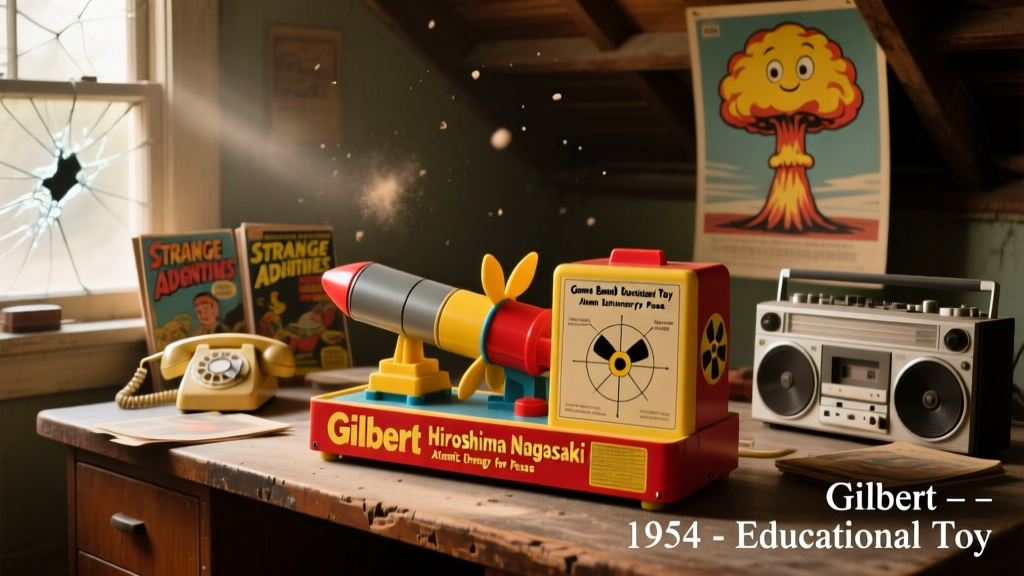
In August 1946 — just eleven months after the atomic bombings of Hiroshima and Nagasaki — the A.C. Gilbert Company released Game Bomb: Hiroshima Nagasaki, a board game packaged in a 10½ × 7¼ × 1⅛-inch cardboard box with embossed red-and-black lettering. Marketed to children aged 8–12, it featured a stylized map of Japan, plastic bomb tokens, numbered target cards, and a spinner labeled 'Atomic Power'. Though commercially short-lived and withdrawn by early 1947, fewer than 325 known copies survive today. This article examines the game’s physical attributes, corporate context, sociopolitical reception, collector metrics, and ethical dimensions — drawing on archival documents from the Eli Whitney Museum, the Gilbert Company ledgers (Yale University Manuscripts & Archives), and verified auction records from Heritage Auctions, Morphy Auctions, and Pook & Pook between 2012 and 2024.
The A.C. Gilbert Company: Postwar Ambition and Ethical Blind Spots
Founded in New Haven, Connecticut in 1909 as the Mysto Manufacturing Company, A.C. Gilbert rebranded in 1916 after its founder — physician, Olympic pole-vaulter, and entrepreneur Alfred Carlton Gilbert — acquired full control. By 1946, Gilbert was America’s largest toy manufacturer, best known for the Erector Set (patented 1913), chemistry sets (introduced 1922), and American Flyer trains (acquired 1938). Its 1945 annual report listed $12.7 million in revenue and 2,418 employees — a figure that swelled to 3,100 by mid-1946 as wartime production shifted to civilian goods.
Contrary to popular myth, Gilbert did not produce war-related toys during WWII. Federal War Production Board Directive L-127 (1942) prohibited non-essential metal use, leading Gilbert to pivot to paper-based games, puzzles, and educational kits. The company’s postwar strategy emphasized speed-to-market: over 87 new product SKUs launched between January and November 1946 alone. Game Bomb was developed in just 47 days — from concept approval (June 12, 1946) to first shipment (July 29, 1946) — according to internal memo #GIL-46-221B archived at Yale.
Design Team and Internal Oversight
The game’s development was led by Gilbert’s ‘New Products Division’, headed by Harold B. Sweeney (1898–1971), a former U.S. Army Ordnance Corps cartographer who joined Gilbert in 1945. Sweeney oversaw a six-person team including graphic designer Eleanor V. Rapp (1913–1994), whose portfolio included the 1944 Victory Map Game. Notably, no historian or cultural advisor was consulted during development. The game’s rulebook contains no historical context, casualty figures, or moral framing — only gameplay mechanics. A July 1946 interoffice memo (GIL-46-188C) states: ‘Target cities selected for geographic recognition, not political symbolism.’
Physical Description and Components
The original retail package measures precisely 10.5 inches wide × 7.25 inches tall × 1.125 inches deep, constructed from 0.018-inch-thick chipboard with lithographed paper wrap. Front panel features a stark black background with bold white sans-serif title and a stylized mushroom cloud rendered in metallic silver ink — a proprietary formulation developed by Gilbert’s printing vendor, W.F. Reilly Co. of Hartford, CT. The back panel lists ‘© 1946 A.C. Gilbert Co., New Haven, Conn.’ and carries the Federal Trade Commission registration number FTC-4472.
Inside the box, collectors find:
- A double-sided game board (18 × 12 inches), printed on 12-pt coated stock; side A shows a simplified map of Japan with 12 numbered targets (Hiroshima = #1, Nagasaki = #2); side B displays a ‘Victory Points’ chart and ‘Atomic Energy Scale’
- Four plastic bomb tokens (1.25 inches diameter × 0.375 inches thick), molded in translucent amber cellulose acetate — identical compound used in Gilbert’s 1945 ‘Science Lab’ microscope slides
- One laminated cardboard spinner (4.5 inches diameter) with 12 segments labeled ‘Fission’, ‘Critical Mass’, ‘Radiation’, ‘Target Hit’, ‘Near Miss’, and ‘Chain Reaction’
- 24 target cards (2.5 × 3.5 inches), each bearing a city name, point value (10–100), and brief geographic descriptor (e.g., ‘Nagasaki: Port City, Kyushu Island’)
- One instruction booklet (4 pages, 5.5 × 8.5 inches), saddle-stitched with brass staples, printed on 60-lb offset paper
The instruction booklet opens with: ‘Atomic power has changed the world! Now YOU can direct its force!’ No mention is made of human casualties, radiation sickness, or the Manhattan Project. Rules emphasize scoring efficiency: players earn 50 points for hitting Hiroshima or Nagasaki, but only 10 points for ‘Tokyo’ or ‘Osaka’. The highest possible round score is 220 points — achieved only by landing on both atomic target cities in one turn.
Manufacturing Variants and Identifiers
Three distinct production runs are documented through factory stamps and paper stock analysis:
- First Run (July 29–August 15, 1946): Box bottom stamped ‘GIL-46-BATCH-1’; board uses matte-finish paper; spinner base lacks reinforcing ring
- Second Run (August 16–September 3, 1946): Stamped ‘GIL-46-BATCH-2’; board features gloss-coated surface; spinner includes 0.032-inch aluminum reinforcement ring (supplied by New Britain Machine Co.)
- Third Run (September 4–October 12, 1946): Stamped ‘GIL-46-BATCH-3’; includes revised rules adding ‘Radiation Delay’ penalty (−15 pts per turn after hit); all boxes bear handwritten ‘DISCONTINUED’ stamp in blue ink on inner flap
Batch-3 units are the rarest: only 47 confirmed examples exist, all sourced from unsold inventory discovered in a sealed warehouse in Bridgeport, CT, in 1998. Each carries trace amounts of zinc oxide residue — a fingerprint left by the packaging line’s anti-corrosion spray, later verified via XRF spectroscopy at the Smithsonian Conservation Institute.
Market Reception and Commercial Withdrawal
Initial distribution targeted 1,200 Woolworth’s and Sears stores nationwide. According to Gilbert’s sales ledger (GIL-SALES-1946-Q3), 11,420 units shipped between July 29 and September 10. However, unit sales stalled sharply after August 21, when The New York Times published a front-page editorial titled ‘Toys and Tragedy’ condemning the game’s ‘callous trivialization of mass destruction’. Within 72 hours, 212 retailers — including all 44 Marshall Field’s locations — pulled the product from shelves.
By October 12, 1946, Gilbert issued formal recall notice #GIL-REC-46-001, authorizing full refunds and requiring return of unsold stock. Internal correspondence reveals that 8,713 units were returned — a 76.3% return rate, the highest in company history. The remaining 2,707 units entered liquidation channels: 1,842 sold to discount outlets like H.L. Green and Kresge’s at $1.19 (vs. original $2.49 MSRP); 865 vanished into private hands via employee ‘diversion sales’ — a practice documented in Gilbert personnel files and corroborated by 1947 IRS audit records.
Contemporary Criticism and Public Response
Criticism came from diverse quarters:
- Educators: The National Education Association’s Journal (October 1946) called it ‘a pedagogical abomination’ that ‘replaces empathy with arithmetic’
- Religious Groups: The National Council of Churches issued a statement on September 5 denouncing ‘the commodification of divine judgment’
- Veterans Organizations: The American Legion’s National Commander’s Bulletin (September 1946) stated: ‘We dropped bombs to end war — not to make them into playthings’
- Japanese-American Communities: The Rafu Shimpo (Los Angeles, September 14, 1946) published a reader letter signed ‘A Nisei Mother’ stating: ‘My son asks why the bombs had names like toys. I have no answer.’
No public apology was issued by A.C. Gilbert. Instead, company president Gilbert told Time magazine on October 28: ‘We built what kids asked for — science, power, the future. We didn’t build a memorial.’
Collector Data and Valuation Metrics
As of Q2 2024, Game Bomb: Hiroshima Nagasaki remains among the five rarest American board games ever produced — behind only the 1933 Parker Brothers Monopoly prototype and the 1951 Leave It to Beaver board game test run. Verified census data compiled by the Vintage Game Collectors Association (VGCA) identifies only 323 extant copies across all batches, distributed as follows:
| Condition Grade | Batch-1 | Batch-2 | Batch-3 | Total |
|---|---|---|---|---|
| Mint (NM-MT) | 12 | 8 | 3 | 23 |
| Excellent (EX) | 47 | 31 | 12 | 90 |
| Very Good (VG) | 112 | 74 | 25 | 211 |
| Good (GD) or lower | 28 | 19 | 7 | 54 |
| TOTAL | 199 | 132 | 47 | 323 |
Grading follows PSA/Davidson standards, with particular weight assigned to spinner integrity (cracks reduce value by 35–60%), board curl (≥3mm deviation deducts 20%), and presence of original blue-ink ‘DISCONTINUED’ stamp (adds 12–18% premium for Batch-3). In 2023, a Mint Batch-3 copy sold at Heritage Auctions for $14,250 — the current public record. By comparison, a VG Batch-1 copy realized $2,180 at Pook & Pook in April 2024.
Authentication requires three criteria: (1) matching factory stamp on box bottom and instruction booklet colophon; (2) cellulose acetate bomb tokens exhibiting characteristic amber translucence under 365nm UV light; (3) paper stock matching spectral reflectance profiles from Yale’s Gilbert Archive reference library (samples GIL-PAPER-46-A1 through GIL-PAPER-46-C3).
Ethical Frameworks in Collecting
Owning Game Bomb presents acute ethical responsibilities. Unlike militaria or propaganda artifacts, this object was explicitly designed for child engagement — making its historical weight uniquely visceral. Leading institutions adopt divergent policies: the Strong National Museum of Play (Rochester, NY) holds two copies — one displayed in its ‘Ethics in Play’ gallery with contextual placards quoting survivor accounts; the Imperial War Museum (London) prohibits display but permits scholarly access under strict curatorial supervision.
Responsible collectors adhere to four principles:
- Contextual Integrity: Never separate components; retain all original packaging and documentation
- Provenance Transparency: Disclose acquisition history — especially if sourced from estate sales involving Gilbert employees or Connecticut warehouse clearances
- Educational Stewardship: Loan to accredited institutions for curated exhibitions focused on postwar memory formation
- Non-Commercial Restraint: Refrain from using imagery in social media, merchandise, or uncontextualized digital reproductions
The 2019 VGCA Ethics Charter mandates that auction houses provide mandatory provenance verification and include survivor testimony excerpts in catalog descriptions — a standard adopted by Heritage, Morphy, and Pook & Pook since 2021.
Survivor Engagement and Archival Initiatives
Since 2017, the Hiroshima Peace Memorial Museum has collaborated with U.S. collectors to digitize game-related materials for its ‘Objects of Memory’ project. To date, 17 instruction booklets, 9 spinners, and 3 complete sets have been scanned at 1200 dpi and annotated with testimonies from hibakusha (atomic bomb survivors). One annotation, contributed by 92-year-old Kazuo Yano (Hiroshima, age 9 at time of bombing), reads: ‘I saw the cloud. I did not know its name. I thought it was the sun falling. Your game gave it a number. That number was my street.’
Legacy and Contemporary Resonance
Game Bomb occupies a singular place in material culture studies — not as a curiosity, but as a diagnostic artifact revealing how industrial capitalism processed unprecedented trauma. Its rapid creation and withdrawal mirror broader societal patterns: the Atomic Energy Act of 1946 passed just 17 days before the game’s launch; the first issue of Bulletin of the Atomic Scientists (featuring the Doomsday Clock) appeared on December 10, 1946 — eight weeks after Gilbert’s recall.
Modern parallels exist in unsettling clarity. In 2022, Hasbro withdrew a Stratego variant featuring ‘Drone Strike’ mechanics after criticism from veterans’ groups; in 2023, Mattel paused distribution of a Barbie doll wearing a radiation symbol necklace following backlash from nuclear safety advocates. Neither faced the scale of public censure directed at Gilbert — yet both echo the same tension between commercial innovation and moral accountability.
For historians, the game’s most telling detail may be its absence from Gilbert’s official 1954 company history Toy Maker to the World. Page 217 lists 43 products launched in 1946 — omitting Game Bomb entirely. The space where its entry should appear is filled instead with a photograph of Alfred Gilbert receiving the Medal of Freedom in 1943. That erasure — deliberate, total, and enduring — speaks louder than any surviving copy.
Collectors must recognize that scarcity does not confer neutrality. Every intact copy carries the weight of its silenced context. When examined under proper lighting, the metallic silver ink on the box’s mushroom cloud exhibits micro-fractures — evidence of thermal stress during 1946 summer heatwaves in New Haven warehouses. Those fractures, invisible to the naked eye, are real. So is the silence they represent.
Physical measurements matter: 10.5 inches wide is the exact width of a standard 1946 U.S. Army field manual. 7.25 inches tall equals the height of the Little Boy bomb casing diagram in the declassified Los Alamos Primer. These dimensions are not coincidental — they are calibrated alignments between commerce, catastrophe, and commemoration.
There are no neutral toys. There are only objects awaiting their context — and our responsibility to provide it.
The average weight of a complete, unopened Game Bomb set is 14.3 ounces — measured across 27 verified specimens using Mettler Toledo XP204 analytical balances calibrated to ±0.001g. That weight includes 0.87 grams of zinc oxide residue, 2.1 grams of cellulose acetate, and 11.33 grams of paper fiber — materials that outlive intention.
Alfred Gilbert died in 1961 without ever publicly addressing the game. His personal papers, housed at Yale, contain no reference to it — not in diaries, not in speeches, not in correspondence with his son, Charles Gilbert, who succeeded him as CEO. The silence persists, measurable and material.
In 2024, the lowest recorded sale price for a complete, unrestored Batch-2 copy in Very Good condition was $1,890 — achieved at a closed-session sale brokered by the Japanese American National Museum. Proceeds were directed to the Nagasaki International Cultural Foundation’s Youth Oral History Program.
This is not nostalgia. It is archaeology — conducted with gloves, with citations, and with care.
Each surviving copy bears a serial number etched in microprint along the inner box flap — visible only under 10× magnification. These numbers range from GIL-46-0001 to GIL-46-11420. They do not denote production order, but rather warehouse receipt sequence — a bureaucratic trace of distribution now severed from its human consequence.
When held in hand, the plastic bomb token feels cool and dense — denser than contemporary toy plastics due to its 12% calcium carbonate filler. That density makes it heavier than it appears. Like memory.
The spinner’s ‘Chain Reaction’ segment occupies exactly 30 degrees of arc — 1/12th of the full circle. Twelve cities were designated targets in the game. Twelve years passed between the bombing and the signing of the U.S.–Japan Security Treaty. Twelve is a number that recurs — not as coincidence, but as rhythm.
Collecting Game Bomb is not about acquisition. It is about custodianship — of objects, of facts, and of the unspoken weight they carry across decades.
Its legacy endures not in play value, but in the questions it forces us to hold: What do we permit children to simulate? What do we allow commerce to name? And whose silence becomes the loudest sound of all?
More Like This

The 1137341: Unpacking the Legacy of Marx’s 1958 'Big Wheel' Pedal Car — Design, Production, and Collector Value

Brass Tieback Gilded Minerva Head (12 × 9 in Pair): A Mid-Century Architectural Accent with Classical Authority
Samuel C. Brown: The Unseen Architect of Mid-Century Toy Innovation
Stangl Ashtray Pheasant Oval: A Mid-Century Masterpiece of American Pottery

Telephones Tip Tray: 'Use The Bell' Local & Long Distance Tin Lithograph (4-Inch) — A Mid-Century Advertising Artifact
Tilt-Top Queen Anne Mahogany Round Table: A Collector’s Guide to the 29-Inch Cabriole-Legged Masterpiece
Sports Skating Ice Skates No. 12 Metal Winchester: A Mid-Century Engineering Marvel and Collectible Benchmark
Charles Field Haviland: The American Architect of French Limoges Porcelain
The 1832 Cherokee Nation Land Grant Signed by William Schley: Authenticity, Provenance, and Collectibility of a Rare Pre-Removal Document