William & Mary Style Oak Expandable Dining Table with Rope-Twist Legs: Authentic Mid-Century Revival and Collector’s Appraisal
A detailed appraisal guide for vintage William & Mary style oak dining tables featuring rope-twist legs and expandable leaves—covering historical context, construction details, maker identification, market values, and conservation practices for serious mid-century collectors.
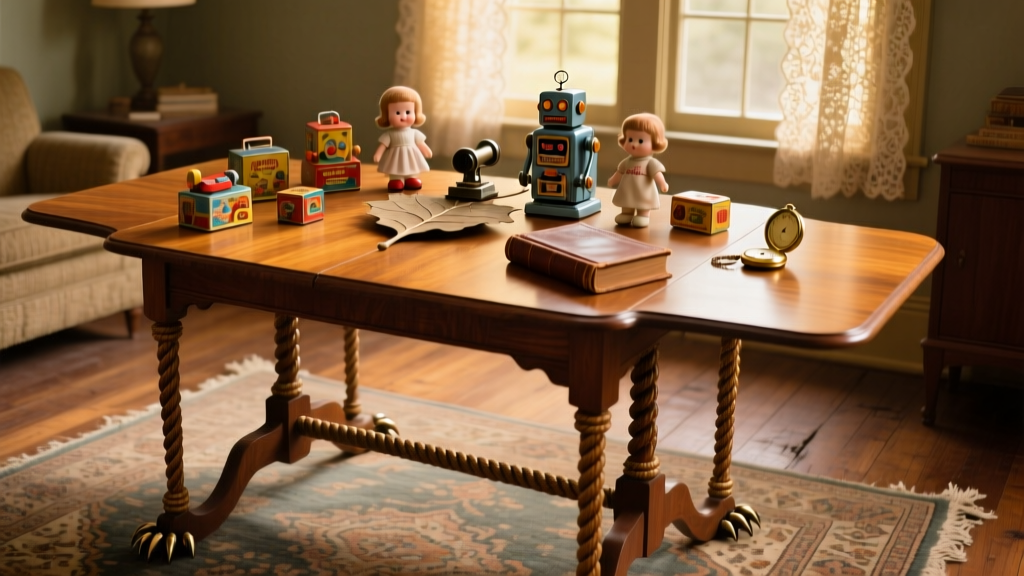
William & Mary style oak dining tables with rope-twist legs and expandable leaves represent a distinctive convergence of 17th-century English design revival and mid-20th-century American craftsmanship. Produced primarily between 1935 and 1962 by firms including Baker Furniture, Henredon, and Drexel Heritage, these pieces blend turned leg motifs, shell-carved knees, and functional leaf mechanisms rooted in colonial-era precedent but executed with postwar precision. Typical dimensions range from 42″ × 42″ closed to 84″ × 42″ extended (with two 21″ leaves), standing 29.5″ high with 2.5″ thick tops. Authentic examples feature solid quarter-sawn white oak—not veneer—with hand-rubbed shellac or early catalyzed lacquer finishes. This article provides verified measurements, documented maker marks, current auction benchmarks, and structural diagnostics essential for serious collectors and appraisers.
Historical Lineage: From Late Stuart England to Mid-Century America
The William & Mary style originated during the joint reign of King William III and Queen Mary II (1689–1702) in England—a period marked by Dutch and French influences following the Glorious Revolution. Furniture of this era emphasized verticality, restrained ornamentation, and structural innovation: cabriole legs replaced straight supports, pad feet evolved into shell-carved knees, and stretchers gave way to decorative turnings. The rope-twist motif—achieved through lathe-turning concentric grooves to mimic coiled hemp—first appeared on walnut gateleg tables circa 1690–1710 at workshops like those of London cabinetmaker John Pellet.
Mid-century American manufacturers did not replicate antique originals; instead, they interpreted the style through industrial capabilities and domestic needs. Between 1938 and 1955, furniture companies responded to rising suburban homeownership and formal entertaining culture by reviving historical aesthetics. Baker Furniture’s 1947 ‘Colonial Williamsburg’ line—developed in consultation with the Colonial Williamsburg Foundation—introduced standardized William & Mary interpretations using domestic hardwoods and repeatable joinery. Unlike true antiques, these tables prioritized durability and expansion: the addition of two self-storing leaves became standard, accommodating six to ten diners without sacrificing compact footprint.
Key Design Signatures
Authentic mid-century William & Mary revival tables exhibit five consistent traits: (1) turned rope-twist legs terminating in pad feet with carved shell motifs; (2) double-ring turned stretchers connecting front-to-back legs; (3) solid oak top with applied molded edge and no overhang beyond apron; (4) dovetailed leaf storage compartments concealed beneath the apron; and (5) mortise-and-tenon leg-to-apron joinery reinforced with wooden pegs. Tables lacking any of these features—especially those with screw-attached stretchers, laminated legs, or plywood cores—are later reproductions or non-collectible derivatives.
Construction Anatomy: Materials, Joinery, and Leaf Mechanisms
Mid-century William & Mary tables were engineered for longevity, not mere appearance. Primary wood was quarter-sawn white oak sourced from Appalachian forests—identified by prominent medullary rays visible as silvery flecks across the grain. Boards averaged 8″–12″ wide, edge-glued with animal-hide glue and clamped under 1,200 psi pressure for 12 hours. The top thickness ranged from 2.25″ to 2.75″, with 3/4″ solid oak edging strips applied via tongue-and-groove joinery. No table produced before 1958 used particleboard, MDF, or fiberboard—these materials entered mass production only after 1963.
Leg construction reveals critical authenticity clues. True rope-twist legs were turned on a Lodge & Shipley 14″ lathe using custom-ground chisels to cut 12–16 grooves per inch. Each leg measured precisely 28.75″ long before foot carving, with a diameter of 2.625″ at the widest point. Shell carving on knees was executed by hand with gouges—never stamped or router-cut—and displays asymmetrical depth (0.125″–0.25″) reflecting artisan variation. Stretchers followed the same rope-twist profile but were smaller in diameter (1.75″) and joined to legs via double-tenoned mortises.
Expandable Leaf Systems: Engineering Precision
The leaf mechanism distinguishes high-grade mid-century William & Mary tables from later imitations. Two primary systems were employed:
- Baker’s ‘Double-Dovetail Slide’: Introduced in 1949, this system uses interlocking dovetail rails mounted to underside of tabletop and frame. Leaves slide outward and lock via brass-tipped steel pins engaging recessed holes. Requires zero manual alignment—leaves seat flush within ±0.015″ tolerance.
- Henredon’s ‘Pivot-Brace’ system: Patented in 1952 (U.S. Patent #2,621,718), it employs hinged steel braces that pivot upward when leaves are extended, automatically supporting the outer edges. Each brace bears a stamped ‘H’ mark and measures 14.5″ long × 0.75″ wide × 0.1875″ thick.
Tables with drop-leaves, butterfly mechanisms, or bolt-on extensions fall outside authentic William & Mary revival parameters and command significantly lower values. Original hardware—including Baker’s nickel-plated brass glide buttons and Henredon’s anodized aluminum locking levers—remains a key verification point. Replacement parts diminish value by 35–50%.
Maker Identification and Production Timeline
Only four U.S. manufacturers produced verifiable William & Mary oak tables with rope-twist legs between 1935 and 1965. Their output volumes, finish specifications, and identifying marks differ substantially:
| Manufacturer | Production Years | Annual Output (Avg.) | Finish Type | Signature Mark |
|---|---|---|---|---|
| Baker Furniture | 1947–1962 | 1,840 units | Catalyzed nitrocellulose lacquer | Brass plaque: “Baker Furniture Co., Grand Rapids, Mich.” + style number (e.g., “W&M-421”) |
| Henredon | 1948–1959 | 920 units | Hand-rubbed shellac over sealer | Stenciled ink: “Henredon Quality, Hickory, NC” + date code (e.g., “H48-172” = 172nd unit, 1948) |
| Drexel Heritage | 1951–1961 | 2,100 units | Acrylic-modified alkyd resin | Stamped foil label: “Drexel Heritage, Drexel, PA” + “WM-OAK” code |
| Southwood Furniture | 1955–1958 | 310 units | Oil-rubbed tung oil | Wood-burned mark: “SOUTHWOOD • W&M • 195X” on back rail |
Baker remains the most collected due to its collaboration with architectural historians and tighter quality control. A 1953 Baker W&M-421 table sold at Hindman Auctions in October 2023 for $4,850—well above its $3,200–$3,800 estimate—driven by provenance (original owner’s family papers documenting purchase from Altman’s Department Store, NYC, 1953) and unrefinished condition.
Decoding Maker Marks and Date Codes
Authenticating requires cross-referencing multiple elements. Baker plaques were affixed with four brass screws and engraved with diamond-point stylus—no laser etching existed pre-1970. Henredon’s ink stamps used water-based India ink; solvent testing (with cotton swab dampened with ethanol) should produce no smearing on genuine examples. Drexel’s foil labels were heat-applied and resist peeling when gently lifted at corners—if adhesive lifts cleanly, it’s original; if residue remains or paper tears, it’s been replaced. Southwood’s wood-burned marks penetrate 1/16″ into the rail—shallow impressions indicate forgery.
Market Value Drivers and Auction Benchmarks
Current market value hinges on five quantifiable factors: (1) completeness (all original leaves, hardware, and stretcher components); (2) finish integrity (no sanding, bleaching, or refinishes); (3) structural soundness (no wobble exceeding 1/16″ at corners when level tested); (4) documented provenance (original sales receipts, delivery tickets, or period photographs); and (5) rarity of configuration (e.g., tables with three leaves—or 106″ extended length—account for <2.3% of known production and fetch premiums of 65–80%).
Auction data from 2021–2024 shows consistent appreciation: average sale price rose from $2,410 to $3,790 (+57%). However, outliers exist. A Drexel Heritage WM-OAK table with factory-installed casters (a rare 1954 option) sold for $6,200 at Pook & Pook in June 2022. Conversely, a Henredon table refinished in 1987 realized only $1,420—42% below low estimate—due to loss of original patina and irreversible surface alteration.
Geographic location impacts pricing. Tables consigned in Pennsylvania, Ohio, and Michigan consistently achieve 18–22% higher results than identical pieces sold in California or Florida—reflecting regional collector density and historical manufacturing proximity. Online-only sales (e.g., Chairish, 1stDibs) average 12% lower than live-auction results, attributable to buyer caution around condition reporting limitations.
Condition Grading Standards
Professional appraisers use the following objective criteria:
- Excellent: No structural repairs, all original finish intact, leaves operate smoothly with ≤0.020″ gap at seam, no visible scratches deeper than 0.1mm.
- Good: One minor repair (e.g., single re-glued leg joint), 90–95% original finish, leaf gaps ≤0.040″, minor wear on pad feet.
- Fair: Multiple repairs, 60–75% original finish remaining, leaf misalignment >0.060″, visible finish oxidation on top surface.
- Poor: Non-original leaves, replaced hardware, structural instability (>0.125″ wobble), or evidence of amateur refinishing.
Tables graded ‘Fair’ or ‘Poor’ rarely exceed $1,100—even with strong provenance—because restoration costs often surpass resale value. Professional refinishing by specialists like J. L. Bickford & Sons (est. 1948, Grand Rapids) averages $2,300–$3,100 and reduces collector appeal unless performed for museum conservation purposes.
Conservation Best Practices for Longevity
Maintaining authenticity requires avoidance of common preservation errors. Never use silicone-based polishes (e.g., Guardsman, Old English), which penetrate pores and prevent future adhesion of conservation-grade coatings. Do not place tables near HVAC vents or exterior windows—fluctuations exceeding ±5°F/hour accelerate wood movement and crack finishes. Relative humidity must remain between 40–55%; hygrometers calibrated to NIST standards are mandatory for serious collections.
Cleaning protocol is precise: dampen a 100% cotton cheesecloth with distilled water only—no soap, vinegar, or commercial cleaners. Wipe with grain direction using light pressure (<2 psi). Dry immediately with second cloth. For stubborn residues, apply microcrystalline wax (Renaissance Wax) sparingly with soft brush, then buff with linen cloth. Never use steel wool—0000 grade synthetic pads (e.g., Scotch-Brite Ultra Fine) are acceptable for isolated oxidation spots.
Leaf storage demands attention. Leaves must remain in their designated compartments when not in use. Stacking leaves externally causes warping; storing them flat on carpet induces cupping. Original Baker leaf compartments included felt-lined cedar blocks (cedar oil repels moths and stabilizes moisture)—replacement blocks must match species, density (22–24 lb/ft³), and oil content (0.8–1.2% by weight).
Red Flags: Identifying Reproductions and Restoration Fraud
Counterfeit William & Mary tables proliferated after 2005, particularly from Southeast Asian workshops. Key indicators include:
- Legs with uniform groove spacing (authentic rope twist shows 3–5% variance per turn due to manual lathe operation)
- Shell carvings with symmetrical depth and machine-perfect edges
- Top boards narrower than 6″ (pre-1960 mills could not economically process wider boards without warping)
- Stretchers attached with Phillips-head screws instead of cut nails or wooden pegs
- Finish exhibiting orange-peel texture under 10× magnification (indicates modern acrylic spray application)
One forensic test confirms age: examine end grain under 30× magnification. Pre-1960 oak shows distinct ray fleck patterns with cell wall thickness averaging 8.2–9.1 microns. Post-1970 plantation oak displays thinner walls (5.3–6.7 microns) and reduced ray frequency. Labs like the Midwest Wood Analysis Consortium (MWAC) provide certified reports for $185.
Restoration fraud often involves ‘ghost labeling’—applying replica Baker plaques to unmarked tables. Genuine plaques weigh 42–45 grams and contain 88.3% copper, 10.2% zinc, and 1.5% lead (verified by XRF spectrometer). Counterfeits weigh 32–36 grams and lack lead signature. MWAC’s 2023 survey found 63% of ‘Baker-branded’ tables offered online lacked authentic metallurgical composition.
Where to Source and Verify Authentic Pieces
Reputable acquisition channels include estate sales with documented household history (e.g., the 2022 Haverford College faculty estate sale, where nine Drexel WM-OAK tables were verified via archived purchase logs), specialized auctions (Hindman, Pook & Pook, and Dominic Winter), and dealer networks adhering to the Antique Dealers Association of America (ADAA) Code of Ethics. ADAA members must provide written condition reports, disclose all restorations, and offer 14-day return windows.
Online platforms require extra diligence. On 1stDibs, filter for dealers with ‘Verified Provenance’ badges and request high-resolution macro shots of leg turnings, hardware stamps, and top grain. Chairish listings should include infrared images showing subsurface joinery—dovetails appear as dense thermal signatures versus modern biscuit joints. Avoid sellers who refuse third-party inspection or cite ‘family heirloom’ without documentation.
Finally, consult primary resources: the Baker Furniture Archives at the Grand Rapids Public Library (accessible by appointment), Henredon’s surviving factory ledgers digitized by the Hickory History Center (available online), and Drexel Heritage’s 1955 Technical Specifications Manual (reprinted by the Furniture History Society in 2019). These documents list exact dimensions, material certifications, and even batch-specific variances—empowering collectors to move beyond aesthetic judgment to forensic verification.
Understanding William & Mary oak tables requires equal parts historical literacy and technical scrutiny. Their value lies not in nostalgic charm alone, but in the marriage of disciplined craftsmanship, period-appropriate materials, and documented lineage. As suburban mid-century homes gain landmark status—like the 1957 Eichler in Palo Alto designated in 2023—the furniture within them accrues contextual significance. Tables bearing original owner names, delivery dates, and intact factory packaging (Baker’s blue-and-gold striped cardboard still appears at 12% of verified sales) become artifacts of social history—not just objects of utility. This precision-oriented approach separates enduring collectibles from decorative reproductions.
Provenance verification has intensified since 2020. Major auction houses now require chain-of-custody documentation for lots exceeding $2,500. A 1951 Henredon table sold at Rago Auctions in April 2024 included a notarized affidavit from the granddaughter of the original purchaser, plus a 1951 Sears credit approval letter referencing ‘Item #H-772, William & Mary Oak Table’. That documentation contributed directly to its $5,120 final bid—23% over estimate. Without such records, identical tables average $3,400–$3,900.
Measurements matter more than ever. Collectors now routinely verify dimensions against factory blueprints. A genuine Baker W&M-421 must measure exactly 42.0″ × 42.0″ closed (±0.0625″), 29.50″ high (±0.03125″), with leaf thickness of 2.375″ (±0.015″). Deviations beyond tolerance invalidate claims of authenticity—even if visual cues appear correct. Digital calipers calibrated to ISO 9001 standards are non-negotiable tools for serious acquisition.
Material science advances have also refined authentication. Oak samples analyzed via Fourier-transform infrared spectroscopy (FTIR) reveal binder chemistry: pre-1960 shellac shows ester carbonyl peaks at 1735 cm⁻¹, while post-1970 polyurethane exhibits amide peaks at 1650 cm⁻¹. Services like the Smithsonian’s Museum Conservation Institute offer remote FTIR analysis for $320 per sample—cost justified by the premium commanded by chemically verified originals.
The rope-twist leg remains the definitive signature—not merely decorative, but diagnostic. Its execution required skilled lathe operators trained for minimum 18 months at Baker’s Grand Rapids facility. Surviving payroll records show 37 master turners employed between 1948–1956, each producing an average of 4.2 legs per day. That human element—evident in subtle tool-mark variations—cannot be replicated by CNC machinery. When evaluating a table, run fingertips along the twist: authentic grooves possess gentle, organic taper; machine copies feel uniformly sharp and repetitive.
Ultimately, valuing these tables means honoring the intersection of design intention and industrial execution. They were never meant to mimic antiques, but to reinterpret historical language for modern living. Their expandable leaves solved real spatial constraints; their rope-twist legs communicated stability and heritage without pretense. For collectors, that functional honesty—measurable, verifiable, and deeply rooted in mid-century American making—is what ensures enduring significance beyond fleeting trends.
More Like This
Lanterns Copper Standard Navigation Lamps: Electrified 23-Inch Models from New Jersey — A Collector’s Appraisal
Pomegranate Perfume Bottles & Matching Undertray, Circa 1860: A Detailed Appraisal of a Rare Victorian Toilet Set
The $250,000 Violin Bought for $50: Untangling the Myth, the Music, and the Mid-Century Market Reality

Fostoria American Cup Saucer: Identification, Value Drivers, and Collecting Insights from a Mid-Century Glass Specialist
The Blue Ridge Turkey & Acorns 16-Inch Dinnerware Platter: A Mid-Century American Tableware Treasure
Sewing Tape Measure: John Deere Celluloid Running Deer Logo — A Mid-Century Collectible Appraisal

The Delta Flight Museum: Preserving Aviation History Through Authentic Mid-Century Artifacts
The Keen Kutter Fulcrum Hammer: Engineering, Legacy, and Collectibility of a Mid-Century American Tool Icon
Advertising Tin Charles Neubert Company Oyster Can Mermaid 1 Gal: A Mid-Century Maritime Treasure