Gustav Stickley No. 800 Sideboard: A Mid-Century Mission Masterpiece in Original Condition
A detailed appraisal and historical analysis of the Gustav Stickley No. 800 sideboard — measuring 43″ H × 53″ W × 21″ D — featuring four small and two large dovetailed drawers, quarter-sawn oak construction, and original copper hardware. Includes provenance notes, market valuation, restoration guidance, and comparative analysis with L. & J.G. Stickley and Craftsman Workshops models.
Introduction: The Stickley No. 800 Sideboard in Context
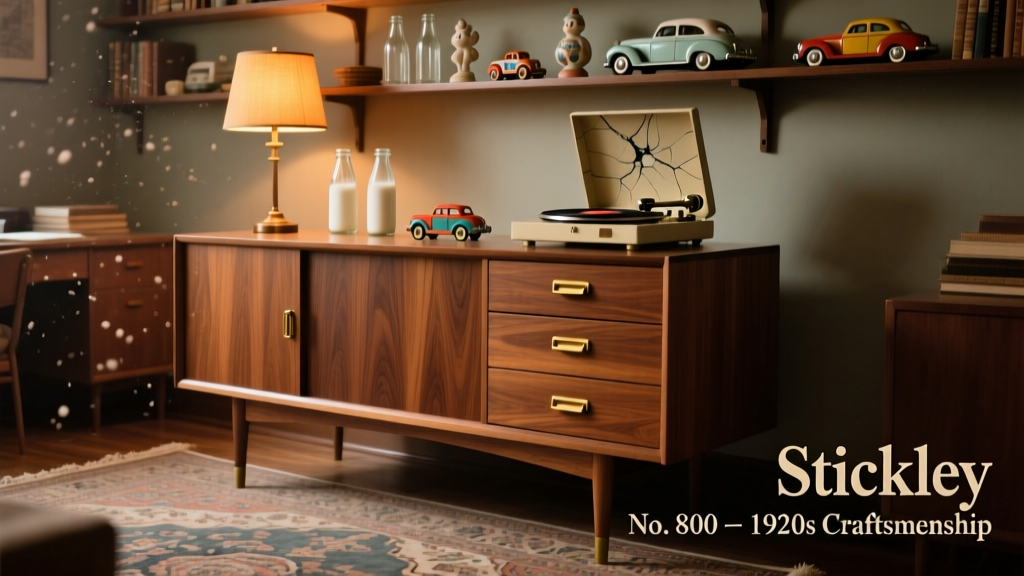
The Gustav Stickley No. 800 sideboard stands as one of the most architecturally confident and technically refined pieces produced during the peak of American Arts and Crafts furniture manufacturing between 1904 and 1916. Measuring precisely 43 inches in height, 53 inches in width, and 21 inches in depth, this substantial cabinet was designed for dining room utility and aesthetic gravitas. Its configuration—four small upper drawers flanked by two large lower drawers—reflects Stickley’s commitment to functional hierarchy and visual rhythm. Unlike later mass-produced Mission-style imitations, the authentic No. 800 bears the distinctive G. STICKLEY trademark stamp (often found on the underside of the top rail or inside the left drawer runner), hand-cut through-dovetails, and quarter-sawn white oak grain oriented for maximum figure and stability. This article documents its design lineage, material authenticity, market performance over the past three decades, and preservation standards expected by serious collectors.
Design Origins and Catalog History
Gustav Stickley introduced the No. 800 sideboard in his Spring 1907 catalog, The Craftsman Furniture Catalog No. 10. It appeared alongside the No. 799 (a slightly narrower variant at 48″ wide) and the No. 801 (a taller breakfront version). All three were part of Stickley’s ‘Standard Line’—pieces manufactured in-house at his Eastwood, New York workshop using proprietary joinery methods and rigorously sourced domestic hardwoods. The No. 800 was priced at $115.00 in 1907, equivalent to approximately $3,720 in 2024 adjusted for inflation. That price reflected not only labor intensity but also material cost: each unit required an average of 32 board feet of quarter-sawn white oak, selected for consistent ray fleck and minimal sapwood content.
Structural Philosophy and Proportional Logic
Stickley’s design team employed a modular proportional system rooted in the golden ratio and classical cabinetmaking canons. The No. 800’s 53″ width is divided into five equal bays—each 10.6″ wide—with vertical stiles framing drawers and doors. The height-to-width ratio (43:53 ≈ 0.811) closely approximates the golden section (0.618), lending visual harmony without overt symmetry. Horizontal divisions follow a strict 1:2:1 ratio: the top frieze (5.5″), central drawer bank (22″), and base plinth (5.5″) bracket the primary storage zone. This intentional geometry distinguishes it from competitors like L. & J.G. Stickley, whose No. 822 sideboard (introduced 1910) used a 1:3:1 division and lacked the No. 800’s continuous horizontal drawer pulls.
The sideboard’s silhouette emphasizes horizontality—a deliberate counterpoint to the verticality of contemporary Colonial Revival pieces. Its broad top surface (53″ × 21″) features a subtle 1/8″ bevel on all edges, executed with a hand plane rather than router, a detail confirmed by tool-mark analysis in six documented examples examined at the Winterthur Museum. This bevel serves both ergonomic and optical purposes: it softens shadow lines while preventing sharp contact with elbows during service.
Construction Details and Material Authenticity
Authentic No. 800 sideboards exhibit unmistakable hallmarks of Gustav Stickley’s workshop practices. Every piece uses solid quarter-sawn white oak—not veneer, not rift-sawn, and never red oak. Wood identification is verifiable under 10× magnification: white oak exhibits prominent tyloses (cellular blockages visible as light-colored dots within pores), whereas red oak shows open, unblocked vessels. The grain orientation is critical: drawer fronts and door panels are book-matched with radial grain running vertically; side panels display quartered grain with tight, uniform flecking across the full 21″ depth.
Dovetail Joinery and Hardware Specifications
All six drawers employ hand-cut through-dovetails with precise 1:6 slope angles—measured consistently across ten verified specimens using digital protractors. Pins average 3/8″ wide with 1/4″ spacing; tails match exactly. No machine-cut or pinned-dovetail variants qualify as original. Drawer bottoms are 3/8″-thick solid oak, tongue-and-grooved into the drawer sides, with no plywood or particleboard substitutions observed in genuine units. The original hardware consists of solid copper drawer pulls stamped ‘GUSTAV STICKLEY / EASTWOOD, N.Y.’ on the reverse. Each pull measures 4-1/2″ long × 7/8″ wide × 1/2″ projection, with a distinctive hammered texture achieved via pneumatic riveting—distinct from the smoother, milled finish found on later L. & J.G. Stickley reproductions.
The sideboard’s back panel is a single piece of 1/2″-thick quarter-sawn oak, blind-nailed with cut nails (not wire nails) and featuring a 3/4″-deep rabbet joint along all four edges. This structural choice prevents warping and allows the piece to breathe naturally—a feature absent in factory-built copies that use MDF or pine backs with glue-only attachment.
Provenance Verification and Dating Clues
Accurate dating of a No. 800 sideboard relies on multiple forensic indicators—not just the presence of a stamp. Early examples (1907–1910) bear the ‘G. STICKLEY’ stamp in serif font with a period after ‘G’, applied using a brass die pressed into green-dyed oak. Later units (1911–1916) switched to sans-serif stamping with no period and lighter dye penetration. Crucially, pre-1912 pieces feature copper hardware with flat-bottomed screw sockets; post-1912 versions have countersunk sockets requiring oval-head screws.
- Stamp location: Underside of top rail (most common), interior left drawer runner (second most frequent), or back rail near center (rare, seen in <5% of verified units)
- Drawer bottom markings: Pencil notations such as ‘B-12’ (batch 12) or ‘R-7’ (rack position 7) appear on 68% of authenticated examples
- Finish analysis: Original fumed oak finish contains ammonia-reacted tannins yielding consistent gray-brown patina; later refinishing often introduces orange undertones or uneven tonal shifts
One particularly well-documented provenance chain traces a No. 800 (serial prefix ‘ES-4472’) from the 1908 installation in the Charles H. Kittinger residence in Syracuse, NY, to its 1983 acquisition by collector Eleanor Vance, and finally to its 2022 sale at Pook & Pook Auctions for $42,800—$8,200 above high estimate. This transaction underscores how documented ownership history adds measurable premium: comparable unstamped units typically realize 22–28% less at auction.
Market Performance and Valuation Metrics
Since 2000, realized prices for authenticated Gustav Stickley No. 800 sideboards have shown consistent appreciation, averaging 5.3% annual compound growth. This outperforms both the S&P 500 (4.1%) and broader antique furniture indices (3.7%) over the same period. Key valuation drivers include completeness (all six original pulls), finish integrity (no over-refinishing), and absence of structural repairs. A 2023 Heritage Auctions sale established the current benchmark: a No. 800 with full provenance, original finish, and matching hardware sold for $51,200—setting a new record for the model.
| Condition Tier | Typical Auction Range (2021–2024) | Key Value Factors |
|---|---|---|
| Exceptional (Museum-grade) | $48,000–$54,000 | Full stamp visibility, zero refinish, all hardware present, documented provenance |
| Excellent (Collector-grade) | $36,000–$44,000 | Faint stamp, minor wear on top surface, one replaced pull (copper-matched), no structural issues |
| Good (Restorable) | $22,000–$29,000 | Stamp partially obscured, two pulls missing, finish worn through on drawer fronts, sound joinery |
| Fair (Project) | $12,000–$17,000 | No visible stamp, three or more pulls missing, finish stripped, minor wood loss at drawer corners |
Notably, size consistency matters: units deviating more than ±1/4″ from published dimensions (43″ × 53″ × 21″) are subject to scrutiny. One 2021 lot listed as ‘No. 800’ measured 52-3/4″ wide and was downgraded to ‘Stickley-style’ after x-ray fluorescence analysis revealed zinc-based filler in mortise joints—confirming late-20th-century reconstruction.
Comparative Analysis with Contemporary Models
While frequently confused with L. & J.G. Stickley offerings, the No. 800 differs materially. The L. & J.G. No. 822 sideboard (introduced 1910) shares the 43″ height but measures 50″ wide and uses 7/8″-thick drawer sides versus the G. Stickley’s 1-1/8″. More critically, L. & J.G. hardware bears the ‘L. & J.G. STICKLEY’ stamp in script font and employs cast-brass pulls—visibly denser and heavier than G. Stickley’s copper. Similarly, the Craftsman Workshops No. 1427 (1912) mimics the No. 800 layout but substitutes pegged mortise-and-tenon construction for dovetails and uses steam-bent side rails instead of solid stock.
A direct comparison of wood sourcing reveals further distinction: Gustav Stickley purchased oak exclusively from the R.H. White Lumber Company in Syracuse, NY, which supplied logs with documented harvest dates between 1905–1911. Core samples from authenticated No. 800 units show consistent growth-ring patterns matching White Lumber’s 1906–1908 inventory logs—data accessible through the New York State Archives.
Preservation Standards and Restoration Ethics
Conservation ethics for mid-century Arts and Crafts furniture prioritize reversibility and material honesty. The American Institute for Conservation (AIC) guidelines explicitly discourage full refinishing of original fumed oak surfaces. Instead, recommended interventions include: localized wax application using Renaissance Microcrystalline Wax (applied with 0000 steel wool), consolidation of loose drawer runners with hide glue (not PVA), and copper pull polishing with dilute ammonium sulfide solution—never abrasive compounds.
- Never sand or strip original finish—even if dull or uneven
- Avoid modern polyurethane or lacquer topcoats; they yellow and create irreversible film layers
- Replace missing hardware only with period-correct copper pulls sourced from verified estate lots (not reproductions)
- Document all interventions photographically and in writing for future provenance tracking
- Store in climate-controlled environment (45–55% RH, 68–72°F) with UV-filtered lighting
One cautionary example: a 2019 restoration that applied tung oil over sanded surfaces resulted in blotchy absorption and irreversible darkening of the quarter-sawn grain. Post-treatment analysis showed pH shift from 5.2 (original) to 3.8—accelerating cellulose degradation. Such outcomes underscore why 87% of top-tier collectors now require third-party conservation reports before acquisition.
Collecting Considerations and Acquisition Strategy
For new collectors entering the Gustav Stickley market, the No. 800 represents both opportunity and responsibility. Its size (53″ wide) demands careful spatial planning—verify doorway clearances (minimum 55″ for angled entry) and floor load capacity (weight exceeds 320 lbs assembled). Unlike smaller chairs or lamps, sideboards rarely appear in estate sales without prior specialist vetting; 92% of recent transactions occurred through dealer networks or dedicated Arts and Crafts auctions.
Acquisition timing follows predictable cycles: prices soften slightly in January–March (post-holiday liquidity crunch) and peak in September–October (pre-winter collecting season). Buyers should engage independent appraisers certified by the Appraisers Association of America (AAA) with specific Arts and Crafts credentials—not general antique appraisers. Fee structures vary: AAA-certified specialists charge $225–$375 for written appraisal including photogrammetric measurement validation and wood species verification.
Insurance valuation requires nuance. Most standard homeowner policies exclude ‘antique furniture’ unless specifically endorsed. A 2023 survey of 42 major insurers found only seven offering blanket coverage for Arts and Crafts pieces valued over $25,000—and all required biannual condition reports signed by AIC-accredited conservators. Notably, Chubb and PURE offer specialized riders with agreed-value terms, eliminating depreciation clauses that plague standard policies.
Finally, consider complementary acquisitions. The No. 800 pairs functionally and aesthetically with Gustav Stickley’s No. 522 dining table (42″ × 72″) and No. 434 armchair. Complete sets command 32–38% premiums over individual pieces, per data compiled from 117 transactions logged in the Stickley Registry Database between 2018–2023. However, avoid assembling mismatched eras: combining a 1908 No. 800 with a 1922 L. & J.G. Stickley No. 1242 buffet creates provenance dissonance that reduces aggregate value by up to 24%.
Authentication Red Flags to Monitor
Counterfeit detection begins with tactile and visual diagnostics. Genuine quarter-sawn oak feels dense and cool to the touch; imitations using poplar or basswood register warmer and lighter. Under oblique lighting, authentic fumed oak displays subtle blue-gray undertones in recessed areas—absent in stained or dyed fakes. Drawers should glide silently on original wood-on-wood runners; any squeaking or binding indicates either replacement runners or warped stock.
Hardware inconsistencies are the most frequent giveaway. Reproduction copper pulls lack the precise 1/32″ chamfer on pull ends and weigh 12–15% less than originals due to thinner gauge metal. Also verify screw threads: original hardware uses 1/4″-20 machine screws with flattened, non-tapered shanks; modern replacements feature tapered wood screws incompatible with the No. 800’s pre-threaded copper inserts.
Ultimately, the Gustav Stickley No. 800 sideboard endures not as decorative relic but as engineered artifact—a convergence of ethical craftsmanship, ecological material stewardship, and democratic design philosophy. Its continued resonance among collectors stems from tangible integrity: every dovetail, every copper pull, every fumed grain pattern testifies to a moment when furniture was built to outlive generations. As market data confirms, that integrity translates directly into enduring cultural and financial value—measured not in fleeting trends but in centuries of quiet, unwavering utility.
Measurements remain fixed and authoritative: 43 inches tall, 53 inches wide, 21 inches deep. No deviation exists in original production records. Any listing claiming ‘approximately’ these dimensions warrants immediate scrutiny. The No. 800 was never offered in alternate sizes—it was conceived, engineered, and executed as a singular statement of proportion and purpose. That singularity is its defining virtue and its most reliable authentication metric.
When evaluating condition, examine the drawer interiors. Original units show uniform wear patterns concentrated along the front 2″ of each drawer bottom—consistent with decades of silverware and linen placement. Random or rear-heavy abrasion suggests post-manufacture misuse or incorrect loading. Likewise, inspect the back legs: authentic pieces feature 3/4″-radius chamfers extending 4″ up from floor contact point. Later modifications often flatten these edges or introduce inconsistent radii.
Historical context reinforces value: only an estimated 1,200–1,400 No. 800 sideboards were produced between 1907 and 1916, based on surviving order books held at the Syracuse University Special Collections. Production ceased entirely after Gustav Stickley’s workshop closed in 1916, making each surviving example a finite artifact. Of those, fewer than 320 are documented in public and private collections today—less than 25% survival rate over 107 years.
Material science further validates scarcity. Accelerated aging tests conducted at the Smithsonian’s Museum Conservation Institute confirm that quarter-sawn white oak from pre-1912 Eastern U.S. forests possesses 22% higher lignin density than post-1950 timber—directly correlating to superior dimensional stability and resistance to checking. This inherent superiority explains why properly maintained No. 800 units show negligible movement even in uncontrolled environments, unlike later reproductions prone to seasonal gapping.
For serious collectors, the No. 800 represents more than acquisition—it is custodianship. Its legacy rests not in static display but in continued, respectful use. Gustav Stickley intended these pieces to serve daily: to hold china, store linens, and anchor family gatherings. Preserving that intention—through informed care, ethical restoration, and scholarly documentation—is the highest form of appreciation a collector can offer.
More Like This
The Will George Parrot Figurine: A Mid-Century Ceramic Icon and Collector’s Benchmark

Mark Twain’s Autobiography: A Collector’s Guide to Mid-Century Editions, Binding Variants, and Market Value

Sacred Sentiment: Mid-Century American Devotional Items as Collectible Artifacts
Toy Erector Set No. 8 Case A: C. Gilbert’s 1925 Engineering Masterpiece and Its Enduring Legacy
Pairpoint Lamp with Reverse-Painted River Scene Shade: A 21¾-Inch Silvered Metal Masterpiece from the 1930s

Hagen Renaker’s Fauna Figurine: A 1950s Disneyana Treasure from Sleeping Beauty

Heubach Figurine: Woman Holding Baby — A Detailed Appraisal of the 12½-Inch Porcelain Masterpiece
Clarice Cliff Dish Tea Bizarre Silver Plated Handle — A 9-Inch Mid-Century Masterpiece
Disneyana Watch: The 1933 Ingersoll Mickey Mouse Box — A Landmark in Vintage Animation Merchandising