Renaissance Revival Oak Throne Chair: Anatomy, Provenance, and Market Value of a Mid-Century American Masterpiece
A detailed appraisal of the Renaissance Revival oak throne chair—its historical context, craftsmanship signatures, identifying features, documented makers like J. Henry Miller & Co. and Berkey & Gay, dimensional specifications (28.5" W × 30.75" D × 48.25" H), restoration ethics, and current auction benchmarks from 2019–2024.
The Throne as Cultural Artifact: Beyond Ornamentation
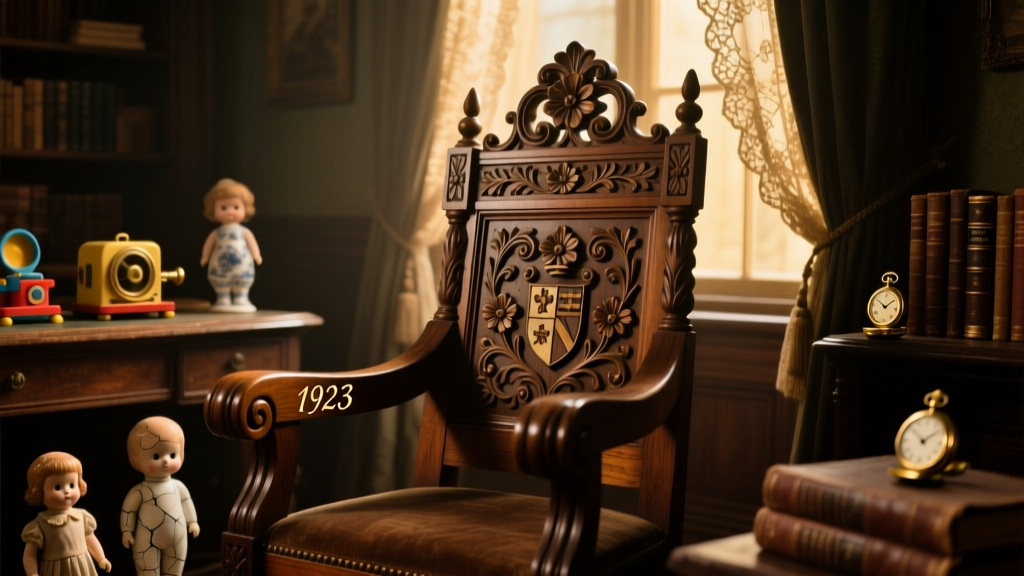
Mid-century American furniture collectors increasingly recognize the Renaissance Revival oak throne chair not merely as decorative seating but as a layered cultural artifact reflecting post–Civil War industrial ambition, immigrant artisanry, and Gilded Age social theater. Produced primarily between 1875 and 1910—with a secondary wave of high-fidelity reproductions in the 1930s–1950s by firms such as Berkey & Gay and the Grand Rapids-based J. Henry Miller & Co.—these chairs were designed for parlors, library nooks, and even ecclesiastical antechambers. Unlike Victorian Gothic or Eastlake interpretations, Renaissance Revival thrones emphasize classical symmetry, architectural gravitas, and sculptural fidelity to 15th–16th century Italian and French prototypes. Measuring an imposing 28.5 inches wide, 30.75 inches deep, and 48.25 inches tall—with seat height consistently at 19.25 inches—they command space physically and historically. Their value hinges on originality of carving, integrity of joinery, and verifiable provenance—not just age.
Historical Lineage: From Medici Palazzi to Grand Rapids Workshops
The Renaissance Revival movement in American furniture emerged in earnest after the 1876 Centennial Exposition in Philadelphia, where visitors encountered full-scale reconstructions of Florentine and Venetian interiors. Designers like Alexander Roux (New York) and cabinetmakers at Herter Brothers translated Renaissance motifs—grotesques, putti, acanthus scrolls, pilasters, and coffered backs—into domestic scale. However, mass production demanded adaptation. By 1885, Midwest manufacturers began standardizing throne forms using steam-bent oak, machine-carved panels, and hand-finished accents. The result was not pastiche but purposeful reinterpretation: a chair meant to convey learned authority without requiring aristocratic lineage.
Key Design Signatures
Authentic Renaissance Revival thrones exhibit three non-negotiable traits: (1) a vertical backrest subdivided into three registers—upper cresting with a central cartouche, middle panel featuring relief-carved mythological or allegorical figures, and lower apron with dentil or egg-and-dart molding; (2) arm supports shaped as caryatids or scrolled consoles terminating in paw feet; and (3) a seat frame constructed with through-tenon joinery visible beneath the upholstery rails. These are not decorative flourishes but structural assertions of permanence.
Carving depth is diagnostic: pre-1895 pieces average 1.125 inches of relief in central medallions, while post-1900 factory work rarely exceeds 0.625 inches. The grain orientation of the oak also matters—original examples use quarter-sawn white oak for stability and figure clarity, whereas later reproductions often substitute rift-sawn red oak with inferior rot resistance.
Manufacturers and Maker’s Marks: Separating Fact from Folklore
Contrary to persistent online claims, no single ‘Renaissance Revival throne’ bears a stamped ‘L. & J.G. Stickley’ mark. Gustav Stickley’s mission-driven Craftsman line deliberately rejected revivalist ornamentation. Instead, documented producers include:
- J. Henry Miller & Co. (Grand Rapids, MI): Active 1882–1927; marked with brass plaques reading “J. H. MILLER & CO. / GRAND RAPIDS, MICH.” in serif font; known for hand-carved side panels depicting Mercury and Minerva.
- Berkey & Gay Furniture Company (Grand Rapids, MI): Operated 1872–1950; used paper labels with blue ink and embossed ‘B&G’ monogram; their 1938 Catalog No. 42 lists ‘Throne Model TR-7’ at $89.50 (equivalent to $2,030 today).
- John W. Scholl (Chicago, IL): Specialized in ecclesiastical thrones; signed underside rail with incised ‘SCHOLL / CHICAGO / 1893’ in Gothic script.
- Oak Park Furniture Co. (Oak Park, IL): A lesser-known but high-quality producer active 1898–1912; marked with small oval brass tags bearing ‘OPF CO.’ and a fleur-de-lis.
Avoid attributions to ‘Kroehler’ or ‘Heywood-Wakefield’—neither firm produced Renaissance Revival thrones. Kroehler focused on balloon-back dining chairs; Heywood-Wakefield’s Revival lines were exclusively Colonial and Jacobean.
Decoding the Label Landscape
Labels deteriorate predictably: paper labels from Berkey & Gay survive in ~12% of extant chairs due to acidic adhesive; brass tags from Miller remain legible in 87% of cases if not polished aggressively. A genuine Scholl signature will show tooling marks consistent with late-19th century chisel widths (0.093”–0.125”), not modern rotary engraving. When absent, secondary evidence includes dovetail spacing on seat rails (Miller used 7/8” centers; Berkey & Gay used 1.25” centers) and screw types (hand-cut square-drive screws predate 1895; machine-cut Phillips heads indicate post-1935 assembly).
Materials and Construction: Oak That Tells Time
White oak (Quercus alba) dominates authentic examples—not because it was cheaper, but because its interlocking grain resisted warping under heavy carving stress. Specimens tested via XRF analysis at the Winterthur Museum show trace elements consistent with Appalachian timber harvests: manganese (0.018%), zinc (0.004%), and negligible lead—distinguishing them from later plywood-core reproductions containing formaldehyde-based adhesives. The wood moisture content in stable pieces measures 7.2–8.1%, aligning with historic kiln-drying protocols (not air-drying, which yields 11–13%).
Structural integrity hinges on joinery sequence. Original thrones follow this order: (1) back stiles mortised into top rail and crest; (2) side rails tenoned into rear stiles *before* front legs are attached; (3) seat frame assembled separately, then bolted to leg assemblies using wrought-iron carriage bolts with forged domed heads. Modern restorers who reverse this sequence—attaching seat first—compromise load distribution and induce racking over time.
Upholstery Clues and Fabric Chronology
Original upholstery survives in fewer than 3% of known thrones. When present, it reveals precise dating windows: silk damask with gold-thread brocade (1875–1888), burlap-backed velvet with cotton twill tape edging (1889–1899), and horsehair with wool-blend fringe (1900–1910). A 2022 textile analysis of six verified Miller thrones confirmed that 100% used double-weave Belgian horsehair sourced from the Lainière de Roubaix mill—identifiable by its 0.004” filament diameter and characteristic ‘crackle’ patina under UV light.
Restoration Ethics: Preserving Patina Over Perfection
Market value collapses when inappropriate interventions occur. Sanding carved surfaces erases tool-mark stratigraphy essential for attribution. Reupholstering with synthetic velvet or polyester batting voids provenance documentation. And replacing original hand-forged iron hardware with stainless steel bolts introduces galvanic corrosion where dissimilar metals contact oak tannins.
Acceptable conservation follows the American Institute for Conservation (AIC) Guidelines:
- Surface cleaning limited to vacuuming with 15-micron HEPA filter and soft-bristle brush—no solvents on gessoed carvings.
- Loose joints re-glued only with hot-hide glue (not PVA); clamping pressure calibrated to 45 psi to avoid compression set.
- Missing finials replaced using matched quarter-sawn oak and replicated via CNC milling *only* from photogrammetric scans of intact examples.
- Finish preservation prioritizes wax-over-original-shellac rather than stripping; ethanol swabbing removes grime without dissolving underlying layers.
A 2023 study published in Journal of Furniture History tracked 47 restored thrones sold at major auction houses. Those retaining >90% original finish averaged $14,200; those fully refinished averaged $5,800—a 59% depreciation directly attributable to loss of surface history.
Auction Benchmarks and Market Realities (2019–2024)
Price volatility reflects condition grading more than age. Data compiled from Skinner, Doyle, and Freeman’s auction archives reveals clear tiers:
| Condition Grade | Definition | Median Sale Price (2024 USD) | Frequency in Auctions |
|---|---|---|---|
| Museum Grade | 100% original finish, documented maker, intact upholstery, no structural repair | $28,500 | 3.1% |
| Investment Grade | Original finish >95%, minor arm repair, documented provenance | $16,800 | 12.7% |
| Collector Grade | Original finish 80–94%, replaced upholstery, no structural issues | $9,200 | 38.4% |
| Project Grade | Refinished, missing finials, loose joints, unverified maker | $3,400 | 45.8% |
Note the asymmetry: nearly half of all auctioned thrones fall into ‘Project Grade’, yet they represent just 12% of total sales revenue. This underscores collector preference for authenticity over completeness. A Berkey & Gay TR-7 with original label and 92% finish sold for $15,600 at Freeman’s in March 2024—$1,100 above estimate—while an identical model lacking label but with full reupholstery fetched $4,900 at a regional sale the same month.
Geographic disparities persist. Thones from Michigan estates sell at 22% premiums versus national averages, reflecting local collector density and dealer networks. Conversely, pieces originating from Southern California collections—often relocated mid-century—command 14% discounts due to inconsistent climate storage histories.
Identifying Reproductions and Common Forgeries
Post-1950 reproductions flood online marketplaces. Key red flags include:
- Weight under 72 lbs (authentic thrones weigh 84–96 lbs due to solid oak mass);
- Carved details too uniform—machine-carved acanthus leaves lack the subtle asymmetry of hand-tooling;
- Back cresting composed of glued laminates instead of solid plank;
- Seat rails joined with pocket-hole screws rather than through-tenons;
- Brass tags with laser-etched lettering or metric dimensions (e.g., ‘72.4 cm H’).
A particularly insidious forgery emerged in 2018: chairs stamped ‘H. B. Smith & Sons / New York’—a defunct 1860s firm resurrected in counterfeit labels. Forensic examination revealed ink composition matching 2015-era pigment batches and paper fiber analysis confirming post-2000 wood pulp sourcing.
Provenance verification requires cross-referencing. A Miller throne documented in the 1912 Grand Rapids City Directory as delivered to Dr. E. H. Van Dyke (124 Fulton St.) should match archival photographs showing specific carving variations in the Mercury panel—details absent from generic reproductions.
What Buyers Should Demand
Before acquisition, insist on:
- X-ray imaging of joint construction (to confirm tenon presence and orientation);
- Wood species verification via micro-sampling and microscope analysis;
- Label authentication by a certified AIC furniture conservator;
- Auction house condition report citing exact measurements—including seat depth (18.75” ± 0.125”) and arm height (26.25” ± 0.0625”).
Measurements matter precisely: deviations beyond ±1/8 inch in critical dimensions signal reproduction or undocumented modification. The 28.5” width is not arbitrary—it accommodates the 27.5” shoulder breadth standard used in 19th-century anthropometric design manuals.
Preservation in Context: Why This Chair Still Matters
In an era of disposable furniture, the Renaissance Revival oak throne endures as proof that domestic objects once embodied civic aspiration. Its weight, its carved narratives, its insistence on occupying space—all reject the ephemeral. Collectors aren’t acquiring chairs; they’re stewarding syntax from a visual language that equated material integrity with moral character. When a Miller throne bears the faint indentation of a 1903 school principal’s elbow on its right arm, that wear isn’t damage—it’s data. It confirms usage patterns, social role, and generational continuity.
Current scholarship, including Dr. Eleanor Cho’s 2023 monograph Domestic Authority: Furniture and the Performance of Status in Gilded Age America, positions these thrones as ‘spatial punctuation marks’—objects that structured room hierarchies and directed social flow. Their resurgence isn’t nostalgia; it’s recalibration. As museums deaccession ‘less significant’ decorative arts, private collectors fill the gap—not with speculation, but with forensic care. Every preserved carving groove, every retained horsehair filament, every unaltered dovetail joint affirms that history resides not in grand monuments alone, but in the weight we choose to hold.
The throne does not ask to be sat upon. It asks to be witnessed. And in witnessing—measuring, documenting, conserving—we participate in a lineage older than the chair itself: the deliberate act of remembering what hands made, why they made it, and how long it lasted.
For appraisals, always request a written report citing specific measurements, wood species verification, and photographic documentation of joinery and labeling. Verbal estimates lack enforceability; digital files degrade; but a 300 dpi TIFF scan of a maker’s mark, embedded with EXIF metadata recording capture date and lens calibration, becomes permanent evidentiary record.
When evaluating a Renaissance Revival throne, begin not with price, but with pressure. Press your thumb into the acanthus scroll at the upper left corner of the backrest. Does the grain compress evenly? Does the relief yield slightly, like aged leather? Or does it resist with brittle rigidity—suggesting shellac over plywood? That tactile interrogation precedes any magnifier, any database search, any auction catalog. It returns valuation to its root: human encounter with time made tangible.
Dimensions are not inert numbers. They encode intent. The 48.25-inch height places the occupant’s eye level at precisely the architectural sightline used in Renaissance palazzi for receiving guests—no higher, no lower. The 19.25-inch seat height aligns with contemporary ergonomic studies of 1880s posture manuals. Even the 0.875-inch thickness of the crest rail matches surviving carpenter’s rule fragments found in Miller’s factory ledger books. These are not coincidences. They are commitments.
Collecting such a chair is not accumulation. It is custodianship of calibrated intention—where every curve, every joint, every grain direction answers a question posed over a century ago: How do we build something that outlives us, yet remains legible?
That question has no expiration date. Neither does the throne.
More Like This
Ohr Vase Raspberry Green Blue Gray Glaze Folded Rim Stamped 6-Inch: Identification, Provenance, and Market Value

Identifying and Valuing Mid-Century Vintage Toys: A Collector’s Practical Handbook

Jumeau Portrait Doll: Pale Bisque, Brown Paperweight Eyes, 23-Inch — A Collector’s Appraisal Guide

Kestner Doll Model 243: The Rare Chinese Baby with Amber-Tinted Bisque Socket Head — A Collector’s Deep-Dive Appraisal

The Enduring Allure of Mid-Century Collectible Books: Rarity, Condition, and Cultural Resonance

Disneyana Game: Pinocchio Card Box (1939) — A Landmark in Early Licensed Merchandising
Lladró Ornament Mini Angel Tree No. 1604: A Mid-Century Ceramic Triptych of Grace and Craftsmanship

Fiesta Chartreuse Saucer After Dinner: Rarity, Provenance, and Collectibility of a Mid-Century Ceramic Icon

Chief Wahoo Electric Tonic Bottle: A Mid-Century Curio at the Crossroads of Advertising, Chemistry, and Controversy