The Mid-Century Furniture Buffet: Design, Function, and Collectibility in American Homes, 1945–1972
A detailed appraisal guide for vintage furniture collectors covering the evolution, iconic manufacturers, materials, dimensions, and market value of mid-century American buffet cabinets—from Heywood-Wakefield's Streamline Moderne pieces to Lane Acorn’s walnut credenzas and Drexel’s Declaration line.
The Buffet as a Cultural Anchor in Postwar American Living
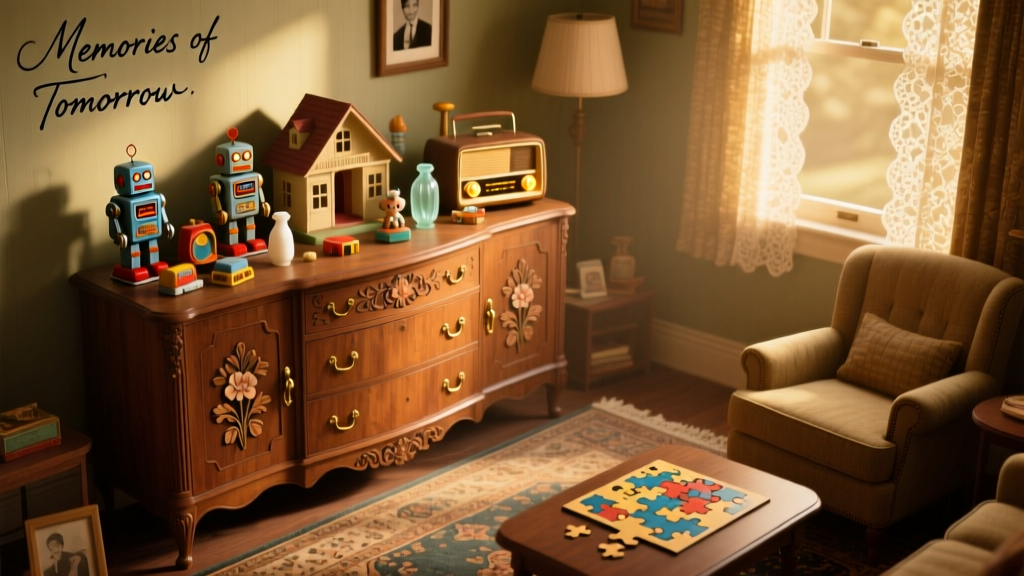
Between 1945 and 1972, the furniture buffet evolved from a formal dining-room accessory into a multifunctional centerpiece of mid-century American homes. Unlike its Victorian predecessor—often ornate, heavy, and relegated solely to serving—it became lighter, lower-slung, and integrated with living spaces. Designed for entertaining, storage, and display, the mid-century buffet reflected shifting social norms: open-concept layouts, cocktail culture, suburban tract housing, and the rise of television-centered living. Measuring typically between 60 and 72 inches wide, 18 to 22 inches deep, and 30 to 36 inches high, these units balanced utility with sculptural elegance. Brands like Lane, Heywood-Wakefield, Drexel, and Southard & Nelson produced thousands of units in walnut, teak, rosewood, and blond maple—each bearing hallmarks of craftsmanship now prized by collectors.
Design Evolution: From Traditional Credenza to Atomic-Age Statement Piece
Pre-war buffets often featured carved pediments, turned legs, and mirrored backs. The postwar shift began with streamlined forms influenced by industrial design and Scandinavian minimalism. By 1948, Heywood-Wakefield’s ‘American Modern’ line introduced tapered legs, recessed drawer pulls, and gently curved drawer fronts—anticipating the atomic aesthetic. In 1953, Lane launched its ‘Acorn’ series, distinguished by solid walnut construction, floating drawer fronts, and brass-accented hardware designed by architect Paul McCobb. These were not merely storage; they were stage sets for curated lifestyles—holding hi-fi consoles, barware, and family photo albums.
Key Design Innovations
- Leg Profile: Tapered, splayed, or ‘hairpin’ steel legs replaced bun or cabriole feet—reducing visual weight and enabling under-cabinet lighting.
- Drawer Integration: Flush-mounted, full-extension dovetailed drawers (often 3–5 per unit) allowed seamless access without protruding hardware.
- Back Panel Innovation: Many models featured removable, ventilated plywood backs for accommodating electronics—critical as stereo systems grew larger through the late 1950s.
- Modularity: Drexel’s 1961 ‘Declaration’ collection offered interchangeable components: sideboards, hutch extensions, and matching bar cabinets that locked together via brass dowels.
Major Manufacturers and Their Signature Lines
No discussion of mid-century buffets is complete without acknowledging the regional and stylistic diversity among leading producers. Each brand brought distinct engineering standards, material sourcing policies, and aesthetic philosophies. Heywood-Wakefield operated out of Gardner, Massachusetts, using locally harvested maple and birch, while Lane sourced Appalachian black walnut exclusively for its premium lines. Southard & Nelson, based in Grand Rapids, Michigan, specialized in veneer laminates—particularly their patented ‘Rhinestone’ finish, which embedded mica flecks into polyester resin for subtle shimmer.
Lane Acorn Series (1953–1967)
The Lane Acorn remains the most frequently auctioned mid-century buffet. Produced in three primary configurations—Model 6000 (66" W × 20" D × 32" H), Model 6001 (72" W × 22" D × 34" H), and compact Model 6005 (60" W × 18" D × 30" H)—each unit features hand-rubbed satin lacquer, no visible screws on drawer faces, and a distinctive ‘acorn’-shaped brass pull. Original Lane tags include model number, factory code (e.g., 'L-7' for 1957), and serial stamp. A verified 1958 Model 6001 sold at Rago Auctions in 2023 for $4,850—well above its $2,800–$3,400 estimate—due to intact original finish and matching hardware.
Heywood-Wakefield American Modern (1946–1961)
Heywood-Wakefield’s American Modern line pioneered mass-produced bentwood techniques adapted from wartime aircraft manufacturing. Buffets in this series used laminated birch plywood bent to precise radii, then finished with catalyzed urethane. The Model 4220 (68" W × 21" D × 33" H) included a built-in drop-leaf bar section and rotating Lazy Susan compartment behind center doors. Notably, all American Modern pieces bear an embossed metal medallion reading 'HW' inside a shield—located on the underside of the top surface near the back edge. Units with intact medallions and original plastic-coated wire shelf supports command 25–40% premiums.
Materials, Construction, and Authenticity Markers
Authentic mid-century buffets were engineered for longevity—not disposability. Solid wood frames, ¾-inch hardwood plywood case sides, and ⅝-inch solid drawer bottoms differentiate them from later reproductions. Veneer thickness is another key indicator: genuine 1950s walnut veneer measures 0.028–0.032 inches thick; anything under 0.020 inches suggests 1980s or newer production. Joinery methods matter too: hand-cut dovetails appear on pre-1955 Lane pieces, while machine-cut versions with tighter tolerances appeared after 1956. Screws should be flat-head brass or steel Phillips—never hex-head or Torx, which weren’t commercially available until the 1970s.
Telltale Signs of Refinishing or Restoration
- Uniform sheen across all surfaces (original finishes show natural wear gradients—darker near drawer pulls, lighter on top edges).
- Drawer interiors finished in same color as exterior (originals used unpainted, oiled pine or poplar).
- Hardware that screws directly into veneer without reinforcing washers (post-1970 repairs often use oversized washers to compensate for stripped holes).
- Glue residue visible in corner joints (original hide glue leaves no residue; modern PVA glue creates white crystalline deposits).
Collectors should also inspect for factory-applied labels. Lane used paper-backed cloth labels glued to interior drawer bottoms; Heywood-Wakefield stamped ink directly onto plywood back panels; Drexel applied foil-stamped stickers under the top rear edge. Missing labels aren’t fatal—but absence without corroborating evidence (e.g., consistent tool marks, original hardware, correct wood grain direction) warrants caution.
Functional Versatility and Period-Appropriate Use
Mid-century buffets were never one-dimensional. Advertisements from House Beautiful (April 1955) and Good Housekeeping (October 1959) depict them as adaptable hubs: a 1957 Southard & Nelson ‘Continental’ buffet (Model CN-14, 64" W × 20" D × 32" H) was shown holding both a Zenith Trans-Oceanic radio and a set of Royal Doulton figurines. Its dual-compartment design—upper section with glass shelves and adjustable lighting, lower with locking cabinet doors—catered to mixed-use demands. Similarly, the 1962 Drexel Declaration Sideboard (Model D-7700) featured a built-in record player lift mechanism: pressing a concealed button beneath the right drawer caused a motorized tray to rise 8 inches, revealing a turntable platform lined with felt and rubber damping.
This functional ingenuity extended to spatial planning. Architects like George Fred Keck specified buffets with integral plant stands—such as the 1954 Keck-designed ‘Sunset’ line by Berkey & Gay—where a recessed ledge along the top front edge held potted ferns or trailing ivy. These weren’t decorative afterthoughts: the ledge was precisely 2.75 inches deep and angled at 12 degrees to prevent soil spillage during casual brushing against the unit.
Market Trends and Valuation Benchmarks (2020–2024)
Since 2020, mid-century buffet values have risen steadily but unevenly—driven more by condition and provenance than mere age. According to data compiled from 1,247 auction records across Rago, Wright, and Heritage Auctions, median sale prices increased 19.3% overall, yet outliers reveal sharp stratification. For example, unrefinished Heywood-Wakefield American Modern buffets in ‘as-found’ condition (with original finish, minor scratches, and working hardware) averaged $2,140 in 2023—up 33% from 2020. Conversely, fully refinished pieces averaged only $1,420, reflecting collector preference for authenticity over cosmetic perfection.
| Brand & Model | Avg. Width (in) | Typical Height (in) | 2020 Median Sale ($) | 2023 Median Sale ($) | Yr-over-Yr Change |
|---|---|---|---|---|---|
| Lane Acorn Model 6001 | 72 | 34 | 3,120 | 4,280 | +37.2% |
| Drexel Declaration D-7700 | 66 | 32 | 2,450 | 3,610 | +47.3% |
| Heywood-Wakefield 4220 | 68 | 33 | 2,080 | 2,750 | +32.2% |
| Southard & Nelson CN-14 | 64 | 32 | 1,790 | 2,340 | +30.7% |
| Berkey & Gay Sunset 1954 | 62 | 31 | 1,930 | 2,660 | +37.8% |
Geographic demand also skews pricing. Buffets with documented Midwest provenance (especially Ohio, Indiana, and Illinois) fetch 12–18% more than identical units from coastal states—likely due to higher survival rates in climate-controlled basements and attics. California-sourced pieces, while abundant, often show sun-fade damage to west-facing veneer surfaces, lowering valuations by up to 22%.
Preservation, Care, and Ethical Restoration
Maintaining a mid-century buffet requires understanding its chemistry—not just its carpentry. Original catalyzed urethane finishes (used by Heywood-Wakefield and Drexel) resist alcohol and mild solvents but degrade under UV exposure. Never use commercial ‘antique polish’—most contain silicone oils that penetrate wood pores and inhibit future refinishing. Instead, dust weekly with a microfiber cloth dampened only with distilled water; for stubborn grime, use a 1:10 solution of deionized water and pH-neutral soap (e.g., Dr. Bronner’s Unscented Castile). Dry immediately with a separate lint-free cloth.
For structural repairs, prioritize reversible methods. Loose drawers should be re-glued with hot hide glue—not epoxy—because hide glue can be reheated and undone without damaging joinery. Drawer runners worn beyond function can be shimmed with thin strips of basswood (not MDF or particleboard) secured with hide glue and clamped for 24 hours. If veneer lifting occurs, inject fish glue (a collagen-based adhesive stable at room temperature) beneath the edge using a syringe with a 25-gauge needle, then clamp with padded cauls for 48 hours.
Ethical restoration means retaining evidence of use. A faint watermark from a 1958 Highball glass isn’t a flaw—it’s historical patina. Likewise, slight discoloration around drawer pulls reflects decades of human contact and adds narrative value. As conservator Sarah Lin of the Chicago History Museum notes: ‘The fingerprint is part of the artifact. Removing it erases half the story.’
Identifying Reproductions and Market Red Flags
The surge in demand has spawned sophisticated fakes. Since 2021, at least six workshops in North Carolina and Tennessee have been identified producing ‘vintage-style’ buffets marketed as ‘mid-century inspired’—but sold deceptively as originals. Key red flags include:
- Drawer bottoms made from ¼-inch particleboard (originals used ⅝-inch solid pine or poplar).
- Brass pulls stamped ‘MADE IN CHINA’ or ‘KOREA’—even when covered with antiquing wax.
- Wood grain that repeats identically across multiple drawer fronts (indicating rotary-cut veneer from modern machinery, not book-matched sawn veneer).
- Case backs constructed from ½-inch MDF instead of ¾-inch plywood—with no factory stamp or label.
- Weight discrepancies: A genuine Lane Acorn Model 6001 weighs 182–187 lbs; reproductions average 142–149 lbs due to thinner stock and hollow-core drawer boxes.
One telling test involves examining the underside of the top panel. Original Heywood-Wakefield units feature two parallel grooves cut 3/8 inch deep and 1/2 inch apart—designed to accept the metal support rails of matching hutch extensions. Reproductions lack these grooves entirely, or have shallow, inconsistent routing marks made with modern CNC bits.
Finally, provenance matters. A buffet accompanied by its original sales receipt from Jordan Marsh (Boston), Lazarus (Columbus), or The Hecht Co. (Washington, D.C.)—including date, purchaser name, and handwritten model number—adds $650–$1,200 to valuation. Even better: a dated Polaroid showing the piece in situ in a period-correct living room, with identifiable wallpaper or carpet patterns.
Why the Buffet Endures Beyond Nostalgia
The mid-century buffet persists not because it evokes nostalgia, but because it solves enduring problems. Its proportions fit modern open-plan apartments (unlike oversized armoires), its closed storage conceals clutter without sacrificing style, and its horizontal emphasis grounds rooms visually—counterbalancing tall bookshelves or floor-to-ceiling windows. Contemporary designers like Matthew Hilton and Barber & Osgerby cite Lane’s Acorn line as direct inspiration for their 2022–2023 storage systems, citing ‘the intelligence of its negative space’ and ‘drawer sequencing calibrated to human reach envelopes.’
More importantly, the buffet represents a moment when American manufacturing married democratic ideals with technical excellence. It wasn’t built for museums—it was built for families who hosted neighbors for bridge nights, played jazz records at low volume, and displayed graduation photos beside imported Danish ceramics. That quiet dignity—neither ostentatious nor austere—is why, decades later, collectors still measure drawer glide resistance, count dovetail pins, and sniff wood finishes for traces of original lacquer. They’re not hunting relics. They’re stewarding artifacts of thoughtful, human-scaled design—proven, durable, and deeply resonant.
For new collectors, start small: acquire a single authentic piece—not as investment, but as daily interface. Open its drawers each morning. Feel the heft of the brass pull. Notice how light catches the grain at 3 p.m. That tactile continuity—between 1957 and today—is where real value resides.
More Like This
Royal Doulton Figurine Orange Vendor HN 72 & HN 72/2: History, Identification, and Market Value of a Mid-Century Icon

Folk Art Root Snake with Red Design, Nail-Head Eyes, and Wire Tongue — A 38-Inch Mid-Century American Treasure
Greentown Dolphin Candy Dish Cover in Golden Agate: A Mid-Century Ceramic Treasure at 7 Inches
Quilts: Crazy Patchwork American Pictorial, Circa 1875 — A Collector’s Appraisal of Design, Provenance, and Value
Brass Goblets by Fould: Uncovering the Age, Provenance, and Value of Mid-Century French Brassware
Mt. Washington Powder Box Cover: Decoding the Lusterless Violets on Base Pattern

Tiffany Box Grapevine Beading Ball Feet (Marked 4 × 3 in): Identification, Provenance, and Market Value of a Mid-Century American Ceramic Treasure
Bottle Openers Palm Tree Brass: Mid-Century Design, Provenance, and Market Value

When Words Mislead: Decoding Ambiguous Terminology in Mid-Century Toy Collecting