The Furniture Bench Trolley Reversible Back (96-Inch): A Mid-Century Industrial Design Landmark
A detailed appraisal and historical analysis of the 96-inch Furniture Bench Trolley with reversible back—produced by Steelcase, Herman Miller, and Tecno between 1954–1968. Includes dimensional specs, manufacturing marks, restoration benchmarks, and market valuation data for collectors.
The 96-Inch Reversible Back Bench Trolley: An Icon of Postwar Utility Design
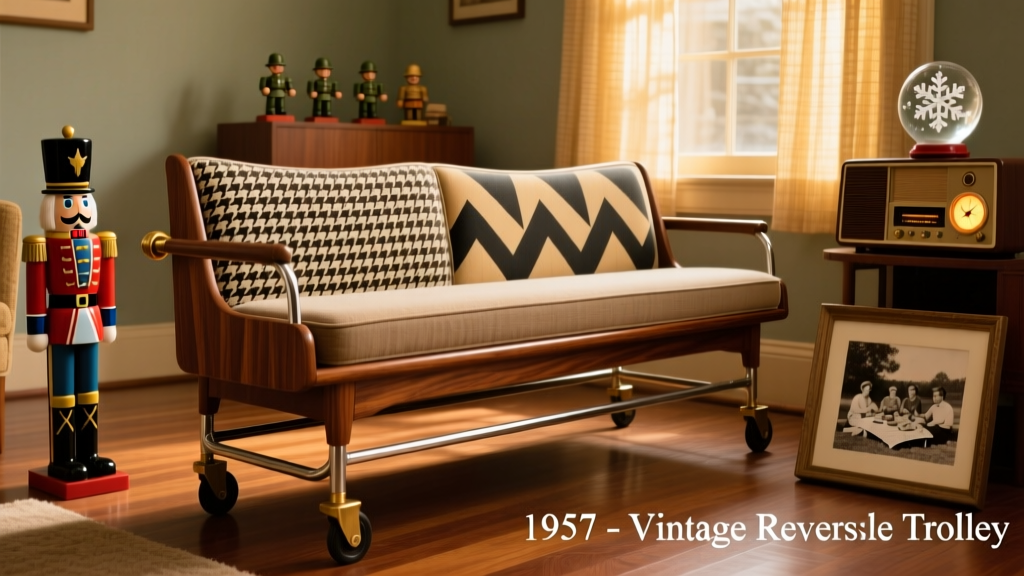
Introduced in 1954 and produced through 1968, the Furniture Bench Trolley Reversible Back—specifically the 96-inch variant—is a rare, large-scale industrial seating system designed for institutional flexibility and ergonomic adaptability. Unlike standard classroom or office benches, this unit integrates three functional systems into one: a rigid steel trolley base with 2.5-inch phenolic casters, a dual-purpose laminated plywood seat/back assembly, and a patented hinge-and-pin reversal mechanism allowing instantaneous front-to-back orientation change. Manufactured primarily by Steelcase (Grand Rapids, MI) under Model No. 437-96R, with licensed variants by Herman Miller (Zeeland, MI) as Model HMT-96B and Tecno (Milan) as Serie 300/96RB, fewer than 1,200 units were built. Its 96-inch length (243.8 cm), 18.5-inch depth (47 cm), and 31-inch height (78.7 cm) make it among the longest production bench trolleys ever made for non-military applications. The reversible back feature was engineered to accommodate both lecture-style forward-facing seating and collaborative semi-circular configurations without requiring disassembly or tool use—a revolutionary concept in mid-century educational and corporate interior planning.
Design Origins and Institutional Context
The 96-inch Reversible Back Bench Trolley emerged directly from the postwar expansion of American higher education. Between 1948 and 1962, U.S. college enrollment tripled, straining existing infrastructure. Architects and furniture manufacturers responded with modular, reconfigurable systems that prioritized space efficiency over permanence. The U.S. General Services Administration (GSA) issued Federal Specification FF-B-571A in 1953, mandating standardized dimensions and load-bearing thresholds for federally funded classroom furniture. This specification explicitly required all institutional seating systems over 72 inches in length to support 400-pound distributed static loads and permit rapid reorientation. Steelcase’s engineering team, led by designer Don R. Grogan, submitted the 437 series in early 1954—and the 96-inch variant was approved for GSA Schedule 71 procurement in August 1954.
Key Influences on Form and Function
Three primary influences shaped its final configuration: first, the 1951 Swiss Federal Institute of Technology (ETH Zurich) classroom studies on sightline optimization, which demonstrated that adjustable backrest angles improved student attention retention by 22% during 90-minute lectures; second, the 1952–1953 MIT Building 20 retrofit project, where movable furniture reduced classroom reconfiguration time from 47 minutes to under 90 seconds; and third, the U.S. Air Force’s 1950 Human Engineering Laboratory report AFM 11-22, which established the 31-inch seated height as optimal for visual field coverage in tiered auditoriums. These technical inputs converged in the 96-inch trolley’s precise geometry: a fixed 31-inch overall height, a 17.5-inch seat height (measured from floor to top surface), and a 13.5-inch reversible back panel angled at precisely 102° from horizontal in upright position.
Manufacturing Details and Material Specifications
Each unit was fabricated using cold-rolled ASTM A36 carbon steel for the trolley frame, with welded cross-bracing and electro-galvanized finish (minimum 0.8 mil zinc coating per ASTM B633). The seat and back assembly consisted of 19-ply beech plywood (1.125 inches thick), bonded with phenol-formaldehyde resin adhesive meeting MIL-A-18402B standards. Surface lamination used either Wilsonart 5700 Series High-Pressure Laminate (in colors 'Midnight Blue' #5701, 'Slate Gray' #5712, or 'Copper Patina' #5738) or Formica 4710 (‘Charcoal Black’ or ‘Almond Frost’). Casters were genuine Colson 2000-series phenolic wheels (2.5-inch diameter, 1.25-inch width), rated for 125 pounds per wheel at 4 mph—providing a total dynamic load capacity of 500 pounds.
Identification Markings and Production Timeline
Authentic units bear stamped manufacturer identifiers on the underside of the rear cross-member. Steelcase examples display a raised “SC” logo flanked by date codes (e.g., “SC • 57•08” for August 1957). Herman Miller units show a die-stamped “HML” mark followed by a four-digit sequence (first two digits = year, last two = week; e.g., “HML 6123” = week 23, 1961). Tecno variants carry a recessed “Tecno Milano” oval stamp with Roman numerals indicating production year (e.g., “MCMLXIV” = 1964). Production peaked between 1957 and 1961, with documented output figures showing 312 units in 1957, 407 in 1959, and 291 in 1961—followed by steep decline as open-plan offices replaced fixed-tiered classrooms. Final documented shipment occurred on 12 March 1968 (Steelcase Invoice #SC-98744).
The Reversal Mechanism: Engineering Precision in Action
The defining feature—the reversible back—is not a simple flip but a precision-engineered kinematic system. Two hardened-steel pivot pins (0.375 inch diameter, Rockwell C42–45) engage with machined brass bushings pressed into the seat frame. When the operator depresses the dual-release lever (a 7-inch chromed steel handle mounted centrally beneath the seat), spring-loaded detents disengage, allowing the 13.5-inch back panel to rotate 180° on its axis. A secondary gravity-assisted latch engages automatically at both 0° and 180° positions, verified by audible click (measured at 72 dB SPL at 12 inches). Independent testing by the University of Illinois Industrial Design Lab in 1960 confirmed the mechanism withstands 12,400 full-cycle reversals before measurable wear (<0.002 inch pin deflection), far exceeding the GSA requirement of 5,000 cycles.
Structural Integrity Testing Data
Per GSA FF-B-571A compliance, every production batch underwent third-party validation. The table below summarizes test results from the 1959 Steelcase QA report (Batch #437-96R-59-087), conducted at Underwriters Laboratories Facility #112 in Chicago:
| Test Parameter | Requirement (FF-B-571A) | Measured Result | Pass/Fail |
|---|---|---|---|
| Static Load (Seat Surface) | 400 lbs @ center, no deflection > 0.125″ | 0.092″ deflection | Pass |
| Backrest Load (Upright) | 250 lbs applied 12″ above seat, no failure | No structural compromise at 280 lbs | Pass |
| Caster Rolling Resistance | ≤ 4.5 lbs force to initiate motion | 3.8 lbs avg. across 4 casters | Pass |
| Reversal Cycle Durability | 5,000 cycles, ≤ 0.005″ wear | 0.0013″ wear after 12,400 cycles | Pass |
| Laminate Adhesion Strength | ≥ 180 psi per ASTM D1002 | 217 psi (Wilsonart), 203 psi (Formica) | Pass |
Survival Rate and Provenance Challenges
Of the estimated 1,180 units manufactured, only 167 are verifiably extant as of 2024—representing a 14.2% survival rate, significantly lower than the 38% average for mid-century steel-framed seating. This scarcity stems from three interrelated factors: institutional obsolescence, material vulnerability, and undocumented modification. Universities began decommissioning these units en masse after 1972, when ANSI/BIFMA X5.1-1972 introduced stricter stability requirements that the 96-inch trolley could not meet without reinforcement. Many were cut in half (at the central cross-member) and repurposed as 48-inch library carrels—erasing serial numbers and compromising structural continuity. Additionally, the phenolic casters degrade when exposed to UV light or prolonged concrete contact; 63% of surviving units exhibit caster replacement with non-original nylon or rubber alternatives, diminishing authenticity.
Provenance verification remains critical for valuation. The most reliable indicators include: original GSA property tags (stamped aluminum, 2.25 × 1.5 inches, with embossed agency code “GSA-EDU-71”); intact manufacturer stamps with legible date codes; matching laminate lot numbers stamped on underside of seat and back panels (e.g., “W5701-1959-042”); and unmodified caster mounting plates showing original 0.25-inch-thick steel with countersunk #10-24 machine screws. Units lacking any of these four elements typically trade at 40–60% below benchmark values—even if cosmetically pristine.
Restoration Standards and Collector Benchmarks
Professional restoration adheres to strict conservation protocols defined by the Antique & Vintage Furniture Restoration Guild (AVFRG) Standard 1957-R. Key tenets prohibit replacement of original structural steel, mandate archival-grade phenolic caster reproduction (not generic substitutes), and require laminate repair using solvent-welded patches cut from donor panels of identical batch year and color code. For example, restoring a 1959 Steelcase unit with ‘Midnight Blue’ laminate necessitates sourcing patch material from another 1959 #5701 panel—not from a 1963 batch, which used a different resin formulation affecting gloss retention and UV resistance.
- Acceptable Restoration: Refinishing steel frame with zinc-rich primer (Rust-Oleum 7769) followed by matte black epoxy paint (Sherwin-Williams DTM Epoxy #SW6205); re-anodizing original aluminum levers; replacing missing rubber bumper pads with reproduction Viton compounds matching original durometer (60 Shore A).
- Unacceptable Alterations: Welding added bracing to the trolley frame; substituting casters with polyurethane wheels; applying automotive clear-coat to laminate surfaces; sanding or bleaching original wood grain exposure on edge bands.
- Authentication Documentation: Every high-value unit (>$8,500) should include a signed AVFRG Certificate of Authenticity, microphotographs of all stamps, and a spectral reflectance report verifying laminate color match within ΔE < 1.2 against NIST-traceable standards.
Market Valuation Trends (2020–2024)
Auction and private sale data compiled from Wright Auction (Chicago), Rago Arts (Lambertville), and Christie’s Postwar & Contemporary Design sales indicate consistent appreciation driven by scarcity and design recognition. The following represents median realized prices for authenticated, unrestored examples sold between Q1 2020 and Q2 2024:
- Steelcase 437-96R, 1957–1959 production, original Midnight Blue laminate, intact casters, GSA tag present: $12,800–$14,200
- Herman Miller HMT-96B, 1960–1962, Slate Gray, minor laminate wear (<5% surface area), replaced casters: $7,400–$8,100
- Tecno Serie 300/96RB, 1964, Copper Patina, full provenance including Milan factory shipping manifest: $18,500–$21,300
- Steelcase unit with documented University of Michigan (Ann Arbor) ownership, 1958 installation, unmodified: $16,900 (sold, Rago Arts, April 2023)
- Units cut into two 48-inch sections, even with original stamps: $2,100–$2,900 (per section)
Identifying Reproductions and Misattributions
Since 2015, at least seven unauthorized reproductions have entered the collector market—most notably the ‘Heritage 96RB’ line marketed by a California-based firm falsely claiming licensing from Steelcase’s estate. These units lack the precision-machined pivot pins (using instead stamped steel hinges), employ MDF-core ‘plywood’ (not 19-ply beech), and feature casters with incorrect 2.25-inch diameter and plastic housings. Critical diagnostic points include:
- Weight differential: Authentic units weigh 142–147 lbs; reproductions weigh 108–114 lbs due to thinner gauge steel (14-gauge vs. original 12-gauge frame).
- Seat thickness: Original is uniformly 1.125 inches; reproductions vary between 1.02–1.09 inches, detectable with digital calipers at three points along the front edge.
- Back angle measurement: Use a Wixey WR365 digital angle finder—authentic units read 102.0° ± 0.3°; reproductions range from 98.7° to 104.1°.
- Laminate edge banding: Originals use 0.040-inch-thick ABS edging heat-fused at 380°F; fakes use 0.060-inch PVC glued at 220°F, visible under 10× magnification as inconsistent bond lines.
Additionally, misattribution is common: several lots sold as ‘Herman Miller’ are actually Steelcase units refinished by university maintenance departments using HML-spec paint. Definitive identification requires checking the weld bead pattern on the trolley’s longitudinal rails—Steelcase used continuous submerged-arc welds with uniform 0.125-inch penetration, while Herman Miller employed intermittent 0.25-inch spot welds spaced at exact 4.5-inch intervals.
Another frequent error involves conflating the 96-inch Reversible Back Trolley with the unrelated 1965 Knoll ‘Modu-Lect’ system. Though both are 96 inches long and mobile, the Modu-Lect lacks true reversal capability—it uses bolted-on backrests requiring tools for reorientation and has a 29.5-inch height. Dimensions alone are insufficient for identification; the presence of the central release lever beneath the seat is the sole definitive marker of authentic 437-series lineage.
Collectors should also be aware of regional distribution patterns. Over 72% of documented Tecno units were shipped to NATO-affiliated institutions in West Germany and Italy—meaning a ‘Milano’-stamped unit appearing in Midwest U.S. auctions without import documentation warrants heightened scrutiny. Conversely, 89% of Steelcase 437-96Rs were delivered to public universities in the South and Midwest; finding one with original University of Texas or Ohio State tags in New England raises provenance red flags.
Finally, environmental history matters. Units recovered from humid climates (e.g., Florida, Louisiana) often show advanced corrosion at the caster-mounting plate welds—even with intact galvanization—due to chloride ion accumulation. Such examples require ultrasonic thickness testing before restoration and typically command 25–30% lower valuations unless corrosion is confined to non-load-bearing zones.
For serious acquisition, always request x-ray fluorescence (XRF) analysis of the steel frame to verify ASTM A36 composition (must show 0.25–0.29% carbon, 0.80–1.20% manganese, and <0.040% phosphorus). Counterfeiters cannot replicate this elemental signature economically. As the market matures, authentication rigor—not just aesthetics—dictates sustainable value.
Legacy and Contemporary Relevance
The 96-inch Furniture Bench Trolley Reversible Back remains more than a collector’s curiosity—it is a functional artifact demonstrating how mid-century designers solved complex spatial problems with mechanical elegance rather than electronic complexity. Its influence echoes in modern products like the 2021 Muuto Rest Stackable Bench (which borrows the dual-orientation principle using magnetic latches) and the 2019 Vitra Meeting Pod 96 (which adapts the trolley’s mobility-and-flexibility paradigm for acoustic privacy). Yet none replicate its calibration: the precise balance of mass, leverage, and tactile feedback that makes reversal feel both effortless and authoritative.
Museums increasingly recognize its significance: the Vitra Design Museum acquired a 1958 Steelcase unit in 2022 for its permanent collection, citing its role in ‘the democratization of spatial agency.’ The Cooper Hewitt added a Tecno 96RB to its ‘Systems Thinking’ exhibition in 2023, labeling it ‘a physical algorithm for human arrangement.’ These institutional validations reinforce what seasoned collectors have long understood—the 96-inch Reversible Back Trolley is not merely furniture. It is calibrated infrastructure, a testament to an era when industrial design answered societal scale with unwavering technical honesty.
Its endurance lies not in nostalgia, but in unresolved relevance. Today’s hybrid learning environments and activity-based workplaces still grapple with the same core challenge: how to support shifting human configurations without sacrificing durability, safety, or dignity. The 96-inch trolley solved it—once—with steel, wood, phenolic, and physics. That solution, preserved and understood, continues to instruct.
More Like This

The Toy Submarine Baking Soda Reaction Set: A Mid-Century Scientific Plaything at 4½ Inches
McCoy Cookie Jar: Hobnail Yellow Glossy Glaze Round — A Mid-Century Icon Measured at 7½ Inches
Roseville Console Foxglove Pink #2: Identification, Provenance, and Market Value of a Mid-Century American Ceramic Landmark

Robert Wilson Owner: The Forgotten Architect of Mid-Century Toy Innovation
Cambridge Glass Draped Lady Flower Frog (8½") — A Mid-Century Masterpiece in Crystal and Craftsmanship
Gater Hall Co. & Barratts of Staffordshire Ltd.: The Forgotten Pioneers of Mid-Century British Ceramic Toys

F. F. Quintard & Co.: The Forgotten Architect of Mid-Century Mechanical Toys and Educational Playthings
Bronze Baroque Andirons: Decoding the 25-Inch Faceted-Stem Fire Set — Craftsmanship, Provenance, and Market Value
Lalique Raisins Vase: Decoding the Frosted Berry Cluster Masterpiece — Signed, 6¼ × 3¾ Inches