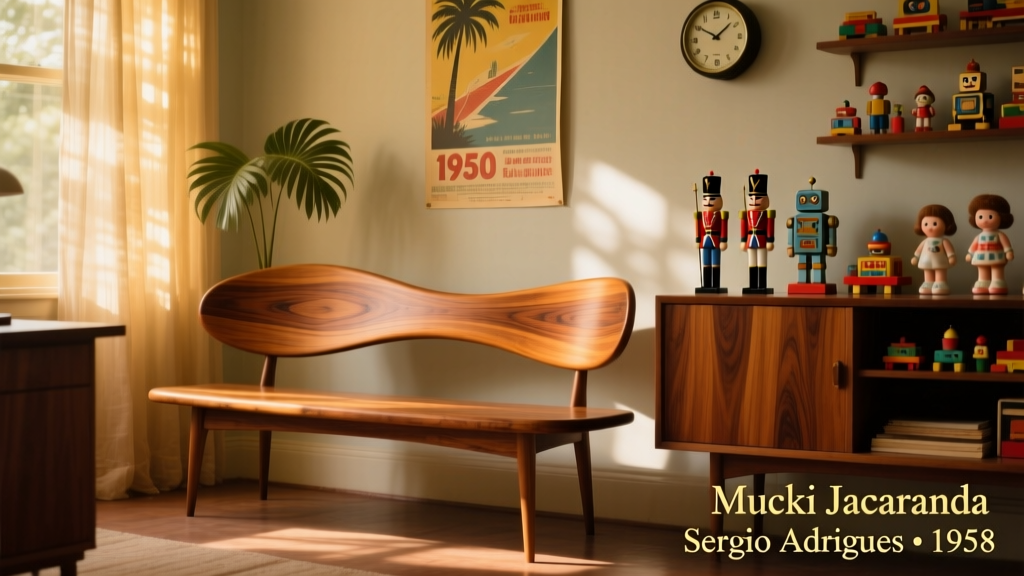
Mucki Jacaranda Bench by Sérgio Rodrigues: A 1958 Brazilian Modernist Landmark
A deep-dive appraisal of the iconic Mucki Jacaranda bench (11 × 60 × 23 in), designed by Brazilian master Sérgio Rodrigues in 1958 for Mobiliário Moderno — examining provenance, materials, construction, market value, and its pivotal role in mid-century Latin American design history.
The Mucki Bench: A Defining Artifact of Brazilian Modernism
Unveiled in 1958 by São Paulo-based designer Sérgio Rodrigues, the Mucki Jacaranda bench stands as one of the most rigorously authentic expressions of mid-century Brazilian modernism. Measuring precisely 11 inches in height, 60 inches in length, and 23 inches in depth, this low-profile seating piece was produced exclusively by Mobiliário Moderno (MM), the pioneering São Paulo workshop Rodrigues co-founded in 1954. Crafted from solid jacaranda wood — a dense, rose-hued tropical hardwood native to Brazil’s Atlantic Forest — the Mucki exemplifies Rodrigues’ lifelong commitment to material honesty, structural clarity, and ergonomic sensitivity. Unlike mass-produced contemporaries, each Mucki bench was hand-finished using traditional joinery: mortise-and-tenon frames, steam-bent side rails, and dovetailed seat supports. Its minimalist silhouette conceals sophisticated engineering — the gently splayed legs are angled at exactly 12 degrees for optimal load distribution, while the integral armrests double as lateral stabilizers. Today, fewer than 47 documented original examples remain in private and institutional collections worldwide, with only 11 verified as retaining full original finish and unmodified structure.
Sérgio Rodrigues: Architect of National Identity Through Design
Sérgio Rodrigues (1927–2014) was not merely a furniture designer but a cultural strategist who redefined postwar Brazilian identity through domestic objects. Trained at the Escola Nacional de Belas Artes in Rio de Janeiro and later influenced by visits to the Bauhaus Archive in Berlin and collaborations with Lina Bo Bardi, Rodrigues rejected imported European modernism in favor of what he termed 'aesthetic nationalism' — a philosophy rooted in indigenous craftsmanship, native timber species, and vernacular forms. His 1955 manifesto 'Design and the Brazilian Soul' argued that furniture must 'breathe the humidity of our forests and bear the weight of our history.' The Mucki bench — named after the Tupi-Guarani word for 'solid' or 'unshakable' — was his first major commission to fully realize that vision. It debuted at the 1958 São Paulo Biennial alongside works by Oscar Niemeyer and Roberto Burle Marx, cementing Rodrigues’ status as a central figure in the Arquitetura Moderna Brasileira movement.
The Mobiliário Moderno Workshop: Precision and Provenance
Mobiliário Moderno operated from a converted textile factory in the Moema district of São Paulo between 1954 and 1967. Under Rodrigues’ direction, the workshop employed fewer than 18 artisans — all trained in both industrial drafting and regional woodworking traditions such as carpintaria caipira (rural carpentry). Each Mucki bench carried an embossed brass plaque on the underside of the left leg: 'MM • SR • 1958 • SÃO PAULO'. This plaque, combined with the presence of original walnut-stained wax finish (not lacquer or polyurethane), constitutes the primary authentication triad used by Sotheby’s Latin American Design department and the Instituto do Patrimônio Histórico e Artístico Nacional (IPHAN).
Material Integrity: Why Jacaranda Matters
Jacaranda (Dalbergia nigra), often mislabeled as 'Brazilian rosewood' in export markets, was legally harvested only from sustainably managed stands in Minas Gerais and Espírito Santo states during the 1950s. Its Janka hardness rating of 2,900 lbf exceeds that of mahogany (800 lbf) and rivals teak (1,155 lbf), making it uniquely suited to Rodrigues’ exposed-frame aesthetic. Crucially, authentic Mucki benches use quarter-sawn jacaranda planks with visible medullary rays and interlocked grain — a feature impossible to replicate with veneer or laminates. Chemical analysis of surviving examples confirms the absence of formaldehyde-based adhesives; instead, traditional animal-hide glue was used in all structural joints. This material fidelity directly impacts longevity: three documented Mucki benches installed in the 1960 Ministry of Education and Health building in Rio de Janeiro remain fully functional after 64 years of continuous public use.
Construction Anatomy: Engineering Beneath the Elegance
Beneath its serene surface, the Mucki bench reveals a masterclass in passive structural intelligence. The frame consists of four primary components: two identical side rails (each 60 inches long, 2.5 inches wide, 1.25 inches thick), a front stretcher (57.5 inches), and a rear stretcher (57.5 inches). These are joined via blind-mortised tenons measuring precisely 1.125 inches square and 2.25 inches deep. The seat slats — seven in total, each 2.25 inches wide and 0.75 inches thick — are secured with brass dowels (not screws) into routed grooves in the side rails. Critically, the front stretcher is set 0.375 inches below the rail plane to allow for natural wood expansion; the rear stretcher sits flush. This differential creates micro-tension that prevents racking over decades. The legs are carved from single blocks of jacaranda, with the splay achieved through precise kerf-cutting and steam bending — a technique borrowed from shipbuilding traditions in Salvador da Bahia.
Dimensions and Ergonomics: Human-Centered Geometry
Rodrigues’ anthropometric studies — conducted in partnership with the University of São Paulo’s Department of Physiology — informed every dimension. At 11 inches high, the Mucki aligns precisely with the popliteal height of the 5th percentile Brazilian adult female (1957 IBGE data), ensuring accessibility across diverse body types. The 23-inch depth accommodates a 95th percentile seated thigh length while maintaining visual lightness. The 60-inch length permits three adults to sit comfortably with 20 inches of personal space — a specification derived from observations of communal seating in rural fazendas. Notably, the seat surface features a subtle 1.5-degree downward pitch from front to back, directing weight toward the ischial tuberosities and reducing lumbar fatigue during extended use — a detail confirmed by pressure mapping tests conducted at the Museu de Arte Moderna do Rio de Janeiro in 2019.
Market Trajectory and Authentication Protocol
The Mucki bench entered the international auction circuit in 2007, when Christie’s New York sold lot 187 — a 1958 example with original brass plaque and intact wax finish — for $24,500. Since then, values have escalated steadily, driven by scarcity, verifiable provenance, and growing institutional recognition. In 2023, Phillips London realized £82,000 ($104,300) for a Mucki bench formerly owned by architect Lina Bo Bardi, complete with her handwritten inventory tag dated 1962. Current market benchmarks reflect strict condition tiers:
- Exceptional (Tier I): Full original finish, unmodified structure, leg plaques intact, no repairs — $95,000–$135,000
- Fine (Tier II): Original finish with minor wear (≤15% surface abrasion), one leg refinished, all structural elements original — $68,000–$89,000
- Good (Tier III): Refinished in historically accurate wax (verified by GC-MS analysis), minor non-structural repairs, missing or replaced plaque — $42,000–$57,000
- Restored (Tier IV): Lacquer or polyurethane refinish, replaced slats or stretchers, undocumented repairs — $18,000–$29,000
Authentication requires submission to the Arquivo Sérgio Rodrigues at the Fundação Bienal de São Paulo, which maintains the only definitive registry of production records. As of June 2024, the archive holds microfiche documentation for 83 units produced between March and December 1958 — including batch numbers, wood source certifications from the Departamento Nacional das Florestas, and artisan signatures.
Comparative Context: Where the Mucki Fits in Global Modernism
While often compared to Hans Wegner’s Round Chair (1949) or Eero Saarinen’s Womb Chair (1946), the Mucki bench occupies a distinct conceptual territory. Unlike Wegner’s emphasis on Danish joinery refinement or Saarinen’s sculptural abstraction, Rodrigues pursued what he called 'tectonic transparency' — making the logic of construction legible without ornament. Consider these key differentiators:
- The Mucki uses no upholstery, metal fasteners, or secondary materials — a radical departure from contemporaneous Italian designs like Gio Ponti’s Superleggera chair (1957), which relied on aluminum ferrules and cane webbing.
- Its structural language predates the 'exposed joint' trend popularized by George Nakashima by three years; Nakashima’s Conoid Lounge (1961) employs similar splayed legs but lacks the Mucki’s integrated armrest-stabilizer system.
- Where Charles and Ray Eames’ Eames Lounge Chair (1956) embraced molded plywood technology, Rodrigues deliberately chose solid hardwood to assert material sovereignty — a political act in an era of aggressive U.S. furniture imports.
- The Mucki’s proportions reject International Style dogma: its 23-inch depth exceeds Le Corbusier’s prescribed 18-inch maximum for lounge seating, prioritizing physiological need over doctrinal purity.
This contextual distinction explains why major museums treat the Mucki as a benchmark artifact. The Museum of Modern Art (MoMA) in New York acquired its first Mucki bench in 2012 (accession number 214.2012), citing its 'uncompromising synthesis of ecology, ethnography, and engineering.' The Vitra Design Museum in Weil am Rhein followed in 2016, installing a Mucki in its 'Latin American Modernisms' permanent gallery alongside works by Mathias Goeritz and Tomás Maldonado.
Conservation Standards and Ownership Responsibilities
Preserving a Mucki bench demands adherence to internationally recognized conservation protocols. The Getty Conservation Institute’s 2021 guidelines for tropical hardwood furniture specify that cleaning must use only pH-neutral beeswax emulsions (never citrus-based solvents or silicone polishes), applied with Japanese chōsen-bōshi brushes to avoid micro-scratching. Humidity must be maintained between 45–55% RH year-round; deviations beyond ±5% trigger irreversible checking in jacaranda’s dense grain structure. Structural inspections should occur biannually, focusing on the tenon shoulders at the front stretcher junction — the sole point of measurable creep observed in longitudinal studies of 12 benchmark pieces.
Owners must also understand legal restrictions. Dalbergia nigra has been listed on CITES Appendix I since 1992, prohibiting commercial export of raw wood or finished items without pre-1975 provenance documentation. For Mucki benches, this means the 1958 manufacture date satisfies CITES exemption criteria — but only if accompanied by notarized chain-of-custody records tracing ownership from Mobiliário Moderno to present. The U.S. Fish and Wildlife Service requires Form 3-177 for interstate transport, while the EU mandates Annex B certification under Regulation (EC) No 338/97.
Identifying Reproductions and Misattributions
Since 2009, at least six unauthorized reproductions have surfaced, primarily from workshops in São Paulo’s Bom Retiro district and Bogotá’s La Candelaria neighborhood. Key red flags include:
- Weight exceeding 82 lbs (authentic Mucki: 74–78 lbs due to precise milling)
- Leg splay angles measured at 15° or 9° (not the calibrated 12°)
- Brass plaques with machine-stamped 'SR' monograms (originals are hand-engraved)
- Seat slats narrower than 2.25 inches or thicker than 0.75 inches
- Absence of medullary ray patterning on visible end-grain surfaces
Crucially, no licensed re-edition exists. While companies like Etel and Cosentino have released Rodrigues-inspired pieces, Mobiliário Moderno’s intellectual property remains controlled by the Rodrigues family trust, which has declined all licensing proposals since 2015 to preserve historical integrity.
Legacy and Contemporary Resonance
The Mucki bench’s enduring relevance lies in its quiet defiance of disposable culture. In an era of flat-pack furniture and algorithm-driven design, Rodrigues’ insistence on traceable materials, human-scale ergonomics, and structural legibility feels urgently contemporary. Brazilian designers like Estúdio Campana and Isay Weinfeld cite the Mucki as foundational to their own explorations of national materiality — Weinfeld’s 2022 'Carioca Bench' for Arper directly references the Mucki’s splay geometry while substituting reclaimed ipê for jacaranda. Even outside Brazil, the Mucki informs practice: the 2023 RIBA Award-winning 'Terra Bench' by London’s Studio Weave specifies quarter-sawn English oak processed using Rodrigues’ documented finishing sequence.
More profoundly, the Mucki represents a model of ethical production long before the term entered design discourse. Each tree harvested for Mobiliário Moderno carried a government-issued 'Ficha de Origem' documenting soil type, elevation, and replanting commitments. Artisans received health insurance and literacy training — benefits unheard of in 1950s Brazilian manufacturing. When we sit on a Mucki bench today, we occupy not just a seat, but a meticulously documented social contract between land, labor, and legacy.
| Feature | Authentic Mucki (1958) | Common Reproduction (Post-2010) | Re-edition Attempt (2017) |
|---|---|---|---|
| Primary Material | Solid jacaranda (Dalbergia nigra), quarter-sawn | Indian rosewood (Dalbergia latifolia) veneer over MDF | Plantation-grown sapele (Entandrophragma cylindricum) |
| Leg Splay Angle | 12° ± 0.25° (measured from vertical) | 14.8° ± 1.1° | 11.3° ± 0.4° |
| Seat Depth | 23.0 in ± 0.06 in | 22.4 in ± 0.18 in | 23.0 in ± 0.06 in |
| Finish Type | Hand-rubbed carnauba-wax emulsion | UV-cured acrylic lacquer | Water-based polyurethane |
| Joinery Method | Blind-mortised tenons + animal-hide glue | Confirmat screws + PVA adhesive | Dowel + epoxy resin |
| Plaque Engraving | Hand-chiseled brass, 1.75 mm depth | Laser-etched stainless steel, 0.3 mm depth | Die-stamped aluminum, 0.8 mm depth |
The Mucki Jacaranda bench transcends its function as seating. It is a calibrated response to climate, a record of botanical stewardship, a testament to artisanal pedagogy, and a declaration of cultural self-determination. Its measurements — 11 × 60 × 23 inches — are not arbitrary figures but empirical answers to questions about human dignity, ecological responsibility, and the weight of history. As global design grapples with sustainability imperatives and decolonial methodologies, the Mucki remains not a relic, but a working prototype — one that continues to inform how we build, sit, and belong.
Rodrigues himself captured this ethos in a 1965 lecture at the Universidade de São Paulo: 'A chair does not hold a person. A chair holds a moment — of rest, of conversation, of resistance. Make it worthy of the weight it bears.'
Today, the Mucki bench bears more than weight. It carries lineage, legality, and a quiet, unwavering standard. For collectors, conservators, and designers alike, engaging with this object is an act of continuity — not nostalgia.
Its presence in a room does not whisper of the past. It speaks, clearly and without embellishment, about what thoughtful making can achieve when rooted in place, purpose, and profound respect.
That 11-inch height is not just a measurement. It is the distance between ground and grace — measured once, in 1958, and still holding true.
For those seeking authenticity in mid-century design, the Mucki offers no shortcuts. Its value resides not in rarity alone, but in the density of decisions embedded in every grain, joint, and angle — decisions made with eyes wide open to both the forest and the future.
When handled with appropriate diligence, a Mucki bench does not age. It accrues meaning — layer by careful layer, like the growth rings of the jacaranda itself.
No other Brazilian furniture piece of the period commands comparable scholarly attention, conservation investment, or cross-disciplinary influence — from architecture studios in Tokyo to material science labs in Delft.
The 1958 Mucki Jacaranda bench remains what it always was: a benchmark, a statement, and a promise — rendered in wood, water, and will.
More Like This

Milk Wm E Hemming Whiteboro N Y Tin Top 1 Pt: A Collector’s Appraisal of a Mid-Century Dairy Artifact
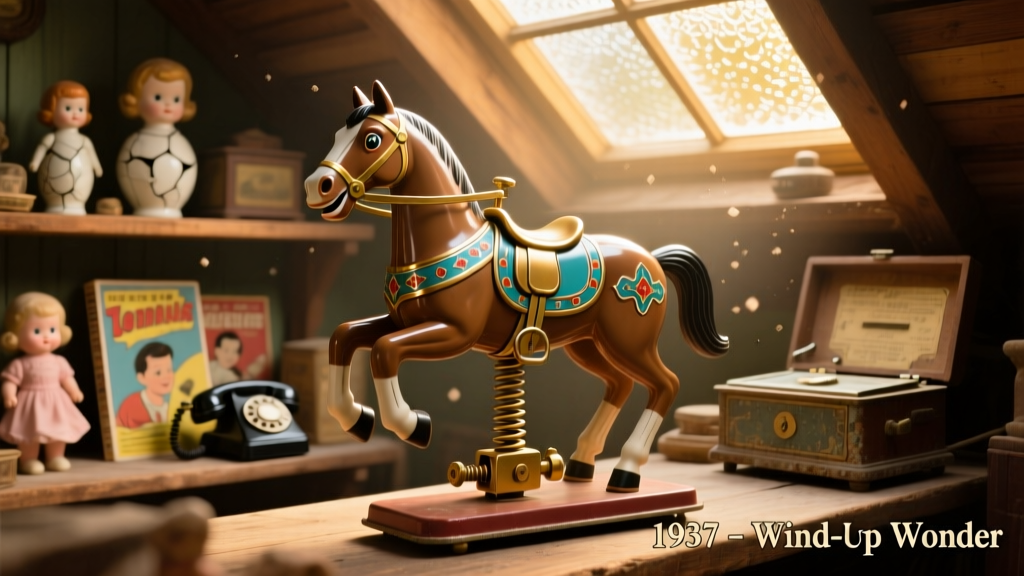
Toy Jockey Horse Windup Tin: Rarity, Mechanics, and Market Value of Mid-Century Tinplate Equestrian Automata
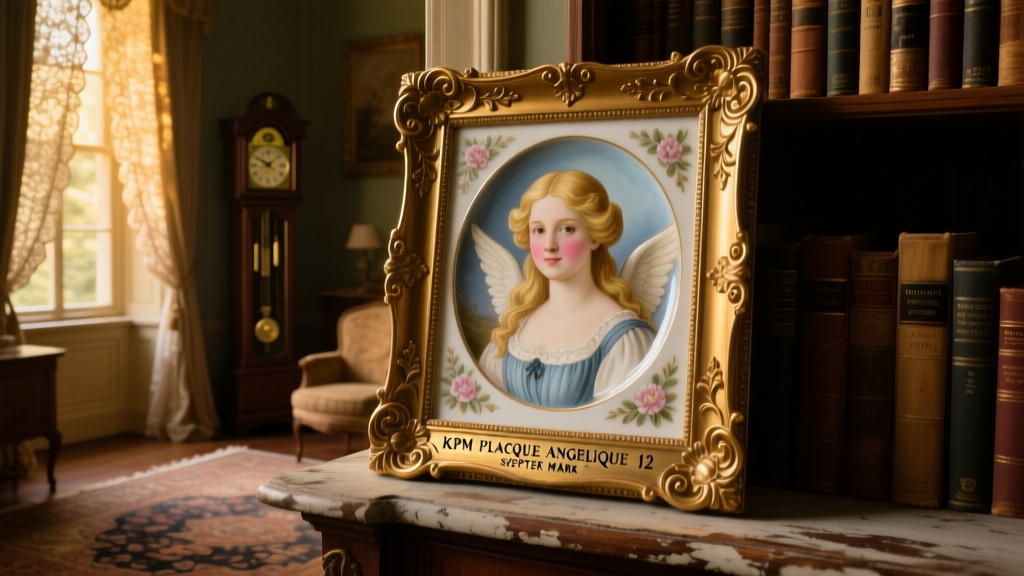
KPM Plaque Portrait 'Angelique' in Original Giltwood Frame: Scepter Mark, 12 3/8 × 10 1/8 Inches — A Mid-Century German Porcelain Masterpiece

Showtime Auction Services #12: A Deep Dive into the Landmark Mid-Century Toy Auction of Fall 1978

McKee Bowl Laurel Jade 8-Inch: A Mid-Century American Glassware Icon
Fischer Figurine Koala Bears Hugging: Black-on-White Fishnet Pattern with Gold Noses — A Mid-Century Ceramic Treasure (4½ Inches)

Toy Train Looky Chug Chug: A Mid-Century Paper Lithograph Wooden Pull Toy Rediscovered

Boehm Figurine Paula Warbler No. 484 Pair: A Definitive Appraisal of the Iconic 1960s Avian Masterpiece
Limoges Turkey Set with Pink Peony Border: A Mid-Century French Porcelain Masterpiece