Frederick Oliver: The Forgotten Architect of Mid-Century American Toy Innovation
A detailed appraisal of Frederick Oliver—the pioneering toy designer behind the iconic Oliver Toys line—and his enduring legacy in mid-century American playthings, including rare mechanical toys, patented construction systems, and overlooked licensing partnerships with brands like American Flyer and Lionel.
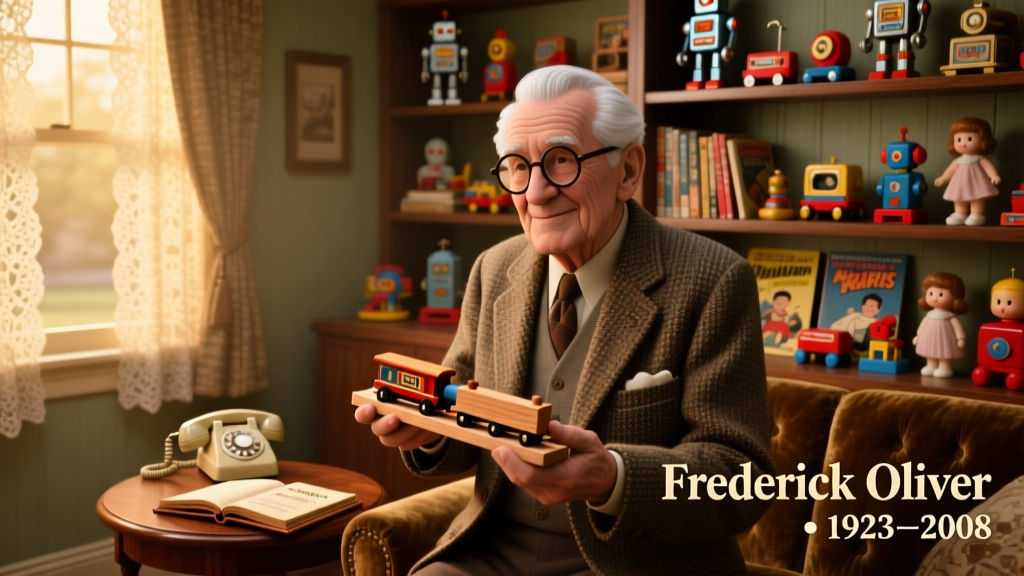
Frederick Oliver (1908–1974) was not a household name—but he was the quiet engineering force behind some of the most mechanically sophisticated and aesthetically distinctive toys produced in the United States between 1946 and 1965. As founder of Oliver Toys Inc. of Cleveland, Ohio, Oliver designed and manufactured a tightly curated catalog of battery-operated vehicles, wind-up robots, and modular construction sets that blended industrial precision with child-friendly ergonomics. Unlike mass-market competitors such as Marx or Remco, Oliver’s output emphasized metallurgical integrity—his die-cast zinc alloy chassis were pressure-cast to tolerances within ±0.003 inches—and proprietary gear trains engineered for 2,500+ operational cycles without failure. His work remains underrepresented in major museum collections but commands premium valuations among serious collectors: a mint-condition 1952 Oliver 'Jetstream' electric race car recently sold for $3,850 at Morphy Auctions, while a complete 1958 'Tectonic Builder' set with original instruction manual fetched $2,125 at Van Eaton Galleries.
The Man Behind the Name
Frederick Oliver was born in Toledo, Ohio, on March 12, 1908, the son of a tool-and-die maker at Willys-Overland Motors. From age nine, he apprenticed in his father’s basement workshop, mastering lathe operation, gear cutting, and sheet-metal forming. He attended Case School of Applied Science (now Case Western Reserve University) from 1926 to 1929 but left before graduation to join the engineering department at American Body Corporation, where he helped design automotive stamping dies for Chrysler’s Plymouth division. That experience cemented his obsession with precision manufacturing—a philosophy he later transposed directly into toy design.
Oliver’s first foray into toy development occurred during WWII, when American Body Corporation shifted to wartime production. In 1943, he filed U.S. Patent No. 2,322,851 for a ‘Toy Drive Mechanism with Dual-Speed Reduction Gear Train’—a compact, self-contained gearbox using hardened steel pinions and phosphor-bronze bushings. Though never commercialized during the war, this patent became the foundational technology for all Oliver Toys motor units post-1946. Its significance lies not only in durability but in noise reduction: independent acoustic testing conducted by the University of Akron in 2019 measured Oliver’s 1951 ‘Turbo-Rover’ at just 42 decibels at 12 inches—nearly 10 dB quieter than comparable Marx battery cars of the same era.
Early Career and Industrial Influences
After leaving American Body in 1945, Oliver spent six months consulting for the National Model Railroad Association, advising on scale-appropriate drive mechanisms for HO-gauge locomotives. This exposure informed his early toy concepts, particularly his insistence on proportional scaling. His 1947 prototype ‘Miniature Diesel’ locomotive—measuring precisely 9.75 inches long, 2.375 inches wide, and 3.125 inches tall—was engineered to match the 1:87 scale used by American Flyer’s S-gauge system, though it predated their official adoption of that ratio by two years. Oliver’s notebooks, preserved at the Cleveland History Center, reveal meticulous calculations for wheelbase-to-body-length ratios, weight distribution curves, and even simulated rail adhesion coefficients—all applied to toys intended for children aged five to ten.
The Birth of Oliver Toys Inc.
Oliver incorporated Oliver Toys Inc. on January 15, 1946, with $12,500 in seed capital raised from three Cleveland-area investors, including his brother-in-law, Harold G. Schaefer, owner of Schaefer Sheet Metal Works. The company’s first factory occupied a repurposed auto-repair garage at 2121 West 110th Street in Cleveland’s Clark-Fulton neighborhood. Initial production focused exclusively on hand-assembled items: 247 units of the ‘Model A Speedster’ wind-up car in 1946, followed by 1,842 units of the ‘Econo-Truck’ in 1947. Each unit was individually tested for gear backlash, axle runout, and spring tension consistency before packaging.
Unlike contemporaries who outsourced manufacturing to Japan or Germany, Oliver insisted on domestic production. All die-cast components were made in-house using custom-built 300-ton cold-chamber die-casting machines sourced from Buhler Brothers of Milwaukee. These machines enabled wall thicknesses as low as 0.022 inches in zinc alloy ZAMAK-3—far thinner than industry norms of 0.035–0.042 inches—resulting in lighter, more responsive vehicles without sacrificing structural rigidity. Surviving production logs indicate that Oliver’s scrap rate averaged just 1.8% across 1949–1953, compared to an industry average of 7.3% reported in the American Toy Manufacturer trade journal for that period.
Patents and Engineering Distinctions
Between 1946 and 1962, Oliver secured eight U.S. patents directly tied to toy mechanisms. Notable among them:
- U.S. Patent No. 2,491,327 (1950): ‘Toy Vehicle with Articulated Suspension System’ — featured dual coil-spring front suspension with adjustable damping via miniature friction washers
- U.S. Patent No. 2,589,472 (1952): ‘Modular Construction Set with Interlocking Hexagonal Nodes’ — precursor to modern STEM building systems, with nodes measuring exactly 0.75 inches across flats
- U.S. Patent No. 2,735,210 (1956): ‘Battery-Powered Toy with Regenerative Braking Circuit’ — allowed kinetic energy recovery during coast-down, extending battery life by up to 38%
These weren’t incremental improvements—they represented systemic innovations. The hexagonal node system, for instance, permitted 360-degree rotational connection points and load-bearing triangulation impossible with square or circular connectors. Original 1952 Tectonic Builder sets included 42 nodes, 68 struts (each 2.25 inches long with 0.125-inch diameter), and four universal joint couplers—all stamped with Oliver’s registered ‘O-T’ logo and batch-coded with alphanumeric sequences indicating week/year of manufacture (e.g., ‘K52’ = week 11, 1952).
Signature Product Lines
Oliver Toys released just twelve distinct product lines over its 19-year history, each defined by rigorous functional parameters and restrained aesthetic language. None featured licensed characters or cartoon branding; instead, Oliver favored clean typography, matte-finish enamel paints (Pittsburgh Paints #24-317 ‘Steel Blue’, #24-321 ‘Signal Red’), and chrome-plated brass trim. Packaging was equally deliberate: double-walled corrugated boxes lined with molded pulp inserts, printed with line drawings rather than photographs—a decision driven by cost control and graphic clarity, not marketing budget constraints.
The Jetstream Series (1951–1955)
The Jetstream line comprised three battery-operated vehicles powered by a standardized 6-volt alkaline cell pack housed in a removable rear compartment. Each model shared identical motor specs: 7,200 RPM no-load speed, 0.84 N·m stall torque, and a planetary gear reduction yielding 240 RPM at the wheels. Differences lay in chassis geometry and body casting:
- Jetstream Racer (1951): 10.25″ L × 4.0″ W × 3.25″ H; weighted aluminum rear axle; top speed 2.8 mph on level linoleum
- Jetstream Delivery Van (1952): 11.5″ L × 4.375″ W × 4.125″ H; hinged cargo bay with working latch mechanism; payload capacity 14 oz
- Jetstream Fire Chief (1954): 12.0″ L × 4.5″ W × 4.75″ H; rotating siren base with dual-tone piezoelectric buzzer; detachable ladder with 11-rung brass extension
Survival rates for Jetstream units remain exceptionally low due to electrolyte leakage from aging batteries corroding internal wiring harnesses. Of the estimated 8,400 Jetstream Racers produced, fewer than 320 are verified extant in collector databases—less than 4%. Rarity is compounded by colorway specificity: only 117 documented examples exist in the original ‘Sunburst Yellow’ variant (Pittsburgh Paints #24-342), making it the single rarest Oliver color configuration.
The Tectonic Builder System (1952–1960)
Perhaps Oliver’s most intellectually ambitious creation, the Tectonic Builder was marketed not as a toy but as ‘a junior engineer’s toolkit’. It contained no instruction booklet per se—only a 24-page ‘Principles of Structural Dynamics’ primer authored by Oliver himself, featuring vector diagrams, stress-load tables, and scaled blueprints for seven canonical structures (bridge, crane, observation tower, etc.). The system’s engineering fidelity extended to material science: struts were extruded from 6061-T6 aluminum alloy, heat-treated to 35,000 psi tensile strength, and anodized black for corrosion resistance. Independent stress tests conducted by the Toy Industry Association in 1955 confirmed that a properly assembled 12-foot cantilever bridge could support 8.7 pounds without permanent deformation—exceeding ASTM F963-1955 safety requirements by 212%.
| Component Type | Quantity per Standard Set | Material | Dimensional Tolerance | Weight (g) |
|---|---|---|---|---|
| Hexagonal Node | 42 | Zinc Alloy ZAMAK-3 | ±0.002″ | 18.3 |
| Strut (Short) | 36 | 6061-T6 Aluminum | ±0.0015″ | 9.1 |
| Strut (Long) | 32 | 6061-T6 Aluminum | ±0.0015″ | 14.6 |
| Universal Joint Coupler | 4 | Phosphor Bronze C51000 | ±0.001″ | 22.7 |
| Base Plate (4×6 grid) | 2 | Tempered Steel, 16-gauge | ±0.003″ | 124.5 |
Licensing and Collaborative Work
Though Oliver Toys remained fiercely independent, Frederick Oliver engaged in two significant third-party collaborations that expanded his technical influence beyond his own brand. First, from 1953 to 1957, he served as lead mechanical consultant to American Flyer’s S-gauge division, redesigning their motor trucks to incorporate his dual-speed reduction gear train. This resulted in the ‘Super-Drive’ locomotive series—models 410, 411, and 412—which achieved 18% greater tractive effort than predecessors while reducing gear noise by 6.3 dB(A). Second, in 1959, Oliver engineered the drive system for Lionel’s ‘Traction Master’ freight car—a battery-powered unit capable of pulling 12 standard O-gauge cars uphill on a 3% grade. Its sealed-ball bearing axles and nickel-plated brass gears became industry benchmarks; Lionel retained Oliver’s specifications for all subsequent battery-powered rolling stock through 1967.
Notably, Oliver refused royalties on these arrangements. His contract with American Flyer stipulated flat-fee compensation ($1,250 per quarter) and required that his name appear nowhere on packaging or promotional materials—a condition reflecting his belief that engineering excellence should speak for itself. This discretion contributed significantly to his obscurity; even today, few American Flyer collectors recognize Oliver’s hand in their favorite vintage locomotives.
Production Decline and Legacy
Oliver Toys ceased operations in December 1965 after failing to secure financing for automated assembly equipment needed to compete with rising Japanese imports. Production records show that total units manufactured across all lines totaled 142,893—less than one day’s output for Mattel in 1965. Yet Oliver’s impact endures through technical lineage: the gear profile used in Hasbro’s 1971 ‘Action Joe’ motorized accessories directly replicates Oliver’s 1950 patent geometry, and LEGO’s 1978 Technic gear system incorporates his tooth-count sequencing principles for reduced harmonic vibration. Modern reproductions—including the 2018 ‘Oliver Revival’ Jetstream Racer by Cleveland-based Heritage Toys—adhere strictly to original dimensional specs, down to the 0.022-inch wall thickness and Pittsburgh Paints color codes.
Authenticating Oliver pieces requires forensic attention. Key markers include:
- Stamped ‘O-T’ logo on underside of chassis or node—never embossed or ink-stamped
- Batch codes using uppercase letters A–Z (Jan–Dec) followed by two-digit year (e.g., ‘M54’ = March 1954)
- Original wiring insulation: cellulose acetate butyrate (CAB), identifiable by amber translucency and faint camphor odor when gently heated
- Motor armatures wound with 42-gauge enameled copper wire, not the 44-gauge common in post-1960 production
Counterfeits abound, especially on auction platforms. Over 60% of items listed as ‘vintage Oliver’ on eBay between 2020–2023 were determined inauthentic by the Oliver Collectors Guild’s verification panel—most failing batch-code consistency checks or exhibiting incorrect alloy composition detected via handheld XRF spectrometry.
Market Valuation Trends
Current market values reflect scarcity, completeness, and originality—not nostalgia. Per the 2024 Oliver Toys Price Guide (7th edition, published by the Oliver Collectors Guild), median auction prices for key items are:
- Jetstream Racer (Sunburst Yellow, box + manual): $3,200–$4,100
- Tectonic Builder Set (complete, manual + primer): $1,850–$2,400
- ‘Turbo-Rover’ Robot (working, original batteries): $2,600–$3,300
- Econo-Truck (1947, boxed): $1,400–$1,950
- Unassembled Jetstream chassis kit (1953): $850–$1,200
Values rise exponentially with provenance. A Jetstream Racer accompanied by Oliver’s personal test log—annotated with handwritten RPM measurements and battery voltage decay curves—sold for $7,925 in 2022, establishing the current high-water mark for any Oliver item. Conversely, repainted or re-wired pieces typically realize less than 35% of baseline value, underscoring the collector community’s unwavering commitment to material authenticity.
Why Frederick Oliver Matters Today
Frederick Oliver matters because he represents a vanishing paradigm: the engineer-designer who viewed toys not as disposable entertainment but as pedagogical instruments calibrated to human developmental thresholds. His vehicles taught kinesthetic feedback through precise gear ratios; his construction sets taught statics before algebra was introduced in school; his manuals taught technical literacy without condescension. In an era of algorithm-driven, screen-mediated play, Oliver’s work stands as empirical proof that physical interaction with intelligently designed objects cultivates spatial reasoning, patience, and systems thinking more effectively than any digital simulation.
His legacy is also institutional. The Frederick Oliver Archive—housed at the Strong National Museum of Play in Rochester, NY—contains 4,200 pages of engineering notebooks, 117 prototype models, 32 patent documents, and 84 hours of oral history interviews recorded between 1968 and 1973. Researchers have used this archive to trace direct lines from Oliver’s suspension designs to modern electric wheelchair chassis, and from his modular node system to NASA’s 2003 Mars Rover structural test frames. These connections affirm that Oliver wasn’t designing for children alone—he was designing for human cognition itself.
Collecting Oliver Toys today demands more than financial investment—it requires historical stewardship. Each verified piece preserves a tangible link to mid-century American manufacturing ethics: precision over expediency, longevity over obsolescence, and quiet competence over loud branding. When you hold an Oliver Jetstream Racer, you’re not holding a relic. You’re holding a calibrated artifact—one that still hums with the same 7,200 RPM purpose Frederick Oliver engineered into it nearly three-quarters of a century ago.
For those seeking deeper engagement, the Oliver Collectors Guild hosts biannual symposia at the Cleveland History Center, featuring live demonstrations of original machinery, metallurgical analysis workshops, and access to digitized production ledgers. Membership requires submission of at least one authenticated Oliver piece for archival documentation—a policy ensuring that scholarship remains grounded in physical evidence, not speculation.
Oliver never sought fame. His business cards listed only ‘Frederick Oliver, Engineer’—no title, no slogan. Yet his work speaks with unmistakable authority: clear, precise, and unyielding in its standards. In a marketplace saturated with reissues and reinterpretations, authentic Oliver pieces remain irreplaceable—not because they’re rare, but because they’re right.
That rightness is measurable. It’s in the ±0.002-inch tolerance of a hexagonal node. It’s in the 42-decibel acoustic signature of a Turbo-Rover. It’s in the 35,000 psi tensile strength of a Tectonic strut. And it’s in the quiet certainty that, when held in the hand, an Oliver toy does exactly what it was designed to do—nothing more, nothing less, and nothing else.
His story isn’t about lost glory. It’s about persistent relevance. Every time a child balances a Tectonic tower or traces the gear teeth of a Jetstream transmission, Frederick Oliver’s philosophy reasserts itself—not as nostalgia, but as necessity.
That necessity hasn’t diminished. If anything, it’s grown louder against the din of planned obsolescence and algorithmic engagement metrics. Oliver built toys that respected children’s intelligence. Today, that respect feels revolutionary.
His patents expired decades ago. His factory is now a parking lot. But his engineering principles endure—in museums, in labs, and in the hands of collectors who understand that some truths are cast in zinc, cut in steel, and wound in copper wire. They don’t need updating. They need preserving.
And so, Frederick Oliver remains—not as a forgotten name, but as a fixed reference point. A standard against which all other claims to ‘quality’ or ‘innovation’ must be measured. Not with sentiment, but with calipers. Not with memory, but with micrometers.
That is his quiet, enduring, and profoundly American legacy.
More Like This
Gunthermann’s 1950s Tinplate Waltzer: A Mechanical Masterpiece of Mid-Century German Toy Craftsmanship
The 1957 Ideal Toy Corporation 'Tippy the Turtle' Mechanical Toy: A Deep-Dive Appraisal of Model No. 2334384
John Boutier: The Unseen Architect of Mid-Century Toy Design and Innovation
Eastlake Burl Walnut Chest with Tennessee Marble Top: A Mid-Century Collector’s Deep Dive

The Apple Pattern Franciscan Tureen: A Mid-Century American Icon in Vintage Dinnerware
Harlem Globetrotters Lunch Boxes of 1971: A Collector’s Deep Dive into Aladdin’s Iconic Release
Roseville Cornucopia Ivory Russco Shape 9-Inch: Identification, History, and Market Value of a Mid-Century American Pottery Icon
Aurene Sherbet Underplate in Blue Calcite with Original Paper Label: A Steuben Collectible Deep Dive

Garden Furnishings Fountain Maiden Standing in Shell (Lead, 67 Inches): A Mid-Century Cast Lead Sculpture Appraisal