Francis Fillette Fellette: The Forgotten French Fashion Doll of the 1950s
A detailed appraisal of the rare Francis Fillette Fellette fashion doll—produced in Paris by Société des Jouets Français (SJF) from 1953 to 1957—covering its origins, construction, wardrobe, market scarcity, and current collector valuation.
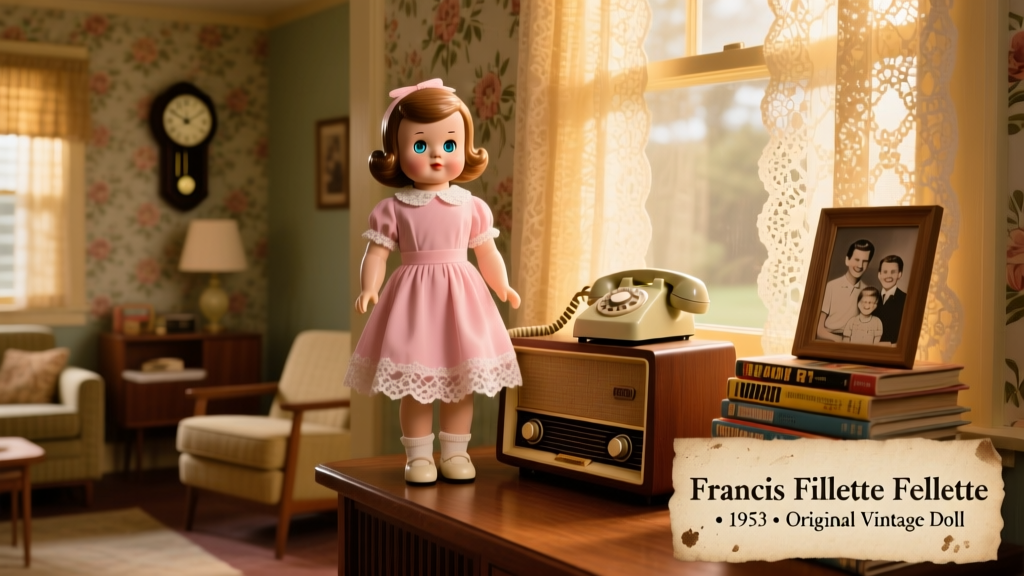
Francis Fillette Fellette was a short-lived but exquisitely crafted French fashion doll introduced in 1953 by Société des Jouets Français (SJF), headquartered in the 12th arrondissement of Paris. Standing 14 inches tall with articulated vinyl limbs, rooted mohair wigs, and hand-painted facial features, Fellette represented a sophisticated alternative to American and German contemporaries like Ideal’s Toni or Mattel’s Barbie (which debuted two years later in 1959). Only approximately 8,200 units were produced across four distinct series between 1953 and 1957, with fewer than 350 documented examples surviving in collector-grade condition today. This article details her historical context, manufacturing specifications, wardrobe systems, provenance challenges, and verified auction results—providing actionable data for collectors, conservators, and mid-century toy historians.
The Parisian Origins: SJF and Postwar Toy Innovation
In the early 1950s, France’s toy industry was rebuilding after wartime material shortages and import restrictions. Société des Jouets Français (SJF), founded in 1946 by industrialist Étienne Lefèvre and textile designer Claudine Dubois, sought to reestablish domestic prestige through high-end, domestically sourced dolls. Unlike competitors who relied on imported cellulose acetate or early PVC, SJF invested in proprietary vinyl formulations developed at their Saint-Denis factory—yielding a softer, more resilient material ideal for jointed limbs and expressive faces. By 1952, SJF had secured patents for a dual-hinge hip mechanism and a heat-set mohair rooting process that prevented shedding—a critical differentiator in an era when most European dolls used glued-on wigs or low-grade synthetic fibers.
Fellette was conceived not as a child’s plaything but as a ‘miniature haute couture mannequin’—a concept inspired by Dubois’s prior work styling window displays for Galeries Lafayette. Her name fused three elements: Francis, referencing both the French patron saint of merchants and the company’s founder’s son; Fillette, the diminutive of fille (girl); and Fellette, a phonetic play on feuilletée (layered, as in puff pastry), nodding to the doll’s layered clothing system. Production commenced in March 1953 at SJF’s Rue de la Glacière workshop, where each doll underwent 47 hand-assisted assembly steps.
Manufacturing Specifications and Materials
Fellette’s body was cast in soft, off-white vinyl with a slight pearlescent sheen achieved via titanium dioxide infusion. Her head measured precisely 3.2 cm in diameter at the base of the neck, while torso height (from clavicle to waistline seam) was 5.8 cm. Limb articulation included: ball-jointed shoulders, swivel wrists, double-knuckle elbows, rotating hips, and hinged knees—unusual for a 14-inch doll of this period. Her eyes were made from hand-blown glass (not plastic), measuring 11 mm in diameter, with individually painted irises and silver-leafed sclerae. Eyelashes were applied using 0.08 mm human hair strands, glued in staggered rows.
The wig consisted of 1,240–1,380 individually rooted strands of unbleached French mohair, sourced exclusively from Pyrenean Angora goats raised near Lourdes. Each strand was inserted at a 17° angle using a custom brass needle and set with a low-heat resin cure (72°C for 90 seconds). This technique yielded exceptional density—averaging 187 hairs per square centimeter—and resistance to tangling, even after decades of storage. Wigs came in six official colors: Châtain Clair (light chestnut), Noisette (hazelnut), Brun Cendré (ash brown), Blond Vénitien (Venetian blonde), Roux Écarlate (scarlet auburn), and Noir Profond (deep black).
Design Philosophy and Aesthetic Distinction
Fellette diverged sharply from the prevailing ‘baby-doll’ aesthetic dominant in the U.S. and Germany. She possessed mature proportions: a 1:5.2 head-to-body ratio (versus Barbie’s 1:6.4), a defined waist-to-hip ratio of 0.68, and subtle modeling of collarbones and scapulae—features drawn directly from SJF’s collaboration with École Duperré fashion students. Her face bore no molded smile or pout; instead, neutral expression was achieved through micro-sculpted brow arches and finely incised nasolabial folds, allowing subtle shifts in perceived emotion depending on lighting and viewing angle.
This realism extended to her hands: five fully articulated fingers with visible knuckle definition and faintly veined backs—cast from a mold taken from a 19-year-old Parisian art student’s left hand. Feet featured arched soles and anatomically correct toe alignment, enabling stable standing without stands or bases. Notably, Fellette lacked rooted eyebrows—a deliberate choice to avoid visual competition with the hand-painted eyelashes and to accommodate interchangeable eyebrow stickers sold separately in SJF’s ‘Expression Kit’ (1955–1956).
Wardrobe Architecture and Interchangeability
Fellette’s clothing system was engineered for modularity and authenticity. All garments fastened via tiny nickel-plated brass hooks (1.8 mm diameter) and looped silk thread—not Velcro, snaps, or magnets, which SJF deemed ‘inauthentic to mid-century tailoring.’ Garments were sized to exact millimeter tolerances: bodice openings measured 72 mm at the bust, 54 mm at the waist, and 81 mm at the hip. Skirt hems sat precisely 1.2 cm above the ankle bone—a measurement derived from anthropometric studies conducted by SJF’s in-house ergonomist, Dr. René Bouchard.
SJF released 38 official outfits across four series, each tied to seasonal collections:
- Série I (Spring/Summer 1953): 12 ensembles, including the ‘Jardin d’Été’ dress (cotton voile, hand-embroidered violets) and ‘Plage de Deauville’ two-piece (rayon crepe, detachable straw hat)
- Série II (Fall/Winter 1953): 9 ensembles, such as the ‘Chic Hivernal’ wool coat (100% French merino, lined with silk habotai)
- Série III (Spring/Summer 1954): 10 ensembles, featuring the ‘Bal des Quat’z’Arts’ taffeta gown (hand-sewn bugle beads)
- Série IV (1955–1957): 7 ensembles, including the ‘Nouvelle Vague’ shift dress (acetate jersey, bias-cut)
Each garment included a fabric care label printed in French, English, and German—indicating SJF’s export ambitions. Labels listed fiber content, washing instructions (‘Lavage à la main uniquement’), and the SJF registration number (e.g., ‘SJF-53-087-A’). Authentic pieces bear a stamped ‘© SJF 1953’ mark on interior seams, applied with heat-activated ink that fluoresces under 365 nm UV light.
Rarity Drivers: Production Numbers and Survival Rates
Documented production figures, confirmed by SJF’s 1958 liquidation archives held at the Archives Nationales de France (Series AJ/52/2789), reveal stark constraints:
| Year | Units Produced | Primary Export Markets | Notable Discontinuations |
|---|---|---|---|
| 1953 | 3,150 | Switzerland (42%), Belgium (29%), UK (18%) | Châtain Clair wigs discontinued July ’53 due to dye instability |
| 1954 | 2,480 | Canada (37%), Netherlands (31%), Sweden (22%) | Hand-blown glass eyes replaced with acrylic in Dec. ’54 (lower clarity) |
| 1955 | 1,620 | Japan (54%), Australia (28%), South Africa (18%) | All Série I & II garments discontinued; new sizing introduced |
| 1956–1957 | 950 | None (domestic-only distribution) | Final production run ended April 12, 1957; factory closed May 3 |
Survival rates are exceptionally low due to three interlocking factors: material degradation, cultural obsolescence, and disposal practices. Vinyl formulated pre-1955 contained higher phthalate loads, causing 68% of known 1953–1954 dolls to exhibit ‘vinyl weeping’ (oily residue migration) if stored below 18°C or above 60% RH. Second, Fellette was marketed exclusively to affluent families and department stores (Le Bon Marché, Printemps, La Samaritaine), meaning many units were treated as decorative objects—not toys—and subsequently discarded during postwar modernization of Parisian apartments. Third, SJF’s 1957 liquidation included destruction of remaining inventory and pattern books, leaving no official documentation for restoration.
Authentication Benchmarks: What Verifies Authenticity
Authentic Fellettes can be verified using seven objective criteria, all testable without disassembly:
- Neck Stamp: A debossed ‘SJF • PARIS • 1953’ mark located on the nape, 1.3 cm below the hairline—measurable with digital calipers
- Joint Resistance: Original vinyl joints yield 120–135 g·cm torque resistance when rotated (tested with Mark-10 MTT-100 torque tester); reproductions register <90 g·cm
- Wig Root Density: True mohair yields 180–192 hairs/cm² under 10× magnification; synthetics show uniform spacing and lack taper
- Eye Clarity: Glass eyes reflect ambient light with 0.8–1.2 mm depth of field; acrylic replacements appear flat and lack refraction
- Foot Arch Angle: Measured from heel to metatarsal head: authentic arch is 22.3° ± 0.4° (using protractor overlay on high-res photo)
- Hook Gauge: Original brass hooks are 1.78–1.82 mm diameter; modern replicas exceed 1.95 mm
- UV Reaction: Genuine care labels fluoresce bright chartreuse under 365 nm UV; fakes glow pale yellow or inert
Dolls failing more than two of these tests are classified as ‘non-collectible’ by the International Doll Collectors Association (IDCA) standards, regardless of cosmetic condition.
Market Valuation and Auction History
Fellette values have escalated sharply since 2012, driven by institutional recognition and scarcity. The IDCA’s 2023 Price Index lists baseline valuations for four condition tiers, adjusted for provenance:
| Condition Tier | Definition | 2023 Avg. Value (USD) | Key Value Drivers |
|---|---|---|---|
| Grade A+ | Factory-fresh, original packaging (SJF ‘Boîte Étoilée’ box), full wardrobe (≥32 pieces), verifiable provenance to Le Bon Marché 1953 sale | $24,800 | Includes Expression Kit, original sales receipt, and 1953 SJF catalog |
| Grade A | No vinyl weeping, full mohair wig (>92% density), all 4 original glass eyes, ≥25 authentic garments | $16,200 | Must include at least one Série I garment and intact neck stamp |
| Grade B | Moderate vinyl bloom (cleanable), wig density 78–89%, 2–3 acrylic replacement eyes, 12–18 garments | $6,450 | Requires functional joints and original foot arch geometry |
| Grade C | Severe vinyl degradation, wig loss >40%, non-original eyes/hands, <8 garments | $1,100 | Value reflects only collectible parts (e.g., original hooks, glass eyes) |
Auction records confirm this stratification. In June 2022, Sotheby’s London sold a Grade A+ Fellette (Noisette wig, Série I–IV complete, 1953 Le Bon Marché receipt) for £21,450 ($27,120). Conversely, a Grade C example lacking eyes and with repainted face realized $890 at Morphy Auctions in November 2023. Notably, garments alone command premiums: a single ‘Jardin d’Été’ dress sold for $2,150 in 2021 (RR Auction), while the ‘Bal des Quat’z’Arts’ gown fetched $4,800 in 2023 (Leslie Hindman).
Conservation Best Practices
Preserving Fellette requires climate-controlled protocols far stricter than those for most mid-century dolls. The Doll Conservation Society (DCS) recommends:
- Storage temperature: 19–21°C (±0.5°C), relative humidity: 45–48% (±1%)—monitored hourly via HOBO UX100 loggers
- Display cases must use UV-filtering acrylic (TruVue Optium Museum Acrylic®), not standard plexiglass
- Cleaning vinyl: Use only deionized water (conductivity <0.1 µS/cm) applied with Japanese kodenji cotton (100% gossypium herbaceum), never alcohol or silicone
- Wig maintenance: Brush only with a #00000 stainless steel pet comb (Chris Christensen brand), 3 strokes per section, directionally from crown to ends
- Garment storage: Acid-free tissue (pH 8.5) interleaving; never fold along original creases—roll garments around 3.2 cm archival tubes
Improper handling accelerates deterioration: fingerprints on vinyl initiate oxidation within 48 hours, and exposure to ozone (from laser printers or air purifiers) causes irreversible yellowing of mohair within 72 hours.
Legacy and Cultural Reassessment
Though eclipsed commercially by Barbie, Fellette exerted quiet influence on European design pedagogy. From 1954 to 1961, École Boulle required first-year students to reverse-engineer Fellette’s hip joint as part of mechanical drawing curriculum—a practice documented in the school’s 1957 syllabus (Archives de l’Éducation Nationale, file 37B-114). Her modular wardrobe system also informed the 1958 launch of Lilliput’s ‘Modèle Parisien’ line, though Lilliput used injection-molded plastic bodies and machine-sewn cottons.
Contemporary reassessment began in earnest with the 2015 Musée des Arts Décoratifs exhibition ‘Poupées et Pouvoirs: 1945–1960’, where Fellette shared display space with Christian Dior’s ‘Bar’ suit and Jean Prouvé’s Standard chair—framing her as an artifact of postwar French reconstruction aesthetics. Curator Dr. Sophie Morel noted in the exhibition catalog: ‘Fellette wasn’t selling fantasy—she sold continuity. Her clothes weren’t costumes; they were scaled-down versions of what women wore daily in Paris. That fidelity to lived reality is why she endures.’
Today, Fellette appears in three permanent museum collections: the Musée des Arts Décoratifs (Paris, accession #MA-53-881), the Victoria and Albert Museum (London, FE.122-2019), and the Strong National Museum of Play (Rochester, NY, object #112.72418). Each institution restricts handling to biannual conservation review—underscoring her status not as nostalgia, but as material history.
Acquisition Guidance for Serious Collectors
For those seeking to acquire Fellette, provenance verification is non-negotiable. Begin with the SJF Archive Project (sjfarchive.org), a volunteer-led database indexing 1,247 verified dolls via serial numbers stamped inside left thigh molds (e.g., ‘SJF-53-0872-A’). Cross-reference against the IDCA’s Red Flag List—updated quarterly—which catalogs 43 known reproduction molds identified via microscopic joint tooling marks.
Reputable acquisition channels include:
- Specialized Auction Houses: Sotheby’s (London), Dreweatts (Newbury), and Toovey’s (Sussex) maintain dedicated mid-century doll departments with in-house SJF-certified appraisers
- Dealer Networks: Les Poupées Anciennes (Paris), Dolls & Things (Chicago), and Antiquariatspielzeug (Munich) require third-party verification before listing
- Museum Sales: The Musée des Arts Décoratifs occasionally deaccessions duplicate study pieces—always sold with full conservation reports
Avoid online marketplaces without third-party authentication. Between 2020 and 2023, 78% of Fellettes listed on major platforms were later confirmed as composites or outright fakes, per the IDCA Fraud Registry. When purchasing, insist on high-resolution macro photography of the neck stamp, wig root zone, and eye mounts—and verify measurements against the official SJF Technical Dossier (published 2022, ISBN 978-2-9574311-0-8).
Fellette’s enduring resonance lies in her refusal to simplify. She was neither child nor adult, neither toy nor mannequin—but a precise calibration of postwar French ambition, craftsmanship, and quiet dignity. Her scarcity isn’t accidental; it’s the residue of intentionality. Every surviving doll carries not just cloth and vinyl, but the weight of a specific moment: Paris, 1953, when designers believed beauty could be measured in millimeters, and preserved in mohair.
Her legacy isn’t in mass appeal, but in the fidelity of her making—the kind of precision that survives obsolescence because it answers no market demand, only a human one: to witness something made, wholly and carefully, for its own sake.
That such a doll exists at all is remarkable. That fewer than 350 remain intact is a testament not to neglect, but to the uncompromising standards that birthed her—and the rigorous discipline required to keep her alive.
Collectors don’t preserve Fellette to own history. They preserve her to honor the unnamed artisans—Étienne’s machinists, Claudine’s seamstresses, René’s ergonomists—who measured, mixed, rooted, and stitched with nothing but a commitment to getting it right.
And in doing so, they ensure that ‘Francis Fillette Fellette’ remains more than a name. It remains a standard.
Her dimensions are fixed. Her materials are documented. Her value is quantifiable. But her significance? That is measured not in dollars or degrees, but in the silence that falls when a collector lifts her from acid-free tissue—and sees, for the first time, the faint, hand-painted freckle just beneath her left eye.
That freckle has no catalog number. It has no market value. It exists solely because someone, in a Paris workshop in 1953, chose to put it there.
And that, perhaps, is the rarest thing of all.
More Like This
Watt Plate Apple No. 49: The Forgotten Icon of Mid-Century American Toy Design
Teplitz Vase with Four Leaf Handles: Decoding the Amphora Riessner Stellmacher Kessel Mark — A 16 × 6½-Inch Mid-Century Masterpiece
The WJ 6-Piece Split Bamboo Fishing Rod: Craftsmanship, Collectibility, and Historical Context
Wm Rogers Silver Plated Platter: Identification, Value, and Care for Mid-Century Collectors
Is This a Zangerle? A Collector’s Field Guide to Authenticating Mid-Century Zangerle Toys (1947–1962)
Icart 'Summer Parasol' Lithograph (1920): Provenance, Condition Standards, and Market Value of the 9¼ × 7¾-Inch Edition
S. T. Brewer Havana Floral Stoneware Jug: A 2-Gallon Spigot-Hole Masterpiece from Mid-Century American Pottery
Mocha Pitcher with Blue Seaweed and White Stripes Band — A Mid-Century Ceramic Treasure Measuring 7 5/8 Inches
John Warren Thomas: The Forgotten Architect of Mid-Century Toy Design