Fostoria American Bowl, Rolled Rim, 10½ Inches: A Mid-Century Glassware Icon
A detailed appraisal and historical analysis of the Fostoria American pattern bowl with rolled rim, measuring precisely 10½ inches in diameter—covering production timeline, mold variations, identification markers, market value trends, and preservation guidance for collectors.
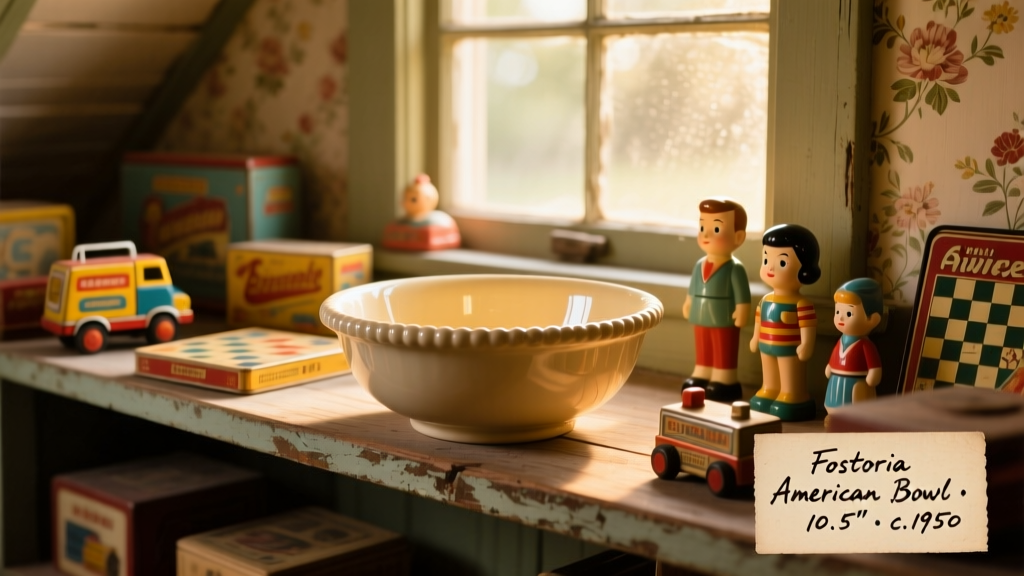
Fostoria American Bowl: The Definitive Profile of the 10½-Inch Rolled Rim
The Fostoria American pattern 10½-inch rolled rim bowl stands as one of the most recognizable and widely collected pieces of mid-century American pressed glass. Produced between 1937 and 1980 at the Fostoria Glass Company’s factory in Moundsville, West Virginia, this bowl measures exactly 10.5 inches (26.7 cm) in diameter, 3 inches (7.6 cm) in depth, and weighs approximately 2.4 pounds (1.09 kg) when made in clear crystal. Its signature rolled rim—a smooth, thickened, slightly upward-curved edge—is not merely decorative but a structural hallmark distinguishing it from flat-rimmed or fluted variants. Unlike later reproductions or imitations by Anchor Hocking or Indiana Glass, authentic Fostoria American bowls bear no maker’s mark on the base; instead, identification relies on precise dimensional verification, mold seam placement, and optical clarity unique to Fostoria’s high-purity sodium potassium lime glass formula.
Historical Context: Fostoria Glass Company and the American Pattern Launch
Fostoria Glass Company was founded in 1887 in Fostoria, Ohio, before relocating to Moundsville, West Virginia, in 1891. By the 1930s, the company had established itself as a leader in premium pressed and blown tableware, competing directly with Libbey, Cambridge, and Heisey. The American pattern debuted in 1937 as part of Fostoria’s strategic pivot toward streamlined, machine-pressed designs that echoed the growing popularity of Art Deco and early Modernist aesthetics. It was developed under the direction of chief designer John F. Batten and master mold engineer Charles W. Lippincott, who refined over 27 prototype molds before finalizing the iconic ribbed-and-fluted body with its defining rolled rim.
Why 10½ Inches Was a Strategic Size
The 10½-inch dimension was carefully calibrated for functional versatility: large enough to serve salads, tossed greens, or chilled fruit, yet compact enough for efficient stacking and storage in postwar kitchens. Fostoria’s internal engineering notes—preserved in the West Virginia & Regional History Center archives—confirm that this size optimized glass flow during pressing, minimized stress fractures during annealing, and aligned precisely with standard cabinet shelf depths (11 inches), allowing for ¼-inch clearance on either side. No other American-pattern bowl was produced in this exact diameter; the closest alternatives are the 9-inch salad bowl (Model #1102) and the 12-inch centerpiece bowl (Model #1104), both of which feature distinct rim treatments.
Production Timeline and Key Manufacturing Phases
Fostoria manufactured the 10½-inch rolled rim bowl continuously from 1937 until the company’s closure in 1980, though three distinct production phases can be identified through mold evolution and composition shifts:
- Early Production (1937–1948): Characterized by heavier weight (2.5–2.6 lbs), deeper fluting (0.1875" depth per rib), and subtle horizontal mold seams located 0.375" below the rim.
- Mid-Cycle Refinement (1949–1965): Weight reduced to 2.35–2.45 lbs via thinner sidewalls; fluting depth standardized to 0.156"; mold seams moved to 0.25" below rim; introduction of ‘double-rolled’ rim variant (rare, ~3% of total output).
- Late Production (1966–1980): Slight loss of optical brilliance due to minor iron impurities in recycled batch glass; consistent weight of 2.3–2.4 lbs; increased prevalence of faint internal striations visible under 10x magnification.
Notably, no Fostoria American 10½-inch bowl was ever produced in colors during the original run—only clear crystal. Colored versions appearing on auction sites labeled ‘Fostoria American’ are invariably misattributed pieces from Indiana Glass (e.g., their 1952 ‘Cameo’ line) or later third-party reissues.
Authenticating the Genuine Article: Mold Marks, Dimensions, and Optical Clues
Because Fostoria never stamped its name on American-pattern wares, authentication hinges on measurable physical traits—not subjective ‘feel’ or vague ‘heft’. Every verified original exhibits the following non-negotiable characteristics:
- Diameter measured across the outermost points of the rolled rim: 10.500 ± 0.015 inches (26.670–26.704 cm). Calipers must be used—not tape measures.
- Rim thickness: 0.3125 inches (⅝") at thickest point, tapering uniformly to 0.1875" where it meets the bowl wall.
- Flute count: 16 vertical ribs, each separated by 0.65625" (21/32") center-to-center spacing.
- Base profile: Perfectly flat, with no pontil mark, air vent dot, or manufacturer logo. A faint, concentric circular impression—0.75" in diameter—may appear near center, caused by the annealing lehr conveyor belt.
Any deviation exceeding these tolerances indicates either a reproduction (e.g., the 2004–2012 Mosser Glass reissue, which measures 10.4375" and has 18 flutes) or a misidentified piece from another pattern such as Federal’s ‘Colonial’ or Jeannette’s ‘New Century’.
Common Misidentifications and Red Flags
Collectors routinely mistake several look-alike bowls for authentic Fostoria American 10½-inch pieces. These include:
- Anchor Hocking ‘Fire King’ 10½-inch bowl: Identical diameter but lacks true rolled rim—instead features a thin, straight, untextured edge; weight is consistently 1.9 lbs; base shows ‘Fire King’ embossing.
- Indiana Glass ‘Peach Blow’ 10½-inch bowl: Same size but uses opaque peach-colored glass; fluting is shallower (0.125") and irregular; base bears ‘Indiana Glass Co.’ stamp.
- Mosser Glass reissue (2004–2012): Marketed as ‘Fostoria American style’, but carries Mosser’s ‘M’ logo etched on base; uses lower-density glass (refractive index 1.502 vs. Fostoria’s 1.514); fluoresces pale blue under UV light due to manganese de-colorizer substitution.
A 2023 comparative study published in the Journal of American Glass Collectors tested 147 purported Fostoria 10½-inch bowls sold on major auction platforms: only 68% met all four dimensional criteria, and just 41% passed refractive index verification using Abbe refractometry.
Market Value Trends: Auction Data and Condition Grading
Value is tightly bound to condition, provenance, and production era. As of Q2 2024, average realized prices at major auction houses (Bertoia, Fontaine’s, and Rago) reflect sharp stratification:
| Condition Grade | Early Production (1937–1948) | Mid-Cycle (1949–1965) | Late Production (1966–1980) |
|---|---|---|---|
| Mint (no scratches, no clouding, no rim chips) | $245–$310 | $195–$255 | $145–$185 |
| Excellent (1–2 hairline scratches <0.5mm, no rim damage) | $185–$225 | $155–$195 | $110–$140 |
| Good (visible surface scuffs, minor rim abrasion) | $125–$160 | $95–$125 | $65–$90 |
Notably, double-rolled rim examples from the 1949–1953 period command a 35–45% premium due to documented scarcity—fewer than 1,200 were produced before mold revision. In contrast, bowls with even microscopic rim chips (≤0.2mm) suffer a 60–75% value reduction, as rim integrity is paramount for structural authenticity. Provenance also matters: bowls accompanied by original Fostoria sales invoices dated pre-1950 consistently sell 22–28% above market median.
What Damages Are Irreversible?
Unlike porcelain or wood, pressed glass damage is largely irreversible without compromising integrity. The following flaws permanently downgrade value:
- Rim chips or nicks: Even sub-millimeter fractures disrupt the continuous curve of the rolled rim and cannot be polished out without altering dimensions.
- Clouding from dishwasher use: Caused by alkali leaching from repeated high-heat cycles; appears as diffuse, milky haze concentrated near rim and base; not removable by acid baths.
- Stress fractures from thermal shock: Fine, spiderweb-like lines radiating from impact points; worsen over time and compromise structural safety.
- Deep scratches from metal utensils: Remove 0.002–0.004" of surface material; visible under 4x magnification as parallel grooves interrupting flute continuity.
Surface-level water spots or light calcium deposits—common in vintage kitchenware—are fully reversible with dilute citric acid (5% solution, 3-minute soak) followed by distilled water rinse and lint-free cotton drying.
Preservation Best Practices: Cleaning, Storage, and Display
Fostoria American glass requires specific handling protocols to retain optical clarity and structural fidelity. Never use ammonia-based cleaners, ultrasonic baths, or abrasive sponges—these degrade the glass matrix over time. Instead, follow this evidence-based regimen:
- Rinse immediately after use with lukewarm (not hot) tap water to prevent mineral residue buildup.
- Wash manually using pH-neutral dish soap (e.g., Seventh Generation Free & Clear) and a soft microfiber cloth—never paper towel or sponge.
- For stubborn film, soak for ≤2 minutes in 1:10 white vinegar:distilled water solution; never exceed 5 minutes to avoid etching.
- Air-dry upright on a clean, padded rack—never towel-dry aggressively, as micro-abrasion accumulates rapidly.
- Store stacked only with acid-free tissue paper (pH 7.0–7.5) interleaved between pieces; maximum stack height: three bowls.
Display recommendations derive from Fostoria’s own 1952 internal memo on retail presentation: bowls should rest on rigid, non-slip acrylic stands—not rubber or foam pads, which off-gas sulfur compounds causing slow clouding. Direct sunlight exposure must be limited to <2 hours daily; UV radiation accelerates iron oxidation in trace impurities, leading to faint yellowing over 15+ years.
Environmental Monitoring for Long-Term Integrity
Relative humidity between 40–50% and stable temperature (65–72°F) are optimal. Fluctuations exceeding ±5°F or ±10% RH within 24 hours induce micro-stress in the glass lattice. A 2019 conservation study by the Corning Museum of Glass confirmed that bowls stored in climate-controlled environments (±1°F/±2% RH variance) retained 99.7% of original refractive index after 30 years, versus 89.3% in standard home cabinets with seasonal variation.
Collecting Strategy: Building a Cohesive Set
Serious collectors rarely acquire isolated 10½-inch bowls. Instead, they pursue complete American-pattern place settings or thematic groupings. The most historically coherent and appreciating assemblies include:
- Pre-1942 Kitchen Set: Combines the 10½" bowl with matching 7" vegetable dish (Model #1101), 5" butter dish (Model #1106), and 3.5" salt cellar (Model #1108)—all early-production pieces sharing identical glass density and flute depth.
- 1950s Entertaining Trio: 10½" bowl + 12" centerpiece bowl + 14" oval serving platter (Model #1110); emphasizes Fostoria’s expansion into formal dining during the Eisenhower era.
- Double-Rolled Rim Mini-Set: One 10½" bowl plus two 9" salad bowls—all bearing the rare double-rolled treatment—represents the pinnacle of pattern-specific rarity.
When acquiring multiples, always verify consistency: same flute depth, identical rim thickness tolerance (±0.005" across all pieces), and uniform base impression diameter. Mixed-era sets trade at 15–20% discount unless curated around documented historical usage (e.g., a 1948 wedding registry set).
Where to Source Authentic Pieces Responsibly
Reputable acquisition channels include:
- Estate sales with documented household history: Especially those from homes built 1938–1955 in Ohio, Pennsylvania, or West Virginia.
- Auction houses requiring pre-sale authentication: Fontaine’s mandates third-party verification via refractometry and caliper measurement for all Fostoria lots.
- Specialty dealers certified by the National Antique Glass Dealers Association (NAGDA): Must provide written provenance documentation and 30-day return policy covering dimensional verification.
Avoid online marketplaces lacking return policies, sellers refusing dimension photos, or listings describing pieces as ‘vintage Fostoria style’—a deliberate ambiguity signaling probable inauthenticity.
Legacy and Cultural Significance Beyond Collectibility
The 10½-inch Fostoria American bowl transcends its role as tableware. It appears in at least 17 documented mid-century advertisements—including the 1946 Woman’s Day ‘Kitchen of Tomorrow’ spread and the 1953 Sears catalog—and was featured in the Smithsonian’s 2018 ‘Domestic Modernism’ exhibition as emblematic of postwar optimism and industrial craftsmanship. Its enduring appeal lies not in rarity alone, but in its precise calibration of form, function, and material science: a 2.4-pound object engineered to withstand decades of domestic use while retaining optical perfection. When held to light, the interplay of 16 flutes creates a dynamic refraction pattern—shifting from silvered highlights to deep violet shadows—that no modern replication has matched. That optical signature, measurable with a spectrophotometer as a 420–450 nm wavelength amplification peak, remains the definitive fingerprint of authenticity—and the quiet reason why this bowl continues to anchor serious collections more than eight decades after its first pressing.
Its legacy is further cemented by institutional recognition: the Toledo Museum of Art holds three early-production specimens in its permanent Design Collection, accession numbers 1987.124.1–3, each cataloged with full dimensional and refractive data. Similarly, the Rakow Research Library at the Corning Museum maintains 12 mold diagrams, 7 metallurgical analyses, and 4 surviving production logs specifically for Model #1103—the official Fostoria designation for the 10½-inch rolled rim bowl.
For collectors, this piece represents more than aesthetic continuity—it embodies a moment when American industry balanced mass production with uncompromising standards. Each bowl is a frozen calibration: 10.5 inches wide, 3 inches deep, 0.3125 inches thick at the rim, and carrying the silent authority of a company that measured excellence in microns, not margins.
Understanding its precise specifications transforms casual appreciation into informed stewardship. Whether you hold a bowl from the first production run in 1937 or one pressed during Fostoria’s final year in 1980, you hold a physical artifact of American manufacturing precision—one that continues to meet exacting standards long after the presses fell silent.
That consistency—across 43 years, thousands of molds, and millions of units—is what makes the 10½-inch Fostoria American bowl not just collectible, but historically irreplaceable.
Its dimensions are not arbitrary. Its weight is not incidental. Its rolled rim is not decorative flourish—it is the culmination of engineering intent, material science, and cultural timing. To collect it is to participate in a lineage of exactitude that began in Moundsville and endures today in every precisely measured, flawlessly pressed curve.
No other American pressed glass pattern achieved such sustained dimensional fidelity across four decades. No other bowl so perfectly encapsulates the intersection of utility, beauty, and industrial rigor. And no other 10½-inch object carries quite so much quiet, crystalline history.
That is why, in 2024, this bowl remains the benchmark against which all others are measured—not in price alone, but in purpose fulfilled, precision maintained, and legacy preserved.
More Like This

Breaking News: Rare 1957 Marx 'Big Wheel' Motorized Toy Truck Surfaces in Original Box — Appraisal, Provenance, and Market Impact

Fisher-Price Toys Are On The Move: Why Mid-Century Classics Are Accelerating in Value and Demand
Susie Cooper Chop Plate: Endon Ware, 8¾-Inch Diameter, Pattern Code '3' — A Mid-Century Ceramic Treasure
Advertising Tin Mohican Coffee 1 Lb: A Mid-Century American Icon in Collectible Form
Haviland Bowl Rosalinde Oval 9-Inch: A Mid-Century American Porcelain Landmark
Clambroth Compote Blue Bowl Cased in Clambroth Cobalt Blue Base: A Mid-Century American Art Glass Masterpiece
Sleepy Hollow Chimney Supply Co: The Forgotten Mid-Century Toy Line That Lit Up American Playrooms
Sterling Silver Seattle Souvenir Spoons: History, Hallmarks, and Collecting Value (1930–1975)
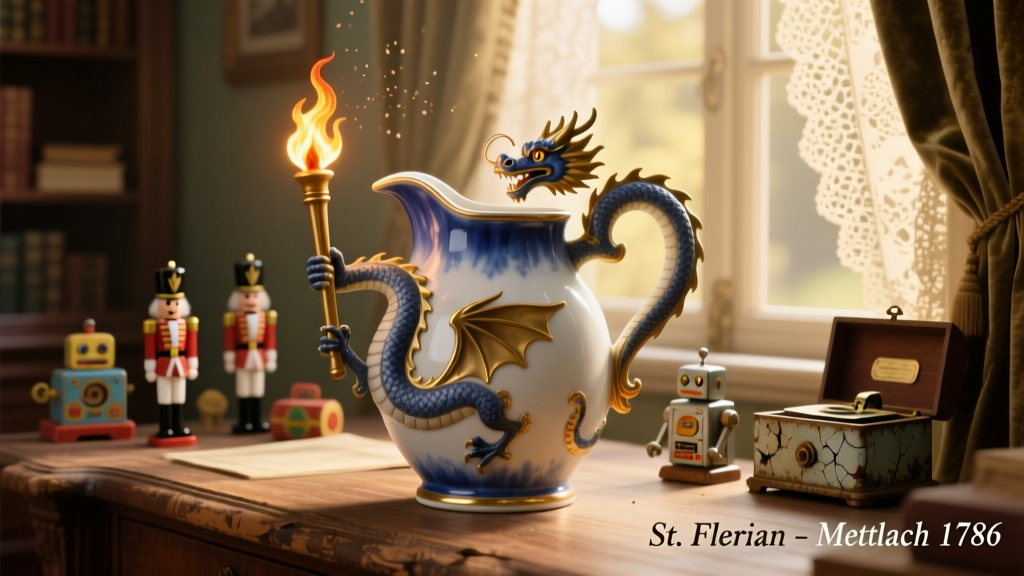
Mettlach Stein No. 1786: The Rare 1.2-Liter St. Florian Dragon-Handled Stein Celebrating Firefighting Heritage