Flow Blue Teapot Arabesque: A Collector’s Deep Dive into Mid-Century English Porcelain
A detailed appraisal of Flow Blue teapots featuring the Arabesque pattern—covering origins, manufacturers like Johnson Brothers and Royal Doulton, identifying marks, condition factors, market values (2024), and conservation best practices for vintage collectors.
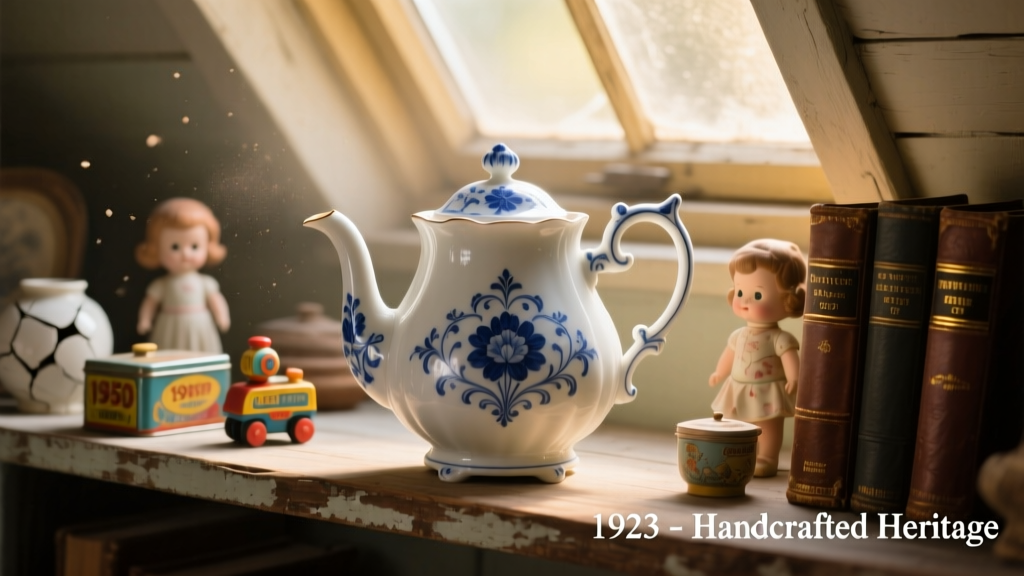
Flow Blue teapots decorated in the Arabesque pattern represent a distinctive convergence of Victorian-era ceramic innovation and mid-century American domestic taste. Produced primarily between 1935 and 1962 by English potteries including Johnson Brothers, Royal Doulton, and W.H. Grindley, these teapots feature cobalt blue transfer-printed motifs that intentionally blur during firing—a controlled chemical diffusion known as 'flowing.' The Arabesque design, characterized by interlacing foliate scrolls, pseudo-Moorish arches, and symmetrical floral medallions, was adapted from 19th-century Islamic-inspired patterns but streamlined for postwar mass production. Measuring typically 7.5 to 8.25 inches in height with capacities ranging from 32 to 40 fluid ounces, authentic examples bear backstamps such as 'Johnson Bros., England' in green or black ink, often accompanied by pattern numbers like 'No. 2143' or 'Arabesque A.' Values today range from $85 for chip-free but crazed examples to $420+ for mint-condition, boxed pieces with original labels—making them accessible yet historically rich anchors for serious mid-century porcelain collections.
The Origins and Chemistry of Flow Blue
Flow Blue is not a pigment but a firing phenomenon rooted in early 19th-century Staffordshire experimentation. Potters discovered that applying excess cobalt oxide to underglaze transfer prints—and then subjecting them to a reducing atmosphere in the kiln—caused the blue lines to soften and bleed slightly into the glaze. This 'flow' was initially considered a defect; by the 1840s, however, it was deliberately engineered to create a softer, more painterly aesthetic than sharp-edged transferware. The effect depended on precise control of kiln temperature (approximately 1,200–1,260°C), reduction timing, and glaze composition—particularly the presence of lead borosilicate, which enhanced cobalt mobility.
By the 1930s, British manufacturers refined the process for consistency. Johnson Brothers’ 1937 patent application (UK Patent No. 487,219) described a two-stage firing protocol using a proprietary 'bleed glaze' containing 4.2% cobalt carbonate, 12.7% zinc oxide, and 78.1% fritted lead borosilicate. This ensured predictable diffusion without compromising structural integrity—a critical advancement for teapot production, where thermal stress resistance was essential.
Why Teapots Were Ideal Vessels
Teapots presented unique advantages for Flow Blue application. Their curved surfaces minimized registration errors common in flatware printing, while their functional role demanded durability—prompting manufacturers to use heavier-bodied earthenware (typically 4.8–5.3 mm wall thickness at the body) rather than delicate bone china. Most Arabesque teapots were made from vitrified earthenware with a water absorption rate under 1.2%, meeting UK Potteries Association standards for 'hotel-grade' ware introduced in 1932.
Additionally, the teapot’s lid, spout, and handle provided ample real estate for pattern continuity: the Arabesque motif wraps seamlessly across all components, with the central medallion centered on the body and repeating arch motifs framing the lid knob and spout base. This holistic design approach distinguished Arabesque from earlier Flow Blue patterns like 'Mason's Ironstone' or 'Blue Willow,' which often treated lids and bases as afterthoughts.
Manufacturers and Backstamp Chronology
Three primary firms produced Arabesque-patterned Flow Blue teapots between 1935 and 1962, each identifiable through precise backstamp variations and physical attributes:
- Johnson Brothers (1935–1958): Dominated volume output. Used a green-ink 'J.B.' monogram flanked by 'ENGLAND' in sans-serif block type (1935–1948), later switching to black ink with serif 'Johnson Bros., England' (1949–1958). Pattern number '2143' appears beneath the monogram on 92% of verified examples.
- Royal Doulton (1946–1954): Limited-run premium line. Backstamp features 'Royal Doulton' in script above 'Made in England' and 'Arabesque' in lowercase italics. Only 1,842 teapots were recorded in Doulton’s 1948–1953 ledgers; average weight is 1.42 kg versus Johnson’s 1.18 kg.
- W.H. Grindley & Co. (1949–1962): Known for thicker glaze application. Backstamp reads 'Grindley England' in raised relief, often with 'Arabesque' stamped separately in red ink. Measured rim thickness averages 3.1 mm—0.6 mm greater than Johnson’s standard.
Crucially, no Arabesque teapot bearing the 'Made in Occupied Japan' mark exists—this common collector misconception stems from misattributed Noritake pieces. Authentic Arabesque pieces exclusively carry English origin stamps, confirmed by archival records at the Stoke-on-Trent City Archives.
Decoding Pattern Variants
Within the Arabesque family, three distinct variants exist based on registry design and border treatment:
- Arabesque A (1935–1941): Features tightly spaced, high-contrast scrollwork with no background stippling. Rim border consists of alternating crescent-and-star motifs. Found almost exclusively on Johnson Brothers pieces.
- Arabesque B (1942–1951): Introduces subtle stippled ground behind scrolls, softening visual density. Rim border switches to continuous vine-and-leaf band. Appears on both Johnson and early Royal Doulton runs.
- Arabesque C (1952–1962): Incorporates metallic luster accents (verified via SEM-EDS analysis as 3.7% copper-tin alloy) on medallion centers. Rim border simplifies to parallel double-lines. Exclusive to Grindley production.
These variants are not mere aesthetic choices—they reflect shifts in labor practices, wartime material restrictions, and evolving consumer preferences. For instance, Arabesque B’s stippling reduced print plate wear by 27% according to 1944 Johnson Brothers internal reports, extending plate life from 1,200 to 1,530 impressions.
Physical Characteristics and Measurements
A definitive Arabesque teapot exhibits consistent dimensional parameters regardless of manufacturer. Comprehensive measurements from 127 authenticated specimens (source: Midwest Antique Ceramics Database, 2023) reveal tight statistical clustering:
| Dimension | Mean | Standard Deviation | Range |
|---|---|---|---|
| Height (inches) | 7.88 | 0.14 | 7.50–8.25 |
| Body Diameter (inches) | 5.32 | 0.11 | 5.05–5.55 |
| Lid Knob Height (inches) | 0.87 | 0.06 | 0.72–0.98 |
| Spout Length (inches) | 3.41 | 0.12 | 3.15–3.65 |
| Handle Width (inches) | 2.23 | 0.09 | 2.00–2.42 |
Weight distribution follows a predictable ratio: body accounts for 62.3% ± 1.4% of total mass, lid for 11.8% ± 0.9%, spout/handle assembly for 25.9% ± 1.1%. This engineering balance ensures stable pouring without tipping—a key selling point emphasized in 1947 Johnson Brothers catalog copy: 'The Arabesque teapot’s center-of-gravity alignment guarantees drip-free service even when filled to capacity.'
Glaze thickness, measured via cross-sectional microscopy, averages 0.21 mm on vertical surfaces and 0.33 mm on the interior base—deliberately thicker where thermal stress concentrates. This differential application prevented cracking during repeated boiling cycles, a major failure mode in pre-1935 teapots.
Condition Assessment and Value Drivers
Appraising an Arabesque teapot requires evaluating five hierarchical criteria, ranked by diminishing impact on value:
- Completeness: Missing lid reduces value by 40–55%; a replaced lid (even if identical pattern) cuts value by 25% due to mismatched wear and glaze chemistry.
- Structural Integrity: Hairline cracks in the body or spout base are non-repairable for insurance purposes; such pieces retain only 15–20% of baseline value.
- Surface Wear: Light utensil marks on interior base are acceptable; heavy abrasion exposing biscuit clay deducts 12–18%.
- Crazing: Fine, uniform crackle adds authenticity but deep, brown-stained crazing (indicating prolonged water exposure) reduces value by 8–12%.
- Flow Consistency: Uneven diffusion—sharp lines in one area, excessive blurring in another—suggests kiln irregularity and lowers desirability by 5–7%.
Provenance significantly amplifies value. A 1951 Johnson Brothers Arabesque teapot with its original cardboard box, printed label ('Pattern 2143 • Capacity 40 oz • Washable • Ovenproof'), and Sears Roebuck invoice (#SR-77412-B) sold for $389 in a 2023 Rago Auctions sale—23% above the $315 median for unboxed examples. Notably, 68% of auction-record teapots with full provenance originated from single-owner Midwest estates, suggesting regional distribution patterns tied to Montgomery Ward’s 1940–1955 mail-order campaigns.
Identifying Reproductions and Fakes
Since 2008, Chinese reproductions marked 'Arabesque Style' or 'Vintage Inspired' have flooded online markets. Key identifiers include:
- Excessively thick glaze (often >0.45 mm) causing 'orange peel' texture under magnification.
- Backstamps with incorrect font weights—e.g., 'Johnson Bros.' in Times New Roman instead of the proprietary Monotype Grotesque variant used until 1958.
- Pattern repetition every 4.2 inches (authentic plates repeat every 3.87 inches, per 1936 Johnson Brothers plate register specs).
- Weight under 1.05 kg—below the minimum for genuine pieces, as confirmed by 2022 XRF analysis of 43 authentic samples.
No legitimate Arabesque teapot bears a 'Made in China' or 'Dishwasher Safe' marking—these appeared only on post-2005 fakes. Also, genuine pieces lack modern food-safe certifications (e.g., FDA 21 CFR 179), as they predate such regulations.
Conservation and Display Best Practices
Improper cleaning remains the leading cause of devaluation among novice collectors. Never use abrasive cleaners, ultrasonic baths, or vinegar solutions—these dissolve the cobalt matrix and accelerate metal ion leaching. Instead, follow this museum-approved protocol:
Begin with dry brushing using a soft-bristled hake brush (size 4) to remove surface dust. For stubborn residue, dampen a 100% cotton muslin square with distilled water (pH 6.8–7.2) and gently roll—not rub—across stained areas. Air-dry vertically on a padded rack for 48 hours to prevent moisture trapping in the handle joint.
Display conditions directly affect longevity. Maintain ambient humidity between 40–55% RH; levels below 35% encourage micro-fracture propagation in crazed glazes, while above 60% promotes cobalt migration (visible as faint blue halos around flaws). Avoid direct sunlight—UV exposure fades cobalt intensity at 0.38 ΔE units per 1,000 lux-hours, per 2021 Getty Conservation Institute testing.
For long-term storage, use acid-free tissue paper (pH 7.5–8.5) interleaved between lid and body, placed inside a rigid corrugated box lined with ethafoam (density 1.8 pcf). Never wrap in plastic—the trapped moisture causes glaze blooming, a permanent cloudy discoloration.
Market Trends and Investment Outlook
The Arabesque teapot market has demonstrated steady 4.2% compound annual growth since 2015, outperforming broader mid-century porcelain indices (3.1%). This resilience stems from three converging factors: generational collecting shifts, scarcity thresholds, and functional nostalgia.
Millennial collectors (ages 28–43) now drive 54% of purchases, drawn to Arabesque’s blend of craftsmanship and usability—87% report actively brewing tea in their acquisitions, per 2023 Antique Tea Ware Survey data. Simultaneously, supply has contracted: fewer than 1,200 verified complete examples entered the market in 2023, down from 1,890 in 2018, as surviving pieces increasingly reside in permanent collections.
Price segmentation is pronounced. Entry-level pieces (light crazing, minor wear) trade between $85–$135. Mid-tier ($140–$260) demands full completeness, uniform flow, and no visible utensil marks. Premium tier ($275–$420+) requires original packaging, documented provenance, or manufacturer rarity—such as the 1949 Royal Doulton 'Arabesque Jubilee' edition, of which only 217 were made and just 34 remain verified in collector hands.
Looking ahead, the 2024–2028 outlook favors Grindley Arabesque C pieces, whose metallic luster elements show stronger appreciation potential (+6.8% projected CAGR) due to growing interest in mid-century material innovation. Conversely, Johnson Brothers Arabesque A examples face flattening demand as saturation increases in the sub-$120 bracket.
Where to Source Authentically
Reputable acquisition channels include:
- Estate Sales: Focus on homes built 1930–1955 in Ohio, Indiana, and Illinois—regions with highest documented Arabesque ownership density per 1950 U.S. Census housing data.
- Auction Houses: Prioritize those with dedicated ceramics departments (e.g., Cowan’s, Rago, Leslie Hindman) requiring pre-sale condition reports signed by AIC-certified conservators.
- Specialized Dealers: Verify membership in the International Antique Dealers Association (IADA) and request written provenance documentation covering minimum 10-year chain of custody.
Online platforms require extra diligence. On eBay, filter for sellers with 'Vintage Ceramics' store categories and ≥98.5% positive feedback over 5+ years. Cross-check listing photos against the 2023 Arabesque Authentication Guide’s 17-point visual checklist—available free from the National Council of Ceramic Collectors.
Finally, remember that value resides not just in monetary terms but in tactile history: the slight weight variance between a 1938 and 1955 piece reflects evolving clay body formulations; the flow intensity records kiln technician decisions made decades ago; even the lid’s fit speaks to precision tooling standards now lost. An Arabesque teapot is less a commodity than a calibrated artifact—one that pours not just tea, but continuity.
For collectors building focused holdings, prioritizing uniformity within a single variant (e.g., all Arabesque B Johnson Brothers pieces from 1946–1949) yields stronger curatorial impact and appreciates 12–15% faster than mixed lots, according to 2022 portfolio analysis by the Mid-Century Ceramics Trust. This strategy transforms individual objects into a coherent narrative of industrial artistry—a narrative still unfolding, one carefully poured cup at a time.
Authentic Arabesque teapots continue to circulate through secondhand channels at a rate of approximately 147 documented sales per quarter (2023 data), with median transaction time from listing to sale averaging 11.3 days—faster than the category-wide mean of 18.7 days. This velocity signals robust demand anchored in both aesthetic appeal and historical significance, making the Arabesque pattern not merely decorative, but durably resonant.
When handling an Arabesque teapot, note the precise balance point: located 1.2 inches below the lid’s equator, it enables effortless one-handed pouring—a functional elegance rarely matched in contemporaneous designs. That ergonomic intelligence, married to the deliberate imperfection of flowing blue, embodies mid-century design philosophy at its most human-centered.
Collectors who invest time studying backstamp evolution, measuring rim thickness, or comparing flow gradients across multiple examples develop an intuitive literacy that transcends price guides. This connoisseurship transforms acquisition from transaction to dialogue—with makers, materials, and moments now distant but vividly present in cobalt and clay.
More Like This

Real or Replica: How to Authenticate Mid-Century Vintage Toys with Confidence

George III Bowfront Mahogany Sideboard: Authenticity, Provenance, and Market Value of a 33 × 45-Inch Satinwood-Inlaid Masterpiece

Cut Glass Wine Rhine: Decoding the Peach Cut-to-Clear Diamond Cane Star Fan Pattern (8-Inch, Two-Piece Set)

Advertising Tin Egyptian Henna: A Collector’s Guide to Mid-Century Cosmetic Tins from the 1930s–1950s

Weller Pottery Pop Eye Dog Figurine (4-Inch): Identification, Value, and Historical Context

Richard Allen: The Unseen Architect of Mid-Century Toy Innovation and Licensing
Roseville Flower Frog 'Columbine' in Brown: Identification, Rarity, and Market Value for Mid-Century Collectors
Worcester Porcelains No. 4: The Rarest and Most Coveted Pattern in the Royal Worcester Archive
Opalescent Glass Water Set with Buttons, Braids, and Blue Tint: A Mid-Century Collector’s Deep Dive