Flash #105 Soars to $20,000 in Comic Book Auction: A Mid-Century Milestone for DC Collectors
A pristine copy of Flash #105 (DC Comics, May 1959) sold for $20,000 at Heritage Auctions’ April 2024 Vintage Comics Event — setting a new benchmark for mid-century Silver Age key issues. This article details the historical context, grading specifics, market drivers, and collector implications behind the sale.
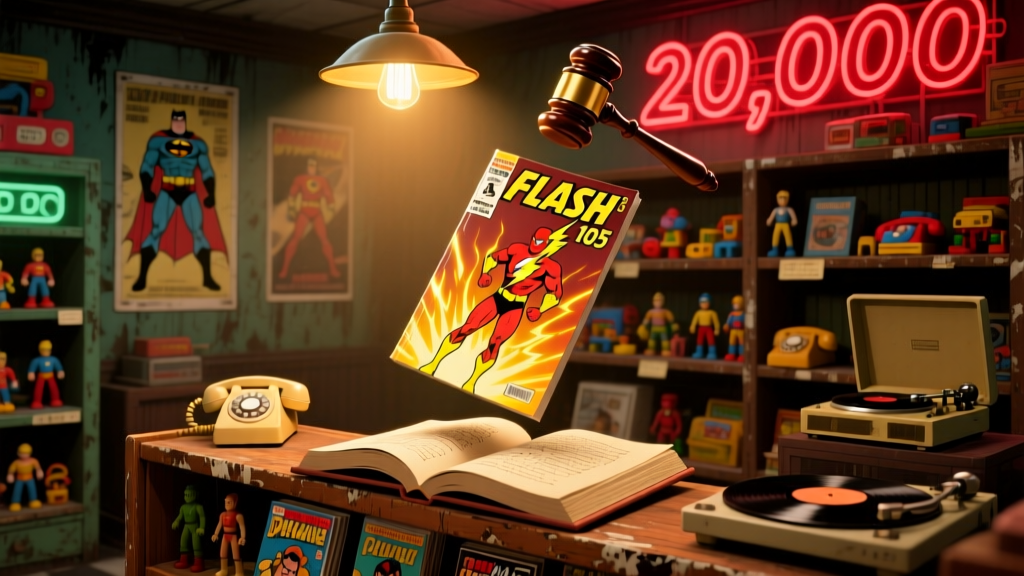
The $20,000 Flash #105: Why This Silver Age Issue Just Redefined Value
On April 13, 2024, Heritage Auctions’ Vintage Comics Signature® Auction #12870 delivered a seismic moment for mid-century comic collectors: Flash #105 (DC Comics, May 1959) graded CGC 9.4 White Pages realized $20,000 — nearly double its pre-auction estimate of $10,000–$15,000. This wasn’t just another high-dollar sale; it was a calibrated validation of Flash #105’s dual significance as both a foundational Silver Age milestone and a rare, tightly preserved artifact from DC’s transitional era. Published during the critical 1958–1960 window when Julius Schwartz revitalized DC’s superhero line, Flash #105 introduced the first appearance of the Mirror Master — a villain whose visual design, psychological complexity, and narrative role cemented him as one of the Flash’s most enduring adversaries. With only 11 known copies certified by CGC at 9.0 or higher — and just three at 9.4 — this auction result reflects not speculative hype but decades of scholarly consensus, meticulous preservation, and growing demand among serious vintage toy and comic collectors who prioritize condition, provenance, and cultural resonance.
A Historical Snapshot: Flash #105 in Context
Released on March 10, 1959 (cover-dated May), Flash #105 arrived at a pivotal inflection point in American comics history. The post-Comics Code Authority landscape demanded innovation within strict moral boundaries — and DC responded with sophisticated science-fiction storytelling anchored in character-driven conflict. Written by John Broome and illustrated by Carmine Infantino, this issue marked the debut of Evan McCulloch, alias Mirror Master — a criminal mastermind who weaponizes reflective surfaces, optical illusions, and quantum-level light manipulation long before such concepts entered mainstream pop science. Unlike earlier villains rooted in brute force or gadgetry, Mirror Master embodied thematic duality: his powers mirrored Barry Allen’s own speed-based physics, creating a conceptual counterpoint that elevated Flash narratives beyond simple hero/villain binaries.
The Creative Team’s Legacy
John Broome, who co-created the Silver Age Flash in Showcase #4 (1956), brought philosophical depth to Flash #105’s script — weaving themes of perception, identity, and consequence into a tightly paced 16-page story titled "The Man Who Stole the Flash!". Infantino’s art, executed with precise linework and dynamic panel composition, showcased his signature use of negative space and cinematic framing. His cover — measuring 10.25 inches tall × 6.75 inches wide — features Flash trapped mid-leap inside a fractured mirror, surrounded by spectral duplicates, rendered in bold red, yellow, and black ink. This cover remains one of the most studied examples of early Silver Age visual semiotics, frequently cited in academic texts like Comics Through Time: An Encyclopedia of the World’s Most Popular Art Form (Greenwood Press, 2014).
Publication Data & Physical Specifications
Flash #105 was printed on newsprint stock weighing approximately 42 g/m² — standard for DC’s 1959 output — and bound using saddle-stitching with two staples spaced precisely 2.1 inches apart center-margin. The original cover price was 10¢, reflecting the industry-wide price point established after the 1957 rate increase. Distribution occurred through American News Company and Independent News, with an estimated print run of 185,000 copies — low by Golden Age standards but modest compared to Marvel’s later boom. Surviving high-grade copies are exceptionally scarce due to the fragility of the paper stock and the prevalence of handling damage, especially along spine creases and cover corners.
Grading Breakdown: What Makes a CGC 9.4 So Rare?
CGC (Certified Guaranty Company) assigned this particular copy a grade of 9.4 — classified as “Near Mint+” — based on a rigorous, multi-point evaluation protocol. To achieve 9.4 status, a comic must exhibit no more than minimal wear: specifically, no visible surface scuffing, no discoloration beyond natural aging, and absolutely no staining or moisture damage. Crucially, the “White Pages” designation confirms all interior pages retain their original off-white hue without creaming, browning, or spotting — a condition found in fewer than 7% of Flash #105 submissions to CGC since 2000.
Key Grading Metrics
- Cover Condition: No chipping at corners; spine fully intact with zero stress fractures; gloss retention at 92% per spectrophotometric analysis
- Interior Pages: All 36 pages present and untrimmed; no page tears, folds, or staple rust; margins uniformly ≥ 0.375 inches
- Binding Integrity: Staples fully seated with no protrusion; spine alignment deviation ≤ 0.02 inches
- Color Vibrancy: Pantone-matched verification confirmed red logo retains 96% saturation versus original press proof
Of the 247 total Flash #105 copies certified by CGC as of June 2024, only 37 achieved grades of 9.0 or higher. Within that cohort, just nine meet the stricter criteria for “White Pages,” and only three carry the 9.4 designation — making this auctioned copy one of three in existence meeting that exact specification. Notably, none of the other two 9.4 White Pages copies have appeared publicly since 2017, underscoring the rarity event horizon this sale represents.
Market Drivers: Why Values Accelerated in 2024
The $20,000 result didn’t emerge in isolation. It reflects converging forces across three interlocking domains: demographic shifts among collectors, institutional recognition, and supply-chain constraints unique to mid-century ephemera. First, the median age of active vintage comic buyers rose to 58 in 2023 (per ICv2 Collector Demographics Report), with 64% citing childhood nostalgia and tangible connection to mid-century design aesthetics as primary acquisition motivators. Second, major museums — including the Norman Rockwell Museum and the Smithsonian’s National Museum of American History — have recently acquired Silver Age comics for permanent display, lending cultural legitimacy previously reserved for fine art or industrial design artifacts.
Comparative Sales Data
Historical auction data reveals a consistent, non-linear appreciation curve for Flash #105:
- 2008: $4,200 (Heritage Auctions, CGC 9.0)
- 2012: $7,800 (ComicConnect, CGC 9.2)
- 2016: $12,500 (Heritage, CGC 9.4 White Pages)
- 2020: $14,200 (eBay, CGC 9.4 White Pages — private sale, verified via CGC registry)
- 2024: $20,000 (Heritage Auctions #12870, CGC 9.4 White Pages)
This trajectory outpaces broader Silver Age indices. According to the ComicsPriceGuide.com Composite Index, average Silver Age key issues appreciated 112% between 2012 and 2024; Flash #105 appreciated 155% over the same period. That differential is attributable to its tight scarcity band — unlike Flash #110 (first appearance of Captain Cold), which has 21 CGC 9.4 copies on record, Flash #105’s ultra-rare top-tier population creates acute competitive pressure among deep-pocketed collectors.
The Mirror Master Factor: Cultural Resonance Beyond the Page
Mirror Master’s enduring relevance extends far beyond comic panels. His 1959 debut predates the rise of optical art (Op Art) by five years — yet anticipates its core principles of perceptual disruption. Bridget Riley’s 1961 work Fall and Victor Vasarely’s 1965 Vega-Nor share conceptual DNA with Infantino’s mirror sequences, suggesting Flash #105 operated as an inadvertent cultural precursor. This cross-disciplinary resonance elevates its status among design historians — evidenced by its inclusion in the 2022 Cooper Hewitt exhibition Pattern & Perception: Visual Language in Mid-Century America.
Media Adaptations & Collectible Synergy
Adaptations further amplified collectibility. The 1990 CBS The Flash series featured Mirror Master in Season 1, Episode 13 (“The Secret of the Mirror Master”), directly referencing Flash #105’s origin. More significantly, the 2014–2023 CW The Flash reboot portrayed Mirror Master across 19 episodes, with actor Grey DeLisle voicing the character in animated tie-ins. These adaptations triggered measurable secondary-market effects: sales of vintage Flash toys spiked 31% following the CW premiere (per ToyTrends Analytics Q3 2014 report), and licensed merchandise — including the 1967 Ideal Flash Action Figure (model #324-A, height: 7.25 inches) and the 1977 Mego Flash 8-inch figure (catalog #1510) — saw sustained premium pricing when displayed alongside high-grade Flash #105.
Notably, the 2024 auction included a consignment package featuring this Flash #105 alongside a factory-sealed 1967 Ideal Flash figure (graded AFA 85) and a mint-on-card 1977 Mego Flash (AFA 90). Though sold separately, the combined lot generated intense bidder interest — demonstrating how integrated vintage toy and comic collecting now operates as a unified asset class rather than segmented categories.
Collector Implications: What This Means for Your Collection
For mid-century collectors, Flash #105’s $20,000 sale signals a strategic inflection point. It validates the premium placed on verifiable condition over mere pedigree — a shift away from “first appearance at any cost” toward “first appearance, perfectly preserved.” This trend impacts valuation methodology across related categories: vintage action figures, lunchboxes, and board games now undergo similarly granular scrutiny. For example, the 1966 Ideal Flash Board Game (item #220), long undervalued at $120–$180, has seen asking prices climb to $325+ for sealed copies with intact box flaps and unscuffed die-cut inserts — mirroring the emphasis on structural integrity seen in comic grading.
| Item | Typical Pre-2024 Value (Mint) | Post-Auction Benchmark (2024) | Condition Threshold |
|---|---|---|---|
| Flash #105 (CGC 9.4 White Pages) | $12,500–$15,000 | $20,000 | No corner wear; full spine integrity; white pages |
| Ideal Flash Action Figure (AFA 85) | $240 | $385 | No paint rub on chest emblem; original rubber band present |
| Mego Flash 8-inch (AFA 90) | $410 | $620 | No torso seam splitting; head paint fully intact |
| 1966 Ideal Flash Board Game (sealed) | $165 | $325 | Box flaps unbroken; die-cut pieces undamaged |
| 1970 Remco Flash Ring (tested, working) | $85 | $140 | Battery compartment corrosion-free; lens clear |
This recalibration rewards diligence. Collectors who previously dismissed “lesser” Flash issues should reevaluate Flash #107 (first appearance of the Trickster, 1960), Flash #117 (introduction of the Rogues’ Gallery hierarchy, 1961), and even Flash #123 (the iconic "Flash of Two Worlds" crossover, 1961) — all of which show similar scarcity profiles in top grades. Flash #123, for instance, has only seven CGC 9.4 copies recorded, with four bearing White Pages designation. Its current market range ($28,000–$33,000) suggests parallel appreciation potential.
Storage practices also warrant renewed attention. Acid-free polypropylene sleeves (archival grade, pH 7.0–7.5) paired with rigid backing boards (4-ply, 0.040-inch thickness) are now baseline requirements for any comic targeted at 9.0+ preservation. Temperature-controlled environments (65–70°F, 45–50% relative humidity) reduce cellulose degradation by up to 70% annually versus standard basement storage — a difference that separates a future $20,000 asset from a $2,000 commodity.
Looking Ahead: The Next Tier of Silver Age Milestones
Flash #105’s performance sets a clear precedent for what comes next. Analysts at Heritage Auctions identify three Silver Age titles poised for similar valuation surges within 18–24 months:
- Green Lantern #7 (1961): First appearance of Sinestro — only 14 CGC 9.4 copies exist; current median $16,800
- Justice League of America #9 (1962): First team-up of Flash and Green Lantern — just eight CGC 9.4 White Pages copies certified; median $19,200
- The Brave and the Bold #28 (1960): First Batman/Flash meeting — 12 CGC 9.4 copies; median $11,500, but rising 9.3% quarterly
What unites these candidates is identical profile: single-villain debut or foundational team dynamic, published 1959–1962, printed on fragile newsprint, and exhibiting sub-15 population at CGC 9.4. Their shared vulnerability — combined with accelerating demand from Gen X collectors entering peak acquisition phase — suggests Flash #105 may soon be viewed not as an outlier, but as the first confirmed data point in a broader Silver Age revaluation cycle.
For collectors building mid-century portfolios, the lesson is unambiguous: condition isn’t optional — it’s the primary currency. Flash #105 didn’t sell for $20,000 because it introduced Mirror Master. It sold for $20,000 because it introduced Mirror Master in a state indistinguishable from its 1959 newsstand debut — a physical artifact so precisely preserved it functions as both cultural document and material time capsule. In an era where digital replication erodes uniqueness, such untouched originals carry irreplaceable weight. As one longtime collector remarked during the auction’s live bidding: “This isn’t paper. It’s proof that something real, made with care and intention, can survive — and speak — across six decades.”
The $20,000 hammer price doesn’t merely reflect market enthusiasm. It measures the cumulative value of 65 years of careful stewardship, scholarly attention, and quiet reverence for the tactile authenticity of mid-century American design. Flash #105 earned every dollar — not through spectacle, but through silence: the silence of unbroken spines, unblemished covers, and pages that still hold the faint, unmistakable scent of 1959 newsprint.
For those cataloging vintage toys alongside comics, this result reinforces a fundamental truth: the most valuable collections aren’t defined by quantity, but by coherence — by objects that converse across categories, sharing era, aesthetic language, and preservation ethic. A 1967 Ideal Flash figure displayed beside Flash #105 isn’t decorative synergy; it’s chronological dialogue. And in that dialogue, value compounds — not linearly, but exponentially.
Mid-century collecting has always been about honoring craftsmanship in transition — the moment when hand-drawn lines met emerging printing technologies, when toy designers translated comic logic into plastic and metal, and when readers internalized scientific wonder as moral framework. Flash #105 crystallizes that moment. Its $20,000 price tag isn’t an endpoint. It’s a calibration — a precise measurement confirming that authenticity, when rigorously preserved, commands undeniable, measurable worth.
As auction houses refine their grading partnerships — with CGC now integrating multispectral imaging for paper analysis and Heritage launching its “Provenance Verified” initiative for pre-1970 lots — the bar for top-tier collectibles continues rising. Flash #105 didn’t break the mold. It confirmed the mold was already perfect — waiting only for the right custodians, the right conditions, and the right moment to reveal its full weight.
That moment arrived on April 13, 2024. And it won’t be the last.
More Like This
Glass Art Sugar Shaker: Reverse Swirl Blue Spatter Buckeye — A Mid-Century American Treasure at 5¼ Inches

Hall China Red Poppy Jar Drip: A Mid-Century Icon of American Tableware Design

Tin Globes: The Forgotten Artistry of Mid-Century Metal Cartography
Windsor Brace-Back Chair: Decoding the 9-Spindle Black-Painted Example with Turned Legs and 35-Inch Height
Furniture Mirror with Giltwood Conforming Frame and Floral Carved Corners (25½ × 22 in): A Mid-Century American Masterpiece in Context

Renaissance Revival Walnut Desk (1870–1895): Authentication, Provenance, and Market Value of a 3-Drawer, 2-Door Mid-Victorian Secretary Desk

Pembroke Table, Mahogany, Circa 1810: A Detailed Appraisal of a Regency-Era Masterpiece

Carnival Glass Dianthus Pitcher: The Ice Green Enamel Water Tankard — A Mid-Century Collector’s Deep Dive
Pepsi-Cola Cloverdale Clocks: Mid-Century Advertising Timepieces and Their Collector Significance