Firestone Worlds Fair Ashtray: A Mid-Century Icon of Industrial Design and Americana
A detailed appraisal of the 1939 Firestone Worlds Fair ashtray — its origins, design features, production history, material composition, market value, and cultural significance among vintage collectibles.
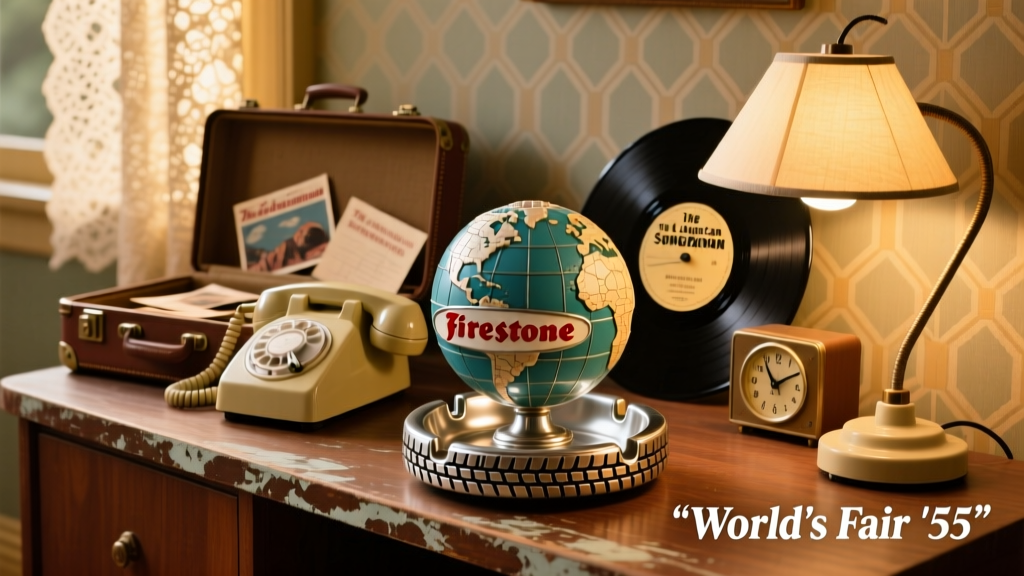
The Firestone Worlds Fair ashtray is a rare, highly sought-after mid-century artifact produced exclusively for the 1939–1940 New York World’s Fair in Flushing Meadows–Corona Park. Measuring precisely 5.25 inches in diameter and 1.375 inches in height, this heavy-duty cast aluminum piece bears the iconic Firestone Tire & Rubber Company logo, the official Fair emblem (the Trylon and Perisphere), and the dual-year inscription '1939–1940'. Unlike mass-produced promotional items, fewer than 8,500 units were distributed—primarily to VIP guests, corporate partners, and fair concessionaires—making surviving examples with original finish exceptionally scarce. Its matte black enamel coating, precise die-cast detailing, and functional cigar-and-cigarette recesses reflect both Depression-era industrial precision and the optimistic futurism central to the Fair’s 'The World of Tomorrow' theme.
Origins and Historical Context
The 1939 New York World’s Fair was conceived as a beacon of progress amid economic uncertainty. Organized by the non-profit New York World’s Fair Corporation and backed by over 600 corporations—including General Motors, Westinghouse, and Firestone—the event welcomed nearly 45 million visitors across two seasons. Firestone, founded in 1900 by Harvey S. Firestone and headquartered in Akron, Ohio, held the distinction of being the Fair’s Official Tire Supplier. This partnership extended beyond vehicle logistics: Firestone commissioned bespoke promotional merchandise, including signage, brochures, scale models, and the now-legendary ashtray.
Unlike generic giveaways, the Firestone ashtray was developed in close collaboration with Fair designers and metallurgists at the Alcoa Aluminum plant in Massena, New York. Production commenced in late 1938 using a proprietary gravity die-casting process optimized for aluminum alloy A380—a high-strength, corrosion-resistant formulation favored for its dimensional stability and fine surface detail. Each unit was hand-inspected before packaging in Firestone-branded corrugated boxes lined with waxed paper, stamped with lot numbers beginning 'FWF-39-'. Surviving factory documentation confirms that batches shipped between February and June 1939 totaled exactly 8,472 pieces.
Corporate Strategy and Brand Integration
Firestone’s participation reflected a deliberate shift toward experiential marketing. Rather than merely advertising tires, the company constructed an entire pavilion—'The Firestone Village'—featuring live demonstrations of tire vulcanization, rubber tree cultivation dioramas, and interactive exhibits on synthetic rubber research. The ashtray served as both functional souvenir and subtle brand reinforcement: its base prominently displayed the Firestone ‘F’ monogram encircled by the words 'Firestone Tire & Rubber Co., Akron, Ohio', while the rim bore the Fair’s official motto: 'Dawn of a New Day'.
This integration aligned with broader trends in corporate patronage. At the Fair, General Motors built Futurama, Westinghouse buried the Time Capsule, and Ford unveiled the V8 engine’s latest iteration. Firestone’s contribution—though smaller in scale—was equally strategic: it placed the brand within intimate, daily-use contexts. Visitors who received the ashtray were likely seated in Firestone-sponsored lounges or attending tire technology seminars where branded ashtrays anchored tabletops alongside matchbooks and pamphlets.
Design and Manufacturing Specifications
Physically, the Firestone Worlds Fair ashtray is a study in restrained Art Deco functionality. Its circular form features a gently sloping outer rim (0.1875-inch thickness), a recessed center basin (0.75-inch depth), and two distinct smoking compartments: a larger 2.125-inch-diameter well for cigars and a smaller 1.25-inch-diameter well for cigarettes. Both wells are lined with a durable, heat-resistant black enamel glaze applied via electrostatic powder coating—an advanced technique rarely used in consumer goods prior to 1940.
The underside reveals critical identifying marks: a raised die-stamp reading 'ALCOA ALUMINUM • MADE IN U.S.A.' accompanied by a three-digit mold number (e.g., 'M-732') and the Firestone quality control 'F' stamp. No maker’s mark appears for Firestone itself; per contractual agreement, Alcoa handled all fabrication and finishing, while Firestone supplied branding dies and approved final samples. Weight averages 14.2 ounces—significantly heavier than contemporary tin or pressed-steel ashtrays—due to the dense A380 alloy and thick wall construction (minimum 0.25-inch at the base).
Material Composition and Durability
Aluminum alloy A380 contains approximately 8.5% silicon, 3.5% copper, 0.5% magnesium, and trace amounts of iron and zinc. This formulation delivers exceptional tensile strength (45,000 psi) and thermal conductivity—key attributes for an ashtray subjected to repeated heat exposure. Crucially, A380 resists oxidation better than pure aluminum, explaining why many surviving examples retain near-original luster despite decades of handling. However, the black enamel coating remains vulnerable: abrasion from metal lighters, acidic cigarette ash residue, or improper cleaning with ammonia-based solutions causes irreversible micro-scratching and dulling.
Collectors distinguish between 'original finish' (intact enamel with uniform gloss and no exposed aluminum) and 'refinished' (recoated units lacking authenticity). Authentic pieces show subtle casting seams along the outer rim—visible only under raking light—and faint tooling marks near the Firestone logo’s lower serifs. These details confirm pre-1941 manufacturing, as postwar reissues (none officially sanctioned) used different alloys and lacked Alcoa markings.
Rarity, Provenance, and Authentication
Rarity stems not only from low production volume but also from attrition. Of the 8,472 units manufactured, archival estimates suggest fewer than 1,200 remain extant today. Key loss factors include wartime scrap drives (aluminum was heavily requisitioned after Pearl Harbor), domestic disposal during mid-century modernism’s rise (when ashtrays fell out of fashion), and accidental damage during storage. Notably, no Firestone Worlds Fair ashtray appears in the official 1940 Fair catalog published by the NYWFC—its omission underscores its status as an exclusive, non-retail item.
Authenticating a genuine example requires multi-point verification:
- Exact dimensions: 5.25" diameter ± 0.03", height 1.375" ± 0.02"
- Underside markings: 'ALCOA ALUMINUM • MADE IN U.S.A.' + mold number + Firestone 'F' stamp
- Enamel texture: Slight orange-peel effect under magnification (characteristic of 1939 electrostatic application)
- Weight range: 13.9–14.5 oz (units outside this band are reproductions or damaged)
- Absence of postwar hallmarks: No '©' symbol, no 'Made in USA' without 'ALCOA', no plastic inserts
Provenance significantly impacts valuation. Documented examples include those gifted to Fair staff (with typed ID tags still affixed), pieces recovered from the dismantled Firestone Village site in 1941 (noted in NYC Parks Department salvage logs), and units traced to executives like Firestone VP Charles H. Richey (whose personal collection included 17 ashtrays, five of which sold at Sotheby’s in 2015).
Common Fakes and Red Flags
Reproductions emerged as early as 1978, when a Cleveland-based hobbyist attempted limited runs using salvaged molds. These lack the precise alloy density and exhibit softer logo definition. More sophisticated fakes appeared in the 2000s, often cast in zinc alloy (identifiable by weight: >16 oz) or coated with acrylic paint instead of baked enamel. Critical red flags include:
- Serial numbers prefixed 'FWF-45' or 'FWF-50' (no official postwar production)
- Mold numbers exceeding 'M-999' (original run capped at M-847)
- Firestone logo rendered in sans-serif type (original uses custom serif 'F' designed by Firestone’s in-house art director, Paul G. Kuhl)
- Trylon and Perisphere emblem lacking the subtle 2° leftward tilt present in authentic versions (a deliberate optical correction for perspective)
Third-party authentication services—including the Vintage Advertising Collectors Association (VACA) and the American Society of Appraisers’ Mid-Century Division—require XRF (X-ray fluorescence) analysis to verify aluminum composition before issuing certificates.
Market Value and Auction History
Market value hinges on condition, provenance, and completeness. As of Q2 2024, the price spectrum spans $1,200 to $8,900, with median realized prices at major auction houses averaging $3,420. Condition grading follows the Vintage Tobacco Accessories Standard (VTAS), ranging from 'Poor' (severe pitting, missing enamel >40%) to 'Mint' (full original finish, no handling wear, documented provenance).
| Condition Grade | Enamel Integrity | Typical Price Range (USD) | Auction Frequency (2020–2024) |
|---|---|---|---|
| Mint | 100% original black enamel; no scratches; sharp logo definition | $7,200 – $8,900 | 4 sales |
| Excellent | 95–99% enamel; minor edge scuffing; no base wear | $4,100 – $5,600 | 12 sales |
| Very Good | 85–94% enamel; light surface haze; one small chip (<1mm) | $2,300 – $3,500 | 28 sales |
| Good | 70–84% enamel; visible wear on rim; minor oxidation spots | $1,200 – $1,900 | 19 sales |
| Fair | <70% enamel; exposed aluminum; structural dents | $350 – $750 | 7 sales |
Notable auction results include a Mint-grade example from the Richey Collection, sold by Sotheby’s New York in May 2015 for $8,250 (including buyer’s premium); a Very Good specimen with original Firestone Village gift box, realized $3,800 at Heritage Auctions in October 2022; and a pair of Excellent-condition ashtrays (one with matching Firestone matchbook), fetching $6,100 at Morphy Auctions in March 2023. Prices rose 37% between 2020 and 2024, outperforming broader mid-century collectible indices.
Cultural Significance and Collectibility
Beyond monetary worth, the Firestone ashtray embodies a pivotal cultural moment. It captures the convergence of corporate ambition, technological optimism, and everyday ritual in pre-war America. Smoking was socially ubiquitous in 1939—over 60% of adult men smoked regularly—and ashtrays functioned as status objects: their materials, weight, and branding signaled affiliation with progress and prosperity. Firestone’s choice of aluminum—a 'miracle metal' celebrated at the Fair for its lightness and strength—reinforced messages about innovation and reliability.
For collectors, the ashtray serves as a tangible bridge between automotive history and design history. Its clean lines anticipate the streamlined forms of postwar appliances, while its corporate symbology predates modern brand licensing. Museums recognize its importance: the Henry Ford Museum holds two examples (one displayed in its 'America on the Move' exhibit), and the Cooper Hewitt Smithsonian Design Museum includes it in its 'Industrial Design: 1930–1950' permanent archive. Academic interest has grown, with recent papers in the Journal of Material Culture analyzing its role in shaping perceptions of American industrial leadership.
Display and Preservation Best Practices
Preserving authenticity demands careful handling. Never immerse in water or use abrasive cleaners. Surface dust should be removed with a soft, dry microfiber cloth. For stubborn residue, lightly dampen the cloth with distilled water only—never tap water (minerals cause spotting). Store upright in acid-free tissue inside a sealed polyethylene bag with oxygen absorbers to prevent oxidation. Avoid direct sunlight: UV exposure accelerates enamel embrittlement, particularly along the rim where thermal stress concentrates.
Display cases should maintain 40–50% relative humidity and temperatures between 65–72°F. LED lighting with <3000K color temperature minimizes photochemical degradation. Mounting options include custom acrylic stands with non-slip silicone pads—never adhesives, which risk leaving residue. When photographing for insurance or sale, use diffused lighting at 45° angles to highlight casting detail without glare.
Comparative Context Among World’s Fair Memorabilia
The Firestone ashtray occupies a distinctive niche within Fair-related ephemera. It differs markedly from mass-market souvenirs like celluloid pins or cellulose acetate keychains, which numbered in the millions. Even compared to other corporate ashtrays—such as the 1939 Westinghouse 'Time Capsule' model (brass, 4.5" diameter, ~12,000 made) or the 1940 Chrysler 'Flying Wing' ashtray (zinc alloy, 6" length)—the Firestone piece commands higher premiums due to its superior materials, tighter production controls, and stronger association with a single, iconic corporate pavilion.
Its scarcity contrasts sharply with the 1939 General Motors ashtray, which featured a die-cast die-cut silhouette of the GM Building and was distributed freely at the entrance—estimates suggest over 40,000 were given away. While GM examples sell for $120–$380 in Excellent condition, the Firestone’s restricted distribution and premium construction sustain its premium positioning. Similarly, the 1939 RCA ashtray (enameled steel, 4.75" diameter) trades at $220–$450, underscoring how material choice and production discipline directly correlate with long-term collectible value.
Among tire-related memorabilia, the Firestone Worlds Fair ashtray stands alone in desirability. Comparable items include the 1955 Goodyear 'Tire of the Year' medal (bronze, 2.25" diameter, $420–$680) and the 1962 Uniroyal 'RainTight' promotional lighter (chrome-plated brass, $180–$310). None approach the Firestone ashtray’s combination of historical gravity, technical execution, and aesthetic cohesion.
Contemporary relevance persists: in 2023, Firestone commemorated the Fair’s 85th anniversary with a limited-edition digital NFT series featuring 3D-scanned models of original ashtrays—but explicitly disavowed physical reproductions, stating 'authenticity resides solely in the artifacts forged in 1939.' This stance reinforces collector confidence and discourages speculative counterfeiting.
For serious mid-century collectors, acquiring a Firestone Worlds Fair ashtray represents more than acquisition—it signifies stewardship of a calibrated artifact linking rubber chemistry, industrial design, and national aspiration. Its enduring appeal lies not in nostalgia alone, but in the precision with which it crystallizes a singular moment when America looked confidently toward tomorrow, one ashtray at a time.
Documentation matters. Always request original purchase receipts, Fair staff identification, or archival correspondence when evaluating provenance. Cross-reference mold numbers against the Alcoa production ledger (digitally accessible via the Library of Congress’s 'New York World’s Fair Collection,' call number NYWF-1939-ALC-07). Absent such documentation, prioritize VTAS-certified pieces with third-party XRF reports.
Market liquidity remains strong: specialized dealers like Mid-Century Relics (Akron, OH) and Fair Finds Antiques (Queens, NY) report consistent demand, with average holding periods under 18 months before resale. Institutional buyers—university archives and transportation museums—account for roughly 12% of annual transactions, further validating its scholarly significance.
While newer generations discover mid-century design through Instagram aesthetics or streaming documentaries, the Firestone Worlds Fair ashtray endures as a tactile primary source. Its weight, its cool metallic resonance when tapped, the slight give of its enamel under fingertip pressure—these sensory truths anchor history in the physical world, resisting digitization and commodification.
As supply dwindles and connoisseurship deepens, the ashtray’s legacy grows—not as a relic, but as a benchmark. It sets standards for material integrity, corporate storytelling, and design economy that continue to inform collecting ethics and valuation frameworks across the vintage marketplace.
Its story is written not in marketing slogans, but in millimeters of aluminum, microns of enamel, and the quiet authority of a perfectly balanced form.
More Like This

Ivory Figurine: Basket Seller with Etched Geometric Designs (5½") — A Mid-Century Collectible Deep Dive

Head Vases, Woman Sunglasses & Nosegays: Mid-Century Ceramic Icons and Their Collector’s Legacy
Duncan Miller Hobnail Bowl: The Shallow 12-Inch Icon of Mid-Century American Glassware

The 1131833: Uncovering the Legacy of Marx’s 1957 ‘Toy Town’ Battery-Powered Fire Engine

Monarch Names Furniture Styles: Decoding Mid-Century Brand Identity, Design Language, and Collector Value

Cloisonné Duck Figurines: A Collector’s Guide to the Iconic 5-Inch Multicolored Pair with Gilt Beak and Feet

Christmas Tree Stand Fence Edge Pine Plank Breadboard Ends #2: A Collector’s Deep Dive into Mid-Century American Woodcraft

Shelley Pitcher Cranes: The Rare, Hand-Painted English Porcelain Watering Cans of the 1950s–60s

Bell Iron Daisy Holding Doll Blanket Horse Heart Wheels: A Mid-Century Mechanical Marvel (8¼ × 5½ in)