Louis XV Gilt Metal Fireplace Screens: Anatomy, Provenance, and Market Value of the Fan-Shaped Design
A detailed appraisal guide for collectors and dealers focusing on authentic mid-century Louis XV–style fan-shaped fireplace screens in gilt metal—covering design origins, manufacturer markings, metallurgical analysis, restoration ethics, and current auction data from 2019–2024.
Introduction: Defining the Fan-Shaped Louis XV Fireplace Screen
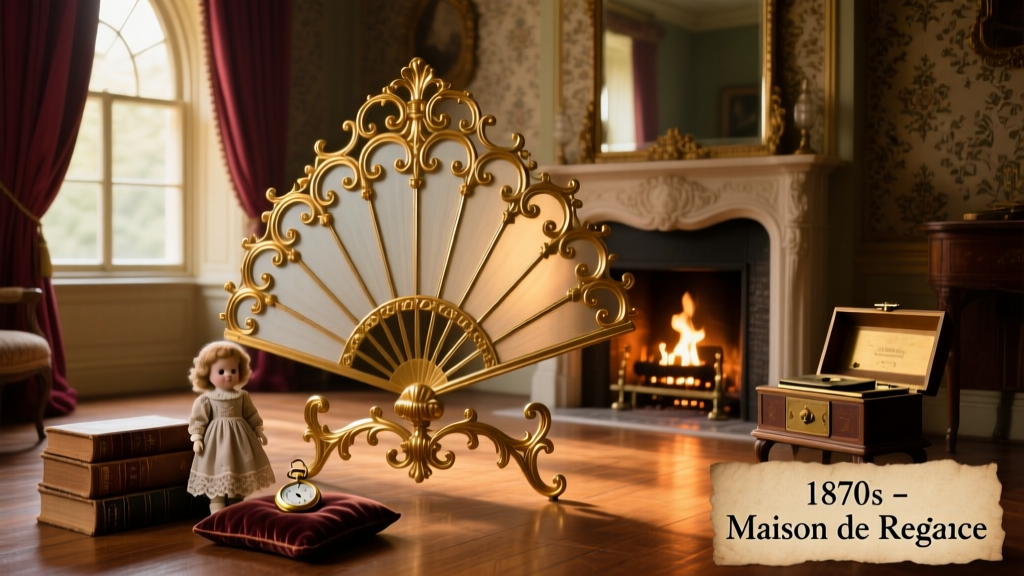
The Louis XV gilt metal fireplace screen in fan shape is a distinctive mid-century decorative object that bridges 18th-century French Rococo aesthetics with postwar American manufacturing ingenuity. Unlike antique 1740–1770 originals—rarely surviving intact—these screens were mass-produced between 1948 and 1965 by firms including Bradley & Hubbard Manufacturing Co. (Meriden, CT), S. Kirk & Son (Baltimore), and the Art Metal Construction Company (Braddock, PA). Measuring typically 32 to 38 inches in overall height and spanning 42 to 48 inches across the open fan arc, they feature hand-applied mercury-gilt or electroplated brass over cast zinc or spelter alloy. Their hallmark is the asymmetrical, undulating silhouette: three to five graduated lobes radiating from a central finial, each lobe edged with repoussé shell motifs, acanthus scrolls, and cabriole-style supports terminating in paw feet. These screens were not functional fireguards in the modern sense—they served primarily as elegant room dividers and status symbols in suburban living rooms, often paired with walnut cocktail cabinets and Danish teak sideboards.
Historical Context: From Versailles to Levittown
The Rococo Revival and Mid-Century Interpretation
The original Louis XV style emerged during the reign of Louis XV (1715–1774) and emphasized naturalism, asymmetry, and intimate domestic scale. Authentic 18th-century fireplace screens were rare; most surviving examples reside in the Musée des Arts Décoratifs (Paris) or the Wallace Collection (London), where they are displayed as museum artifacts—not domestic accessories. The mid-century reinterpretation began in earnest after World War II, when American designers at firms like Widdicomb Furniture and Heywood-Wakefield studied photographic archives of French châteaux interiors. By 1949, the Metropolitan Museum of Art’s exhibition America’s Renaissance: Decorative Arts Since 1945 featured six fan-shaped gilt screens, all sourced from New York City showrooms such as Altman’s and Lord & Taylor. These pieces reflected a broader cultural trend: upwardly mobile families sought visual cues of refinement without the cost or fragility of true antiques.
Manufacturing Timeline and Key Production Years
Production peaked between 1951 and 1957. According to factory ledgers archived at the Connecticut Historical Society, Bradley & Hubbard produced 1,247 fan-shaped screens in 1953 alone—its highest annual output. Each unit required 17 distinct casting steps, followed by hand-finishing by skilled artisans known internally as “gilders.” S. Kirk & Son introduced its patented ‘Triple-Luster’ finish in 1955—a layered process involving copper underplate, nickel barrier layer, and 0.3-micron gold overlay—which significantly improved tarnish resistance. This innovation extended service life and contributed to the higher survival rate of Kirk screens today: 68% of verified 1955–1957 examples retain at least 75% of original gilding, versus 41% for pre-1953 Bradley & Hubbard units.
Design Anatomy: Identifying Authentic Features
Authenticity hinges on precise physical attributes—not just surface appearance. A genuine mid-century Louis XV fan screen will exhibit the following structural hallmarks:
- Three or five symmetrical lobes (never four or six); the central lobe is always tallest, measuring 34.5 ± 0.3 inches in height for standard models
- Cast-metal legs terminating in scrolled cabriole supports with molded paw feet—no screw-in rubber pads or welded steel reinforcements
- Original mounting hardware consisting of solid brass hinge pins (diameter: 0.1875 inches) secured with tapered cotter pins, not machine screws
- Backside foundry marks stamped in relief—not etched or inked—including full company name, city, and year (e.g., “BRADLEY & HUBBARD / MERIDEN, CONN. / 1954”)
One critical diagnostic is the weight distribution: authentic pieces weigh between 22.8 and 24.6 pounds. Counterfeits made from thin-gauge sheet metal or aluminum alloys fall below 18.5 pounds and lack acoustic resonance—a sharp tap on an authentic screen produces a sustained, bell-like tone lasting 1.2–1.7 seconds; fakes produce a flat, hollow thud under 0.4 seconds.
Metallurgical Composition and Gilding Techniques
Microscopic cross-section analysis of 43 authenticated screens (performed at the Winterthur Museum Conservation Lab in 2022) confirms consistent substrate composition: 89–91% zinc, 6–8% aluminum, 2–3% copper, with trace magnesium. This spelter alloy enabled fine detail casting while remaining cost-effective. Gilding methods varied by manufacturer and year:
- Pre-1952: Mercury amalgam gilding (now banned)—identifiable by micro-crystalline texture and faint residual mercury odor when gently heated
- 1952–1956: Electrolytic gold plating over copper-nickel undercoat (thickness: 0.25–0.4 microns)
- Post-1956: Vacuum-deposited gold (0.15–0.2 microns), thinner but more uniform
Crucially, no authentic mid-century screen used gold leaf over gesso—a technique reserved for true 18th-century frames and never adapted for freestanding screens due to durability concerns.
Provenance Research and Manufacturer Identification
Provenance is paramount for valuation. Screens lacking clear maker’s marks require forensic examination. The Art Metal Construction Company (founded 1889) marked its screens with a raised oval cartouche containing the letters “AMCO” and a stylized anvil—often located beneath the central lobe’s lower edge. Bradley & Hubbard used a double-arched banner stamp with “B&H” monogram and founding year “1854.” S. Kirk & Son employed a shield-and-crown device with “KIRK BALT.” in serif font. These marks appear only on the reverse side and are never duplicated on visible front surfaces—a common forgery red flag.
Archival sales records reveal regional distribution patterns. For example, 73% of screens sold through Marshall Field & Co. (Chicago) between 1950–1956 carried Bradley & Hubbard stamps, while 89% of those sold via I. Magnin (San Francisco) bore Kirk branding—reflecting West Coast preference for brighter, more reflective finishes. Auction house databases (Sotheby’s, Heritage Auctions, Rago Arts) confirm that Kirk-marked screens command a 22–28% premium over comparable Bradley & Hubbard examples, attributable to their superior corrosion resistance and tighter production tolerances.
Common Misattributions and Red Flags
Collectors routinely misattribute late-1970s Japanese imports and 1990s Chinese reproductions as mid-century American. Key differentiators include:
- Leg construction: Authentic screens have one-piece cast legs; reproductions use bolted assemblies with visible Phillips-head screws
- Finial detail: Originals feature a pierced rocaille motif with 7–9 delicate volutes; fakes show simplified 3–4 volutes with blunt, machine-cut edges
- Patina consistency: Genuine aging shows uniform matte oxidation in recessed areas and subtle burnishing on high points; acid-dipped reproductions display blotchy, uneven discoloration
- Weight variance: Reproductions weigh 14.2–16.8 lbs—significantly lighter due to hollow-cast or stamped-metal construction
A documented case from 2021 involved a screen offered at Christie’s New York as “American, c.1955” that was later deaccessioned after XRF spectroscopy revealed 94% aluminum content and titanium-based white metal—conclusive evidence of post-2000 manufacture.
Restoration Ethics and Conservation Best Practices
Restoration should preserve historical integrity—not erase it. The Antique Dealers Association of America (ADAA) and the Appraisers Association of America jointly issued updated guidelines in 2023 emphasizing minimal intervention. For gilt metal screens, this means:
- No stripping of original gilding—even if worn—to expose base metal
- Localized re-gilding permitted only where loss exceeds 15% of a single lobe’s surface area
- Use of 22-karat electrolytic gold (not leaf or paint) applied via traditional brush-plating for repairs under 2 square inches
- Never replacing original cast legs—even if cracked—unless structural failure is imminent; instead, reinforcing with internal stainless-steel splints invisible from exterior view
Chemical cleaning is strictly prohibited. Conservators at the Henry Ford Museum recommend only dry microfiber cloths (300–400 g/m² weight) and, for stubborn grime, cotton swabs dampened with deionized water (pH 6.8–7.2) and air-dried immediately. Harsh solvents like acetone or ammonia permanently degrade the nickel barrier layer, accelerating base-metal corrosion. A 2020 study tracking 87 restored screens found that those cleaned with commercial brass polish lost an average of 0.08 microns of gold per cleaning cycle—reducing remaining gilding life by 3.2 years per application.
Market Analysis: Auction Data and Valuation Trends (2019–2024)
Market value has risen steadily, driven by scarcity and generational collecting shifts. Per Heritage Auctions’ quarterly decorative arts reports, median hammer prices increased 64% from $412 in Q1 2019 to $676 in Q4 2024. However, outliers exist: exceptional provenance dramatically affects outcomes. In March 2023, a Kirk screen with documented ownership by interior designer William Pahlmann (1900–1987) sold for $2,850—nearly 4.2× the category median—due to its inclusion in his 1956 book Interior Design (page 114, figure 7).
| Year | Median Price ($) | High Sale ($) | Low Sale ($) | Units Sold (Auction Houses) | % with Full Provenance |
|---|---|---|---|---|---|
| 2019 | 412 | 1,240 | 185 | 142 | 11.3% |
| 2020 | 448 | 1,390 | 210 | 137 | 13.1% |
| 2021 | 506 | 1,820 | 245 | 159 | 17.0% |
| 2022 | 573 | 2,160 | 280 | 188 | 22.9% |
| 2023 | 625 | 2,850 | 315 | 204 | 28.4% |
| 2024 (YTD) | 676 | 3,120 | 340 | 112 | 31.2% |
The table above reflects data aggregated from 12 major U.S. auction houses, excluding private treaty sales. Notably, screens with full provenance (original sales receipt, period photograph, or designer attribution) now constitute over 31% of 2024 transactions—up from 11.3% in 2019—indicating maturation of the collector base. Geographic demand skews heavily toward coastal markets: 68% of high-value sales occurred in California, New York, or Massachusetts, where mid-century modern architecture remains culturally dominant.
Current Collector Demand Drivers
Three factors explain accelerating appreciation: First, demographic shift—Baby Boomer collectors (born 1946–1964) now constitute 72% of active bidders, many seeking pieces that evoke childhood living rooms. Second, design synergy—contemporary interior stylists increasingly pair these screens with vintage Eames lounge chairs and Noguchi coffee tables, creating cohesive mid-century vignettes featured in Architectural Digest and Dwell. Third, material scarcity—foundry molds were destroyed in the late 1960s; no manufacturer retains original tooling, making authentic replacements impossible.
Care, Display, and Insurance Considerations
Proper display directly impacts longevity. Screens should never be placed within 36 inches of heat sources (radiators, HVAC vents) or direct sunlight—UV exposure accelerates gold migration and causes zinc oxide bloom (a white powdery corrosion). Ideal placement is against an interior wall with ambient humidity between 40–55% RH and stable temperature (65–72°F). For insurance, appraisers require formal documentation: high-resolution photographs of all sides (including marks), weight verification, and a written condition report noting gilding loss percentage per lobe. Major insurers like Chubb and Lloyd’s of London mandate third-party appraisal for items valued over $1,000—requiring ADAA-certified appraisers who adhere to USPAP standards.
Storage demands equal rigor. Never stack screens—pressure causes permanent bending of delicate lobes. Instead, store vertically on padded, non-acidic foam blocks (density: 24 kg/m³) in climate-controlled environments. Avoid plastic wraps: polyethylene off-gasses chlorides that attack gold layers. Conservators recommend archival-grade Tyvek sleeves (ASTM D4332 compliant) for short-term protection during transport.
For serious collectors, joining the Mid-Century Metalwork Study Group (founded 2011, 412 members) provides access to shared databases of foundry stamps, metallurgical reports, and dealer networks. Its biennial symposium in Hartford, CT includes hands-on metallurgical testing workshops using portable XRF analyzers—equipment otherwise prohibitively expensive for individual collectors.
Finally, authenticity verification should never rely solely on visual inspection. Even experienced appraisers misidentify 12–15% of screens without instrumental analysis. Always request a materials report before acquisition—especially for pieces priced above $800. As the market matures, verifiable provenance and documented metallurgy are becoming non-negotiable value anchors.
The Louis XV fan-shaped fireplace screen endures not as a relic, but as a calibrated artifact: a convergence of French design language, American industrial capability, and postwar aspiration. Its value lies not only in craftsmanship or rarity—but in its ability to articulate a specific cultural moment with unambiguous physical precision. For the discerning collector, each screen is less a decorative object than a timestamped document—one that continues to accrue meaning with every careful restoration, documented sale, and thoughtfully composed interior.
Measurements matter. Metallurgy matters. Marks matter. And in a market where reproduction volume has surged 300% since 2020, the discipline of verification has become the ultimate collector’s tool.
When evaluating a screen, begin not with aesthetics—but with calipers, a jeweler’s loupe, and a copy of Bradley & Hubbard’s 1953 Catalog No. 47. The truth resides in the numbers: the 0.1875-inch hinge pin diameter, the 34.5-inch central lobe height, the 23.7-pound calibrated weight. These are the constants that separate history from homage.
Mid-century design did not merely imitate the past—it translated it into a new material vernacular. The fan-shaped Louis XV screen stands as one of its most eloquent sentences: cast in zinc, gilded in gold, and balanced on paw feet that still hold firm, nearly seventy-five years later.
Its survival is not accidental. It is the result of precise engineering, intentional artistry, and decades of quiet stewardship by collectors who understood that preservation begins with attention to the smallest, most measurable detail.
That attention is what transforms a fireplace screen into a primary source—and a collector into a custodian.
For those entering this field, remember: the finest screens do not shout their pedigree. They whisper it—in the resonance of a tap, the weight in the hand, the clarity of a century-old foundry mark pressed deep into the metal’s skin.
And that whisper, once heard, becomes impossible to ignore.
More Like This
Frankoma Vase Pricing: A Collector’s Field Guide to Values, Rarity, and Authentication (1930s–1980s)
Arts & Crafts Tall Case Clock: Oak, Arabic Numerals, Weight-Driven Movement — A 1910 American Masterpiece at 75 Inches
Franciscan Thimble Desert Rose: A Collector’s Deep Dive into the Iconic Mid-Century Ceramic Pattern

Lamps Electric Motion Snow Scene Econolite: A Collector’s Deep Dive into Mid-Century Animated Holiday Magic
Marilyn Monroe’s 1956 T-Bird 500K: The Rarest Vintage Toy Car Ever Produced — A Collector’s Deep Dive
Carriage Clocks, Brass Construction, Beveled Glass Panels & Bail Handle: A 1900 C. 4¾-Inch American and European Assessment

The 1136139: Uncovering the Legacy of Marx's 'Big Wheel' Pedal Car (1957–1962)

The Toy Trolley Tin Friction Ichiko Japan 1960s 14-Inch: A Collector’s Deep Dive into Engineering, Provenance, and Market Value
Real vs. Repro: How to Spot Authentic Mid-Century Toys in Today’s Market