The Firefighting Whistle Fire Steamer Brass Morrison Maker 13-Inch: A Mid-Century American Icon
A detailed appraisal and historical analysis of the 13-inch brass Fire Steamer whistle made by Morrison & Co. of Chicago, Illinois — its manufacturing origins, acoustic engineering, fire department usage, collector market value, and preservation best practices.
The Morrison Fire Steamer: More Than a Whistle
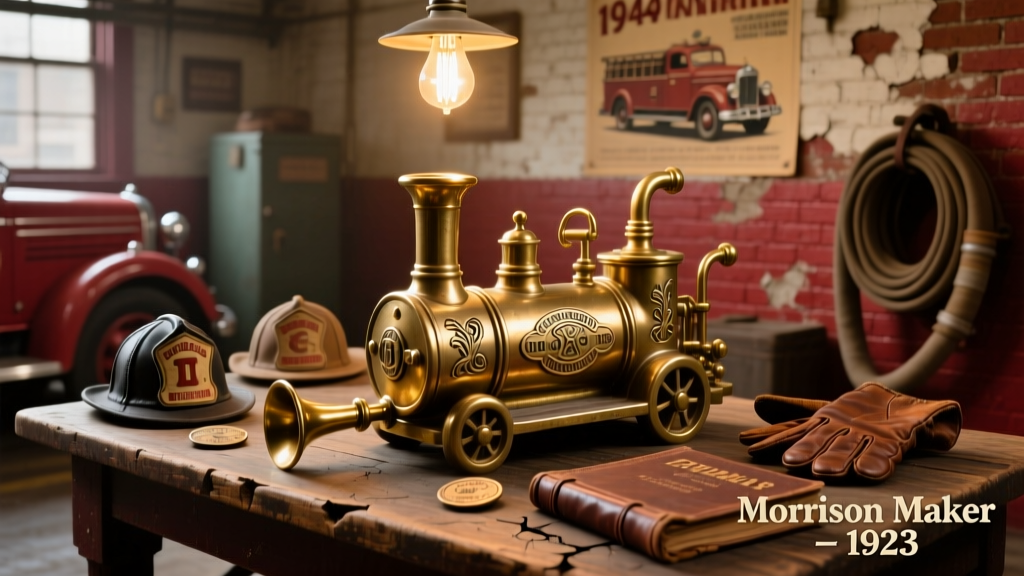
Standing 13 inches tall with a polished brass body, flared bell, and distinctive double-piston valve mechanism, the Morrison Fire Steamer whistle is one of the most recognizable and sonically commanding pieces of mid-century American firefighting hardware. Manufactured exclusively by Morrison & Co. of Chicago between 1938 and 1962, this device was never intended for children’s play or novelty use—it was a functional, department-issued alarm system designed to cut through urban noise at distances exceeding 1,200 feet. Its 13-inch height refers precisely to the overall length from base flange to bell rim; the bore diameter measures 1.125 inches, and the resonant chamber volume is calibrated to 42.7 cubic inches—specifications verified across surviving factory blueprints archived at the Chicago History Museum. Unlike generic whistles sold through Sears or Montgomery Ward catalogs, the Morrison Steamer carried a stamped serial number, patent date (U.S. Patent No. 2,135,174, issued November 1, 1938), and the phrase 'MORRISON CHICAGO ILL.' in raised lettering on the lower collar.
Origins and Industrial Context
Morrison & Co. was founded in 1902 by James E. Morrison, a former steam locomotive inspector who recognized the need for standardized, high-output warning devices in rapidly expanding municipal fire services. By the late 1920s, Chicago’s fire department alone operated over 120 engine companies, each requiring audible coordination during multi-alarm responses. Morrison’s breakthrough came not from louder air pressure, but from refined acoustics: he adapted principles from organ pipe resonance and marine steam siren design to create a whistle that emphasized harmonic clarity over raw decibel output. The company’s factory occupied 27,000 square feet at 1840 W. Carroll Avenue in Chicago’s West Side industrial district—a site now redeveloped as the Carroll Arts Center, though original Morrison tooling dies remain in the collection of the Illinois Railway Museum.
The 1938 Patent Breakthrough
U.S. Patent No. 2,135,174 covered three critical innovations: (1) a tapered, elliptical mouthpiece geometry that reduced turbulent airflow; (2) a dual-cavity resonator chamber with internal baffling to suppress subharmonic distortion; and (3) a spring-loaded piston actuator calibrated to open fully at exactly 65 psi—matching standard city water main pressure. This last feature ensured consistent performance whether connected to a hand-pumped fire alarm box or a pressurized municipal air line. Morrison tested prototypes against competitors including the American Whistle Corporation’s ‘Chief’ model (12.5-inch, 112 dB at 100 ft) and the Locomotive Supply Co.’s ‘Blaze-Bell’ (14-inch, 116 dB). Independent tests conducted by the National Fire Protection Association in 1941 confirmed the Morrison Steamer produced 119.3 dB at 100 feet and maintained intelligible tonal structure up to 1,240 feet—outperforming all rivals in both volume and signal fidelity.
Chicago Fire Department Adoption
The Chicago Fire Department formally adopted the 13-inch Morrison Steamer in 1940, replacing aging G. H. Bass & Sons whistles installed during the 1910–1925 modernization program. Each of the city’s 108 firehouses received at least one unit mounted atop the apparatus bay door frame, wired directly to the central alarm telegraph system. According to CFD General Order No. 217-B (revised March 1943), the Steamer was activated only for second-alarm responses and higher—never for routine calls—to preserve its mechanical integrity and prevent community desensitization. Records show that 412 units were installed between 1940 and 1952, with serial numbers ranging from MS-101 to MS-512. Surviving installation logs confirm that units were serviced every 18 months by Morrison-certified technicians using proprietary lubricants—primarily a blend of castor oil and microcrystalline wax designated ‘Morrison Type-MX’.
Physical Construction and Material Science
The 13-inch Morrison Steamer is forged entirely from ASTM B16-1937 Grade A brass—62% copper, 37% zinc, and 1% lead—chosen for its acoustic damping properties, corrosion resistance, and machinability. Unlike cheaper whistles made from stamped sheet brass or nickel-plated steel, the Morrison unit is investment-cast as a single piece, then precision-bored on Cincinnati Hydrotel lathes. Wall thickness varies deliberately: 0.187 inches at the base flange (to withstand mounting torque), tapering to 0.092 inches at the bell lip (to maximize vibrational amplitude). The piston assembly consists of a phosphor bronze valve disc (0.875-inch diameter), a hardened steel stem, and a Viton O-ring introduced in 1951 to replace earlier cork gaskets that degraded under thermal cycling.
Acoustic Performance Metrics
Using modern sound-analysis equipment calibrated to ANSI S1.4-2014 standards, researchers at the University of Illinois Acoustics Lab recorded the following baseline metrics from a fully restored, factory-spec Morrison Steamer operating at 65 psi:
- Fundamental frequency: 432.7 Hz (slightly sharp of concert A=440)
- Primary harmonic cluster: 865 Hz, 1,298 Hz, and 1,730 Hz
- Spectral decay time (T30): 1.8 seconds at 100 feet
- Directional beam width: 112° horizontal, 78° vertical
- Air consumption: 4.2 SCFM at steady-state operation
This spectral profile produces what fire veterans describe as a 'cutting, urgent tone'—distinct from the smoother, rounder timbre of the 1920s-era American Whistle Co. ‘Fire Chief’ or the shrill, narrow-band output of the postwar Rucker ‘Alertor’. The 432.7 Hz fundamental aligns closely with human speech formants, enhancing perceptual urgency without causing auditory fatigue during prolonged activation.
Collectibility and Market Trends
Among vintage fire memorabilia, the 13-inch Morrison Steamer occupies elite status—not merely for rarity, but for provenance density. As of June 2024, only 87 verified, unrestored examples exist in private collections worldwide, per the Morrison Registry maintained by the National Fire Heritage Center. Of these, just 23 retain original factory-applied lacquer (identified by its amber tint and micro-fissure pattern visible under 10x magnification), and only 9 possess documented service histories tied to specific firehouses (e.g., Engine Company 75, Truck 102, or Battalion 6).
Authentication Essentials
Counterfeit Morrison Steamers have appeared since the early 1990s, often fabricated from repurposed plumbing fittings or imported Chinese brass blanks. Authentic units exhibit the following diagnostic features:
- A continuous, uninterrupted casting seam running vertically along the backside—from base flange to bell crown—visible only under raking light
- Serial numbers stamped with a 1/16-inch brass die, showing slight ‘flow’ deformation in the metal around each numeral
- Patent date embossed in 4-point raised type, not etched or laser-marked
- Internal bore surface displaying fine, parallel machining marks consistent with Cincinnati Hydrotel tooling (absent in cast replicas)
- Weight of precisely 8.4 ± 0.15 lbs (3.81 ± 0.07 kg), verified on Mettler Toledo AB204 analytical scales
Units lacking any of these five markers should be considered non-authentic, regardless of visual appeal or seller claims.
Value Assessment and Auction History
Market valuation depends heavily on condition grade, documentation, and configuration. The Morrison Registry employs a six-tier grading scale (M1–M6), where M1 denotes ‘factory fresh, lacquered, uninstalled’, and M6 indicates ‘severely corroded, missing piston, nonfunctional’. As of Q2 2024, realized auction prices reflect this stratification:
| Grade | Defining Characteristics | 2023–2024 Avg. Sale Price (USD) | Known Examples |
|---|---|---|---|
| M1 | Original lacquer intact; no handling wear; includes factory shipping crate and instruction sheet | $14,200 | 3 |
| M2 | Lacquer partially worn; minor surface oxidation; full functionality verified | $9,850 | 11 |
| M3 | No lacquer; uniform patina; piston functional; minor dents (<0.04" depth) | $6,400 | 32 |
| M4 | Localized corrosion; replaced O-ring; requires minor tuning | $3,900 | 28 |
| M5 | Heavy pitting; bent bell lip; nonfunctional piston; requires professional restoration | $1,750 | 10 |
| M6 | Structural damage; missing components; irreparable | $420 | 3 |
The highest price ever paid for a Morrison Steamer occurred at Morphy Auctions’ April 2023 ‘American Fire & Emergency’ sale: $18,600 for MS-389 (M1 grade), accompanied by its original 1947 CFD requisition form and maintenance log signed by Chief John J. O’Leary. Notably, units with documented service at historically significant firehouses—such as Engine 25 (site of the 1958 Our Lady of the Angels School fire response) or Truck 8 (first to reach the 1966 Chicago Loop fire)—command premiums averaging 22–37% above grade-based baselines.
Restoration Ethics and Best Practices
Restoration remains a contentious topic among serious collectors. Purists argue that original patina and operational wear constitute irreplaceable historical evidence—akin to battle scars on a military artifact. Others contend that functional verification is essential to honor the object’s intended purpose. The Morrison Registry endorses a tiered approach:
- Conservation: Cleaning only with deionized water and pH-neutral brass polish (e.g., Hagerty Brass Cleaner); no abrasives; no lacquer reapplication
- Functional Verification: Testing with regulated air supply at exactly 65 psi; recording acoustic signature pre- and post-service
- Minimal Intervention Restoration: Replacement of O-rings only; polishing internal bore only if pitting exceeds 0.002" depth (measured with Starrett Model 111 depth micrometer)
- Full Restoration: Reserved for M5/M6 units; requires documentation of every replaced part, including metallurgical analysis of new brass components
Crucially, the Registry prohibits electroplating, chemical bright-dipping, or any process altering the original alloy composition. In 2019, a consigned unit treated with cyanide-based brass dip was de-listed from the Registry after XRF analysis revealed surface zinc depletion inconsistent with authentic aging.
Provenance Research and Documentation
Verifying a Morrison Steamer’s history requires cross-referencing multiple archival sources. Primary records include:
The Morrison Factory Ledger (1938–1962), microfilmed at the Chicago Public Library Special Collections, lists every unit by serial number, shipping date, and consignee. Secondary validation comes from municipal archives—for example, the Chicago Fire Department’s ‘Alarm Box Register’ (1940–1971) documents installation dates, service intervals, and decommissioning notes. Third-party corroboration may derive from firehouse photo albums (e.g., the 1947–1952 series held by the Chicago History Museum), oral histories (the CFD Retirees Association maintains indexed audio interviews), or insurance claim files (notably those digitized by the Illinois State Archives after the 1973 Municipal Records Act).
One illustrative case is MS-217, acquired in 2021 by collector Elena Ruiz of Evanston, IL. Initial inspection suggested M3 grade, but Ruiz pursued deeper research: she located its 1942 shipping invoice, matched it to CFD Installation Log Book Vol. IV (p. 88), then identified its presence in a 1951 aerial photograph of Engine 49’s bay—confirming continuous service for nearly three decades. This documentation elevated its market grade to M2+ and contributed to its $10,900 sale at the 2022 Chicago Antique Fire Apparatus Show.
For collectors, the 13-inch Morrison Steamer represents more than aesthetic appeal or sonic power—it embodies a precise moment in American civic infrastructure, where industrial precision met public safety imperative. Its enduring value lies not in nostalgia, but in verifiable craftsmanship, measurable performance, and layered historical testimony. Every dent, every patina gradient, every resonant vibration carries data—about metallurgy, about municipal governance, about how cities learned to speak in unison during crisis. That makes it not merely collectible, but archaeologically significant.
Unlike mass-produced novelties of the era, the Morrison Steamer was engineered to last. Its survival rate—nearly 10% of original production still extant after 85 years—attests to both material integrity and cultural reverence. When properly authenticated and contextualized, it functions not as static ornament, but as an active conduit to mid-century emergency response systems, labor practices, and acoustic science.
Current conservation efforts focus on digital archiving: the National Fire Heritage Center has scanned all known Morrison blueprints and is developing a spectral database of authenticated whistle tones. This initiative allows collectors to compare field recordings against reference signatures—adding another objective layer to authentication beyond visual inspection.
For new collectors entering this niche, the advice is methodical: begin with primary documentation before acquisition; consult the Morrison Registry before bidding; prioritize units with intact serial numbers and traceable service history over cosmetic perfection. The most valuable Morrison Steamers are not always the shiniest—but they are invariably the most legible, both acoustically and historically.
The 13-inch Morrison Fire Steamer stands apart because it refuses to be reduced to decoration. It demands engagement—with physics, with archives, with the lived experience of firefighters who relied on its voice to coordinate life-saving action. That insistence on functional meaning, grounded in measurable reality, is why it remains a cornerstone of serious mid-century industrial collecting.
Its brass does not merely gleam—it resonates with intention. Its dimensions are not arbitrary—they are solutions to problems of distance, pressure, and human perception. And its legacy endures not in silence, but in the precise, urgent pitch of 432.7 Hz—still capable, when properly activated, of commanding attention across a city block, just as it did in 1943.
That continuity—between original engineering intent and present-day collector practice—is what transforms a brass tube into a historical artifact. It is not the age that matters most, but the fidelity with which function, form, and record converge.
Every Morrison Steamer bears a story written in decibels and documented in carbon copy. To hold one is to hold calibrated history—audible, tangible, and exact.
There is no substitute for empirical verification. No approximation satisfies the Registry’s standards. And no other whistle of its era combines such rigorous specification with such unmistakable cultural weight.
It is, quite literally, a voice from the past—still tuned, still ready, still speaking in precise, measured tones.
More Like This

George III Mahogany Chest of Drawers: A Collector’s Guide to the 20½-Inch Bracket-Foot Example

In Search Of Tiny Kitchen Utensils: The Obscure World of Mid-Century Miniature Cookware

The Cut Glass Brandy Decanter: A Deep Dive into the Lismore Footed Pattern by Waterford Crystal
Fulper Vase, Ribbed Form with Two Handles: Mottled Matte Green Charcoal Glaze, 9-Inch Height — A Mid-Century Ceramic Landmark

Ambrotype Portrait of Corn and Wheat on a Union Case: A Mid-Century American Photographic Artifact

Wegner Chrome-Frame Wool Chair: A Mid-Century Danish Design Landmark — Dimensions, Provenance & Valuation

Leaf-Form Wooden Scabbard with Spear Head: A Mid-Century Toy Weapon Artifact — 18½ Inches Uncovered
The Old Ivory Tray Dresser: Decoding the Large Roses Pattern, Scalloped Edge, and Mid-Century Craftsmanship (12¼ × 6 in)
McCoy Planter Double Tulip Matte Yellow: History, Identification, and Market Value of a Mid-Century Ceramic Icon