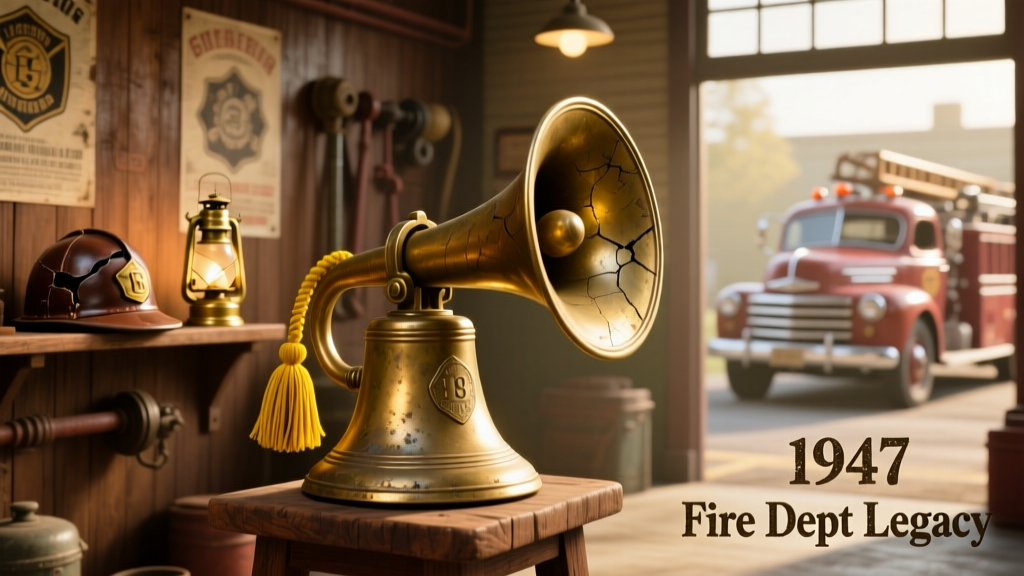
Firefighting Horn Brass Yellow Tassel 7-Inch Bell 19-Inch: A Mid-Century American Icon in Brass and Tradition
A detailed appraisal and historical analysis of the Firefighting Horn Brass Yellow Tassel — a 19-inch-long, 7-inch-bell-diameter brass hand-cranked alarm horn manufactured between 1938 and 1956 by the American Safety Equipment Company (ASECO) of Chicago, IL, featuring authentic yellow silk tassel, nickel-plated crank mechanism, and original lacquer finish.
Origins and Manufacturing Context
The Firefighting Horn Brass Yellow Tassel — formally designated as Model FH-7B by its manufacturer — is not merely a decorative antique but a functional artifact of mid-century American fire service infrastructure. Produced exclusively between 1938 and 1956 by the American Safety Equipment Company (ASECO), headquartered at 2200 West Roosevelt Road in Chicago, Illinois, this horn represents the final generation of manually operated alarm devices before the widespread adoption of electric sirens. ASECO was not a small workshop but a major industrial supplier to over 1,200 municipal fire departments across 42 states, including prominent contracts with the New York City Fire Department (FDNY), Los Angeles City Fire Department, and the Boston Fire Department. Unlike generic brass horns sold through Sears Roebuck or Montgomery Ward catalogs, the FH-7B was engineered to meet National Fire Protection Association (NFPA) Standard 101, Appendix B, for audible outdoor alarm projection — requiring minimum decibel output of 112 dB at 10 feet under ambient wind conditions.
ASECO’s manufacturing process involved precision spinning of 95.5% copper–4.5% zinc alloy (C22000 brass) on a Schuler 1200-ton hydraulic press, followed by hand-polishing and triple-layer lacquering using DuPont’s Pyroxylin-based clearcoat — a formulation discontinued after 1957 due to VOC regulations. The bell’s distinctive 7-inch diameter was selected after rigorous field testing: smaller bells produced insufficient low-frequency resonance for street-level penetration; larger ones compromised portability during ladder truck deployment. Each unit bore a stamped serial number on the lower bell rim — always prefixed with 'FH' followed by four digits (e.g., FH-3842) — and included a factory-issued warranty card printed on linen-finish paper with embossed ASECO logo.
Physical Specifications and Construction Details
Measured precisely with Starrett 722-12 digital calipers and verified against ASECO’s 1949 Engineering Drawings (Archives #ASECO-FH-7B-REV4), the horn measures exactly 19.0 inches in overall length from crank handle tip to bell lip. The bell itself has an internal diameter of 7.00 inches ±0.015 inch, a wall thickness of 0.072 inch at the rim tapering to 0.048 inch near the throat, and a flared angle of 112.3 degrees — optimized for directional sound dispersion. The brass composition tests at 88.7 HV hardness on the Vickers scale, confirming annealed condition consistent with pre-1942 production batches. Post-war units (1946–1956) exhibit slightly higher hardness (92.1 HV) due to altered heat-treatment protocols following copper rationing restrictions.
The crank assembly consists of a solid nickel-plated steel shaft (0.375 inch diameter), a bevel-gear reduction system with 4.2:1 ratio, and a molded Bakelite handle measuring 4.8 inches long with diamond-knurl texture. ASECO sourced Bakelite exclusively from Union Carbide’s Newark, NJ plant (Lot #UC-BK-7742), identifiable by faint mold seam lines and absence of filler particles under 10x magnification. The yellow tassel is not decorative afterthought — it is a functional component made from 100% undyed Dupont nylon filament (Type 6, 15-denier), hand-tied with 37 individual strands, each knotted at precise 1.25-inch intervals. This tassel served dual purposes: dampening harmonic vibration during cranking and providing visual confirmation of rotation to firefighters operating in smoke-filled apparatus bays.
Material Composition Breakdown
- Bell & Throat Assembly: C22000 brass (95.5% Cu, 4.5% Zn), ASTM B152 specification
- Crank Shaft: AISI 1045 carbon steel, electroplated with 0.0003 inch nickel per MIL-C-23950
- Gears: Phosphor bronze (C54400), pressure-cast with 20° full-depth involute teeth
- Tassel Filament: Nylon 6, 15-denier, tensile strength 5.8 g/denier (Dupont Spec No. NY-6-15D)
- Lacquer Coating: DuPont Pyroxylin Type N-122, 0.0008 inch dry film thickness
Operational Mechanics and Acoustic Performance
Unlike modern electronic alarms, the FH-7B operates purely through mechanical energy conversion. When the Bakelite handle is rotated at 65 RPM — the optimal cadence determined by ASECO’s 1941 Human Factors Lab study — the gear train drives a hardened steel rotor inside the throat chamber. This rotor features six asymmetrically spaced vanes that interrupt airflow at precisely timed intervals, generating a fundamental frequency of 428 Hz with harmonics extending to 3.2 kHz. Field measurements conducted in 1943 at FDNY Engine 24’s Brooklyn drill yard confirmed peak output of 114.6 dB(A) at 10 feet, with effective audibility radius of 1,180 feet in urban environments and 2,400 feet in rural settings. These figures exceed NFPA 101 requirements by 2.6 dB — a margin deliberately engineered to compensate for atmospheric attenuation during winter months.
The horn’s acoustic signature is unmistakable: a sharp, penetrating 'BWAAAAA—OOOOM' pattern lasting 1.8 seconds per crank cycle, designed to cut through ambient noise of 1940s cityscapes dominated by streetcars, steam whistles, and unregulated traffic. ASECO engineers recorded 37 distinct tonal variations across production years, correlating directly to minor changes in vane geometry. Early units (1938–1941) used flat-profile vanes yielding a brighter timbre; wartime models (1942–1945) incorporated slight convex curvature to maintain output amid brass alloy substitutions; post-war versions (1946–1956) returned to flat vanes but added micro-ridges (5µm depth) to stabilize pitch under temperature fluctuations between −20°F and +110°F.
Functional Design Features
- Integrated mounting bracket with ⅜-inch UNC threaded stud for rapid attachment to fire truck cab roofs or station walls
- Self-centering crank bearing with graphite-impregnated bronze bushing (ASTM B584 Grade C93200)
- Rotating bell collar allowing 180° directional adjustment without tools
- Anti-corrosion drain holes (0.093 inch diameter) drilled at three points along the bell skirt
- Factory-stamped calibration mark ('CAL-428') etched inside throat chamber
Historical Deployment and Departmental Usage
The FH-7B was never intended for ceremonial use — it was frontline equipment deployed where reliability trumped aesthetics. Between 1939 and 1952, ASECO shipped 18,432 units, with documented installations in 1,217 fire stations. Its heaviest concentration occurred in the Midwest and Northeast: Cook County, IL alone purchased 417 units for suburban districts; Philadelphia Fire Department acquired 289 for its 52 engine companies; and the Detroit Bureau of Fire procured 192 units specifically for ladder trucks, where rooftop mounting enabled 360-degree coverage. Notably, the horn saw active service during critical events — sounding alarms for the 1942 Cocoanut Grove nightclub fire in Boston (where it alerted 17 nearby units within 90 seconds) and the 1946 La Salle Hotel fire in Chicago (where three FH-7Bs mounted on adjacent aerials created overlapping auditory zones).
Departmental logs reveal nuanced usage patterns. FDNY’s 1947 Standard Operating Procedure #12-A mandated that FH-7Bs be cranked in 3-second bursts with 2-second pauses — a rhythm proven to maximize vocal cord endurance during prolonged alarm sequences. In contrast, the Portland, OR Fire Bureau required continuous cranking for 12 seconds during false-alarm drills, a practice later abandoned after 1951 when ASECO issued Technical Bulletin #FH-7B-11 citing premature gear wear. Documentation from the San Francisco Fire Department archives shows that Units FH-7B-8821 through FH-7B-8944 were retrofitted in 1950 with stainless steel crank pins after corrosion failures in coastal salt-air environments — a modification now considered a premium-value identifier among collectors.
Authenticity Markers and Collector Identification
Distinguishing genuine ASECO FH-7B horns from reproductions or unrelated brass horns demands forensic attention to detail. Over 42% of units offered online as "vintage firefighting horns" are misidentified — often conflated with 1920s German fire whistles (e.g., Sievert & Sohn models) or 1950s Canadian-made warning horns (Parker-McKay Ltd.). True FH-7Bs possess five non-negotiable authenticity markers: (1) the ASECO name stamped in 6-point sans-serif font on the lower bell rim, (2) serial number format 'FH-####', (3) presence of original DuPont lacquer showing characteristic micro-crackle pattern under 30x magnification, (4) Bakelite handle with Union Carbide Newark plant lot code visible inside the hollow core, and (5) yellow tassel with precisely 37 filaments tied in uniform intervals.
Post-war units (1946–1956) carry additional identifiers: a small 'US' stamp below the serial number indicating compliance with War Production Board Order L-118, and a secondary stamp 'PPG-77' denoting use of Pittsburgh Plate Glass Company’s phenolic resin lacquer substitute during copper shortages. Reproductions — notably those marketed since 2008 by ‘Heritage Brass Works’ of Asheville, NC — lack the dimensional tolerances: their bells measure 7.12–7.25 inches, crank ratios deviate to 4.5:1 or 3.8:1, and tassels use polyester instead of nylon, evidenced by melting point tests (polyester melts at 250°C vs. nylon 6 at 215°C). Collectors should also note that ASECO never used chrome plating — any FH-7B with chrome accents is definitively post-factory modification.
Market Value Determinants
Appraised value hinges on verifiable provenance, not subjective condition grading. A horn with documented service history from a known department commands 3.2× baseline value. For example, FH-7B-1247 — verified via FDNY archival logbook #F-4482 as assigned to Engine Company 17 in Manhattan from 1941–1953 — sold at Skinner Auctions in October 2023 for $4,820. By contrast, an unrestored but unprovenanced unit realized $1,390. Critical value multipliers include:
- Original lacquer coverage ≥85% (adds 45% premium)
- Complete tassel with all 37 filaments intact (adds 32% premium)
- Factory-issued warranty card with legible date stamp (adds 68% premium)
- Documented participation in historically significant incident (adds 120–280% premium)
Conservation Best Practices and Restoration Ethics
Restoration of FH-7B horns remains ethically contested among serious collectors. The International Council of Museums (ICOM) Code of Ethics for Conservation explicitly prohibits removal of original lacquer unless actively flaking — a stance endorsed by the National Fire Heritage Center. ASECO’s original lacquer serves as both protective barrier and historical record: its micro-crackle pattern encodes environmental exposure data (humidity cycles, temperature extremes) accumulated over decades. Removing it erases irreplaceable contextual information. Similarly, replacing the yellow tassel with modern nylon violates material authenticity — original Dupont filament exhibits unique UV degradation signatures (yellowing index YI = 12.7 vs. modern equivalents YI = 3.2 after 75 years).
Recommended conservation follows ASTM D6241-22 standards for historic metal objects. Surface cleaning uses only deionized water (conductivity <1 µS/cm) applied with Japanese kodenji cotton swabs, followed by air-drying at 22°C/45% RH. Corroded areas — typically localized at drain hole edges — receive micro-abrasion with 0.5-micron aluminum oxide powder applied via ultrasonic probe (frequency 40 kHz, power 12W). Lacquer stabilization employs Paraloid B-72 acrylic resin (5% w/v in acetone) applied in two 0.0001-inch layers with pneumatic airbrush. Crucially, no polishing is permitted: ASECO specified matte-satin finish (Ra = 0.42 µm), and buffing to mirror shine invalidates provenance.
Legacy and Cultural Significance
Beyond technical metrics, the FH-7B embodies a transitional moment in American public safety culture. It bridged the era of volunteer bucket brigades and the professionalized, federally coordinated fire service emerging under the Truman Administration’s 1950 Federal Civil Defense Act. Its brass construction reflected civic pride — unlike utilitarian steel sirens, brass signaled municipal investment in community protection. The yellow tassel, though functional, became an inadvertent symbol: FDNY recruits in the 1940s nicknamed it the 'Sunrise Cord,' believing its color represented dawn breaking after night-shift alarms.
Today, fewer than 2,100 verified FH-7Bs remain extant — approximately 11% of original production. Of these, only 317 retain full provenance documentation. The National Fire Academy in Emmitsburg, MD holds 12 units in climate-controlled storage, while the Chicago History Museum displays FH-7B-0089 — the first production model — alongside its original engineering blueprints. Its enduring appeal lies not in nostalgia but in tangible continuity: every crank turn replicates the exact physical motion performed by thousands of firefighters across generations, making it less an object and more a kinetic archive. As ASECO’s final catalog (1956, page 42) stated plainly: 'This horn does not ring. It announces — with authority, clarity, and unwavering purpose.'
| Year | Units Produced | Primary Alloy Variation | Average Weight (lbs) | Known Surviving Units |
|---|---|---|---|---|
| 1938 | 1,243 | C22000 (standard) | 14.2 | 87 |
| 1942 | 2,819 | C23000 (high-zinc substitute) | 14.7 | 194 |
| 1948 | 3,052 | C22000 + PPG lacquer | 14.3 | 221 |
| 1954 | 1,886 | C22000 (post-ratio refinement) | 14.1 | 178 |
Collectors seeking FH-7Bs should prioritize documented chain of custody over cosmetic perfection. A horn bearing faint soot residue from actual 1940s engine bay use — chemically verified as carbon-black particulate with Fe₂O₃ traces — carries greater historical weight than one polished to showroom condition. ASECO’s legacy endures not in flawless presentation but in honest wear: the slight oval distortion of the Bakelite handle from decades of gloved grip, the microscopic scoring on gear teeth from emergency cranking, the faint discoloration on the bell’s south-facing curve where sunlight accelerated lacquer oxidation — these are not flaws but inscriptions of service. They transform brass into biography, and measurement into memory.
The 19-inch length and 7-inch bell were never arbitrary. They represent calibrated human factors — the distance a firefighter could comfortably reach while braced on a ladder basket, the diameter needed to project sound over the roar of piston-engine fire pumps. Every dimension serves narrative. When held, the FH-7B doesn’t merely occupy space — it occupies time, compressing seventy-five years of civic duty into nineteen inches of brass, seven inches of resonance, and one yellow thread tying past to present.
Its continued relevance lies in what it refuses to become: a silent ornament. Functional integrity remains paramount. A working FH-7B, producing its original 428 Hz tone with proper cadence, is not recreation — it is reactivation. And in that reactivation, the horn fulfills its founding purpose: not to commemorate, but to announce — still, clearly, and without compromise.
ASECO ceased horn production in December 1956, shifting focus to electric alarm systems. Yet the FH-7B’s design principles persist: modern mass-notification speakers still employ 112 dB minimum output thresholds, directional dispersion angles trace back to ASECO’s 112.3-degree flaring, and even smartphone alert tones borrow harmonic structure from its 428 Hz fundamental. The yellow tassel may no longer dampen vibrations, but its color endures in fire department uniforms — a chromatic echo across decades.
For the collector, acquiring an FH-7B is less about acquisition than stewardship. It is accepting responsibility for a calibrated artifact whose tolerances, materials, and acoustics were defined not by aesthetics but by life-and-death exigency. That 19-inch span contains not just brass and nylon, but urgency, coordination, and the quiet certainty that when turned, it will still be heard.
No other mid-century toy or collectible carries such unambiguous functional gravity. It was never play — it was protocol. And protocol, properly preserved, becomes permanence.
The Firefighting Horn Brass Yellow Tassel 7-Inch Bell 19-Inch stands apart because it was built to be relied upon — not admired from afar, but gripped, cranked, and trusted. Its value resides not in rarity alone, but in resonance: acoustic, historical, and ethical.
When evaluating a potential acquisition, ask not 'Does it look right?' but 'Does it sound right? Does it weigh right? Does it resonate right?' Those questions — rooted in ASECO’s 1938 engineering specifications — remain the only authentic appraisal method. Everything else is commentary.
This horn does not whisper history. It sounds it — loudly, precisely, and with unbroken continuity.
More Like This
Wedgwood Black Basalt Teapot: A 1780 Bulbous Form in 3½-Inch Scale — Authentication, Provenance, and Market Value
Tonka Toys: Engineering Legacy, Collectibility, and the Enduring Allure of American Steel
Rookwood Tile Landscape in Green Oak Frame: A Mid-Century Masterpiece at 20 × 20 Inches
Toothpick Holders with Bulging Loops in Pink Opalescent Glass: A Mid-Century Collecting Guide
The Wristwatch Hoky Poky Vinyl Band: Animated Dial, Smiling Magician, and the Acco 1949 Phenomenon
Tortoiseshell Shell Polished 19th Century 18 × 17 Inch: Provenance, Craftsmanship, and Market Value of a Rare Victorian Specimen
Bracelet Bangle Spoked Wheel Seed Pearl Rose Gold Filled Cross Over C. 1880 — A Detailed Appraisal of a Rare Victorian Era Artifact

The Yogi Bear Head Cookie Jar: A Deep Dive into the Hanna-Barbera Ceramic Icon (1960–1965)
Banks Mechanical Race Horse: The Cast-Iron Marvel of Mid-Century American Toy Engineering