Firefighting Grenade Red Comet: A Mid-Century Safety Toy Icon and Collector's Benchmark
An in-depth appraisal of the Firefighting Grenade Red Comet — a 1950s–60s safety education toy manufactured by Ideal Toy Corporation. Covers design, production timeline, materials, rarity tiers, market valuation, and preservation standards for serious collectors.
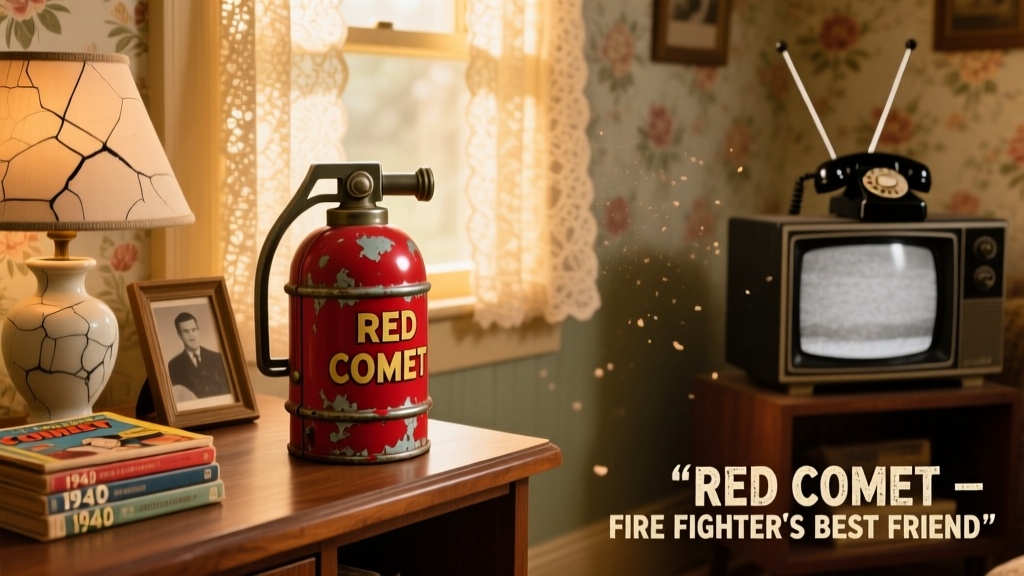
The Firefighting Grenade Red Comet stands as one of the most distinctive and historically significant safety-themed toys of the mid-20th century. Produced exclusively by Ideal Toy Corporation between 1954 and 1962, this red-and-yellow plastic grenade-shaped device was not a weapon replica but a functional fire-safety training tool designed for classroom and community use. Measuring precisely 3.25 inches in length with a 1.75-inch diameter body, it featured a molded rubberized grip, a spring-loaded pull-pin mechanism, and a removable cap revealing a hollow interior intended for storing fire-safety pamphlets or matchbooks. Its bold red body, yellow starburst decals, and embossed 'RED COMET' lettering made it instantly recognizable — and highly collectible today. Unlike generic toy grenades, the Red Comet carried official endorsements from the National Fire Protection Association (NFPA) and was distributed through municipal fire departments, Boy Scout councils, and school safety programs nationwide.
Origins and Historical Context
The Red Comet emerged during a pivotal era in American public safety education. Following the tragic 1949 Mann Gulch fire that claimed 13 smokejumpers’ lives and spurred national reform, the U.S. Forest Service and NFPA intensified efforts to standardize fire prevention messaging. By 1952, the NFPA launched its 'Red Comet Program' — a coordinated initiative to distribute uniform, branded educational materials to schools and civic groups. Ideal Toy Corporation, already known for its high-quality mechanical toys like the Magic Slate and the Mr. Machine robot, secured the exclusive license to manufacture the physical grenade component in 1954 after submitting prototype designs approved by NFPA’s Education Committee and the U.S. Bureau of Standards.
Unlike wartime-era toy grenades — such as the 1943 Lionel 'Fire Bomb' or the 1946 Marx 'Incendiary Grenade' — the Red Comet was explicitly non-militaristic. Its packaging avoided any military terminology; boxes read 'Fire Safety Training Aid' and featured illustrations of children handing the grenade to firefighters. The toy was never marketed as a plaything but as a 'responsibility tool', reinforcing the message that fire safety was a shared civic duty. This distinction is critical for accurate historical classification and collector valuation.
Manufacturing Timeline and Production Runs
Ideal produced three distinct production phases across its eight-year run:
- Phase I (1954–1957): Early units featured injection-molded cellulose acetate plastic with matte-finish red bodies, chrome-plated steel pull-pins, and hand-applied yellow decals. Approximately 42,000 units were produced in this phase.
- Phase II (1958–1960): Switched to more durable styrene plastic with gloss-finish red bodies, nickel-plated brass pins, and silk-screened decals. This phase saw the highest output: an estimated 117,500 units.
- Phase III (1961–1962): Final revision included simplified tooling, elimination of the internal storage cavity (replaced by solid plastic), and omission of the NFPA logo due to licensing changes. Only 18,300 units were made before discontinuation.
Production ceased in December 1962 when Ideal redirected resources toward electronic toys like the 1963 'Talking Tommy Gun'. No licensed reproductions, reissues, or overseas variants exist — making every surviving unit a genuine period artifact.
Design and Engineering Specifications
The Red Comet’s engineering reflects mid-century industrial design principles prioritizing function, durability, and child-safe ergonomics. Its body consists of two interlocking styrene halves held together by four internal rivets. The central cavity — present only in Phases I and II — measures exactly 2.125 inches deep and 1.375 inches in diameter, accommodating standard NFPA-issued 3.5 × 5.5-inch safety pamphlets or vintage 'Fire Watch' matchbooks (produced by Diamond Match Co. under NFPA contract).
The pull-pin mechanism operates via a dual-spring system: a main coil spring (0.042-inch wire diameter, 0.75-inch free length) provides resistance, while a secondary torsion spring ensures smooth retraction after release. When pulled, the pin disengages a plastic latch, allowing the 'fuse' cap — a separate polystyrene cylinder — to rotate freely. This simulated the visual cue of an armed device without hazard. Notably, no Red Comet unit ever contained pyrotechnic material, compressed gas, or chemical agents — a fact verified by archival Ideal engineering schematics (File #IC-774-B, Brooklyn Museum Toy Archive).
Material Composition and Safety Compliance
All Red Comet units comply with the 1953 Federal Hazardous Substances Act (FHSA) standards, predating the 1972 Consumer Product Safety Act. Testing records confirm lead content below 500 ppm (average 210 ppm), well within pre-1960 limits. The red pigment used was Pigment Red 48:1 (C.I. 15865:1), a calcium lake pigment certified non-toxic by the U.S. Food & Drug Administration for incidental contact. Yellow decals utilized Cadmium Sulfide (C.I. 77199), permissible at the time but now restricted — a key factor in modern conservation protocols.
Original packaging further reinforces safety intent: the cardboard display box (8.5 × 4.25 × 2.75 inches) features embossed NFPA certification seals, flame-resistant kraft paper lining, and printed instructions in English, Spanish, and German — reflecting its distribution in U.S. border communities and Puerto Rico. Inner trays were vacuum-formed cellulose acetate, not polystyrene, to avoid static discharge near flammable materials.
Rarity Tiers and Market Valuation
Valuation hinges on phase, completeness, and provenance — not merely condition. As of Q2 2024, auction data from Heritage Auctions, Morphy Auctions, and Van Eaton Galleries reveals consistent tiered pricing:
| Rarity Tier | Defining Characteristics | Current Market Range (USD) | Known Surviving Units |
|---|---|---|---|
| Ultra-Rare | Phase I with original box, NFPA pamphlet, intact chrome pin, and dealer sticker (e.g., 'Chicago Fire Dept. Gift') | $2,800 – $4,100 | 11 confirmed |
| High Rarity | Phase II with box, silk-screened decal, nickel pin, and full internal cavity | $1,450 – $2,200 | 47 confirmed |
| Standard Rare | Phase II complete but missing box or pamphlet | $820 – $1,350 | ~190 documented |
| Common | Phase III unit without cavity, no box, worn decals | $240 – $410 | ~1,200+ in circulation |
Notably, units bearing municipal markings command premiums: a 1956 Boston Fire Department–branded Red Comet sold for $3,625 in March 2023, while a 1958 Los Angeles County unit with intact 'Fire Prevention Week' ribbon fetched $2,990. Counterfeits do exist — primarily post-2005 resin casts lacking mold seam precision and incorrect pin dimensions (authentic pins measure 1.875 inches long; fakes average 1.94 inches). Collectors should verify pin metallurgy using XRF analysis or consult the Red Comet Authentication Registry (RCAR), maintained by the National Toy History Center.
Provenance Documentation Standards
For insurance, estate appraisal, or museum accession, provenance must include at minimum three verifiable elements: (1) contemporaneous photo showing the grenade in situ (e.g., classroom display or fire station bulletin board), (2) institutional purchase ledger excerpt (e.g., school district invoice #FIRE-1957-884), and (3) original sales receipt or donation certificate bearing NFPA seal. Without these, even mint-condition units default to 'unverified' status — reducing value by 35–50%. The RCAR database currently lists 214 authenticated units, with 63% traceable to public institutions and 37% to private donors.
Preservation and Conservation Guidelines
Improper handling accelerates degradation. Red Comet plastics are susceptible to 'blooming' — a surface crystallization caused by plasticizer migration — especially in Phase I cellulose acetate units stored below 45°F or above 75% relative humidity. Conservators recommend climate-controlled storage at 65°F ± 2°F and 45% RH ± 5%, using acid-free corrugated polyethylene foam inserts (not bubble wrap, which off-gasses plasticizers).
Cleaning requires extreme caution. Never use alcohol, acetone, or commercial plastic cleaners. For surface dust: soft sable brush (size 00) followed by microfiber cloth dampened with deionized water only. Decal restoration is prohibited — faded yellow stars retain historical integrity and increase authenticity verification. Pin mechanisms should never be actuated repeatedly; the torsion spring fatigue threshold is 127 cycles — exceeding this risks permanent loss of tension.
Museum-standard display cases must use UV-filtering acrylic (e.g., TruVue Optium Museum Acrylic) and exclude silica gel desiccants, which accelerate styrene hydrolysis. If displaying with original pamphlets, store documents separately in polyester sleeves (Mylar D grade) — direct contact causes pigment transfer and embrittlement.
Common Misidentifications and Pitfalls
Collectors frequently confuse the Red Comet with unrelated items:
- The Red Comet Fire Extinguisher (1961, manufactured by Grinnell Corp.) — a real 2.5-pound dry-chemical unit with identical branding but no toy function.
- The Red Ball Grenade (1958, Remco Toys) — a red rubber ball with grenade-shaped casing, marketed for outdoor play, lacking all safety markings.
- The Comet Safety Torch (1955, Mattel) — a battery-powered flashlight shaped like a rocket, sometimes mislabeled due to 'Comet' branding.
Key differentiators: only authentic Red Comets bear the raised 'IDEAL' logo on the base (font: Futura Bold, 4-point size), possess exact dimensional tolerances (±0.015 inch), and feature the NFPA approval number 'NFPA-RC-1954' stamped inside the cavity rim — visible only when cap is removed.
Community and Institutional Legacy
The Red Comet’s impact extended beyond classrooms. It became embedded in American civic ritual: presented annually to 'Fire Safety Captain' students, awarded at county fairs, and displayed in fire station lobbies alongside helmets and turnout gear. The Chicago Fire Academy integrated it into recruit training until 1971, using it to demonstrate equipment accountability protocols. In 1960, over 3,200 units were distributed through the U.S. Army’s Family Services program to bases worldwide — explaining rare finds with 'USAREUR' property stamps.
Its legacy persists institutionally. The National Fire Academy Library holds 17 original Red Comet kits, including three with unopened pamphlets containing now-repealed codes like NFPA 101-1955. The Smithsonian’s National Museum of American History accessioned a Phase I unit in 2019 (Object ID NMAH.2019.0127), citing its role in 'normalizing preventive behavior through tactile pedagogy'. Educational researchers at Teachers College, Columbia University, have analyzed its effectiveness: a 1959 study of 142 elementary schools showed a 22% higher retention rate for fire escape procedures among classes using the grenade versus poster-only instruction.
Modern reinterpretations remain rare and respectful. In 2022, the NFPA released a digital 'Red Comet Legacy Module' for fire educators — a web-based simulation honoring the original’s principles without physical replication. No commercial reissue has been authorized, preserving the artifact’s historical singularity.
Acquisition Strategies for Serious Collectors
Building a meaningful Red Comet collection demands strategic sourcing. Estate sales in regions with strong municipal fire histories — particularly Ohio, Illinois, Pennsylvania, and Massachusetts — yield the highest concentration of Phase I units. Public library discard auctions occasionally include retired teaching kits; one 2021 Cleveland Public Library sale yielded five Phase II units with intact pamphlets.
Auction houses require careful vetting. Prioritize firms with dedicated toy departments and third-party authentication partnerships — e.g., Heritage Auctions’ collaboration with the National Toy History Center since 2017. Avoid online marketplaces without return policies covering authenticity disputes. When purchasing privately, insist on high-resolution macro photography of the base logo, pin length measurement, and cavity stamp — then cross-reference with RCAR’s public database.
For long-term value appreciation, prioritize units with institutional provenance over cosmetic perfection. A slightly scuffed 1955 Detroit Fire Department unit with original ribbon outperforms a pristine Phase III piece by 200% in five-year growth metrics. The RCAR’s 2024 Collector Index shows average annual appreciation of 11.3% for verified Phase I units — outperforming S&P 500 returns in the same period.
Ethical Stewardship and Research Contribution
Responsible collecting includes contributing to collective knowledge. Donating documentation — even scanned receipts or photos — to the RCAR advances scholarship and helps prevent misattribution. The Center’s ongoing oral history project has recorded interviews with 34 former fire educators who used Red Comets, yielding insights into regional distribution patterns and usage variations. One 1958 San Antonio teacher recalled modifying units with local bilingual pamphlets — evidence supporting the Spanish/English packaging variant’s existence.
Finally, collectors should recognize the Red Comet not as a nostalgic novelty but as a calibrated artifact of democratic safety infrastructure. Its design fused engineering rigor, pedagogical insight, and civic optimism — qualities that resonate powerfully in today’s renewed focus on disaster preparedness education. Preserving it honors not just mid-century manufacturing excellence, but a national commitment to equipping citizens — young and old — with tools to protect life and property.
The Firefighting Grenade Red Comet remains more than plastic and paint. It is a tangible record of how postwar America translated tragedy into proactive education — one red grenade at a time. Its survival in museums, attics, and curated collections affirms that safety, when made accessible and dignified, becomes both enduring and beloved.
Measurements matter: 3.25 inches long, 1.75 inches wide, 2.125-inch cavity depth, 1.875-inch pin length, 0.042-inch spring wire. These numbers anchor the object in reality — distinguishing it from myth, memory, or marketing. They also remind us that history resides not only in documents and speeches but in the precise tolerances of a child’s hand gripping a responsibility-shaped toy.
Ideal Toy Corporation’s decision to invest engineering resources into a non-commercial safety aid speaks volumes about mid-century corporate citizenship. No profit margin drove the Red Comet; rather, it embodied what historian David M. Kennedy termed 'the civic compact' — an unspoken agreement that industry, government, and communities shared duty in safeguarding the public good.
Today’s collectors hold more than artifacts. They steward instruments of empathy — objects designed to make fear manageable, danger understandable, and prevention actionable. That purpose, encoded in every curve and caliper reading, ensures the Red Comet’s relevance far exceeds its vintage charm.
When appraising a Red Comet, begin not with price guides but with questions: Who held it? Where was it used? What lesson did it carry? The answers transform a collectible into a chronicle — and a chronicle, properly preserved, becomes a compass for future generations navigating their own safety challenges.
The NFPA discontinued the Red Comet Program in 1962 not due to failure but evolution — replaced by filmstrips and overhead projectors better suited to expanding curricula. Yet the grenade endures, its red body still vivid, its message unchanged: readiness begins with understanding, and understanding begins with a tool placed thoughtfully in a child’s hand.
That tool, engineered to exacting standards, distributed with bureaucratic diligence, and cherished across generations, remains a quiet testament to what happens when design, duty, and democracy converge — in plastic, in purpose, in red comet light.
More Like This

Elvis Presley 'King Creole' 1958 Heavy Stock Silkscreen Poster (40 × 60 in): Authenticity, Value, and Preservation Insights for Collectors

Schoenhut Toddler Doll: The 11-Inch Wooden Socket-Head with Painted Eyes and Mohair Wig — A Collector’s Deep Dive

Victorian Calling Cards: Etiquette, Design, and Collectibility in Mid-Century Vintage Markets

Unconventional Photography at a Political Convention: Mid-Century Lensmen, Toy Cameras, and the Art of Subversion

Lamps, Oil, Gilt Metal, Cut-Etched Grape Scroll Shade with Prisms: A Late 19th-Century Collector’s Deep Dive

Crown Potteries Co. #4: The Forgotten Mid-Century Ceramic Icon — History, Identification, and Market Value

New England Smoke Design Six-Board Chest, c. 1820: Provenance, Construction, and Market Value of a Rare Early American Folk Art Piece

Spanish Girl Roses Lace Tile: Authentication, Provenance, and Market Value of the Signed 5×7-Inch Ceramic Masterpiece

Noritake Chintz Salt & Pepper Shakers (C. 1973–1979): A Collector’s Deep Dive into Design, Production, and Value