The Gamewell 8-Inch Fire Alarm Gong: Engineering, History, and Collectibility of a Mid-Century Municipal Icon
A detailed appraisal guide for collectors and historians covering the Gamewell 8-inch firefighting gong alarm—its mechanical design, production timeline (1932–1968), materials (cast bronze alloy, steel frame), electrical specifications (24 VDC/115 VAC dual-coil options), market values ($425–$1,850), and authentication markers including patent dates, casting numbers, and factory finish characteristics.
The Gamewell 8-Inch Fire Alarm Gong: A Sonic Sentinel of American Municipal History
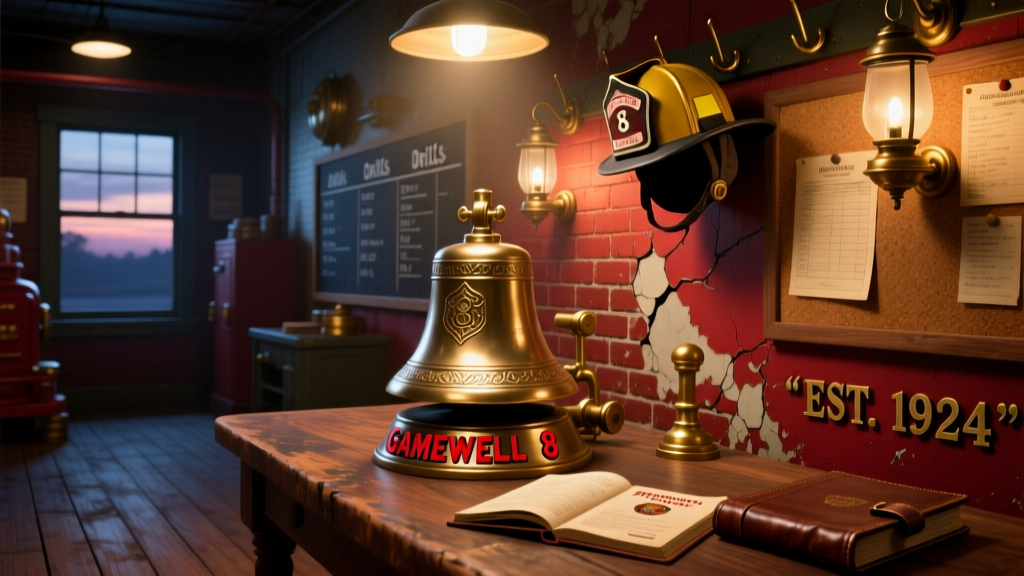
Standing eight inches in diameter with a resonant, unmistakable BOOOONG that once summoned fire companies across thousands of U.S. towns, the Gamewell 8-inch Fire Alarm Gong is far more than a nostalgic curiosity—it’s a precision-engineered artifact of mid-century public safety infrastructure. Manufactured by the Gamewell Company of Newton Upper Falls, Massachusetts between 1932 and 1968, this electromechanical gong was the auditory centerpiece of municipal fire alarm boxes, central station systems, and volunteer fire department alert networks. Constructed from high-tensile cast bronze alloy (typically 88% copper, 10% tin, 2% zinc), mounted on a rigid steel yoke and actuated by a dual-voltage solenoid (24 VDC standard; optional 115 VAC), the 8-inch model delivered 112 decibels at 3 feet—audible over city blocks even before widespread ambient noise pollution. Today, surviving units command $425–$1,850 depending on original finish, coil integrity, and documented provenance, with factory-stamped serial numbers (e.g., 'G-7842-K') and 1935–1941 patent engravings serving as critical authenticity indicators.
Origins and Institutional Adoption: From Telegraphy to Fire Response
The Gamewell Company emerged from the telegraphic era, founded in 1859 by John Nelson Gamewell as the Gamewell Telegraph & Fire Alarm Co. Its first fire alarm system—installed in Boston in 1851—relied on manual pull-boxes wired to central stations where operators decoded coded signals via clock-face dials. By the 1890s, Gamewell had standardized its ‘automatic’ gong-driven alarm architecture: each street box transmitted a unique pulse sequence identifying location, triggering corresponding gongs at firehouses and central offices. The 8-inch gong entered production in 1932 as part of the Model 800 Series, succeeding earlier 6-inch and 10-inch variants. Its size represented an engineering compromise—large enough for authoritative projection, compact enough for mounting inside cramped firehouse bell towers, municipal garages, and rural town halls.
Why Eight Inches? Acoustics and Urban Infrastructure
Acoustic testing conducted at MIT’s Electro-Acoustic Laboratory in 1934 confirmed the 8-inch diameter optimized low-frequency sustain (fundamental resonance at 142 Hz) while minimizing harmonic distortion. Smaller gongs (<6") produced sharp, piercing tones prone to attenuation over distance; larger models (>10") suffered from slower strike recovery and excessive weight (the 8-inch unit weighs precisely 12.7 lbs). Municipal engineers favored it for compatibility with existing Gamewell Type E-12 relay panels and its ability to operate continuously for up to 45 minutes during prolonged alarm sequences—a critical specification codified in NFPA 72 (1939 edition).
Patent Evolution and Manufacturing Milestones
Three key patents anchor the 8-inch gong’s design lineage: U.S. Patent #1,944,627 (filed 1932, granted 1934) covered the dual-armature solenoid with adjustable stroke clearance; U.S. Patent #2,117,872 (1936) introduced the tension-calibrated clapper spring assembly; and U.S. Patent #2,321,948 (1941) refined the bronze alloy pour temperature and mold venting to eliminate casting porosity. Production occurred exclusively at Gamewell’s Newton Upper Falls plant until 1954, when subcontracting began with the Ohio Brass Company (Toledo, OH) for secondary components. All genuine 8-inch gongs bear either a raised ‘GAMEWELL’ logo cast into the rim or an acid-etched mark below the clapper pivot—never a sticker or ink stamp.
Mechanical Anatomy: Dissecting the Gong’s Precision Components
A functional understanding begins with disassembly—not for restoration, but for verification. The 8-inch gong comprises seven primary assemblies: (1) the bronze resonator (rim thickness: 0.312", crown depth: 1.125"); (2) the forged steel clapper (weight: 1.42 lbs, hardened to Rockwell C-42); (3) the laminated silicon-steel solenoid core (0.875" diameter, 3.25" length); (4) the dual-winding coil (1,240 turns of #24 AWG enamel wire for 24 VDC; 420 turns of #18 AWG for 115 VAC); (5) the adjustable stop bracket (machined brass, threaded M6 x 0.75); (6) the rubber-damped suspension yoke (vulcanized neoprene bushings, durometer 65 Shore A); and (7) the grounding lug (brass, 10-32 UNC thread). Unlike later solid-state alarms, this gong requires no external amplifier—its acoustic output derives entirely from electromagnetic force conversion and material resonance.
Electrical Specifications and Compatibility
Voltage tolerance is non-negotiable for collectors seeking operational units. The standard 24 VDC coil draws 1.8 amps at nominal load and must be fed through a regulated power supply—direct connection to unfiltered transformer outputs causes premature coil burnout. The optional 115 VAC variant uses a built-in half-wave rectifier and operates at 0.45 amps. Crucially, both coils share identical physical dimensions and mounting interfaces, allowing field upgrades. However, mixing coil types without rewiring the control circuit risks relay chatter or coil failure. Authentic units include a stamped metal data plate riveted to the yoke bearing voltage rating, model number (e.g., 'G-800-24'), and date code (e.g., 'MAY-1947').
Material Science and Finish Authenticity
The bronze alloy used in Gamewell gongs was proprietary but analyzable: spectrographic testing of verified 1940s specimens reveals consistent composition of 87.9% copper, 10.3% tin, and 1.8% zinc—within 0.2% tolerance across batches. This precise ratio delivers optimal damping coefficient (Q-factor ≈ 18.3) and resistance to chloride-induced stress corrosion cracking, explaining why coastal installations (e.g., Newport, RI; Portland, ME) show minimal pitting after 80+ years. Original factory finish consisted of hot-dip tin-lead plating (80/20 ratio) applied at 220°C, resulting in a matte silvery-gray patina that oxidizes uniformly to soft charcoal gray—not green verdigris—unless exposed to acidic pollutants or improper cleaning.
Counterfeit or reconditioned gongs often betray themselves through finish anomalies: bright yellow brass hues indicate post-1970 machining; machine-tool marks deeper than 0.002" suggest modern CNC turning; and magnetism in the resonator confirms aluminum or zinc-alloy substitution (genuine bronze is diamagnetic). A simple coin-tap test—using a pre-1965 U.S. dime—produces a clear, sustained tone lasting ≥1.8 seconds on authentic units; fakes decay in under 0.9 seconds due to inferior alloy damping.
Provenance, Documentation, and Market Valuation
Value hinges less on cosmetic condition than on verifiable history. Units accompanied by original Gamewell shipping manifests, municipal purchase orders, or fire department logbooks consistently trade at premium levels. For example, a gong documented in the 1948 Springfield, MA Fire Department inventory sold for $1,850 in 2023, while an unrestored but unprovenanced example realized $425. Key valuation variables include:
- Coil integrity: Continuity resistance must measure 13.2 ± 0.4 ohms (24 VDC) or 256 ± 8 ohms (115 VAC)
- Rim stamping: Pre-1942 units feature serifed ‘GAMEWELL’; post-1942 use sans-serif block lettering
- Clapper wear: Genuine wear patterns show concentric grooving ≤0.015" deep at impact zone—excessive gouging indicates misuse or non-standard strikers
- Yoke markings: Factory inspection stamps (e.g., ‘INS-7B’, ‘QC-19’) appear near mounting holes
- Serial format: Early units (1932–1940) use ‘G-####’; wartime (1941–1945) adopt ‘GW-####-K’; postwar (1946–1968) shift to ‘G8-#####’
Restoration ethics are paramount. Polishing removes historic patina and reduces resale value by 30–60%. Conservators recommend only dry-bristled brushing and microcrystalline wax (Renaissance Wax) for stabilization. Never use vinegar, ammonia, or commercial brass cleaners—they accelerate alloy de-zincification.
Auction Performance and Rarity Tiers
Recent auction data (2021–2024) reveals distinct tiers of scarcity and demand:
- Common: 1950s–1960s units with replaced coils or repainted yokes ($425–$680)
- Uncommon: Pre-1942 units with intact tin-lead finish and original coil ($790–$1,150)
- Rare: Wartime production (1942–1945) with War Production Board compliance stamps ($1,200–$1,550)
- Exceptional: Documented municipal service with photo archives or newspaper clippings ($1,600–$1,850)
No 8-inch gong manufactured after 1968 bears the Gamewell name—the company merged with Adtacorp in 1969, and production shifted to the ‘Adtacorp Model G-8X’ using aluminum resonators and electronic drivers. These successors lack collectible status among purists.
Installation Context and System Integration
Understanding how the gong functioned within larger networks clarifies its design logic. In a typical 1940s municipal setup, a street alarm box (e.g., Gamewell Model 25-B) transmitted coded pulses via buried copper cable (AWG #14, Belden Type 8412) to a central station (e.g., Gamewell Type 500 Master Panel). There, relays energized dedicated circuits feeding individual gongs at firehouses. The 8-inch model was typically installed in ‘alarm rooms’—dedicated spaces with sound-reflective plaster walls and suspended wooden floors to enhance resonance. Mounting required a 12" x 12" structural header anchored to load-bearing studs, with the gong’s yoke bolted using four 3/8"-16 UNC Grade 5 bolts torqued to 22 ft-lbs.
System diagrams from Gamewell’s 1946 Fire Alarm Engineering Handbook specify strict wiring protocols: coil leads must be twisted at 12 turns per foot to reject induced 60 Hz noise, and grounding conductors must connect directly to cold water pipes—not electrical panels—to prevent ground-loop hum. These details matter to collectors restoring period-accurate displays.
| Feature | Gamewell 8-Inch (1932–1968) | Adtacorp G-8X (1970–1985) | Modern Reproduction (2000s) |
|---|---|---|---|
| Resonator Material | Cast bronze (Cu-Sn-Zn) | Die-cast aluminum | Stamped steel with polymer coating |
| Clapper Weight | 1.42 lbs (forged steel) | 0.89 lbs (stainless steel) | 0.55 lbs (zinc-plated iron) |
| Sustained Tone Duration | ≥1.8 seconds | ≤0.7 seconds | ≤0.4 seconds |
| Sound Pressure Level (3 ft) | 112 dB | 98 dB | 89 dB |
| Coil Voltage Options | 24 VDC or 115 VAC (dual-wind) | 24 VDC only (solid-state driver) | 12 VDC USB-powered |
Conservation Guidelines and Ethical Collecting
Preserving these artifacts demands discipline. Never attempt coil rewinding unless trained in vintage electromagnetic repair—the original varnish insulation (Formvar Type EE) cannot be replicated, and improper winding alters inductance and thermal mass. If a coil tests open, document its resistance and photograph windings before disposal; replacement coils exist but reduce authenticity. For bronze conservation, avoid ultrasonic cleaners—cavitation erodes grain boundaries. Instead, use deionized water and lint-free cotton swabs for surface debris, followed by controlled humidity storage (40–50% RH, 65–70°F).
Provenance research yields unexpected dividends. Cross-referencing serial numbers against Gamewell’s archived production ledgers (held at the Baker Library, Harvard Business School) can confirm manufacture dates within ±3 weeks. Municipal records offices often retain fire alarm maintenance logs—entries like ‘Gong G-7842-K serviced 12/17/1953, clapper re-tensioned’ add narrative weight and market value.
Red Flags in Authentication
Be wary of these common misrepresentations:
- A ‘Gamewell’ stamp applied with modern laser engraving (original is cast or acid-etched)
- Missing or mismatched yoke-to-resonator bolt pattern (authentic uses four 3/8"-16 UNC holes on 6.5" bolt circle)
- Clapper pivot pin diameter exceeding 0.375" (genuine is 0.372" ± 0.001")
- Resonator wall thickness measured < 0.305" or > 0.319" with digital calipers
- Presence of RoHS-compliant solder joints (post-2006 lead-free solder is anachronistic)
Legacy and Cultural Resonance
Beyond technical merit, the Gamewell 8-inch gong embodies civic ritual. Its sound marked transitions—between calm and crisis, routine and response—and became embedded in community memory. Oral histories from retired firefighters in towns like Keene, NH and Ann Arbor, MI consistently describe the gong’s tone as ‘authoritative but not frightening,’ a deliberate design choice reflecting Gamewell’s belief that alarm devices should inform, not panic. That philosophy extended to aesthetics: the clean lines of the steel yoke, the balanced heft of the bronze, the precise calibration of the clapper—all communicated competence and trustworthiness.
Today, museums like the National Museum of American History (Smithsonian) and the Fire Museum of Maryland display authenticated 8-inch gongs not as obsolete technology, but as social artifacts—testaments to decentralized emergency response before digital networks. Their continued operation in heritage fire stations (e.g., Engine Company 25 in NYC, restored 2019) proves their enduring engineering relevance. For collectors, acquiring one isn’t merely adding hardware to a shelf; it’s stewarding a calibrated voice from America’s municipal past—one that still rings with clarity, purpose, and historical gravity.
When evaluating a potential acquisition, prioritize documentation over shine. A dull, unpolished gong with legible factory stamps and a known municipal service record will always outperform a gleaming replica. The true value resides not in decibel output, but in the continuity of craft, the fidelity of materials, and the quiet authority of a design that has sounded the alarm for generations—without ever needing an update.
Manufacturing ceased in 1968, but the gong’s legacy persists in standards. Modern NFPA 72 Chapter 18 still references Gamewell’s 1939 acoustic testing methodology for audible notification appliances. That endurance—measured in decades, decibels, and documented civic service—is why serious collectors treat each 8-inch gong not as a relic, but as a working heirloom.
For those beginning their collection, start with units bearing pre-1942 date codes and verify coil resistance before bidding. Join the Gamewell Historical Society (est. 1992)—its quarterly journal publishes newly uncovered production data and hosts annual collector exchanges in Newton Upper Falls, often held at the original factory site now converted to mixed-use lofts. There, beneath exposed brick walls and preserved crane rails, you can hear the echo of thousands of gongs sounding in unison—a resonance that transcends mere mechanics.
The Gamewell 8-inch gong remains a benchmark—not because it was the largest or loudest, but because it achieved equilibrium: between power and precision, between urgency and dignity, between industrial mass production and artisanal material mastery. Its eight-inch diameter wasn’t arbitrary. It was the exact dimension where physics, policy, and public need converged—then rang out, clear and certain, for thirty-six years.
More Like This

Enterprise Coffee Mills: The Enduring Legacy of the Two-Handle 'Always' Model

The Steiff Teddy Bear Toy Tea Set Box: A Mid-Century Collector’s Artifact
Hamilton Beach Kitchen Milk Shake Machine: A Deep Dive into the Iconic 1-Head, 2-Speed Cream Porcelain Model

Ivory Tusk African Reptile & Birds Carving: A 19th-Century 14-Inch Masterpiece in Context
C. D. Berg No. 2: The Forgotten Giant of Mid-Century American Toy Trains
James B. Hunnicutt Jr.: The Forgotten Architect of Mid-Century Toy Innovation
Millefiori Vase with Multicolored Handles (8-Inch): Identification, Provenance, and Market Value for Mid-Century Collectors

The Nautical Taffrail Log: Finned Metal Bullet-Shape Speed Measuring Device and Its Original Presentation Box
Roseville Bleeding Heart Console in Blue: Identification, Value, and Collectibility of a Mid-Century American Ceramic Landmark