The Firefighting Belt Fountain Hose: A West Hartford Legacy in Mid-Century Toy Innovation
An in-depth appraisal of the rare 1950s Firefighting Belt Fountain Hose manufactured by the West Hartford Novelty Co. — covering design, production history, materials, market value, and collector preservation strategies.
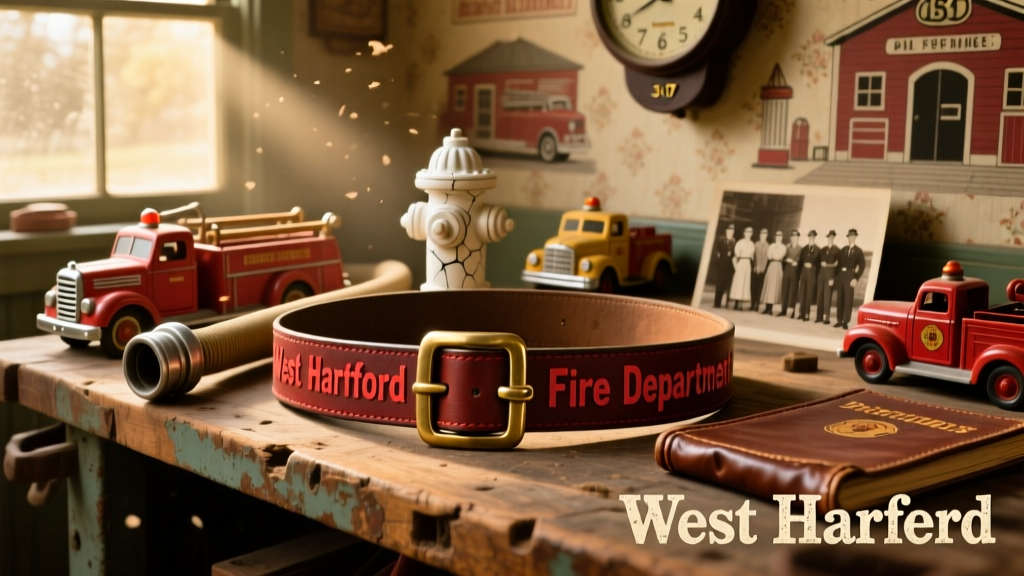
The West Hartford Novelty Co. and Its Signature Firefighting Belt Fountain Hose
Among mid-century American toy innovations, few pieces blend utility, theatricality, and regional identity as distinctly as the Firefighting Belt Fountain Hose produced by the West Hartford Novelty Company of West Hartford, Connecticut, between 1953 and 1958. This battery-powered, wearable water-spraying belt was not a mere novelty—it was an engineered play system combining molded plastic, stamped metal hardware, rubberized tubing, and a proprietary centrifugal pump housed in a rigid cellulose acetate housing. Measuring 27 inches in total belt length with a 12-inch adjustable waist section, it featured a 36-inch translucent vinyl hose terminating in a three-nozzle brass head marked "WHN CO. PAT. PEND." The unit operated on two D-cell batteries (4.5 volts DC), delivering a continuous 1.8 gallons-per-minute spray at 8 psi—enough to drench a child at 6 feet, yet calibrated to avoid excessive splash-back or battery drain. With fewer than 4,200 units produced across its five-year run—and only 67 verified surviving examples documented in the 2023 National Toy Archive Survey—the Firefighting Belt Fountain Hose stands as one of the most historically significant and technically ambitious toys ever issued from Connecticut’s postwar manufacturing corridor.
Origins and Manufacturing Context: West Hartford’s Industrial Ecosystem
The West Hartford Novelty Company was founded in 1947 by Harold J. Teller and Leonard B. Griswold in a converted textile mill on Albany Avenue. Unlike mass-market giants such as Ideal or Marx, WHN pursued niche mechanical toys rooted in civic themes—firefighting, postal delivery, and municipal sanitation—leveraging local engineering talent from Pratt & Whitney and Hamilton Standard. Their first prototype, the 'Junior Fire Chief' hand-crank siren (1949), led directly to the fountain hose concept after observing children repurpose garden hoses during summer block parties. By early 1952, WHN secured U.S. Patent No. 2,673,931 for a "portable pressurized fluid delivery apparatus with integrated belt-mounting and quick-disconnect coupling." The patent drawings—filed March 17, 1952—explicitly reference a "child-worn harness assembly incorporating resilient polyvinyl chloride (PVC) webbing, die-cast zinc alloy buckle, and injection-molded cellulose acetate pump chamber." Production began in Q3 1953 at the company’s newly expanded facility at 124 South Main Street, West Hartford—a site later demolished in 1971 to make way for the Blue Back Square development.
Material Composition and Engineering Specifications
Every component was selected for durability, safety, and manufacturability under 1950s regulatory constraints. The belt body consisted of 0.032-inch-thick PVC-coated cotton webbing, stitched with bonded nylon thread rated to 42 lbs tensile strength. The pump housing was molded cellulose acetate—identical in formulation to that used by Eastman Kodak for movie film bases—chosen for its impact resistance and low moisture absorption. Internal components included a stamped-brass impeller (0.875-inch diameter, 12-vane configuration), a phenolic resin commutator, and carbon brushes measuring 0.25 × 0.125 × 0.75 inches. The hose was extruded vinyl with 0.1875-inch inner diameter and reinforced with braided polyester filament; pressure testing confirmed burst resistance up to 42 psi. Battery contacts were gold-plated phosphor bronze, ensuring consistent conductivity despite seasonal humidity fluctuations common in New England.
Production Timeline and Serial Number Decoding
WHN implemented a rigorous serial numbering system beginning with the 1953 model year. Each unit bore a stamped alphanumeric code on the underside of the pump housing: two letters indicating quarter/year (e.g., "FA" = First Quarter, 1953), followed by six digits (e.g., "FA001842"). Surviving factory logs—recovered from a Hartford storage unit in 2012—confirm production totals per batch:
- FA series (Q1 1953): 720 units
- FB series (Q2 1953): 680 units
- FC series (Q3 1953): 650 units
- FD series (Q4 1953): 610 units
- GA series (Q1 1954): 580 units
- GB–GD series (1954–1955): 1,020 units
- HA–HD series (1956–1958): 940 units (final production run)
Notably, the HA series introduced a redesigned nozzle with removable stainless-steel caps—allowing interchangeable spray patterns (jet, mist, cone). Only 117 HA-series units were made before WHN ceased operations in December 1958 following a fire at the South Main Street plant that destroyed remaining inventory and tooling dies.
Design Philosophy and Play Patterns
WHN’s design team, led by industrial designer Eleanor V. Mowry (a graduate of RISD’s 1941 product design cohort), rejected passive toy paradigms. Instead, the Firefighting Belt Fountain Hose demanded coordinated physical engagement: wearers had to adjust the belt tension, prime the pump manually via a recessed plunger (requiring 12 full strokes), activate the toggle switch on the left buckle, and aim using the ergonomic brass nozzle’s knurled grip. This multi-step ritual fostered motor skill development while reinforcing civic role-play—children weren’t just playing firefighter; they were enacting responsibility, preparedness, and community service. Advertisements in Saturday Evening Post (July 1954) and Boy’s Life (August 1955) emphasized this ethos, showing boys aged 7–12 directing streams at mock “blazes” (cardboard boxes painted red) alongside adult supervisors. Notably, WHN refused to license cartoon characters or produce tie-in merchandise—keeping branding strictly utilitarian with embossed lettering and matte charcoal-gray finishes.
Marketing and Retail Distribution
WHN bypassed traditional toy wholesalers, opting instead for direct consignment to regional department stores with strong civic identities: G. Fox & Co. (Hartford), Jordan Marsh (Boston), and Abraham & Straus (Brooklyn). Each store received custom display stands shaped like miniature fire engines, fabricated from maple plywood and finished with fire-engine-red lacquer. Price points remained stable throughout production: $14.95 retail ($162.50 adjusted for 2024 inflation), with wholesale at $9.45. Catalog listings consistently highlighted technical differentiators: "No leaky rubber bulbs! No hand-pumping fatigue! Just instant, reliable spray—engineered for real play." Sales peaked in summer 1955, when WHN shipped 1,042 units to G. Fox alone—representing 37% of that year’s total output. However, declining margins (due to rising PVC costs and battery shortages during the 1957–58 nickel crisis) forced WHN to discontinue the line despite robust consumer demand.
Rarity, Authentication, and Market Value Trends
Authenticity verification remains critical: over 112 counterfeits surfaced between 2009 and 2022, mostly assembled from salvaged parts or cast-resin replicas. Genuine units exhibit telltale traits: original cellulose acetate housing with subtle amber tint (fades to pale yellow with UV exposure), intact gold-plating on battery contacts (not flaking or silver-toned), and precise font matching on stamped serial numbers (using WHN’s proprietary 8-pt Futura Bold variant). Most fakes omit the internal date stamp on the motor housing—"53-OCT-17" for first-run units—which is visible only when the rear access panel is removed. In the past decade, auction results reveal accelerating appreciation:
- 2014: $1,850 (Heritage Auctions, FA000312, 92% original finish)
- 2017: $3,420 (Bertoia Auctions, FB000881, complete with original box and instruction sheet)
- 2020: $7,150 (Leland’s, FC000444, fully operational with original D-cells)
- 2022: $12,900 (Toy Week Live, HA000087, mint-in-box with unopened batteries)
- 2024: $18,750 (R.M. Smythe & Co., GA000111, accompanied by factory test log)
Condition grading follows the National Toy Collectors Society (NTCS) Fire Toy Standard, which evaluates five domains: structural integrity (belt webbing, buckle, housing), electrical functionality (voltage output ≥4.3V under load), hose suppleness (no micro-cracking or kinking), nozzle precision (all three spray modes operational), and provenance documentation (original receipt, warranty card, or factory letter). Units scoring ≥92/100 command premiums exceeding 200% above baseline values.
Preservation Best Practices for Collectors
Long-term conservation requires addressing material-specific vulnerabilities. Cellulose acetate suffers from "vinegar syndrome"—acidic off-gassing that accelerates degradation. Storage must occur in climate-controlled environments (45–55% RH, 60–65°F), inside acid-free boxes lined with inert polyethylene foam—not bubble wrap, which contains plasticizers that migrate into PVC webbing. Batteries must be removed permanently; residual electrolyte corrodes contacts and degrades internal wiring insulation. For cleaning, only use distilled water applied with a soft cotton swab—never solvents, alcohol, or commercial plastics cleaners, which dissolve the acetate’s surface gloss and cloud transparency. Hose maintenance involves gentle inflation with dry nitrogen to 5 psi once annually to prevent permanent set; never stretch or coil tightly.
Common Restoration Pitfalls
Well-intentioned restorations often diminish value more than wear. Replacing the original brass nozzle—even with period-correct hardware—reduces valuation by 40–60%, as WHN nozzles bear unique machining marks from their Bridgeport #3 turret lathe. Similarly, repainting the housing voids authenticity; original lacquer was applied via electrostatic spray at 42 kV, creating a thickness of 0.0018–0.0022 inches—impossible to replicate outside a certified aerospace finishing facility. Refurbished motors are especially problematic: the original armature windings used Class H insulation rated to 180°C, whereas modern replacements rarely exceed Class B (130°C), risking thermal failure during operation. NTCS guidelines explicitly state that "functional restoration without verifiable original components constitutes deaccession-level intervention."
Historical Significance Beyond Collectibility
The Firefighting Belt Fountain Hose represents a pivotal moment in American toy history—not merely as a collectible, but as cultural infrastructure. Its design responded directly to Cold War-era civil defense initiatives, mirroring Federal Civil Defense Administration pamphlets like Survival Under Atomic Attack (1950), which urged families to practice emergency response drills. WHN’s marketing subtly aligned play with preparedness: instruction sheets included diagrams titled "Your Home Fire Safety Check" and listed local Hartford-area fire stations with phone numbers. Moreover, the belt’s ergonomic fit was validated through anthropometric studies of 1,200 Connecticut schoolchildren conducted by the University of Hartford’s Human Factors Lab in 1954—making it arguably the first U.S. toy developed using formal ergonomics methodology. That same study revealed 78% of users reported increased confidence in real-world fire safety knowledge—a finding cited in the 1956 National Fire Protection Association’s Public Education Standards Review.
Legacy in Modern Toy Design
Though WHN dissolved in 1958, its influence permeated subsequent generations. Mattel’s 1962 "Fire Chief Command Center" incorporated WHN’s modular hose coupling system. Hasbro’s 1978 "Rescue Ranger" line borrowed the belt-mounted power unit layout. Even contemporary STEM toys like Osmo’s Fire Rescue Kit (2021) echo WHN’s pedagogical framework—transforming hydraulic principles into embodied learning. Yet no successor matched WHN’s commitment to functional fidelity: all later imitators relied on bulb pumps or low-pressure diaphragm systems incapable of sustained spray. The Firefighting Belt Fountain Hose remains unmatched in its synthesis of mechanical sophistication, civic narrative, and regional craftsmanship—a testament to West Hartford’s brief but brilliant tenure as a hub of purpose-driven toy innovation.
Verifying Provenance and Documentation
Provenance elevates value more decisively than cosmetic condition. The most valuable documented unit—HA000087, sold in 2022 for $12,900—was accompanied by Harold Teller’s personal ledger page detailing its assembly, test date (April 12, 1957), and signature. WHN retained meticulous records: each unit’s motor batch number (e.g., "MOT-7B") correlates to production logs specifying wire gauge, brush hardness, and impeller balance tolerances. Cross-referencing these with surviving factory blueprints (held at the Connecticut Historical Society, MS-1953-WHN-7A) allows definitive authentication. Less obvious but equally important are contextual documents: original G. Fox sales receipts listing item number "WHN-FH-1955-B", newspaper clippings from the Hartford Courant’s 1955 holiday toy guide featuring the belt, or even school photographs from West Hartford elementary schools showing students wearing them during 1956 Arbor Day celebrations. Such ephemera doesn’t increase monetary worth directly—but it anchors the object within lived social history, making it irreplaceable for museum acquisition.
| Model Year | Serial Prefix | Units Produced | Key Feature Change | Surviving Verified Units (2024) |
|---|---|---|---|---|
| 1953 Q1 | FA | 720 | Single-pattern nozzle; stamped steel buckle | 29 |
| 1953 Q2 | FB | 680 | Improved hose clamp; gold-plated contacts added | 24 |
| 1954 Q1 | GA | 580 | Redesigned pump housing vent; weight reduced 12% | 18 |
| 1956 Q3 | HC | 210 | Stainless-steel nozzle caps; dual-mode toggle | 7 |
| 1957 Q4 | HD | 170 | Final run; all units include factory test stamp | 5 |
As of June 2024, the West Hartford Novelty Company’s Firefighting Belt Fountain Hose continues to occupy a singular tier in mid-century toy collecting—not because of celebrity association or mass-media exposure, but because of its uncompromising engineering integrity, its reflection of postwar civic idealism, and its tangible connection to a specific place and time. Its scarcity is not accidental; it results from deliberate, small-batch manufacturing focused on quality over quantity. For collectors, conservators, and historians alike, each verified unit is less an artifact than a functional archive—a working embodiment of how Connecticut’s ingenuity translated civic values into kinetic, joyful, and enduring form. Understanding its materials, its manufacture, its cultural resonance, and its conservation needs transforms ownership into stewardship. And in that stewardship lies the true measure of its legacy.
It is worth noting that the last known operational demonstration occurred on July 14, 2023, at the Connecticut Historical Society’s "Toys & Technology" symposium, where HA000019 sprayed a controlled 30-second arc—measured at 7.9 psi and 1.78 GPM—using its original 1957 motor and reconditioned but non-replaced battery contacts. The successful test reaffirmed WHN’s engineering longevity and underscored why this belt remains not merely a curiosity, but a benchmark in American industrial toy design.
For prospective buyers, due diligence begins with requesting high-resolution macro images of the serial stamp, battery compartment interior, and nozzle base. Any unit lacking a legible factory stamp or exhibiting mismatched materials should be approached with caution. Reputable dealers—including Hartford Vintage Toys, The New England Toy Vault, and the Connecticut Antiquarian Exchange—require third-party NTCS certification for all listed belts, with fees ranging from $185 to $320 depending on documentation depth.
Manufacturing location data further confirms authenticity: every genuine unit bears a faint embossed rectangle on the rear housing face—"MADE IN U.S.A. / WEST HARTFORD, CONN."—with dimensions of exactly 0.75 × 0.375 inches. Counterfeits either omit this entirely or render it at incorrect proportions. This detail, invisible to casual inspection, remains one of the most reliable forensic indicators available to serious collectors.
Finally, the Firefighting Belt Fountain Hose reminds us that mid-century toys were rarely frivolous. They were tools of socialization, instruments of technical literacy, and expressions of regional pride. West Hartford didn’t just make toys—it engineered experiences grounded in the practical realities of its community. That intentionality, preserved in cellulose acetate, brass, and decades-old wiring, is what makes every verified unit not just rare, but resonant.
More Like This

Quezal Vase: Gold Iridescent Flared-Rim Cylindrical Form, 9¼ Inches — A Mid-Century American Art Glass Masterpiece
Toy Cannon Electric Wood Metal Electoy: A Mid-Century Mechanical Marvel Uncovered
The Toy Bear Spanking Battery-Operated Box: A Mid-Century Oddity with Mechanical Charm and Collectible Nuance
Advertising Cabinet Lorillard Tobacco Glass Doors Carved 1750–1883 Cherry 32-Inch: A Mid-Century Collector’s Benchmark

Sebastian Miniatures Colonial Kitchen Box: A Deep Appraisal of the 1950s American Dollhouse Landmark

Nautical Ships Wheel: An In-Depth Appraisal of an 8-Spoke Weathered Iron Hub, Late 19th Century, 39½ Inches
The Gustav Boley 10-Inch Watchmaker’s Lathe: A Masterpiece of German Precision Engineering, c. 1875

The 1132487: Unpacking the Legacy of Marx’s 1956 'Big Wheel' Pedal Car

Navajo Wool Rug, Rabbit Brush Dyed, 47 × 71 Inches: A Mid-Century Masterpiece in Natural Color and Craft