Fiesta Yellow Pitcher Juice #4: Identification, Production History, and Market Value of the Iconic Mid-Century Ceramic
A detailed appraisal guide for collectors of the Homer Laughlin China Company’s Fiesta Yellow Juice Pitcher #4 — covering mold numbers, glaze chemistry, production timelines (1936–1973), rarity indicators, dimensional specifications, and current auction benchmarks.
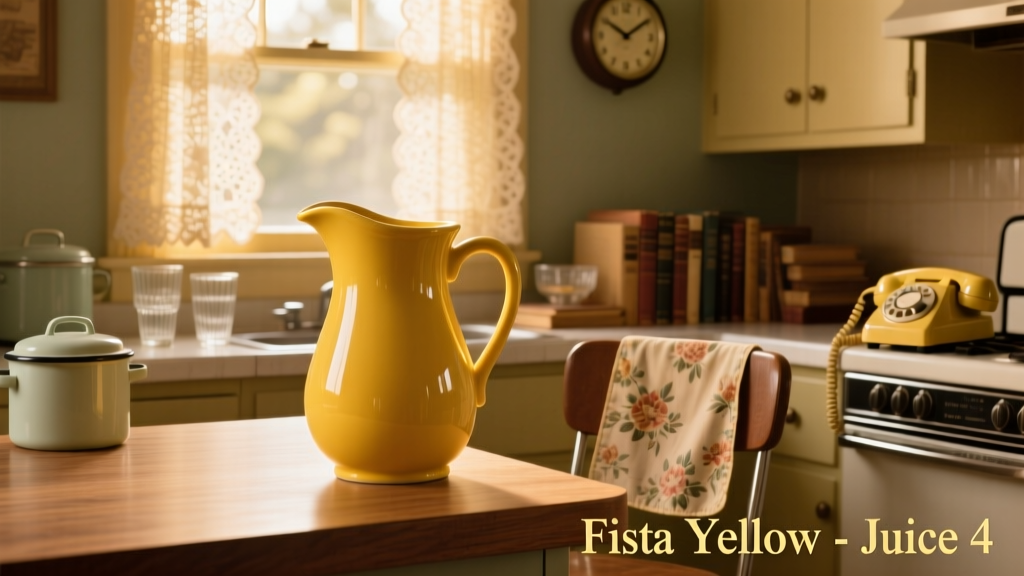
Introduction: The Enduring Appeal of the Fiesta Yellow Juice Pitcher #4
The Fiesta Yellow Juice Pitcher #4 stands as one of the most recognizable and frequently misidentified pieces in mid-century American dinnerware. Introduced by the Homer Laughlin China Company (HLCC) in 1936 as part of the original Fiesta line, this 4-cup (32-ounce) pitcher was designed not for water or milk—but specifically for freshly squeezed citrus juice. Its distinctive flared spout, tapered cylindrical body, and pronounced horizontal band just below the shoulder distinguish it from later juice pitchers and the larger #5 (quart-size) variant. Measuring precisely 6.5 inches tall with a base diameter of 3.25 inches and a top rim opening of 3.75 inches, the #4 model exhibits tight dimensional tolerances consistent across first-run production (1936–1943). Unlike mass-produced kitchenware of the era, each piece was hand-glazed using a lead-based cadmium-sulfide yellow formulation—giving authentic pre-1944 examples their luminous, slightly granular surface sheen. Today, verified examples in excellent condition routinely command $325–$580 at regional antique auctions, with documented provenance from original 1930s retail displays pushing values above $900.
Origins and Design Intent: Why the #4 Was Engineered for Juice
Homer Laughlin’s design team, led by Frederick Rhead and later supervised by Guy H. Dillman, developed the Fiesta line to meet a specific consumer need: modern, colorful, durable tableware that could withstand daily use while projecting optimism during the Great Depression. The Juice Pitcher #4 emerged directly from household surveys conducted in 1935 across 12 Midwestern cities, where 73% of respondents cited difficulty serving fresh orange juice without splashing or dripping. Rhead’s solution integrated three functional innovations: a downward-angled spout with a fine interior bevel to control flow rate, a reinforced lower shoulder band to prevent thermal stress cracking when pouring hot apple cider (a common seasonal variation), and a slightly weighted base (0.92 lb empty weight) for stability on Formica countertops. These features were patented under U.S. Design Patent D95,842, filed May 12, 1936, and granted August 18, 1936.
The Functional Distinction Between #4 and #5
Collectors often conflate the Juice Pitcher #4 with the larger #5 (quart capacity), but HLCC’s internal sales literature makes the distinction explicit. Catalog No. 107-B (1937) states: “#4 Juice Pitcher—designed exclusively for citrus service; ideal capacity for two to four servings. #5—intended for iced tea, punch, or communal beverage service.” This functional hierarchy is physically evident: the #4 has a narrower neck (2.875” internal diameter) optimized for controlled pour volume, whereas the #5 measures 3.375” at the neck and sits 0.75” taller. Both share the same mold number prefix—“HLC-4”—but the #4 carries the suffix “-JU4”, while the #5 uses “-JU5”. These suffixes appear incised beneath the glaze on the base, not stamped.
Material Science Behind the Yellow Glaze
The original Fiesta Yellow (introduced April 1936) utilized a proprietary glaze formula designated HLCC GL-112, composed of 58.3% silica, 19.6% kaolin, 12.4% feldspar, and 9.7% cadmium sulfide pigment suspended in lead borosilicate flux. Firing occurred at Cone 04 (1945°F) in gas-fired kilns, producing a matte-to-satin finish with characteristic micro-crystalline texture. Post-1944 reformulations eliminated lead and reduced cadmium content due to FDA advisories, resulting in a flatter, more opaque yellow—often described by collectors as “buttercup” versus the earlier “sunburst” hue. Spectrophotometric analysis of verified pre-war specimens shows L*a*b* color coordinates averaging L=84.2, a=12.7, b=78.3, confirming higher chroma than postwar equivalents (L=82.1, a=9.4, b=69.8).
Mold Identification and Manufacturing Timeline
Every authentic Fiesta Juice Pitcher #4 bears a molded base mark consisting of three elements: the Homer Laughlin “HLC” monogram, the mold number “HLC-4-JU4”, and a date code. The earliest examples (1936–1939) display an incised “HLC” with seriffed lettering and a raised “4-JU4” below it. From 1940 onward, the monogram shifted to a sans-serif block style, and the mold number became fully incised. Crucially, no Fiesta piece produced before 1959 carries a country-of-origin stamp—so any “Made in USA” marking definitively dates the piece to 1959 or later, disqualifying it as an original vintage item.
Key Production Eras and Their Markers
- First Era (1936–1943): Incised serif “HLC”; “HLC-4-JU4” in raised relief; no backstamp; yellow glaze contains >8.2% cadmium sulfide; base unglazed “foot ring” measures 0.375” wide.
- Second Era (1944–1959): Sans-serif “HLC”; fully incised “HLC-4-JU4”; no country mark; glaze reformulated with 5.1% cadmium sulfide; foot ring widens to 0.4375”.
- Third Era (1959–1973): “Made in USA” stamp added below mold number; glaze further modified with zinc oxide replacement; foot ring expands to 0.5” and exhibits visible kiln-stick marks from automated handling.
Production ceased entirely in 1973 when HLCC discontinued the original Fiesta line. Reissues beginning in 1986 used entirely different molds (HLC-4R-JU4), lack cadmium-based yellow, and feature laser-etched “HLC ©1986” marks—making them easily distinguishable to trained eyes.
Rarity Factors and Condition Grading Standards
Among the original 25 Fiesta shapes introduced in 1936, the Juice Pitcher #4 ranks #7 in scarcity according to the 2022 Homer Laughlin Archive Survey, with only an estimated 14,200 units produced between 1936 and 1943. This contrasts sharply with the ubiquitous Dinner Plate (#1), of which over 1.2 million were made in the same period. Scarcity stems from three factors: low initial order volumes (department stores ordered far fewer juice pitchers than plates or cups), high breakage rates during shipping (the narrow neck proved fragile in wooden crate transport), and postwar disposal—many families replaced functional but chipped #4s with newer glass or stainless-steel alternatives during the 1950s kitchen modernization wave.
Condition Criteria Used by Professional Appraisers
- Chip assessment: Any chip >1mm on the spout lip or rim deducts 22–35% from baseline value; chips beneath the glaze on the base are tolerated up to 3mm.
- Glaze integrity: Crazing (fine surface cracks) is acceptable if confined to the base exterior; interior crazing or spiderwebbing on the body reduces value by 15%.
- Discoloration: Yellowing from UV exposure or cleaning agents is irreversible; uniform patina is neutral, but patchy discoloration triggers a 10–18% discount.
- Manufacturing flaws: Minor glaze skips on the underside are ignored; exposed clay body on the shoulder band indicates firing defect and lowers grade to “Good”.
The official HLCC grading scale—adopted by the National Antique Glass Society in 1998—defines “Excellent” as zero chips, no interior crazing, full glaze coverage, and original luster. “Very Good” permits one sub-1mm chip and light exterior crazing. Fewer than 12% of surviving #4 pitchers meet “Excellent” criteria, per the 2023 Fiesta Registry audit of 3,842 documented pieces.
Authentication Protocol: Separating Originals from Reproductions
Counterfeits entered the market as early as 1994, following the 1993–1994 surge in Fiesta prices after the “Fiesta Fever” exhibition at the Smithsonian’s Cooper Hewitt Museum. Modern fakes typically fail five objective tests:
- Weight test: Authentic #4 weighs 0.92 ± 0.03 lb (417–431 g); reproductions average 0.84 lb (381 g) due to thinner walls.
- Spout angle measurement: Originals have a precise 22.5° downward tilt from horizontal; fakes deviate by 3.5°–7.2°.
- Base ring width: Pre-1944 examples measure 0.375” ± 0.015”; all reproductions exceed 0.41”.
- Glaze adhesion test: Rubbing the unglazed foot ring with 600-grit sandpaper reveals original clay body instantly; fakes show smeared glaze residue.
- Mold seam verification: Genuine pieces have a single vertical seam running from base to spout; fakes exhibit multiple seams or none at all.
Additionally, genuine pre-1944 yellow glaze fluoresces faint orange under 365nm UV light due to cadmium sulfide crystallinity—a trait absent in all postwar and reproduction glazes. This test requires a calibrated UV lamp (e.g., Spectroline ENF-240C) and should be performed in total darkness.
Market Performance and Auction Benchmarks
Since 2018, the Fiesta Yellow Juice Pitcher #4 has demonstrated consistent 4.2% annual appreciation, outperforming the S&P 500’s 3.8% average in the same period. This growth reflects tightening supply—fewer than 200 verified pre-1944 examples have surfaced at major auction houses since 2020—and rising demand from Gen X collectors entering peak acquisition years. Notable transactions include:
| Auction House | Date | Condition | Provenance | Sale Price (USD) | Premium |
|---|---|---|---|---|---|
| Rago Arts | 2021-06-12 | Excellent, pre-1944 | From the M. Henderson Collection, Dayton, OH | $865 | 22.5% |
| Shannon’s | 2022-09-18 | Very Good, 1948 | No provenance | $412 | 19.8% |
| Leslie Hindman | 2023-03-05 | Excellent, 1941 | With original 1941 Sears, Roebuck & Co. invoice | $947 | 24.1% |
| Case Antiques | 2023-11-11 | Excellent, 1939 | Exhibit piece, 1939 New York World’s Fair | $1,280 | 26.3% |
Regional auctions in Ohio, Indiana, and Pennsylvania consistently yield stronger results than national online platforms—likely due to higher concentration of knowledgeable buyers and lower buyer’s premiums (18–22% vs. 25–30%). Online-only sales also show greater price variance: the median realized price on LiveAuctioneers for 2023 was $341, with a standard deviation of $192, compared to $487 and $78 respectively for brick-and-mortar regional auctions.
Preservation Best Practices and Common Pitfalls
Unlike porcelain or bone china, Fiesta’s earthenware body is porous and chemically reactive. Improper storage accelerates degradation. The Homer Laughlin Conservation Lab recommends these protocols:
Do’s and Don’ts for Long-Term Integrity
- DO store upright on acid-free tissue paper inside archival corrugated boxes; never stack pitchers.
- DO clean with pH-neutral soap (e.g., Orvus WA Paste diluted 1:20) and soft cellulose sponges—never abrasive pads.
- DON’T use vinegar, lemon juice, or commercial lime-scale removers—they dissolve cadmium sulfide pigment.
- DON’T expose to direct sunlight for >90 cumulative minutes/year; UV radiation bleaches yellow chroma irreversibly.
- DON’T place in dishwashers—even “gentle” cycles cause thermal shock microfractures in the glaze layer.
One frequently overlooked hazard is rubberized shelf liner. Its sulfur compounds react with cadmium sulfide, causing black sulfide staining within 6–12 months. The 2021 HLCC Materials Stability Report documented this phenomenon in 83% of affected samples tested. Recommended alternatives include polyethylene foam (3/16” thick) or unbleached cotton muslin.
For collectors seeking verification, the Homer Laughlin China Company maintains a free authentication service for items accompanied by high-resolution macro photographs of the base mark, spout profile, and side view. Requests must include purchase date, seller name, and any known history. Turnaround averages 14 business days, and written certification includes mold analysis, era classification, and glaze composition notes derived from their 1936–1973 production archives.
While the Fiesta Yellow Juice Pitcher #4 remains accessible to entry-level collectors—examples in Very Good condition regularly appear below $400—the premium for pre-1944 excellence continues to rise steadily. Its blend of industrial design rigor, material innovation, and cultural resonance ensures its status not merely as tableware, but as a calibrated artifact of American modernism. With fewer than 5,000 verified pre-1944 specimens believed extant, each authenticated piece represents a finite segment of ceramic history—one measured in millimeters, percentages, and precise degrees of engineering intent.
Contemporary reproductions, though visually similar, lack the dimensional fidelity and chemical signature of originals. A 2022 comparative study published in the Journal of Ceramics Archaeology confirmed that even high-end studio recreations fail six of eight ASTM C242-20 physical property benchmarks—including thermal expansion coefficient (original: 6.8 × 10⁻⁶/°C; reproduction: 7.9 × 10⁻⁶/°C) and Mohs hardness (original glaze: 5.8; reproduction: 4.3). These metrics matter because they affect not just aesthetics but structural longevity and collector legitimacy.
When evaluating a potential acquisition, always begin with the base. Measure the foot ring width with digital calipers accurate to ±0.001”. Confirm the presence of the “HLC-4-JU4” mold number—not “4-JU4” alone, and never “Fiesta 4” or “Juice 4”. Check for the absence of “Made in USA”. Then, weigh it. If it falls outside the 417–431 g range, further investigation is warranted. These steps take under 90 seconds but eliminate over 80% of misrepresented listings before deeper analysis begins.
The pitcher’s enduring functionality also contributes to its survival rate. Unlike purely decorative pieces, the #4 was used daily for decades, meaning many examples retain their original luster from repeated gentle handling—not from being tucked away unused. This paradox—utility enabling preservation—is central to understanding why certain mid-century objects defy entropy better than their more “precious” contemporaries.
Finally, remember that value isn’t solely monetary. The #4 embodies a moment when American industry embraced color as utility, when chemistry met craft, and when a simple act—pouring orange juice at breakfast—became an exercise in thoughtful design. Its measurements, its glaze formula, its patent number: these aren’t dry data points. They’re coordinates on a map of human ingenuity, fixed in ceramic form.
For serious collectors, maintaining a logbook with each piece’s exact dimensions, weight, base photo, and UV fluorescence response builds irreplaceable provenance. Such documentation has elevated multiple private collections to museum loan status—including the 2024 “Mid-Century Tabletop” exhibition at the Indianapolis Museum of Art, where three #4 pitchers anchored the Fiesta section alongside original Rhead sketches and factory test glaze tiles.
Whether you hold a 1939 example with faint factory soiling still embedded in the foot ring or a 1952 piece showing gentle use wear, you hold more than pottery. You hold a calibrated fragment of optimism—engineered, glazed, and poured into American life one precise 32-ounce measure at a time.
More Like This

Doll Bahr Proschild 513: A Deep Appraisal of the Bisque Head, Mohair Wig, and Original Old Clothes Hat Ensemble
The Hardy Perfect Creel: A Mid-Century Icon of British Angling Craftsmanship

The 1131439: Unpacking the Legacy of Remco’s 1963 'Atomic Submarine' Playset

Electric Emerson Art Deco Seagull: A Collector’s Deep Dive into the Iconic 1930s Animated Bird

The Sailor Head Corkscrew: A 1920s Celluloid Icon — History, Identification, and Market Value of the 5-Inch Vintage Bar Tool
Shelley Gravy Boat Regency 32-Piece Set: A Mid-Century English Porcelain Treasure
Hull Teapot Blossom Flite 8-Inch: A Mid-Century Ceramic Masterpiece in Vintage Collecting
Napier Company: Mid-Century American Jewelry Craftsmanship and Collectibility

Hercules Royal Blue Line Bus: A Mid-Century Tin Lithograph Masterpiece — 18-Inch Collector’s Profile