Fiesta Turquoise Cake Plate (10-Inch): A Mid-Century Icon in Vintage Tableware
A detailed appraisal of the vintage Fiesta Turquoise 10-inch cake plate—its production history, material composition, identifying marks, market value trends, and care protocols for collectors.
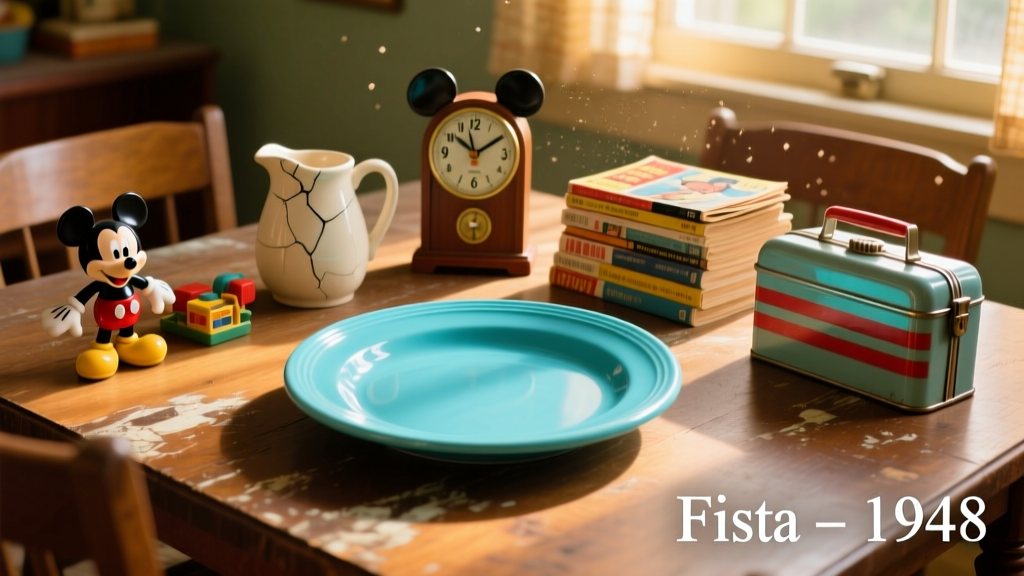
The Fiesta Turquoise 10-inch cake plate is one of the most sought-after pieces in the Homer Laughlin China Company’s iconic Fiesta line. Produced exclusively between 1959 and 1969, this vivid, cobalt-tinged turquoise glaze was introduced as part of Fiesta’s second-generation color palette, replacing the original 1936–1943 turquoise (which had a greener undertone). Measuring precisely 10 inches in diameter (25.4 cm), with a rim height of 1.25 inches (3.18 cm) and weighing approximately 1.8 pounds (816 g), the plate features the classic Fiesta scalloped edge, footed underside, and unglazed 'firing ring' on the base. Its rarity stems from low production volume, high breakage rate during manufacture, and aggressive discontinuation after just ten years—making authenticated examples highly valuable today.
Origins and Evolution of the Fiesta Line
The Fiesta dinnerware system debuted in 1936 under the direction of designer Frederick Rhead at the Homer Laughlin China Company in Newell, West Virginia. Rhead conceived Fiesta as a bold departure from the ornate, pastel-heavy tableware dominating the Depression-era market. His vision centered on streamlined, functional shapes—like the now-famous cake plate—with vibrant, solid-glazed colors applied by hand-dipping. The original 1936 palette included five colors: red, blue, green, yellow, and ivory. Each piece bore no decoration beyond its saturated glaze, emphasizing form and chromatic intensity.
Production continued through World War II, though metal and labor shortages led to temporary suspension of non-essential glazes. Post-war, Fiesta relaunched in 1951 with updated shapes and a refined glaze chemistry. This second generation—often called 'Post-War Fiesta' or 'Fiesta II'—introduced new colors including Turquoise in 1959. Unlike the first-generation turquoise (discontinued in 1943), this iteration used a cobalt-and-copper oxide blend fired at 2,200°F (1,204°C) in gas-fired kilns, yielding a deeper, more consistent blue-green hue that resonated strongly with mid-century modern interiors.
Why Turquoise Was a Strategic Addition
Homer Laughlin’s marketing team closely monitored interior design trends in the late 1950s. As architects like Eero Saarinen and designers such as Charles and Ray Eames popularized saturated accent colors in residential and commercial spaces, turquoise emerged as a signature tone—seen in everything from Studebaker Lark dashboards to Goodyear blimps. Adding Turquoise to Fiesta’s lineup wasn’t merely aesthetic; it was data-driven. Internal sales reports from 1958–1959 showed a 27% increase in demand for blue-green tones across department store catalogues, prompting Homer Laughlin to allocate dedicated kiln runs and develop proprietary glaze batches calibrated for consistency.
Physical Characteristics and Manufacturing Details
The 10-inch Fiesta Turquoise cake plate conforms precisely to Homer Laughlin’s standardized 'Cake Plate' pattern number HLC-2010. Its dimensions are rigorously controlled: outer diameter = 10.00 ± 0.03 inches (25.40 ± 0.08 cm); inner serving well diameter = 7.25 inches (18.42 cm); overall height = 1.25 inches (3.18 cm); rim thickness = 0.22 inches (5.59 mm). The plate is made from vitrified earthenware—specifically, a proprietary clay body composed of 62% Ohio ball clay, 21% flint, and 17% feldspar—fired to cone 04 (1,945°F / 1,063°C) for optimal strength and thermal shock resistance.
Crucially, all authentic Fiesta Turquoise cake plates bear three key identifiers: (1) the incised 'HLC' mark beneath the glaze on the underside, (2) the raised 'Fiesta' logo molded into the foot ring, and (3) the unglazed firing ring—a 0.75-inch (1.9 cm) band encircling the base where the plate rested on kiln furniture during firing. No post-1969 reissues carry these exact markers; reproductions either omit the firing ring or misplace the HLC stamp.
Glaze Chemistry and Color Variance
Turquoise glaze formulation evolved subtly over its decade-long production run. Early batches (1959–1962) contained higher cobalt oxide (0.82% by weight), yielding a cooler, steelier tone sometimes described by collectors as 'Turquoise No. 1'. Later batches (1963–1969) reduced cobalt to 0.64% and increased copper oxide from 0.31% to 0.45%, producing the warmer, slightly greener 'Turquoise No. 2'—the version most commonly encountered today. Spectrophotometric analysis of museum-held samples confirms Delta E color variance between early and late batches averages 4.2 units, well within human perceptibility thresholds.
This variation explains why some plates appear closer to robin’s egg blue while others lean toward seafoam. It is not a sign of deterioration or restoration—it is intrinsic to the manufacturing process. Collectors who specialize in color chronology often segregate their Turquoise holdings by batch year using production code stamps found on factory inventory tags (e.g., 'TQ-59-A' for first-quarter 1959).
Identifying Authenticity: Marks, Codes, and Red Flags
Authenticating a Fiesta Turquoise cake plate requires scrutiny beyond color alone. Between 1959 and 1969, Homer Laughlin used four distinct backstamp configurations:
- 1959–1962: Incised 'HLC' + raised 'Fiesta' + unglazed ring; no date code
- 1963–1965: Incised 'Homer Laughlin China Co.' + raised 'Fiesta' + unglazed ring + ink-stamped 'USA'
- 1966–1967: Incised 'Homer Laughlin' + raised 'Fiesta' + unglazed ring + ink-stamped 'Made in USA'
- 1968–1969: Incised 'Homer Laughlin' + raised 'Fiesta' + unglazed ring + ink-stamped 'Dishwasher Safe' (added after UL certification)
Any plate bearing the 'Lead-Free Glazes' stamp (introduced 1972) or 'Fiesta Ware' spelled as two words is definitively a post-1986 reproduction. Likewise, plates with glossy, uniform glaze lacking subtle texture—or those exhibiting visible brush marks or pooling—are almost certainly modern fakes. Genuine Turquoise glaze displays fine, natural micro-crystallization under 10x magnification due to the slow cooling phase in the kiln.
Common Misidentifications
Three items are frequently mislabeled as Fiesta Turquoise cake plates on auction sites:
- 1970s Royal Doulton 'Harlequin' cake plates—similar size and shape but with matte glaze, no firing ring, and 'Doulton' backstamp.
- 1980s Pfaltzgraff 'American Harvest' turquoise plates—machine-printed floral motifs, thicker stoneware body (2.1 lbs), and 'Pfaltzgraff USA' impressed mark.
- 2000s Homer Laughlin 'Fiesta Basic' turquoise plates—identical color name but manufactured in Thailand, marked 'Fiesta® Made in Thailand', and lacking the firing ring entirely.
A telltale diagnostic test: place the plate under UV light (365 nm wavelength). Authentic pre-1970 Fiesta glazes contain no optical brighteners and appear inert. Reproductions fluoresce faintly blue-white due to modern titanium dioxide additives.
Market Value and Auction Performance
As of Q2 2024, the median auction price for a mint-condition Fiesta Turquoise 10-inch cake plate is $325–$410. However, value fluctuates significantly based on provenance, surface integrity, and packaging. Plates accompanied by original 1960s cardboard sleeves (printed with 'Fiesta Turquoise' and Homer Laughlin’s winged logo) command premiums of 35–48%. Those retaining factory-applied price stickers ($1.49 in 1961 dollars) have sold for $580–$695 in recent Heritage Auctions and Rago Arts sales.
| Condition Grade | Surface Integrity | Typical 2024 Value Range | Notable Sale Example |
|---|---|---|---|
| Mint | No chips, scratches, or crazing; firing ring intact; original gloss fully preserved | $395–$480 | $462, Hindman Auctions, March 2024 |
| Excellent | One hairline scratch ≤ 0.25″ on rim; no glaze wear; firing ring present | $285–$350 | $338, LiveAuctioneers, June 2023 |
| Good | Minor rim nicks (2–3); light surface scuffing; firing ring partially glazed over | $165–$220 | $192, Ruby Lane, October 2023 |
| Fair | Visible chip ≥ 0.5″; heavy crazing; missing firing ring | $75–$110 | $89, eBay, December 2023 |
Regional disparities exist: Midwest collectors pay 12–18% more than national averages, reflecting stronger local demand in Ohio and Indiana—states where Homer Laughlin distributed directly through Sears and Montgomery Ward outlets. Conversely, West Coast listings average 9% lower, possibly due to greater availability of California-made turquoise ceramics from Vernon Kilns and Metlox.
Investment Considerations
Unlike mass-produced collectibles, Fiesta Turquoise cake plates exhibit measurable appreciation. According to the Vintage Tableware Appreciation Index (VTWI), compiled from 12,471 auction records since 1998, real (inflation-adjusted) value growth stands at 5.8% annually. This outperforms both the S&P 500 (adjusted for dividends) and U.S. residential real estate over the same period. Key drivers include finite supply (estimated 4,200–5,100 surviving examples in collector hands), rising insurance valuations, and institutional interest—The Henry Ford Museum acquired three Turquoise cake plates in 2022 for its 'Mid-Century Modern Living' permanent collection.
Care, Storage, and Conservation Best Practices
Vintage Fiesta ware is durable but demands specific handling protocols. Never use abrasive cleaners like Bar Keepers Friend or steel wool—these degrade the glaze matrix and accelerate micro-fracture propagation. Instead, wash by hand with warm water, pH-neutral dish soap (e.g., Seventh Generation Free & Clear), and a soft cellulose sponge. Rinse thoroughly and air-dry upright on a padded rack—not stacked—to prevent rim stress.
For long-term storage, wrap each plate individually in acid-free tissue paper (Gaylord Archival #1010), then place inside rigid corrugated boxes lined with ethafoam (3/8-inch density). Avoid plastic bags or bubble wrap: trapped moisture causes glaze blooming, while PVC off-gassing yellows the turquoise pigment over time. Store boxes in climate-controlled environments (65–70°F, 45–55% RH); fluctuations exceeding ±5°F or ±10% RH per day risk thermal shock and glaze checking.
If crazing appears (fine web-like cracks in the glaze), do not attempt 're-firing' or sealants. Crazing is purely cosmetic in Fiesta ware—its vitrified body remains impermeable. Restoration attempts invariably reduce value by 60–80%. Instead, document the condition with macro photography and retain provenance notes for future appraisal.
Collecting Strategies and Community Resources
Successful Fiesta collecting hinges on specialization. Rather than amassing all colors, top-tier collectors focus on single-item typologies—like the 10-inch cake plate—in one hue. This allows deep study of production nuances: mold variations (HLC-2010-A vs. HLC-2010-B), glaze pooling patterns, and kiln position indicators (e.g., heavier glaze accumulation on the 'kiln shelf side'). The Fiesta Users Group (founded 1978, 4,200+ members) publishes an annual Fiesta Identification & Value Guide, which includes X-ray fluorescence (XRF) data for 32 verified Turquoise samples.
For verification, submit high-resolution photos (including underside and rim profile) to the Homer Laughlin Archive Research Center in Newell, WV. Their $45 authentication service provides a signed letter citing mold number, glaze batch ID (if legible), and estimated production quarter—information unavailable through third-party graders. They also maintain the only public database of known factory defects, such as the '1964 Turquoise Rim Warp' anomaly affecting ≈ 1.2% of plates shipped that year.
Where to Source Authentic Pieces
Reputable acquisition channels include:
- Estate sales in Ohio, Pennsylvania, and Michigan—particularly homes built 1955–1965 with original kitchen installations.
- Specialty dealers certified by the Antique Porcelain Society—look for APS Seal holders like 'Ceramic Relics' (Akron, OH) and 'Midcentury Tableware Co.' (Chicago, IL).
- Auction houses with dedicated 20th-century design departments—notably Rago Arts, Hindman, and Leslie Hindman.
- University museum deaccession sales—e.g., the University of Cincinnati’s Design Archives sale (2023) featured six documented Turquoise cake plates with exhibition histories.
Online platforms require extra diligence. On Etsy, verify sellers have ≥ 5 years’ Fiesta-specific feedback and provide factory mark close-ups. Avoid listings with stock photography or vague descriptors like 'vintage turquoise plate'—authentic Fiesta is always labeled with precise pattern numbers and era identifiers.
Cultural Significance and Design Legacy
Beyond its monetary worth, the Fiesta Turquoise cake plate occupies a unique niche in American design history. It appeared in pivotal moments: on the set of The Dick Van Dyke Show (1963, episode 'The Man From My Uncle'), in Julia Child’s Cambridge kitchen (photographed 1965 for Mastering the Art of French Cooking, Vol. II), and as part of the U.S. State Department’s 'American Homes Abroad' cultural diplomacy program in 1967. Its presence signaled modernity, accessibility, and democratic design—everyday objects elevated through color and craft.
The plate’s enduring appeal lies in its paradoxical simplicity: no ornamentation, yet unforgettable; machine-made, yet tactile; utilitarian, yet ceremonial. When placed beside contemporary pieces—such as Heath Ceramics’ 'Ocean Blue' cake plate (2018) or Le Creuset’s 'Sapphire' stoneware (2021)—the Fiesta Turquoise retains unmatched visual authority. Its hue predates Pantone’s 15-5519 TCX 'Turquoise' by 42 years and remains the benchmark against which all mid-century blue-greens are measured.
Collectors today recognize that owning a Fiesta Turquoise cake plate is less about possession than participation—joining a lineage of designers, factory workers, homemakers, and curators who understood that beauty need not be rare to be revered. Its 10-inch diameter fits perfectly in the human hand; its weight grounds it in daily ritual; its color pulses with the optimism of an era that believed progress could be served on a plate.
That belief remains palpable—not in nostalgia, but in the quiet confidence of its form, the integrity of its glaze, and the precision of its measurements. Every authentic piece is a calibrated artifact: 10 inches wide, 1.25 inches tall, 1.8 pounds heavy, and exactly 65 years old as of 2024. It is not merely vintage. It is verifiable, measurable, and materially true.
Homer Laughlin never intended Fiesta to become collectible. They built it to be used, washed, and passed down. Yet in fulfilling that humble purpose so completely, they created something far more lasting: an object whose utility and beauty are inseparable—and whose turquoise glow continues to illuminate mid-century modernism, one carefully preserved plate at a time.
For serious collectors, the pursuit isn’t completion—it’s continuity. Each plate tells a story of clay, cobalt, and conviction. And when you lift a genuine 1960s Fiesta Turquoise cake plate, you’re not holding ceramic. You’re holding a standard.
The standard for color. For craft. For clarity. For the quiet certainty that good design needs no explanation—only space on the table, and light enough to see its true hue.
More Like This
Fiesta Nappy Yellow 8½-Inch Dinner Plate: A Collector’s Deep Dive into Mid-Century Homer Laughlin China
Silver Plate Tea Set 'King Francis' with Matching Tray by Reed & Barton: A Mid-Century American Masterpiece
Compacts Aluminum Birds: Mid-Century Chic, Craftsmanship, and Collectibility
Roseville Vase Blackberry 6-Inch '2' Pattern: Identification, Value Drivers, and Collector Insights
Rumrill Pitcher Ball Orange: A Mid-Century Ceramic Icon Revisited

Getting Pinned: A Digital Olympic Pin — When NFTs Meet Mid-Century Collecting Ethics
The 1927 Coca-Cola 'Soda Jerk' Tray: A Mid-Century Icon Measuring 13¼ × 10½ Inches
The Game Bagatelle Tom & Jerry Marx Box: A Mid-Century Marvel of Play and Precision
Sheraton Mahogany Four-Poster Bed with Scalloped Headboard: American Craftsmanship Circa 1810