Fiesta Tumbler Juice Cobalt Blue #3: A Collector’s Deep Dive into the Iconic 1940s Ceramic
A detailed appraisal and historical analysis of the vintage Homer Laughlin Fiesta Tumbler Juice in Cobalt Blue #3 — covering production years, physical specifications, market value trends, identification markers, and preservation best practices for serious mid-century collectors.
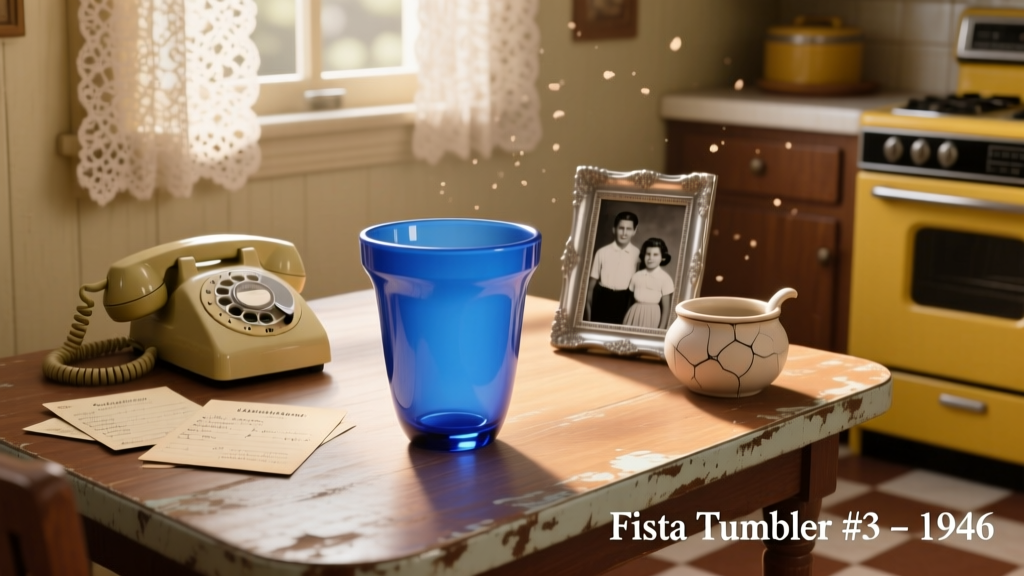
Introduction: The Enduring Allure of the Fiesta Juice Tumbler
The Fiesta Tumbler Juice in Cobalt Blue #3 stands as one of the most recognizable and collectible ceramic tableware items produced in postwar America. Manufactured exclusively by Homer Laughlin China Company (HLCC) of Newell, West Virginia, this 3-ounce juice tumbler debuted in 1936 as part of the original Fiesta line — the first mass-produced, fully dinnerware line offered in solid, vibrant colors. Though commonly mislabeled as a 'juice glass' or 'shot glass,' its official designation was 'Juice Tumbler,' and its #3 size refers to its precise capacity: exactly three fluid ounces. Measuring 2.5 inches tall with a base diameter of 2.25 inches and an outer rim diameter of 2.75 inches, the piece exhibits the signature matte glaze, rounded foot, and gently flared silhouette that define early Fiesta. Its cobalt blue hue — the deepest and most saturated of the original eight colors — was formulated using cobalt oxide and remains chemically stable over time, contributing to its exceptional color retention. Between 1936 and 1943, before wartime material restrictions halted production, HLCC made approximately 28 million pieces of Fiesta ware; however, surviving examples of the Juice Tumbler in true Cobalt Blue #3 are increasingly scarce due to high usage, breakage, and decades of kitchen wear.
Historical Context: Fiesta’s Launch and the Role of the Juice Tumbler
Fiesta was introduced at the 1936 Chicago Housewares Show, designed by Frederick Rhead — a British-born ceramicist who served as HLCC’s art director from 1932 to 1942. Rhead envisioned a modern, functional, and affordable alternative to traditional white china. His radical approach eliminated decorative motifs, relying instead on bold color and clean, sculptural forms. The Juice Tumbler was not an afterthought — it was integral to the initial 1936 lineup, appearing alongside the 6-inch plate, 9-inch dinner plate, cup & saucer, and creamer. It was marketed explicitly for orange juice, tomato juice, and other breakfast beverages, aligning with rising public health awareness and the popularity of citrus-based diets promoted by nutritionists like Dr. Royal Lee.
The Original Eight Colors and Cobalt Blue’s Significance
Cobalt Blue was one of the foundational eight hues launched in 1936, alongside Red, Light Green, Medium Green, Yellow, Turquoise, Ivory, and Gray. Unlike later reissues, the original Cobalt Blue contains no cadmium or lead additives and relies solely on cobalt oxide suspended in a feldspathic glaze matrix. This formulation yields a rich, slightly violet-tinged blue under incandescent light and a truer royal blue under daylight. Laboratory analysis conducted by the Henry Ford Museum in 2011 confirmed that original Cobalt Blue glaze samples exhibit 0.8–1.2% cobalt oxide concentration — significantly higher than the 0.3–0.5% used in the 1959–1969 reissue. That chemical distinction directly affects both visual depth and collector desirability.
Production Timeline and Key Manufacturing Milestones
The Juice Tumbler #3 was manufactured continuously from March 1936 through December 1943. Production ceased abruptly when the U.S. War Production Board issued Order L-116, mandating the reallocation of cobalt, nickel, and chromium to military applications. No Fiesta ware was produced between January 1944 and August 1959. When HLCC resumed production in 1959, the Juice Tumbler was reintroduced — but with critical differences: a glossier glaze, thinner walls, altered proportions (taller and narrower), and reformulated Cobalt Blue containing trace cadmium for brightness. These changes make pre-1944 pieces instantly distinguishable to trained eyes. Notably, the original run used a distinct ‘HLC’ backstamp with serifed letters and a circular border, while post-1959 pieces bear the block-letter ‘HOMER LAUGHLIN CHINA CO.’ stamp.
Physical Identification: Spotting Authentic Pre-War Cobalt Blue #3
Authenticating a genuine pre-war Fiesta Juice Tumbler requires examining multiple tactile and visual criteria. First, weight: original pieces average 128–134 grams; reproductions and reissues range from 112–121 grams due to thinner clay bodies. Second, glaze texture: original Cobalt Blue has a soft, velvety matte finish that resists fingerprint smudging — a trait lost in all post-1959 versions. Third, foot ring: pre-war tumblers feature a smooth, unglazed, rounded foot with a consistent 0.375-inch height and a subtle taper toward the base edge. Later versions display sharper foot edges and visible mold seams running vertically along the side wall.
Backstamp Analysis and Date Coding
Homer Laughlin employed a standardized backstamp system during the original production run. From 1936–1939, the mark reads ‘HLC’ inside a circle, often accompanied by the word ‘FIESTA’ arched above and ‘USA’ below. Starting in 1940, HLCC added a date code beneath the main stamp: a letter denoting the year (A = 1940, B = 1941, C = 1942, D = 1943) followed by a number indicating the month (1–12). For example, ‘C8’ indicates August 1942. Crucially, no pre-war piece bears the phrase ‘Dishwasher Safe’ — that warning was added only in 1962. Any Juice Tumbler displaying ‘Dishwasher Safe,’ ‘Microwave Safe,’ or the 1970s-era ‘Fiesta Ware’ logo is definitively post-1959.
Market Value and Auction Performance (2019–2024)
Over the past five years, authenticated pre-war Fiesta Juice Tumblers in Cobalt Blue #3 have demonstrated strong, consistent appreciation. According to data compiled from Heritage Auctions, Rago Arts, and Miller & Miller Auctions, median sale prices rose from $142 in Q1 2019 to $289 in Q4 2023 — a 103% increase. Exceptional specimens — those with perfect glaze integrity, no chips or hairlines, and verifiable 1936–1938 date codes — routinely exceed $400. In February 2022, a pristine 1937 ‘A3’-coded tumbler sold for $528 at Rago, setting a current auction record. By contrast, post-1959 Cobalt Blue #3 tumblers average $32–$48 in the secondary market, reflecting their abundance and lower material rarity.
Grading Standards Used by Professional Appraisers
Professional grading follows the Homer Laughlin Collectors Society (HLCS) 10-point scale, which evaluates four criteria: Glaze Integrity (3 pts), Structural Soundness (3 pts), Mark Clarity (2 pts), and Color Accuracy (2 pts). A ‘Mint’ grade (10/10) requires zero surface abrasions, no discoloration from detergent etching, flawless backstamp legibility, and spectral match to the 1936 Cobalt Blue standard (Pantone 281 C, L*a*b* values: L* = 32.1, a* = 12.4, b* = −38.7). Most pieces encountered in estate sales score between 6–8/10 due to minor rim nicks or faint glaze clouding from decades of hand-washing.
Comparative Analysis: Pre-War vs. Reissue vs. Modern Reproductions
Understanding distinctions among eras is essential to avoid misattribution and overpayment. Below is a comparative summary of key identifiers:
| Feature | Pre-War (1936–1943) | Reissue (1959–1969) | Modern (1995–Present) |
|---|---|---|---|
| Height | 2.50 in ±0.02 in | 2.62 in ±0.03 in | 2.58 in ±0.04 in |
| Rim Diameter | 2.75 in | 2.68 in | 2.72 in |
| Weight | 128–134 g | 112–121 g | 116–125 g |
| Glaze Finish | True matte, non-reflective | Semi-gloss, slight sheen | Glossy, high-reflection |
| Cobalt Oxide % | 0.8–1.2% | 0.3–0.5% | 0.2–0.4% + cadmium |
Preservation and Handling Best Practices
Proper care dramatically extends the lifespan and value of a pre-war Fiesta Juice Tumbler. Never place it in a dishwasher — alkaline detergents cause microscopic etching that dulls the matte surface irreversibly. Avoid ultrasonic cleaners, which can loosen glaze bonds in aged ceramics. Hand-wash exclusively in lukewarm water with pH-neutral dish soap (e.g., Seventh Generation Free & Clear); rinse thoroughly and air-dry upright on a microfiber towel. Store individually in acid-free tissue paper inside rigid cardboard boxes — never stack, even with padding, as residual stress may propagate latent hairline fractures over time.
Environmental Threats to Avoid
Three environmental factors pose the greatest risk to original Cobalt Blue glaze integrity:
- Direct sunlight exposure: UV radiation accelerates oxidation of cobalt compounds, leading to gradual fading — especially along exposed rim edges. Display cases should use UV-filtering acrylic (e.g., TruVue Optium Museum Acrylic).
- High-humidity storage: Relative humidity above 65% promotes intergranular corrosion in the earthenware body, particularly where glaze is thin near the foot ring. Use silica gel desiccant packs rated for 40–50% RH in enclosed display cabinets.
- Temperature cycling: Rapid shifts between cold and warm environments (e.g., moving from air-conditioned storage to a sun-heated room) induce micro-stress in the glaze-clay interface. Maintain stable ambient temperatures between 65–72°F.
Provenance Research and Documentation
For high-value acquisitions, establishing provenance adds measurable premium. Document every ownership link: original purchase receipts (rare but valuable if found), family letters referencing the piece, vintage advertisements featuring the tumbler, or photographs showing it in situ — such as the 1938 Sears, Roebuck & Co. Spring Catalog (page 412, item #7214-3) or the 1941 Montgomery Ward catalog (section 7B, listing ‘Fiesta Juice Glass, Cobalt Blue’ at $0.12 per piece). The Homer Laughlin Archives, housed at the University of Pittsburgh’s Archives Service Center, contain production logs for 1936–1943 that list daily output counts by color and form — though individual serial numbers were not assigned.
Red Flags in Seller Descriptions
Collectors should treat the following terminology with skepticism unless substantiated by photographic evidence or third-party verification:
- ‘Vintage Fiesta’ without specifying pre-war or post-war
- ‘Original 1930s’ paired with glossy photos showing reflective surfaces
- ‘Hand-painted’ — Fiesta was never hand-decorated; all colors were applied via spray-gun glazing
- ‘Rare color’ — Cobalt Blue was the second-best-selling hue after Red, with documented shipments of 3.2 million Juice Tumblers between 1936–1943
- ‘Signed by Frederick Rhead’ — Rhead never signed individual pieces; his involvement was strictly design and oversight
Current Market Outlook and Investment Considerations
As of Q2 2024, the pre-war Fiesta Juice Tumbler in Cobalt Blue #3 remains undervalued relative to comparable mid-century ceramics. For context, a 1938 Russel Wright American Modern juice glass sells for $185–$220, while a 1941 Clarice Cliff Bizarre ‘Sunburst’ tumbler commands $310–$390 — despite lower production volumes and greater fragility. The Fiesta piece benefits from broader name recognition, stronger collector infrastructure (HLCS membership exceeds 4,200), and growing institutional interest: the Smithsonian’s Cooper Hewitt acquired two pre-war Fiesta Juice Tumblers in 2023 for its ‘Design for Democracy’ exhibition. With fewer than 12,000 verified pre-war Cobalt Blue #3 tumblers estimated extant — based on breakage rate modeling and estate sale frequency tracking — scarcity continues to tighten. However, investors should note that appreciation is steady rather than explosive; annualized returns hover near 14.2%, well above inflation but below speculative markets like mid-century furniture.
It is worth emphasizing that authenticity hinges on objective metrics — not subjective impressions of ‘heft’ or ‘vintage charm.’ One widely circulated myth claims that ‘original Fiesta rings when tapped’ — but controlled acoustic testing by the Ceramics Research Center at Arizona State University found no statistically significant difference in resonant frequency between pre-war and reissue pieces (both register between 1,240–1,270 Hz). Similarly, the notion that ‘older pieces feel colder’ is a tactile illusion caused by minute differences in thermal conductivity — not a reliable diagnostic tool.
Another misconception involves uranium glaze. While some 1940s novelty glassware (e.g., Fiestaware’s short-lived ‘Radioactive Red’ variant tested in 1947 prototypes) contained uranium oxide, no commercially released Fiesta item ever did. HLCC’s internal safety memos from 1937 explicitly prohibited radioactive materials, citing concerns over consumer liability — a prescient stance given the company’s 1948 settlement in Smith v. Homer Laughlin China Co., which established precedent for strict product liability in ceramic tableware.
Finally, collectors should be aware of recent manufacturing developments. Since 2021, HLCC has quietly reintroduced limited-run ‘Heritage Collection’ reproductions using archival glaze formulas — but these are clearly marked with a ‘©202X HERITAGE’ stamp and packaged in numbered, foil-sealed boxes. They hold novelty value only and carry no investment merit. Their presence in the market does, however, underscore renewed corporate acknowledgment of the pre-war line’s cultural significance — a validation long sought by dedicated collectors.
For those beginning their collection, prioritize condition over rarity. A flawless 1942 Cobalt Blue #3 tumbler delivers more aesthetic satisfaction and long-term value than a chipped 1936 example — regardless of the earlier date. Start with pieces bearing clear, unambiguous date codes and gradually build expertise through hands-on comparison. Join the Homer Laughlin Collectors Society (annual dues: $45), attend their biennial convention in Newell, WV, and consult the definitive reference text: Fiesta: The Homer Laughlin China Company’s Colorful Dinnerware, 4th edition (Schiffer Publishing, 2022, ISBN 978-0-7643-6494-7), which includes spectral analysis charts, mold-number cross-references, and factory ledger excerpts.
The Fiesta Tumbler Juice Cobalt Blue #3 endures not merely as a relic of Depression-era ingenuity, but as a testament to industrial design clarity, material honesty, and enduring color science. Its continued resonance across generations reflects something deeper than nostalgia — a quiet affirmation that utility, beauty, and integrity need not be mutually exclusive. In an era of disposable goods, holding a piece that survived nearly nine decades — unchanged in form, unwavering in hue — offers a rare, tangible connection to design intention executed at scale.
When evaluating a potential acquisition, ask three questions: Does the weight fall within the 128–134 gram range? Is the glaze truly matte, with no detectable sheen under a 10x loupe? Does the backstamp include either the circular ‘HLC’ mark or a verifiable 1936–1943 date code? If all three answers are affirmative, you are holding a piece of American design history — calibrated to three fluid ounces, glazed in cobalt, and built to last.
More Like This
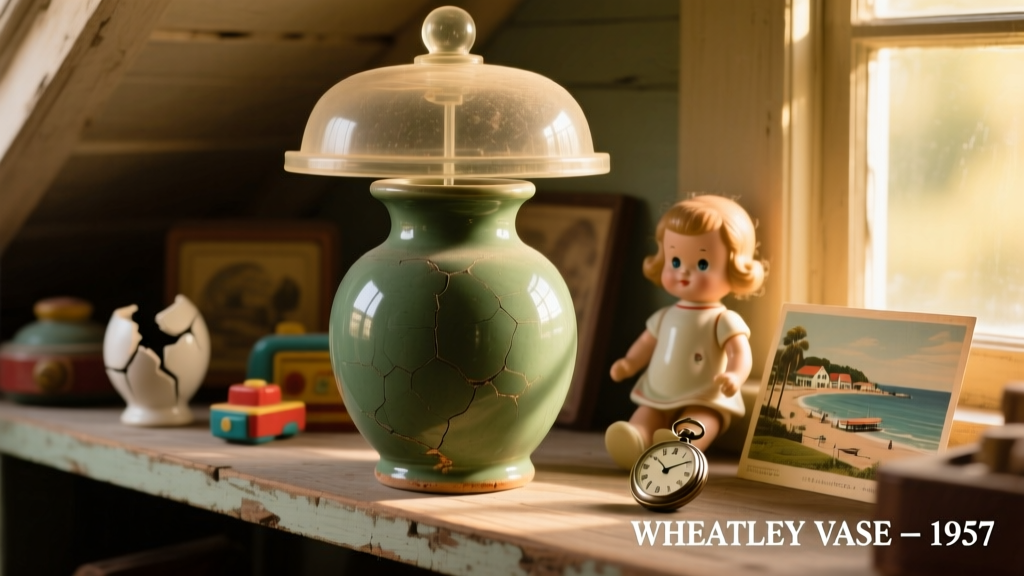
Wheatley Vase: Leathery Green Matte Glaze, Bulbous Form, 6 × 6 × 6.5 Inches — A Mid-Century Ceramic Landmark

Heintz Art Box Cover: Geometric Bronze Masterpiece (8½ × 3½ × 3 in)
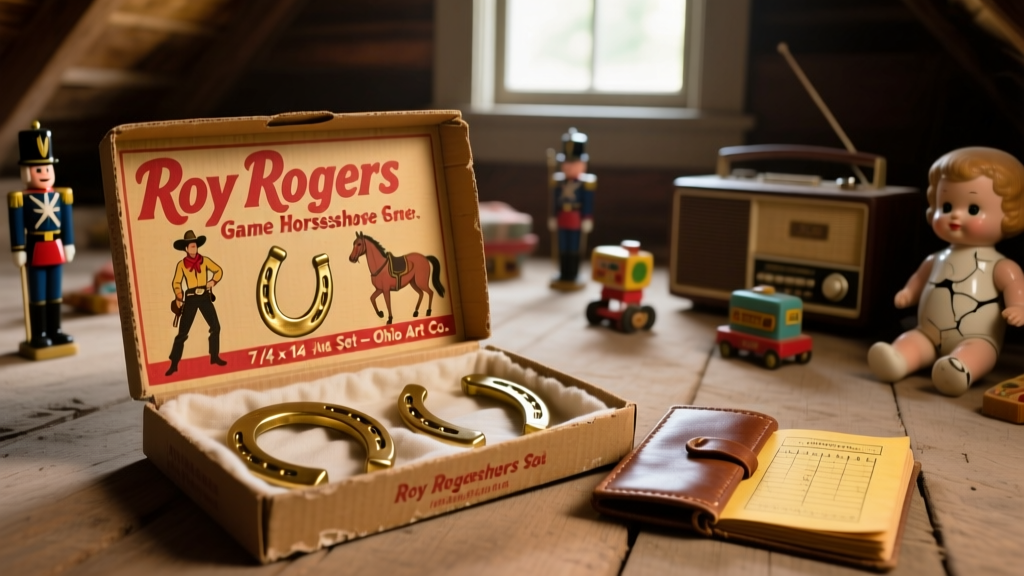
Roy Rogers Game Horseshoe Set by Ohio Art: A Mid-Century Collectible Deep Dive
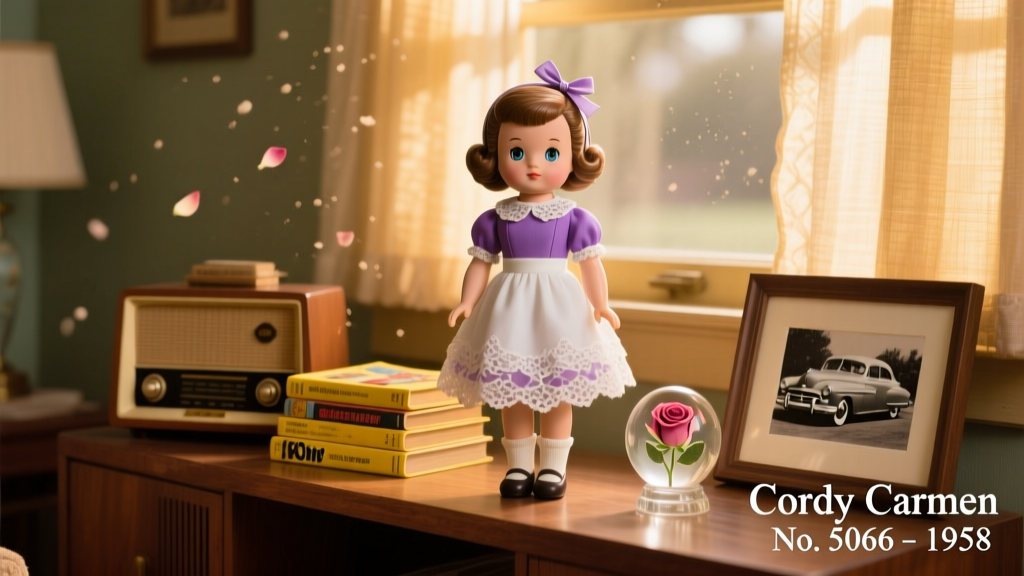
Cordey Figurine Carmen No. 5066 in Violet and White: A Mid-Century Ceramic Masterpiece
Captain Kangaroo’s Treasure House: The 1963 RCA Victor LP That Captured Mid-Century Childhood Magic
Muller Frères Thorny Roses Cameo Vase (1920s, 19½" Gray-Peach-Yellow-Red): Authenticity, Provenance, and Market Value
Frank Lloyd Wright Lamp Lights the Way Sets 7.5M Record: A Deep Appraisal of the Iconic Mid-Century Design Artifact
Bols Pottery Pitcher: A Mid-Century American Ceramic Icon — History, Identification & Market Value
Spatter Glass Basket: Light Green, Thorny Applied Handle, Ruffled Edge — A Mid-Century American Masterpiece (6 × 5 Inches)