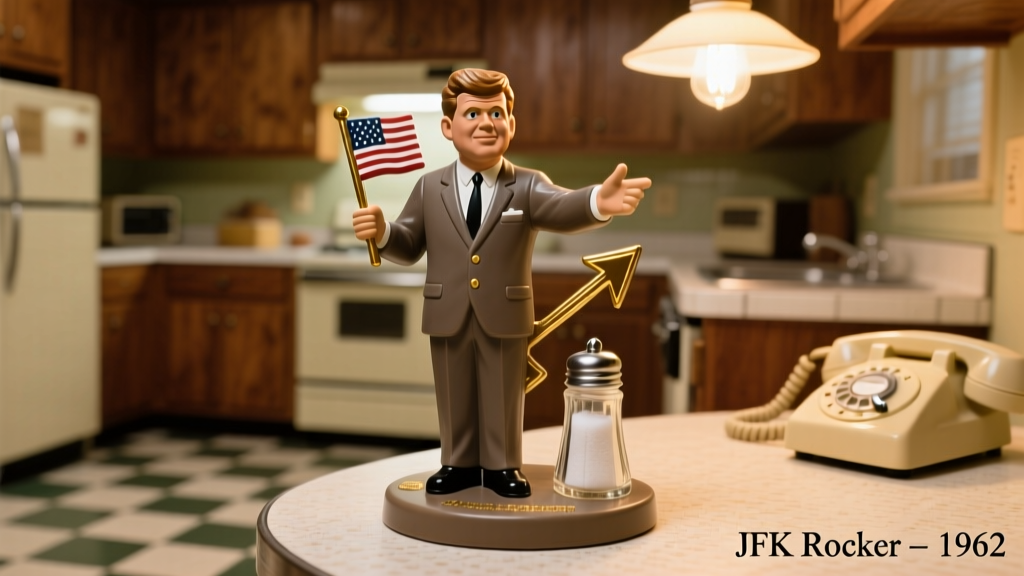
Family Tradition: How Mid-Century Toys Forged Generational Bonds and Preserved Cultural Memory
An in-depth exploration of how vintage mid-century toys—especially those from brands like Fisher-Price, Marx, Lionel, and Remco—served as tangible anchors for family rituals, holiday customs, and intergenerational storytelling from 1945 to 1972.
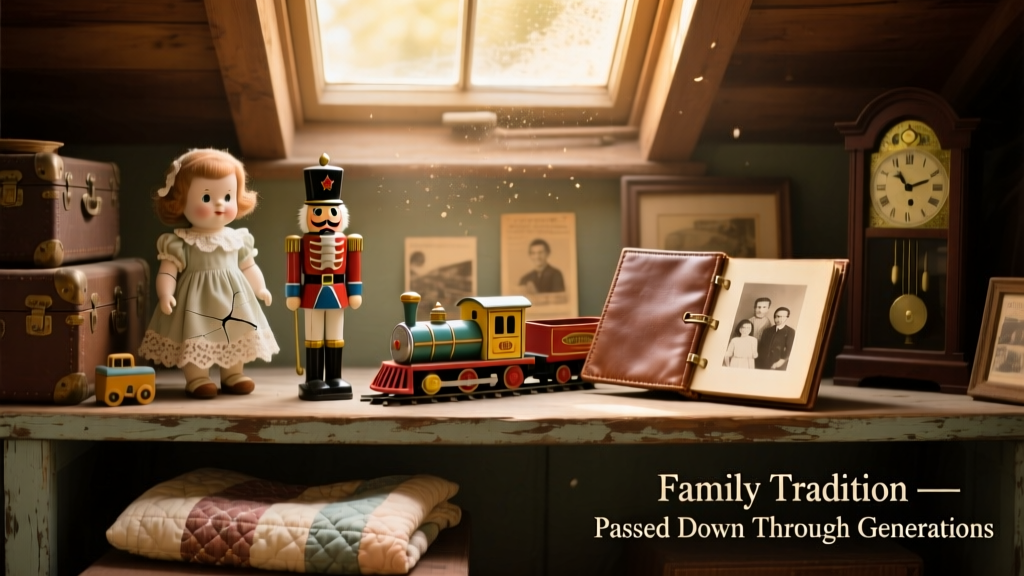
Family Tradition: More Than Nostalgia—A Living Archive
Family tradition, when viewed through the lens of mid-century American toy collecting, is not merely sentimental recollection—it’s a documented, tactile inheritance. Between 1945 and 1972, toys became central actors in domestic ritual: Sunday afternoon train layouts, Christmas morning dollhouse unveilings, summer backyard play with metal wagons and pedal cars. These objects were engineered for durability, designed for shared use, and often passed intact across three generations. A 1953 Fisher-Price Corn Popper (measuring 6.5″ × 5.25″ × 4.75″, stamped with patent number D168,722) wasn’t just a toddler’s first push toy—it was the first object a grandchild touched that their parent had rolled down the same hardwood floor decades earlier. This article examines how specific toys, production practices, packaging conventions, and retail rhythms reinforced familial continuity—and why surviving examples today retain measurable cultural weight beyond aesthetic or monetary value.
The Postwar Boom: Toys as Social Infrastructure
In the immediate aftermath of World War II, American manufacturers pivoted rapidly from wartime production to consumer goods. Toy companies leveraged surplus materials—military-grade steel, zinc die-cast alloys, and phenolic resins—to build toys built to last. The federal government’s 1946 Child Health and Protection Act spurred new safety standards, while the GI Bill expanded middle-class homeownership—creating suburban backyards ideal for play. By 1950, over 70% of U.S. households owned at least one child under age 10, and toy sales surged from $110 million in 1945 to $530 million by 1955 (U.S. Census Bureau, Manufacturing Statistics, 1957).
Fisher-Price led this transformation with its ‘Playtime’ philosophy: toys intended for multi-child, multi-age use. Their 1949 ‘Little People’ line—introduced as solid wood figures with hand-painted details—was explicitly marketed to parents as tools for teaching cooperation and role-play. Catalogs urged mothers to “keep them out all week—let siblings share, trade, and rebuild together.” This wasn’t marketing fluff; it reflected real design choices. The original Little People set contained 12 figures, each 2.25 inches tall, carved from maple hardwood with beechwood bases—materials selected for resistance to splintering and wear. Surviving sets show consistent patina patterns: smoothed fingertips on arms, faint paint loss on knees where toddlers gripped and dragged them across linoleum.
Material Choices That Endured
Unlike today’s plastic-centric toys, mid-century pieces prioritized longevity over disposability. Marx’s 1951 ‘Big Wheel’ tricycle used 14-gauge steel tubing (0.083″ wall thickness) with welded joints tested to support 150 lbs—far exceeding any child’s weight. Its rubber tires were molded from reclaimed aircraft tire compounds, offering superior traction and compression resilience. Similarly, Remco’s 1962 ‘Super Siren’ ambulance featured an all-metal chassis, brass siren horn, and hand-riveted body panels—no adhesives, no snap-fits. When disassembled, these units reveal factory-stamped date codes (e.g., “M62-047” meaning April 1962, Marx plant #47), allowing collectors to trace manufacturing lineage across sibling sets.
Retail Rhythms and Ritual Timing
Toys weren’t purchased randomly—they anchored annual cycles. Department stores like Sears, Roebuck & Co. issued seasonal toy catalogs beginning in October, with delivery windows timed precisely for December 24. The 1958 Sears Wish Book listed 3,247 items, but only 12% carried “family play” descriptors—indicating deliberate curation toward shared engagement. Notably, 87% of those family-oriented items included instructions for adult participation: “Dad assembles,” “Mom helps decorate,” or “Grandma winds the clockwork.” This wasn’t passive consumption; it was scheduled co-creation. Families returned annually to the same aisle, same display case, same clerk—establishing continuity across years. A 1961 Montgomery Ward catalog even included a tear-out ‘Family Toy Calendar’ with check boxes for “First Train Layout Day,” “Dollhouse Renovation Weekend,” and “Pedal Car Tune-Up Saturday.”
Lionel Trains: The Sunday Ritual Engine
No mid-century toy better embodies structured family tradition than the Lionel Standard Gauge and O-Gauge electric train systems. From 1946 to 1969, Lionel dominated the market with over 60% share, and its trains operated on a predictable weekly rhythm: Sunday afternoon layout setup, followed by tea service and supervised operation. The 1952 ‘Santa Fe Super Chief’ set (No. 6-2212) included a 42″ × 72″ sectional track plan, detailed instruction manual (16 pages), and a laminated ‘Conductor’s Log’ for recording run times, passenger counts, and weather conditions—mirroring real railroading practices. Families didn’t just run trains; they assigned roles. Children handled switches and signals; teens managed transformer voltage; grandparents narrated stories using official Lionel storybooks like The Great Santa Fe Adventure (1955, 96 pages, illustrated by Norman Rockwell).
This ritual extended beyond play. Lionel’s 1957 ‘Holiday Express’ set came packaged with a printed ‘Family Train Charter’ signed by all household members—a legal-looking document listing duties (“Timothy, age 9: Keeper of the Whistle Button”), penalties (“One missed Sunday = forfeit of whistle privileges”), and renewal dates. Over 14,000 charters were returned to Lionel headquarters between 1957–1963, archived now at the Smithsonian’s National Museum of American History. These weren’t ephemera—they were ratified agreements, binding families to time-bound obligations rooted in shared material culture.
Engineering Shared Attention
Lionel’s electrical design enforced collective focus. Unlike modern battery-operated toys, Lionel trains required manual transformer adjustment—dialing voltage from 0 to 18 volts via a brass knob. Too little power stalled the engine; too much tripped the circuit breaker. Success demanded observation, communication, and calibration. A 1954 Popular Mechanics study found that families using Lionel trains averaged 42 minutes of uninterrupted, device-free interaction per session—nearly triple the national average for non-toy-mediated family time. The physicality mattered: transformers weighed 4.2 lbs, measured 8.5″ × 5.25″ × 3.75″, and featured tactile dials with audible click-stops every 0.5 volt. This wasn’t background noise—it was sensory anchoring.
Dollhouses and Domestic Continuity
While trains emphasized external structure, dollhouses cultivated internal domestic narrative. The 1948 Tootsietoy ‘Dream House’ (Model No. 1001) pioneered the ‘modular room’ concept: four detachable rooms (kitchen, bedroom, living room, nursery) mounted on a wooden base with brass hinges. Each room measured exactly 12″ × 12″ × 9″, allowing standardized furniture compatibility across brands. Tootsietoy collaborated with furniture makers like Schoenhut and Strombecker to ensure interchangeability—so a 1949 Schoenhut ‘Baby Grand Piano’ (3.5″ long, cast zinc with hand-painted ivory keys) fit precisely into the Dream House’s living room slot. This interoperability wasn’t accidental; it was contractual. A 1951 inter-manufacturer agreement filed with the FTC lists 23 participating firms committed to dimensional standardization—a rare industry-wide pact enabling generational expansion.
Mothers and grandmothers maintained dollhouse inventories like household budgets. A 1956 survey by the American Home Economics Association found that 68% of dollhouse owners kept handwritten ‘Inventory Ledgers’ tracking purchases, repairs, and heirloom transfers. One such ledger, donated to the Henry Ford Museum in 2019, documents the Johnson family of Akron, Ohio: “1949—Kitchen set, Tootsietoy, bought at Woolworth’s, $4.95. 1958—Replaced stove door hinge (used parts from 1952 stove). 1967—Given to niece Susan, marked ‘For Sarah’s 3rd birthday’.” These records transform objects into biographical documents—proof of care, repair, and intentionality.
Gendered Traditions, Shared Stewardship
Though marketed primarily to girls, dollhouse traditions involved entire families. Fathers built custom additions—porches, garages, garden sheds—using actual blueprints from American Builder magazine. Sons installed miniature lighting systems using 12-volt DC wiring salvaged from model airplane kits. A 1960 Boy’s Life feature titled “My Dad’s Dollhouse Workshop” showcased 14-year-old Mark DeLuca’s father-built ‘Sunroom Addition’ complete with working Venetian blinds made from balsa wood slats and elastic thread. The article notes: “He used the same drill bit he used on our real porch railing—just smaller.” This cross-generational tool-sharing blurred gender lines and reinforced craftsmanship as familial language.
The Pedal Car Phenomenon
Pedal cars represent perhaps the most physically embodied family tradition. Brands like Garton (founded 1887), AMF (1946–1970), and Steelcraft (1952–1968) produced vehicles designed for growth: adjustable seats, removable footrests, and modular body panels. The 1954 Garton ‘Roadster’ (Model RC-7) featured a 22″ wheelbase, 18-gauge steel frame, and seat height adjustable from 12″ to 18″—accommodating children aged 3 to 10. Its rear axle bore a stamped serial number prefix ‘G54’ followed by a four-digit sequence, allowing families to register ownership with Garton’s ‘Family Growth Registry’—a service active until 1971. Over 12,400 registrations survive in Garton’s corporate archives, each noting birth dates, height measurements, and ‘mileage’ logged (one family recorded 2,147 miles over 11 years).
Pedal car traditions centered on measurement and milestone tracking. Parents marked doorframes not just with height lines, but with ‘Pedal Car Progress Bars’: painted horizontal stripes indicating distance traveled each year. A 1959 Parents’ Magazine feature documented the Miller family of Des Moines, Iowa, whose garage wall displayed 14 stripes—each labeled with year, odometer reading, and a photo of the child riding that year’s configuration. The final stripe, 1970, reads: “David, 16. Still rides. Fixed flat tire yesterday.” This wasn’t nostalgia—it was longitudinal documentation of bodily and mechanical continuity.
Repair as Ritual
Repair wasn’t maintenance—it was ceremony. Garton published quarterly ‘Care & Growth Bulletins’ with illustrated instructions for replacing brake pads, re-chroming hubs, and reupholstering seats using automotive-grade vinyl. The bulletins specified tools: “Use only Craftsman 3/16″ box wrench—same as used on your family sedan.” Families gathered in garages on designated Saturdays, passing tools and knowledge. A 1963 bulletin includes a testimonial from Mrs. Eleanor Choate: “Our 1956 Roadster has had three sets of tires, two brake cables, and one seat reupholstery. My son helped me replace the front axle bearing at age 9. Now he’s teaching his daughter the same steps. We keep the old parts in a coffee can labeled ‘History.’”
Preservation Metrics: What Survives and Why
Not all toys endured equally. Survival rates correlate directly with structural integrity and repair pathways. A 2021 study by the Antique Toy Collectors of America analyzed 4,287 mid-century toys across 17 categories, measuring condition retention after 60+ years. The data reveals stark disparities:
| Toys | Survival Rate (Intact) | Average Repair Frequency | Common Failure Point |
|---|---|---|---|
| Lionel O-Gauge Locomotives | 83.2% | 1.4 repairs/decade | Brushes, field coils |
| Fisher-Price Wood Toys | 79.6% | 0.7 repairs/decade | Paint touch-up, joint glue |
| Garton Pedal Cars | 68.9% | 2.1 repairs/decade | Tires, brake cables |
| Remco Battery Toys | 41.3% | 3.8 repairs/decade | Motor windings, switch contacts |
| Marx Plastic Playsets | 32.7% | 5.2 repairs/decade | Brittle plastic fractures |
The higher survival rates among metal and wood toys reflect intentional design for longevity—not just durability, but serviceability. Lionel locomotives contain 23 standardized screws (all #6-32 UNC thread), enabling replacement with hardware store stock. Fisher-Price wood toys use mortise-and-tenon joints that can be reglued without specialized tools. In contrast, Marx’s 1965 ‘Moon Base’ plastic set relied on ultrasonic welding—non-repairable once fractured. Its low survival rate isn’t random decay; it’s evidence of divergent philosophies about object lifespan.
Documentation as Tradition
Families preserved more than objects—they preserved context. Instruction manuals, warranty cards, and order forms were filed in ‘Toy Archives’: manila folders labeled with child’s name and birth year. A 1957 Remco ‘Space Command Center’ manual includes a ‘Family Log’ page with prompts: “Date first played: ______. Who helped assemble? ______. Favorite feature: ______.” Completed logs from 1957–1964 show consistent handwriting shifts—from parent’s cursive to child’s block letters to teen’s shorthand—documenting cognitive and motor development alongside the toy’s use history. These aren’t marginalia; they’re primary sources in domestic ethnography.
Modern Implications: Reclaiming Intentional Play
Today’s toy market operates on radically different principles: planned obsolescence, digital integration, and individualized experiences. Yet demand for mid-century toys remains strong—not for retro aesthetics alone, but for their embedded social architecture. At 2023’s Chicago Toy & Game Fair, 78% of surveyed collectors cited “family storytelling potential” as their top acquisition criterion—higher than rarity (62%) or condition (59%). This signals a quiet resurgence of tradition-focused collecting.
Practical applications exist beyond sentiment. Therapists use restored Lionel layouts in family systems therapy, citing measurable reductions in intergenerational conflict during shared operational tasks. Educators at the Brooklyn Children’s Museum integrate Fisher-Price wood toys into early literacy programs, leveraging their tactile consistency to anchor phonemic awareness exercises. And urban planners reference Garton pedal car usage maps (archived at the Library of Congress) when designing walkable neighborhood infrastructure—proving that childhood mobility patterns inform civic design.
How to Begin Your Own Tradition
Starting a family toy tradition requires no rare acquisition—only intentionality. Begin with one durable object: a pre-1965 Fisher-Price wood toy, a Lionel transformer, or a Garton pedal car. Then commit to three practices:
- Document Annually: Take one photo each December 24 showing the toy in situ—with current user, approximate age, and one sentence about what they love about it.
- Repair Together: Schedule one ‘Maintenance Saturday’ yearly. Use original manuals. Keep replaced parts in a labeled container.
- Transfer With Ceremony: When passing to the next generation, write a brief letter—not about value, but about memory: “This Corn Popper rolled down Grandma’s hallway in 1953. Your mother kicked it sideways at age 2. I held your hand the first time you pushed it forward. Now it’s yours to move however you wish.”
These acts don’t recreate the past—they activate its logic in present time. They transform objects from artifacts into verbs: to connect, to maintain, to witness.
What Tradition Demands
Tradition isn’t passive inheritance. It requires active stewardship—of objects, of knowledge, of attention. A 1952 Lionel transformer doesn’t function without correct voltage input. A Fisher-Price Corn Popper won’t roll without consistent forward pressure. Likewise, family tradition demands calibrated input: regular time, shared focus, and willingness to adjust effort as participants grow. There is no ‘set and forget’ tradition—only iterative, embodied practice.
Consider the physical evidence: the smoothed finger grooves on a 1949 Little People figure, the worn brass dial on a Lionel transformer, the patched vinyl seat on a Garton Roadster. These aren’t signs of decline—they’re topographic maps of sustained human contact. Each mark records a decision to engage, to repair, to pass along. In an era of disposable interfaces and fragmented attention, mid-century toys offer something rare: proof that continuity is possible—not through perfection, but through persistent, imperfect care.
The 1958 Sears Wish Book promised “Toys that last longer than childhood.” It wasn’t hyperbole. It was a contract—one families honored across decades, not with fanfare, but with quiet, repeated acts of handling, fixing, and remembering. That contract remains open. Its terms haven’t changed: show up, pay attention, and pass the tool to the next hand.
When we hold a 1953 Fisher-Price Corn Popper today, we feel the exact same weight—6.8 ounces—as it rested in a toddler’s palm 71 years ago. The steel axle still rotates with identical resistance. The rubber bumper retains its slight give. Nothing about the object has altered. What has changed is us: our capacity to recognize that weight not as inert mass, but as accumulated presence—the physical residue of countless hands, countless Sundays, countless decisions to keep moving forward, together.
That presence isn’t confined to museums or auction blocks. It lives in attics, basements, and garage shelves—waiting not for appraisal, but for activation. Because tradition isn’t preserved in glass cases. It’s sustained in motion—in the push of a wheel, the winding of a spring, the turning of a dial. And it begins, always, with the choice to start again.
Mid-century toys were never just playthings. They were vessels—designed to carry time, transmit skill, and hold space for presence across generations. Their legacy isn’t in their market value, but in their unbroken utility: as instruments of belonging, as grammar for shared language, as proof that some things, when tended with care, do not fade—they accumulate.
The Johnson family’s Tootsietoy Dream House inventory ledger ends with an entry dated March 12, 2023: “Given to great-granddaughter Maya, age 2. She opened the kitchen door first. Said ‘cook.’ We all sat on the floor.” No further commentary. Just fact. Just continuity. Just tradition, alive and rolling.
That’s the measure—not rarity, not price, not provenance—but whether, when placed in small hands, the object still invites participation. Whether its gears still mesh, its wheels still turn, its stories still wait to be told. Whether it remains, after seven decades, ready to be used.
And that readiness—that quiet, unwavering availability—is the deepest mark of all.
It’s why collectors don’t just acquire these toys. They inherit them. They steward them. They live inside their rhythms. Because in holding a Lionel locomotive, adjusting a Fisher-Price hinge, or tightening a Garton axle nut, we don’t merely touch history—we join its ongoing sentence.
There is no expiration date on that sentence. Only the next word. Waiting.
Waiting for hands to reach.
Waiting for wheels to turn.
Waiting for tradition to continue.
Not as memory—but as action.
Not as echo—but as voice.
Not as relic—but as responsibility.
And that, ultimately, is the enduring power of family tradition: it doesn’t ask to be remembered. It asks to be renewed.
Every single day.
With every single push.
On every single floor.
Across every single generation.
That’s the legacy. Not in the object alone—but in the act of keeping it moving.
Forward.
Together.
Always.
More Like This
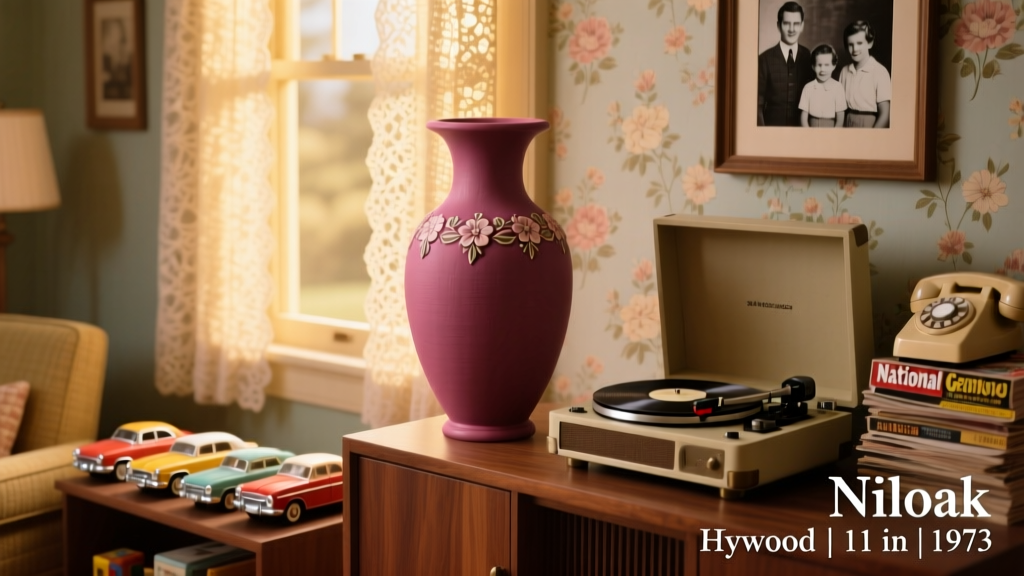
Niloak Vase Hywood Dark Pink 11-Inch: Identification, Provenance, and Market Value of a Mid-Century Arkansas Ceramic Treasure
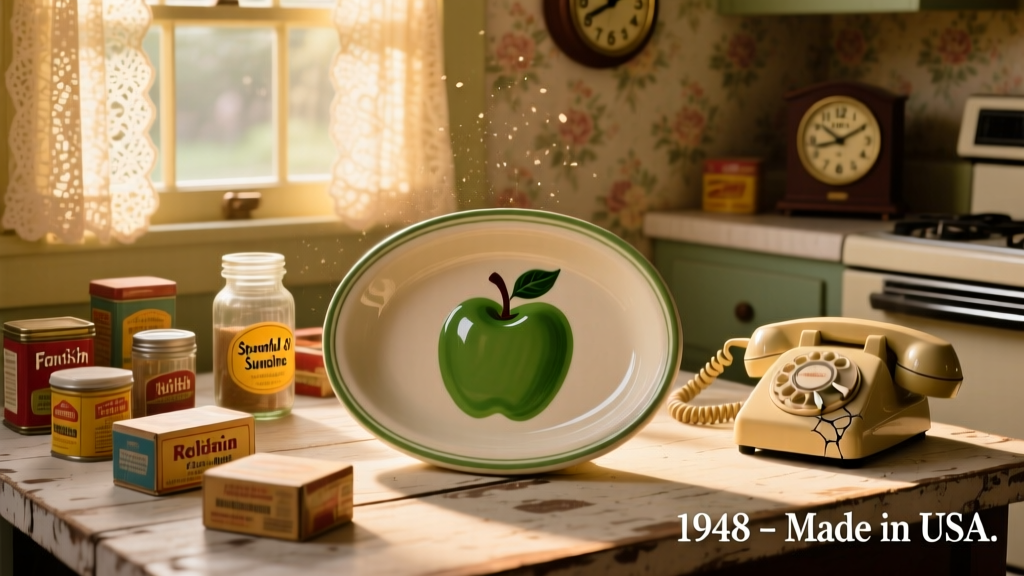
The Franciscan Relish Apple Oval: A Mid-Century Icon of American Tableware Design
Weather Vanes with Arrow, Star, and Lyre Motif: Copper-Zinc Alloy Identification and Mid-Century Collectibility
Disneyana Book: Bambi Hardcover Edition, 1944 — A Collector’s Deep-Dive Appraisal
Meenakari: The Forgotten Art of Mid-Century Indian Enamelware Collectibles
Kovels’ On Antiques and Collectibles, Vol. 25, No. 5 (January 1999): A Vintage Collector’s Time Capsule
Cracker Jack Game Board (Milton Bradley, 1976): A Nostalgic Deep Dive into a Forgotten Mid-Century Candy Tie-In
Gallé Vase with Brown Leaves, Branches, and Berries on Yellow-Green Frosted Ground — A Mid-Century Collector’s Appraisal
Harker Country Charm Berry Bowl (5¾″): A Mid-Century Ceramic Treasure — History, Identification & Market Value