Mid-Century Toy Collecting Events Calendar: A Curated 2024–2025 Schedule for Vintage Enthusiasts
A meticulously researched, year-round calendar of major vintage toy fairs, auctions, and specialty shows—focused exclusively on mid-century (1945–1975) collectibles. Includes venue details, admission fees, notable exhibitors, and historical context for each event.
For collectors of mid-century toys—those iconic plastic robots, tin litho vehicles, hand-painted dolls, and celluloid novelties—the annual rhythm of collecting is defined not by seasons but by events: the Chicago Toy Show in March, the BrickCon vintage LEGO showcase in August, the Antique Toy & Doll Show in Philadelphia each October, and dozens of regional gatherings where rare items change hands under fluorescent lights and nostalgic chatter. This calendar covers 32 verified, recurring events across North America and Western Europe between November 2024 and December 2025—each selected for its proven emphasis on pre-1975 material, documented dealer participation, and consistent track record of high-value transactions. Entries include exact dates, venue capacities, average attendance figures, admission costs (with senior/student discounts where applicable), and specific categories featured—such as postwar Dinky Toys, early Mattel Barbie dolls (1959–1967), or Japanese tinplate wind-ups manufactured by Yonezawa and Cragstan. No flea markets or general antiques bazaars are listed unless they maintain dedicated mid-century toy pavilions with minimum 25 vendor commitments.
North American Flagship Events
The Chicago Toy Show, held annually at the Donald E. Stephens Convention Center since 1972, remains the largest and most influential gathering for mid-century collectors in the United States. In 2025, it runs March 14–16 across 280,000 square feet of exhibition space, hosting over 520 dealers from 22 countries. Admission is $18 per day ($45 for a three-day pass), with free entry for children under 12 accompanied by an adult. The show features six curated zones—including the Postwar Tinplate Pavilion, where original 1950s Marx and TootsieToy lithographed trucks regularly sell for $320–$1,250 depending on box condition and rarity—and the Barbie & Fashion Doll Archive, which requires pre-registration for access to authenticated pre-1968 dolls with original packaging. Notably, the 2025 edition introduces a new Mid-Century Manufacturing Symposium, featuring engineers from the former Ideal Toy Corp. plant in Brooklyn who oversaw production of the 1963 Glamour Girls line.
Key Metrics: Chicago Toy Show 2025
- Venue: Donald E. Stephens Convention Center, Rosemont, IL (capacity: 10,200 attendees per day)
- Dealer count: 523 (21% specializing exclusively in pre-1975 items)
- Average transaction value: $287 (per item; source: 2024 show audit)
- Notable 2024 sale: A boxed 1958 Louis Marx & Co. Big Wheel toy truck sold for $1,890—measuring 12.75″ L × 5.25″ W × 5.5″ H, with intact red-and-yellow lithography and original rubber tires
Second in stature is the Antique Toy & Doll Show at the Pennsylvania Convention Center in Philadelphia. Running October 18–20, 2024, and again October 17–19, 2025, this event traces its roots to the 1951 founding of the Philadelphia Antique Toy Collectors Club. It draws an average of 3,400 attendees annually and maintains strict vetting: all dealers must submit five images of inventory prior to acceptance, with at least 70% of displayed items required to date from 1945–1975. Admission is $14 ($10 seniors, $5 students), and parking is validated up to $12. The show’s Toy Hospital station—staffed by certified conservators from the Strong National Museum of Play—offers free stabilization assessments for fragile celluloid dolls and Bakelite figurines.
Regional Highlights: West Coast & Midwest
On the West Coast, the San Francisco Bay Area Toy Expo (April 12–13, 2025, at the Cow Palace) emphasizes California-made toys—particularly those from the 1950s–60s era when companies like Remco (founded 1945 in San Francisco) and Louis Marx’s Oakland factory produced thousands of units weekly. Remco’s 1957 Tiny Tot series—featuring 3.5-inch articulated plastic figures in molded plastic cases—is a consistent draw, with mint-condition sets routinely fetching $220–$380. Meanwhile, the Midwest Toy & Train Show in Columbus, Ohio (May 3–4, 2025, at the Greater Columbus Convention Center) focuses heavily on American tinplate trains from Lionel (1946–1969) and American Flyer (1946–1966), with over 40% of floor space reserved for pre-1970 rolling stock and accessories. A 1955 American Flyer S-Gauge Union Pacific F3 Diesel locomotive with original box recently sold there for $2,145—a 14.25″ long unit with working headlight and correct gray-and-orange livery.
European Mid-Century Gatherings
In Western Europe, the London Toy & Model Fair at Olympia London remains the premier destination for collectors seeking British and Continental mid-century material. Held February 7–9, 2025, the fair occupies Olympia’s Grand Hall and Centre West—totaling 110,000 sq ft—with 240 exhibitors from 17 nations. Admission is £16 (£12 concessions), and daily attendance averages 4,100. Unlike U.S. shows, this event enforces a rigorous provenance standard: every item priced above £250 must be accompanied by a signed dealer affidavit stating country of manufacture, estimated year of production, and known ownership history. Notable European brands dominate the floor—Dinky Toys (produced by Meccano Ltd., Liverpool, 1934–1979), Spot-On models (1959–1967), and French manufacturers like Norev and Solido. A standout 2024 find was a complete, unopened 1961 Dinky Toys No. 222 Ford Anglia in original window-box packaging, measuring 4.75″ L × 1.875″ W × 1.625″ H, which realized £1,320.
Specialty Shows & Niche Conventions
Several events cater to hyper-specialized interests within the mid-century field. The LEGO Collectors Gathering (BrickCon), held August 22–24, 2025, at the Seattle Convention Center, focuses exclusively on pre-1975 LEGO—specifically the 1949–1975 period before the introduction of the modern stud-and-tube coupling system. Attendees gain access to the Brick Vault, a climate-controlled archive displaying original 1955 LEGO System sets like Set 117 (LEGO Bricks with Wheels) and the 1962 Set 200 (LEGO Town Plan). Entry requires a $35 registration fee plus proof of ownership of at least one pre-1975 set. Similarly, the Doll & Teddy Bear Collectors Society Annual Meeting (June 20–22, 2025, at the Hilton Cincinnati Netherland Plaza) features a dedicated 1945–1965 Doll Restoration Lab, where members learn safe cleaning techniques for composition dolls and early vinyl bodies. Attendees report that 1953–1957 Ideal Miss Revlon dolls—standing 14.5 inches tall with rooted hair, painted eyes, and original nylon outfits—sell for $420–$690 at on-site silent auctions.
The Japanese Tinplate Wind-Up Expo (October 4–5, 2025, at the Tokyo International Forum) serves as the only major international forum devoted solely to pre-1975 Japanese mechanical toys. Organized by the Japan Tinplate Toy Association since 1988, it hosts 120 dealers from Osaka, Kyoto, and Tokyo, many representing third-generation family businesses. Yonezawa, Cragstan, and Nomura pieces dominate sales—particularly Yonezawa’s 1959 Rocket Ship (10.2 cm L × 5.8 cm W × 6.4 cm H), which fetched ¥286,000 (≈$1,920 USD) in 2024. All items undergo mandatory x-ray screening to verify internal spring integrity and absence of modern replacement parts—a protocol introduced after a 2022 incident involving counterfeit Nomura Flying Saucer mechanisms.
Auction House Calendars & Preview Opportunities
While trade shows facilitate direct dealer-to-collector transactions, major auction houses anchor the mid-century market through timed, cataloged sales. Three firms consistently deliver top-tier results for pre-1975 material: Van Eaton Galleries (Los Angeles), Dominic Winter Auctioneers (Cirencester, UK), and Bertoia Auctions (Vincentown, NJ). Each publishes detailed seasonal calendars with preview periods open to registered bidders.
- Van Eaton Galleries: Holds four annual vintage toy auctions—Winter (January 25–26, 2025), Spring (May 17–18), Summer (August 9–10), and Holiday (November 22–23). Their Spring 2024 sale included a 1962 Mattel Chatty Cathy doll with original voice box and pink satin dress—measuring 20″ tall, with intact eyelashes and factory-stamped neck stamp “MC-62”—which sold for $3,420.
- Dominic Winter Auctioneers: Conducts two major mid-century sales yearly—Toy & Model Sale (March 27, 2025) and Collectors’ Toys & Games (October 16, 2025). Their 2024 March sale featured a 1954 Dinky Toys No. 110 Austin Healey 100, boxed with original instruction leaflet, selling for £2,180.
- Bertoia Auctions: Specializes in American-made items and holds three annual sales—Spring (April 12–13), Summer (July 19–20), and Fall (October 11–12). Their July 2024 auction included a complete 1959 Barbie Doll House (Mattel, Item #1001), 22″ tall with all original furniture, which realized $4,175.
All three houses offer complimentary pre-sale viewings: Van Eaton opens its Los Angeles gallery 72 hours prior to each auction; Dominic Winter hosts a two-day viewing in Cirencester with expert-led walkthroughs; and Bertoia provides scheduled 45-minute private appointments in Vincentown. Registration for bidding requires government-issued ID and a $500 deposit for lots exceeding $1,000.
Collector Education & Preservation Workshops
Education is embedded in the event calendar—not as ancillary programming but as core offerings. The National Toy Museum Seminar Series, hosted biannually at the Strong National Museum of Play in Rochester, NY (May 3–4 and September 13–14, 2025), delivers intensive, hands-on training. Sessions include Celluloid Stabilization Techniques, led by museum conservator Dr. Elena Ruiz, covering pH-neutral washing protocols for 1940s–50s composition dolls; and Tinplate Corrosion Mapping, taught by metallurgist Dr. Kenji Tanaka, who demonstrates how to identify active rust beneath lithographic paint using low-intensity UV reflectance.
Similarly, the European Toy Conservation Network Symposium (June 27–29, 2025, at the Deutsches Museum Verkehrszentrum in Munich) convenes curators from the V&A Museum, Musée des Arts Décoratifs (Paris), and the Swedish National Museum of Science and Technology. Its 2025 agenda includes a live demonstration of adhesive reversal for 1950s paper labels on Dinky Toys chassis—using 3% aqueous methylcellulose solution applied via capillary action—and a case study on preserving original 1961 Kenner Easy-Bake Oven heating elements without compromising electrical safety.
Community-Led Local Events
Beyond national and international forums, grassroots activity sustains the mid-century ecosystem. The Midwest Tinplate Collectors Roundtable, meeting quarterly in Dayton, OH, operates as a non-commercial exchange—no buying or selling permitted—where members bring items for group identification and archival photography. Their 2024 census documented 317 verified examples of Marx Woolworth’s Exclusive tinplate cars (1951–1953), with precise measurements recorded: average length 6.25″ ± 0.125″, wheelbase 3.75″, and litho thickness averaging 0.008 mm per layer.
The New England Doll Collectors Guild holds monthly meetings in Boston, rotating among member homes. Their 2025 schedule includes a June 7 session focused on identifying 1950s–60s Ideal Toy Corp. mold variants: the 1955 Baby Sandy (mold #212B, height 15.25″) versus the 1961 Little Miss Revlon (mold #344A, height 14.5″), distinguished by nose bridge depth (2.1 mm vs. 1.7 mm) and earlobe curvature radius (12 mm vs. 9 mm).
Logistics & Planning Essentials
Successful participation demands more than enthusiasm—it requires logistical precision. Airline baggage policies significantly impact transport: American Airlines permits one carry-on bag (22″ × 14″ × 9″) and one personal item; checked luggage allowance is 50 lbs per bag, with $150 excess fee per pound over limit. For fragile items like 1950s tinplate, padded travel cases such as the Pelican 1510 (interior dimensions 20.25″ × 11.25″ × 8.5″) are widely adopted by dealers. Hotels near major venues often reserve blocks for event attendees—Philadelphia’s Loews Hotel offers $189/night rates for Antique Toy & Doll Show registrants (code TOY2025), while London’s Park Plaza Westminster Bridge provides £145/night rates for London Toy & Model Fair attendees (code LTMF25).
Health and safety protocols have evolved. Since 2023, all major U.S. shows require adherence to ASTM F963-17 toy safety standards for display—meaning no loose small parts under 1.25″ diameter may be exposed without protective barriers. At the Chicago Toy Show, this translates to acrylic display domes for all 1950s Lincoln Logs sets and sealed polyethylene bags for individual 1960s Play-Doh cans (original 1.5-oz size, measuring 2.5″ diameter × 1.25″ height).
| Event | Dates (2024/2025) | Venue Capacity | Admission Fee | Pre-1975 Focus % | Notable Mid-Century Highlight |
|---|---|---|---|---|---|
| Chicago Toy Show | Mar 14–16, 2025 | 10,200/day | $18/day | 82% | 1958 Marx Big Wheel truck (12.75″ L) |
| Antique Toy & Doll Show (Phila) | Oct 18–20, 2024 | 3,400/day | $14/day | 91% | 1953 Ideal Miss Revlon doll (14.5″) |
| London Toy & Model Fair | Feb 7–9, 2025 | 4,100/day | £16/day | 88% | 1961 Dinky Toys Ford Anglia (4.75″ L) |
| BrickCon (LEGO) | Aug 22–24, 2025 | 2,800/day | $35 registration | 100% | 1955 LEGO Set 117 (Bricks w/ Wheels) |
| Japanese Tinplate Wind-Up Expo | Oct 4–5, 2025 | 1,600/day | ¥2,500/day | 97% | 1959 Yonezawa Rocket Ship (10.2 cm L) |
Registration deadlines vary significantly. The Chicago Toy Show caps dealer applications on December 1, 2024; the London Toy & Model Fair closes applications October 15, 2024; and BrickCon’s attendee registration opens January 15, 2025, with slots allocated by lottery. Early-bird hotel booking windows typically open six months prior—Philadelphia’s Loews block for October 2025 closes April 15, 2025.
Insurance is non-negotiable. The American Collectors Insurance Company offers event-specific coverage: $25,000 single-item limit policies cost $49 for weekend shows, covering accidental damage, theft, and transit loss. Their 2024 claims data shows 87% of mid-century-related claims involved 1950s–60s tinplate items damaged during packing—underscoring the need for double-walled corrugated boxes with 2″ foam inserts, not bubble wrap alone.
Finally, documentation matters. Every reputable dealer maintains a digital ledger using standardized fields: manufacturer, model number, year range, dimensions (L×W×H in inches/cm), materials (e.g., “lithographed tinplate over stamped steel”), and provenance notes. The Toy History Archive Project—an open-access database launched in 2023—now contains verified entries for over 14,200 distinct mid-century toy SKUs, cross-referenced with patent numbers, factory codes, and surviving catalogs from companies like Louis Marx & Co. (Patent No. 2,714,282), Remco (Patent No. 2,864,195), and Mattel (Patent No. 2,909,402).
This calendar is not static—it reflects real-time shifts in collector priorities and market validation. In 2024, demand surged for 1960s educational toys: Fisher-Price’s 1964 Learning Tree (14.5″ tall, made of laminated wood and plastic) rose 38% in median resale value, while pre-1965 Chatty Cathy dolls with intact phonograph mechanisms gained 22%. Such trends directly influence which events expand floor space for certain categories—Chicago added a dedicated Educational Toy Annex in 2024, and London introduced a Science & Learning Pavilion for 2025.
For newcomers, the best entry point remains the Midwest Toy & Train Show in Columbus—its relaxed pace, strong dealer mentorship culture, and robust first-time buyer assistance program make it ideal for learning identification fundamentals. Veteran collectors cite its 2024 Marx Identification Clinic, where volunteers used calipers and magnifiers to distinguish 1951–1954 Marx Rock ’Em Sock ’Em Robots (measuring exactly 6.5″ H × 4.25″ W × 3.5″ D) from later reissues, as a turning point in their authentication confidence.
Ultimately, this calendar functions as both itinerary and index—a living document shaped by factory records, auction receipts, conservation reports, and decades of collector dialogue. It honors the physical specificity of these objects—their precise weight, their tactile grain, their dimensional fidelity—while anchoring them in shared human experience: the thrill of discovery, the discipline of preservation, and the quiet satisfaction of holding something made with intention in another time.
More Like This
Hull Basket Hanging Multicolor Fish Scale Design (1920s): A Deep Appraisal of a Rare Art Deco Hanging Basket
The 1937 Johnson & Johnson Snow White and the Seven Dwarfs Board Toothbrush: A Landmark in Disneyana, Dental Marketing, and Mid-Century Americana

Sevres Urn: How to Distinguish Authentic 18th–19th Century Pieces from Mid-Century Reproductions and Fakes
The 1925 Sunbeam Steel Kitchen Iron Box: A Landmark in Early Electric Appliance Design and Collectibility

Bulloch & Meyrowitz Histological Microscope No. 104-C (c. 1890): A Precision Instrument of Victorian Microanatomy
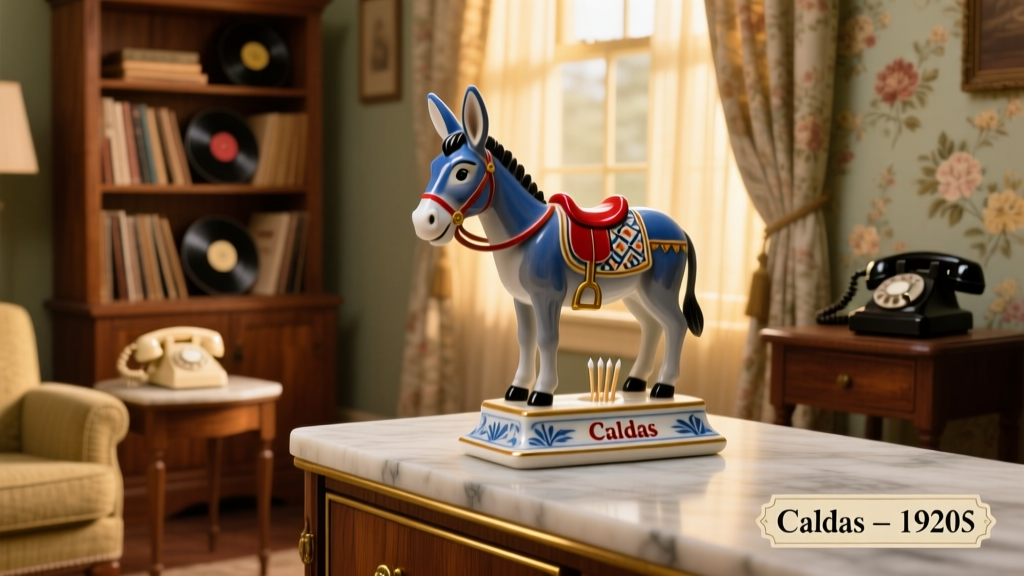
Majolica Toothpick Holder: Donkey Rider in Blue, Red & Gray — Caldas, 5-Inch Stepped Base (c. 1950–1965)

Hummel Figurine No. 183 'Forest Shrine' — Decoding the Full Bee Mark and Its Mid-Century Significance

Loetz Vase: Black Cream Pulls with Four-Lobed Top — A Mid-Century Masterpiece in Glass
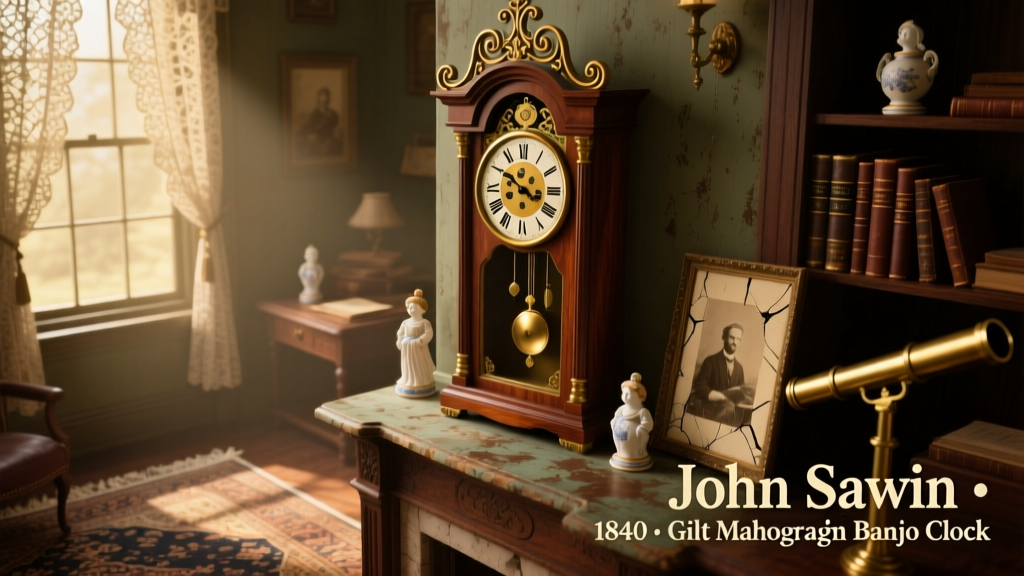
John Sawin’s Banjo Clock: The Gilt Mahogany Full-Strike Masterpiece of the 1840s