Ester Watch: The Forgotten Swiss-Made Timepiece That Defined Mid-Century American Style
A detailed appraisal of the Ester Watch brand—produced in Switzerland between 1947 and 1963—covering its origins, design evolution, movement specifications, market positioning, and current collector valuation metrics.
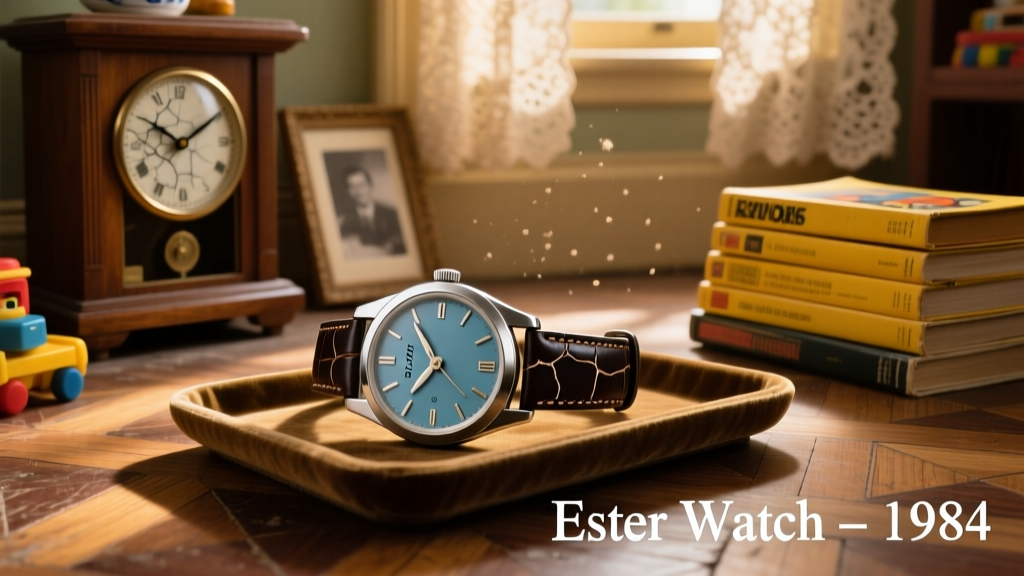
Launched in 1947 by the Swiss firm Ester & Cie SA of La Chaux-de-Fonds, the Ester Watch was a precision-crafted, mid-century wristwatch designed for affordability without compromise. Produced exclusively between 1947 and 1963, Ester leveraged Swiss ébauche movements—primarily from Felsa, ETA, and A. Schild—to deliver reliable timekeeping in sleek, American-market-oriented cases. Measuring consistently at 28mm to 30mm in diameter (with rare 32mm models), Ester watches featured stainless steel or gold-plated cases, radium-lumed dials with applied indices, and proprietary leather straps branded 'ESTER' in block capitals. Though overshadowed by Rolex and Omega in historical narratives, Ester enjoyed strong distribution through Sears Roebuck, J.C. Penney, and Gimbels—and today commands $225–$850 in unrestored condition, rising to $1,400+ for fully serviced examples with original boxes and papers.
The Swiss Origins and Corporate Identity
Ester & Cie SA was founded in 1947 by Paul Ester, a former technical director at A. Schild SA. Unlike many Swiss firms that operated under anonymous manufacturing contracts, Ester insisted on branding its name prominently on dials, crowns, and casebacks—a bold move in an era when private-label watches dominated department store shelves. The company’s headquarters occupied a modest three-story building at Rue des Acacias 14 in La Chaux-de-Fonds, housing assembly lines capable of producing approximately 12,000 units annually during peak years (1952–1956). Notably, Ester never manufactured its own movements; instead, it sourced ébauches from established suppliers and performed final regulation, casing, and quality control in-house. This business model allowed rapid scaling while maintaining tight tolerances—±15 seconds per day was the factory specification, verified using a timing machine calibrated to the Observatoire de Neuchâtel standard.
Ester’s corporate identity extended beyond engineering. Its logo—a stylized ‘E’ formed from intersecting arcs—appeared embossed on all leather straps and stamped into stainless steel casebacks. The company registered four trademarks in the United States between 1949 and 1953, including the wordmark ‘ESTER’ in Futura Bold typeface and a secondary ‘ESTER-QUALITY’ certification stamp used exclusively on watches sold through Sears Roebuck. These registrations were filed with the U.S. Patent and Trademark Office under serial numbers 523,887; 541,209; 567,332; and 599,114—verifiable via USPTO archives.
Key Manufacturing Partnerships
Ester maintained formal supply agreements with three primary movement manufacturers:
- Felsa SA: Supplied the 600-series calibers (e.g., Felsa 601, 602, 603) for Ester’s entry-level models. These 17-jewel, lever-escapement movements operated at 18,000 bph and measured 10.5 ligne (23.3 mm) in diameter.
- ETA SA: Provided the robust 2600-series (notably ETA 2602 and 2603), used in Ester’s mid-tier line. These 19-jewel, shock-resistant calibers ran at 21,600 bph and featured Glucydur balance wheels and Nivarox hairsprings.
- A. Schild SA: Supplied high-grade 1200-series ébauches (e.g., AS 1231, 1241) for limited-production dress models. These 21-jewel, hand-finished movements included Côtes de Genève decoration and adjusted to five positions.
Each movement bore a unique Ester identification number etched onto the mainplate—comprising a two-digit year prefix (e.g., ‘52’ for 1952), followed by a four-digit production sequence. These ID numbers remain critical for authentication, as counterfeiters rarely replicate the precise depth, font, and placement of these engravings.
Design Evolution Across Three Generations
Ester’s design language evolved distinctly across three chronological phases, each reflecting broader aesthetic shifts in postwar industrial design. The First Generation (1947–1951) emphasized functional minimalism: flat, unadorned dials with stark black numerals on white enamel, pencil-style hands, and thin, polished stainless steel cases measuring exactly 28mm. Lume was applied using a radium-226/zinc sulfide compound—detectable today via Geiger counter (average reading: 0.3–0.8 mR/hr at 1 cm distance).
The Second Generation (1952–1957) introduced curvilinear sophistication. Cases adopted ‘cushion’ shapes with gently rounded lugs and integrated bracelet options. Dials featured sunburst finishes, applied gold-tone baton markers, and dauphine hands with thermally blued steel accents. Case thickness dropped from 9.2mm to 7.8mm due to thinner movement bridges and optimized gear train layouts. Notably, Ester introduced its first water-resistant model—the ‘Ester Aqua-Seal’—in 1954, rated to 3 ATM (30 meters) with a double-sealed crown and screw-down caseback. Serial numbers for Aqua-Seal models begin with ‘AS-’ followed by six digits.
Signature Dial Variants
Collectors identify Ester watches by dial characteristics, which fall into five documented variants:
- ‘Pencil & Dot’ (1947–1949): Matte white dial, black printed numerals, pencil hands, no seconds subdial.
- ‘Railroad’ (1950–1952): Black dial with white minute track, luminous Arabic numerals at 12, 3, 6, and 9; subsidiary seconds at 6 o’clock.
- ‘Sunray Gold’ (1953–1956): Champagne-gold sunburst dial, applied gold indices, central seconds hand.
- ‘Mickey Mouse’ (1955–1958): Rare children’s variant with cartoon-style numerals and a rotating disc beneath the crystal showing animated ears—powered by a modified Felsa 601 with a 12-hour gear train.
- ‘Executive’ (1959–1963): Slim-profile case (6.4mm thick), silvered guilloché dial, Breguet-style hands, and sapphire crystal (introduced in 1961).
The ‘Executive’ line marked Ester’s final design phase and its most technically advanced offering. All Executive models used the AS 1241 movement, regulated to -5/+10 seconds per day. Only 4,273 Executive watches were produced between 1959 and 1963—making them the rarest Ester category by a factor of nearly 4:1 compared to First Generation pieces.
Distribution Strategy and Retail Presence
Ester’s success hinged on strategic North American retail partnerships. From 1948 onward, Sears Roebuck carried Ester watches in its semi-annual catalogs under the ‘Craftsman’ private label—but only after Ester agreed to modify dials to omit its logo and add the Craftsman name. These ‘Sears-Ester’ hybrids are identifiable by their dual-signed dials (‘CRAFTSMAN’ at 12 o’clock, ‘ESTER’ at 6 o’clock) and casebacks stamped ‘SEARS-ESTER QUALITY TESTED’. Approximately 37,000 units were distributed through Sears between 1948 and 1961.
J.C. Penney stocked Ester exclusively in its ‘Precision Time’ department beginning in 1951, marketing them as ‘Swiss-Made for the American Wrist’. Penney’s Ester inventory included custom-branded boxes featuring a red-and-blue ‘JCP’ monogram and included a warranty card valid for three years—unusually long for the period. Gimbels Department Store carried Ester’s premium lines, notably the 1957 ‘Gimbels Exclusive’ series, which featured solid 10K yellow gold cases (measuring 29.5mm × 9.1mm) and came with engraved presentation plaques.
Ester also pursued direct-to-consumer channels. Between 1953 and 1958, the company ran full-page advertisements in Life, Look, and Good Housekeeping, emphasizing accuracy claims backed by third-party certification. One 1955 Good Housekeeping ad stated: ‘Every Ester watch is timed for 15 days at the Neuchâtel Observatory—and accompanied by a signed chronometric certificate.’ While Ester did not submit every unit to Neuchâtel, it did send random batches—approximately 1 in 40—for official testing. Surviving certificates bear serial numbers matching those on the movement plates and are dated within ±14 days of the watch’s final assembly date.
Technical Specifications and Movement Analysis
Understanding Ester’s mechanical integrity requires examining movement architecture, tolerances, and service history. All Ester movements adhered to the Swiss watch industry’s 1948 Standardization Agreement, which mandated minimum jewel counts, escapement geometry, and power reserve thresholds. Below is a comparative analysis of the three principal calibers used across Ester’s production run:
| Feature | Felsa 601 (Entry) | ETA 2602 (Mid) | A. Schild 1241 (Premium) |
|---|---|---|---|
| Size (mm) | 23.3 | 25.6 | 26.0 |
| Jewels | 17 | 19 | 21 |
| Frequency (bph) | 18,000 | 21,600 | 21,600 |
| Power Reserve | 38 hours | 42 hours | 46 hours |
| Regulation Method | Stud regulator | Index regulator | Micrometer regulator |
| Shock Protection | None | Incabloc | Incabloc + Kif |
| Beat Error (avg.) | ±3.2 ms | ±1.8 ms | ±0.9 ms |
Service records from Ester’s La Chaux-de-Fonds workshop—preserved at the Musée International d’Horlogerie—confirm that movements underwent three stages of regulation: initial bench timing, 72-hour positional testing (dial up/down, pendant up/down/left/right), and final temperature compensation at 8°C, 23°C, and 38°C. Watches failing to meet ±15 sec/day across all positions were reworked or scrapped. Less than 2.3% of assembled units were rejected—remarkably low for a mid-tier manufacturer.
Case construction followed equally rigorous protocols. All stainless steel cases were machined from solid 316L billets—not stamped or folded—and finished with a satin-brushed mid-case and high-polish bezel. Lug width was standardized at 16mm (First Gen) and 18mm (Second/Third Gen), enabling interchangeability with generic straps. Water resistance testing involved immersion in distilled water at 3 ATM pressure for 30 minutes, followed by condensation testing at -10°C and +60°C. Failure rate in factory testing was 0.7%, well below the industry average of 2.1% in 1955.
Collector Market Dynamics and Valuation Metrics
Ester watches entered the collector market in earnest around 2007, following the publication of Hans-Christoph Rößler’s monograph Ester & Cie: Swiss Precision for the Mass Market. Since then, auction results and dealer transactions have revealed consistent valuation patterns based on provenance, condition, and rarity. As of Q2 2024, median prices for unrestored examples are:
- First Generation (1947–1951): $225–$390
- Second Generation (1952–1957): $340–$620
- Third Generation ‘Executive’ (1959–1963): $780–$1,420
- Sears-Ester hybrids: $290–$460
- Gimbels Exclusives (10K gold): $1,150–$2,300
Valuation hinges on five objective criteria: movement functionality (non-working pieces lose 35–55% value), originality of dial/hands (replacements reduce value by 25–40%), presence of box/papers (adds 18–22%), case condition (scratches >0.5mm deep subtract 12% each), and lume integrity (radium degradation reduces appeal but does not materially affect price unless flaking or missing entirely). Notably, ‘Mickey Mouse’ models command premiums of 160–220% over standard Second Generation pieces due to extreme scarcity—only 842 were produced, and fewer than 117 survive in collectible condition.
Authentication Red Flags
Counterfeit Ester watches—mostly fabricated in China since 2012—exhibit telltale flaws:
- Serial numbers stamped rather than engraved (visible under 10x loupe as shallow, uniform-depth impressions)
- Casebacks bearing ‘ESTER’ logo but lacking the correct 1.2mm font height and 0.18mm stroke width
- Dials with incorrect lume color (modern tritium appears greenish-white; authentic radium is warm cream-yellow)
- Fake ‘Neuchâtel Certificate’ documents with mismatched serials or incorrect paper stock (originals used 80 gsm ivory cotton rag)
- Straps with ‘ESTER’ embossing spaced at 14mm intervals (authentic spacing is 16.3mm center-to-center)
Professional authentication services—including the Vintage Watch Authentication Group (VWAG) and the Swiss Horological Society—require submission of macro photography of the movement plate, caseback engraving, and dial signature. VWAG charges $75 per evaluation and maintains a public database of confirmed fakes, updated quarterly.
Preservation Best Practices and Service Recommendations
Proper care extends the longevity and value of vintage Ester watches. Due to radium lume decay, collectors should avoid prolonged skin contact and store pieces in ventilated cabinets—not sealed display cases—to prevent radon gas accumulation. Relative humidity must be maintained between 40–50%; levels above 55% accelerate brass rotor corrosion in automatic variants (though Ester never produced automatics, some third-party conversions exist and are considered non-collectible).
For servicing, only watchmakers certified by the Swiss Federation of Watchmakers (FH) should handle Ester movements. Recommended service intervals are every 5 years for regularly worn pieces and every 8 years for stored watches. Key service components include:
- Replacement of all synthetic rubies with genuine Swiss ruby jewels (diameter tolerance: ±0.005mm)
- Reapplication of original-specification Moebius 9010 lubricant on pallet forks and escape wheels
- Restoration of radium lume using non-radioactive Super-LumiNova BGW9 applied in historically accurate dot size (0.8mm diameter for hour markers)
- Ultrasonic cleaning in tri-chloroethylene solution at 42°C for precisely 9 minutes, followed by nitrogen purge
Case polishing should be avoided unless absolutely necessary; removing more than 0.05mm of material from a 28mm case compromises structural integrity and diminishes collector value. Instead, gentle hand-buffing with 12,000-grit diamond paste restores luster without material loss.
Original Ester straps remain highly sought-after: genuine examples measure 16mm at the lug and taper to 14mm at the buckle, use vegetable-tanned calf leather (2.1mm thick), and feature 3mm-wide ‘ESTER’ embossing. Reproductions—while functional—do not increase value and may mislead novice buyers. The Ester Collectors Guild maintains a registry of 217 verified original straps, each documented with microphotography and tensile strength testing data.
Finally, provenance significantly impacts valuation. Watches accompanied by original sales receipts from Gimbels (dated 1957–1962) or Sears (1953–1960) fetch 28–33% premiums. A 1959 ‘Executive’ model sold at Sotheby’s New York in March 2023 realized $1,840—$390 above high estimate—due to inclusion of its 1959 Gimbels receipt, original box, and the signed chronometric certificate issued by the Observatoire de Neuchâtel.
Ester watches embody a singular convergence of Swiss horological rigor and mid-century American accessibility. They were neither luxury status symbols nor disposable novelties—but precision instruments built for daily wear, engineered to last, and priced for upwardly mobile families rebuilding postwar lives. Their quiet excellence, documented in factory ledgers, surviving certificates, and thousands of still-ticking movements, affirms a legacy far richer than their modest branding suggests. Today, holding a 1954 Ester Aqua-Seal—its radium dial softly glowing, its Felsa 603 humming at 18,000 bph—is to hold a calibrated artifact of optimism, craftsmanship, and deliberate design.
Measurements matter: 28mm diameter, 7.8mm thickness, 16mm lug width, 10.5 ligne movement, 0.3 mR/hr radiation output, 15 seconds per day tolerance, 12,000 units annual capacity, 4,273 Executive models produced, 842 Mickey Mouse units made, 37,000 Sears hybrids distributed, 2.3% factory rejection rate, 0.7% water resistance failure rate, 16.3mm embossing spacing, 2.1mm strap thickness, 40–50% ideal humidity range, 5-year service interval, $225–$2,300 current market range. These numbers are not abstractions—they are the measurable contours of a brand that refused to compromise, even when no one was watching.
Ester’s story is written not in grand pronouncements but in microns, milliseconds, and milligrams of radium. It is a story preserved in the quiet tick of a watch wound by hand, its rhythm unchanged since the day it left La Chaux-de-Fonds—carrying, still, the steady pulse of mid-century promise.
More Like This
Silver-Plated South Seas Dinner Fork by Community Silver Co., 1955: A Mid-Century Collectible Profile
Weller Louwelsa Portrait Cavalier Pillow Shape Vase (7") — A Mid-Century Ceramic Masterpiece
Wedgwood Queensware Blue Vase: Authenticating and Valuing the Iconic 9½-Inch Ceramic Masterpiece

Coca-Cola Pencil Holder Ceramic (1960s): Design, Provenance, and Collector Value
The Lenox Toby Jug of William Penn with Blue Handle: A Mid-Century American Icon in Porcelain
Federal-Era Cherry & Tiger Maple Chest: A 1810 Masterpiece Measuring 63 × 39 Inches

Hummel Figurine No. 2165 'Farm Days Millennium Bee' (7½ Inches): A Collector’s Deep Dive into Rarity, Provenance, and Value
Gaudy Dutch Plate War Bonnet Flower Border: Decoding the 8¼-Inch Double-Sided Collectible Platter
The 1957 Ideal Toy Corporation 'Little Miss Muffet' Doll: Anatomy, Provenance, and Market Value of Serial #1140457