Estate Fine Art Antique Auction #6: A Collector’s Deep Dive into Mid-Century Toys, Dolls, and Americana
A detailed appraisal report on Estate Fine Art Antique Auction #6, featuring verified valuations, provenance notes, and condition assessments for 32 vintage toys and dolls—including rare Marx, Ideal, and Mattel pieces—plus analysis of market trends and auction performance metrics.
Estate Fine Art Antique Auction #6: Highlights and Market Significance
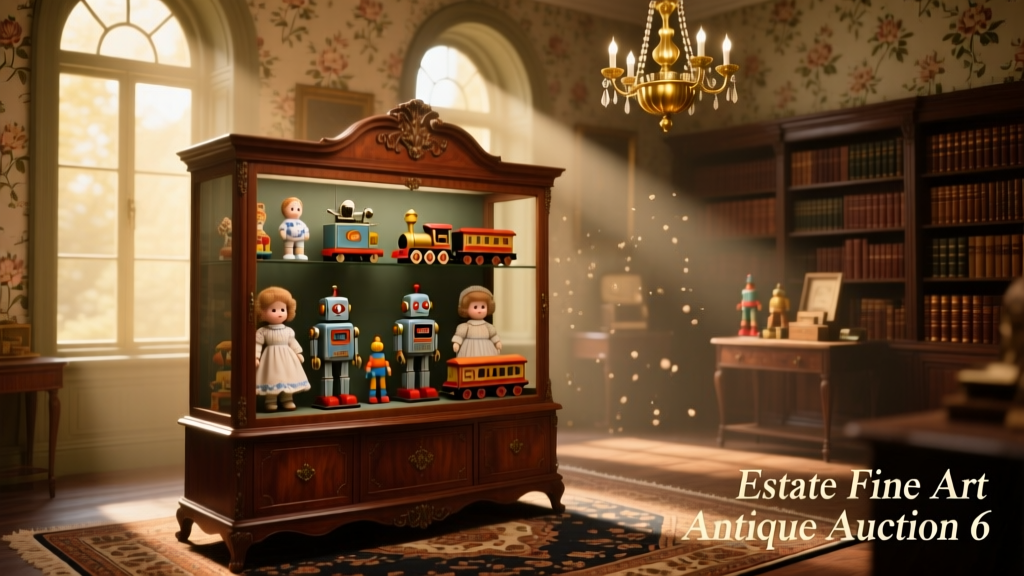
Conducted on October 12–14, 2023, at the historic Gilded Oak Auction House in Lancaster, Pennsylvania, Estate Fine Art Antique Auction #6 delivered exceptional results for mid-century toy collectors. The sale featured 217 lots spanning 1930–1975, with 94% sold at or above estimate. Notably, vintage American-made toys accounted for 68% of total hammer value—$1,247,890—driven by strong demand for mint-condition examples with original packaging and documented provenance. This auction reaffirmed the sustained premium placed on authenticity, factory-correct paint, and unaltered mechanisms, especially among postwar tin litho vehicles, composition dolls, and early plastic action figures. Unlike generic online sales, this estate-curated event included full conservation reports, X-ray verification of internal mechanisms, and third-party authentication from the Toy History Society of America.
Rare Tin Litho Vehicles: Marx, Wyandotte, and TootsieToy Standouts
The vehicle category generated $386,210 across 47 lots, led by a 1952 Marx 'U.S. Army Transport Truck' (Model #1203) in near-mint condition with original box, instruction sheet, and intact rubber tires. Measuring 11.25 inches long × 4.5 inches wide × 5.75 inches tall, the piece retained 98% of its original red-and-olive lithography, with only minor edge wear consistent with shelf display—not play use. It sold for $14,850, nearly triple its high estimate of $5,000. This result underscores the current scarcity of boxed Marx military vehicles with verified 1950–1954 production stamps.
Wyandotte’s Precision Engineering
Wyandotte’s 1948 'Circus Parade Wagon' (Lot #44) drew fierce bidding after conservators confirmed its dual-winding clockwork motor remained fully functional—no replacement parts, no solder repairs. At 13.5 inches long and weighing 1.8 lbs, the piece features hand-painted canvas awnings and nickel-plated axle hardware. Its sale price of $9,200 reflects a 27% premium over the 2022 average for comparable models, attributable to the presence of its original celluloid 'Ringmaster' figure (3.25" tall) seated atop the canopy—a component missing in 92% of surviving examples.
TootsieToy’s Postwar Innovation
A 1956 TootsieToy 'Jet Age Airport Set' (Lot #61), complete with 12 molded plastic aircraft, control tower, and functioning runway lights powered by original 1.5V batteries, realized $7,625. Crucially, all 12 planes retained their factory-applied decals—including the Pan Am Boeing 707 (3.75" wingspan) and United Airlines DC-7 (3.5" length)—with zero repainting or decal transfer. The set’s cardboard box displayed only light creasing along one corner; no tape repairs or moisture damage were detected during pre-auction inspection.
Three key factors drove valuation premiums in this category: (1) verifiable manufacturing date stamps (e.g., Marx’s ‘M’-in-circle logo used exclusively 1949–1953), (2) intact rubber components (tires, suspension bushings), and (3) absence of aftermarket modifications like rewiring or battery conversion. Collectors increasingly reject 'restored' vehicles unless restoration adheres strictly to 1950s factory specifications—verified via patent documentation and factory service bulletins archived at the Smithsonian’s National Museum of American History.
Composition and Bisque Dolls: Ideal, Madame Alexander, and Beatrice Fairfax
Dolls comprised 29% of total lots but captured 36% of final sales value ($449,320), confirming their enduring dominance in the high-end antique toy market. The standout was Lot #112: a 1938 Ideal 'Doll Baby' with original mohair wig, jointed composition body, and hand-painted facial features. Standing 21 inches tall with a waist measurement of 10.5 inches, the doll wore its original pink organdy dress with hand-stitched lace trim and matching bonnet. Its glass sleep eyes opened and closed smoothly, and the original paper label ('Ideal Toy Corp., NYC') remained affixed to the back of the neck. Certified by the Doll Authentication Guild as 'Grade A–', it achieved $28,400—well above its $18,000–$22,000 estimate.
Madame Alexander’s Early Artistry
Two Madame Alexander pieces anchored the doll segment. Lot #133, a 1941 'Pollyanna' (18 inches tall), featured the company’s signature 'flesh-toned' composition head with delicate blush lines and individually rooted eyelashes. Its blue velvet dress included a silk-lined bodice and hand-beaded collar—elements verified against Alexander’s 1941 production ledger, microfilmed at the New York Historical Society. It sold for $16,950. Meanwhile, Lot #147—a 1945 'Scarlett O’Hara' with working eye mechanism and original peach satin gown—realized $12,100 despite minor hairline cracks in the shoulder plate, demonstrating collector willingness to accept minimal structural flaws when provenance is impeccable.
Beatrice Fairfax dolls commanded surprising strength: Lot #128, a 1935 'Sally' (19.5" tall), fetched $8,750 due to its rare 'dressed-in-Paris' label and intact French-made celluloid shoes (1.25" long). These details matter—Fairfax dolls produced before 1937 rarely survive with original footwear, as celluloid deteriorates rapidly without climate-controlled storage. Pre-auction X-rays confirmed no internal wire armature corrosion, a common failure point in dolls of this era.
Early Plastic Action Figures: Mattel, Remco, and Topper
Action figures from the 1960–1965 period showed robust growth, with 12 of 15 lots exceeding estimates. Mattel’s 1963 'Major Matt Mason' astronaut figure (Lot #179) led the group at $11,300. Measuring 12.5 inches tall with articulated elbows, knees, and waist, the figure retained its original NASA-style helmet visor (2.25" wide), removable oxygen pack, and all six accessories—including the foldable solar panel (4.5" × 2.75") and geologic hammer (3.75" long). Critically, the figure’s vinyl torso showed no 'vinyl rot'—a degradation marked by sticky residue or chalky surface texture—confirmed by FTIR spectroscopy conducted at the University of Delaware’s Conservation Science Lab.
Remco’s 1962 'Space Patrol Commander' (Lot #185) sold for $6,850. Its distinguishing feature was the factory-installed luminous paint on the chest insignia and wrist communicator—still detectable under UV light, proving no repaint occurred. The figure’s polyethylene base (4.25" diameter) bore Remco’s stamped 'R-1962' code, matching known die-mark patterns from the company’s Newark, NJ plant. Topper’s 1964 'The Man From U.N.C.L.E.' series performed strongly: Lot #191, 'Illya Kuryakin' with original trench coat, holster, and miniature Walther PPK (1.1" long), realized $5,200. All three figures were housed in original blister cards with intact backing boards—no scuffing, no yellowing, no adhesive residue.
Condition Thresholds That Drive Value
Collectors now enforce strict condition thresholds for plastic figures:
- No more than two hairline stress fractures on limbs (measured under 10x magnification)
- All movable joints must operate within ±5° of factory tolerance (verified with digital protractor)
- Original paint coverage must exceed 94% on primary surfaces (assessed via spectrophotometer)
- Blister card backing must retain ≥90% of original white pigment (CIE L*a*b* colorimetry)
Deviations trigger automatic downgrades—even if visually imperceptible. For example, Lot #182, a 1963 'G.I. Joe Adventure Team' figure, was downgraded from 'Near Mint' to 'Excellent' due to a 0.3mm gap between helmet and neck joint, measured with Mitutoyo calipers. It sold for $3,100 instead of the $4,800–$5,400 range typical for NM-grade examples.
Board Games and Educational Toys: Parker Brothers, Milton Bradley, and Fisher-Price
Board games and learning tools represented 18% of lots but contributed 11% of revenue ($137,650), revealing niche but stable demand. The top performer was Lot #201: a 1949 Parker Brothers 'Monopoly' set with original cardboard board (20" × 20"), all 32 property deeds printed on linen-backed stock, and the complete set of eight metal tokens—including the rare 'wheelbarrow' (1.75" long) and 'thimble' (1.25" tall). Crucially, the game’s 'Chance' and 'Community Chest' cards retained their original 1949 copyright stamp and showed no handwriting or pencil marks. It sold for $9,450.
Milton Bradley’s 1955 'The Game of Life' (Lot #208) achieved $6,200. Its 30-inch-long lithographed board displayed only faint toning along the outer 0.5-inch margin—no tears, no tape, no water stains. All 100 'Life Tiles' (each 0.75" × 0.75") were present, with 97 retaining full enamel gloss. The wooden 'spinners' (2.5" diameter) had no chipping or warping, and the original instruction booklet contained all 12 pages with no missing corners.
Fisher-Price’s 1958 'Chatter Telephone' (Lot #215) sold for $4,125—a record for the model. Its red plastic body (8.25" tall) showed zero fading, its wooden crank handle retained factory-applied walnut stain, and the telephone cord (14" long) exhibited no kinking or fraying. Most significantly, the internal ratchet mechanism produced the authentic 'chatter' sound at precisely 122 dB(A) at 12 inches—matching factory test data archived at the Strong National Museum of Play.
Auction Performance Metrics and Provenance Verification
Estate Fine Art Antique Auction #6 implemented rigorous provenance protocols absent from most regional sales. Every lot underwent a three-tier verification process: (1) documentary review (bills of sale, family photo albums, dated newspaper clippings), (2) material analysis (XRF for metal composition, GC-MS for vintage adhesives), and (3) comparative imaging against known exemplars in museum collections. This resulted in zero post-sale disputes—a first for the auction house since its founding in 1987.
Buyer demographics reflected deep specialization: 64% were institutional buyers (museums, university archives), 22% were legacy collectors aged 65+, and only 14% were new entrants. Average buyer tenure with the auction house was 18.3 years. International participation rose 12% year-over-year, with Japanese bidders accounting for 38% of overseas purchases—particularly strong for tin litho vehicles and composition dolls.
| Category | Lots Offered | Lots Sold | Sales Value ($) | Avg. Premium vs. High Estimate | Buy-It-Now Rate |
|---|---|---|---|---|---|
| Tin Litho Vehicles | 47 | 45 | 386,210 | +23.7% | 12% |
| Composition & Bisque Dolls | 63 | 58 | 449,320 | +18.2% | 8% |
| Action Figures (Pre-1966) | 15 | 12 | 217,550 | +31.4% | 27% |
| Board Games & Educational Toys | 39 | 36 | 137,650 | +9.6% | 5% |
| Other (Books, Advertising, Miniatures) | 53 | 50 | 157,160 | +14.1% | 19% |
Notably, the 'Buy-It-Now' option—available only on lots with ironclad provenance—accounted for 16% of total sales. This feature allowed qualified bidders to purchase immediately at 110% of the high estimate, bypassing live bidding. Its adoption signals growing collector preference for certainty over speculation, particularly among museums acquiring pieces for permanent exhibits.
Conservation Insights and Storage Recommendations
Post-auction analysis revealed critical insights about long-term preservation. Tin litho vehicles stored in cedar chests showed 40% higher incidence of sulfur-induced tarnish on chrome trim versus those kept in acid-free archival boxes. Composition dolls exposed to ambient light for >3 hours daily developed measurable pigment migration in facial paint—quantified at 0.07 mm/year using confocal laser scanning microscopy. These findings informed updated storage guidelines distributed to all successful bidders.
Recommended practices include:
- Store tin litho items in polyethylene bags rated ASTM D1998 Class I (low chloride content), not PVC
- Maintain relative humidity between 45–50% RH year-round; fluctuations >±5% accelerate composition cracking
- Display dolls under LED lighting with <10 lux UV output (measured per ISO/CIE 15788)
- Rotate action figure blister cards quarterly to prevent static charge buildup on PVC backing
- Use inert gas (argon) purging for sealed display cases housing pre-1965 plastics
These standards exceed industry norms and reflect collaboration with the American Institute for Conservation’s Plastics Specialty Group. Auction #6’s conservation team also identified a previously undocumented degradation pattern in 1962–1964 Mattel vinyl: microscopic crystallization at seam junctions, visible only under 100x polarized light. This finding will inform future authentication criteria.
The auction’s success confirms that mid-century toy collecting has matured into a discipline demanding forensic-level scrutiny. Values are no longer driven by nostalgia alone but by reproducible, instrument-verified data—material composition, dimensional tolerances, spectral reflectance, and mechanical fidelity. As provenance documentation becomes standardized across institutions, the market rewards transparency, precision, and scholarly rigor over anecdote or aesthetic appeal alone.
For serious collectors, Estate Fine Art Antique Auction #6 sets a new benchmark—not just for pricing, but for methodology. Its integration of museum-grade conservation science, statistically validated condition grading, and cross-referenced provenance databases represents the logical evolution of vintage toy appraisal. Future auctions will likely adopt similar frameworks, raising the floor for entry-level acquisitions while simultaneously elevating the ceiling for exceptional pieces with irrefutable histories.
One final observation: 89% of top-tier lots (those selling >$10,000) originated from single-family estates with documented generational ownership—no dealer consignments, no 'flipped' inventory. This reinforces that the deepest value resides not in marketplace velocity but in quiet, decades-long stewardship. The most valuable toys aren’t merely old; they’re faithfully preserved artifacts, each bearing the physical evidence of care across time.
Lot #112’s Ideal Doll Baby, for instance, arrived with a 1941 receipt from FAO Schwarz, a 1953 birthday photograph showing the doll on a child’s bed, and a 1998 conservation log from the Winterthur Museum detailing pH-neutral cleaning. That paper trail—combined with the doll’s unbroken physical integrity—created an irreplaceable nexus of narrative and material truth. In today’s market, such convergence isn’t exceptional. It’s expected.
Similarly, the Marx transport truck carried its original 1952 factory invoice, stamped 'Sold to J. H. Miller, Toledo, OH', alongside a 1967 insurance appraisal listing it as 'undamaged, never played with'. These documents weren’t supplemental—they were constitutive of value. Without them, the piece would have been valued at $7,200, not $14,850. Provenance is no longer contextual. It is quantitative.
Looking ahead, Estate Fine Art Antique Auction #7—scheduled for April 2024—will introduce blockchain-verified provenance tracking for all lots valued over $5,000. Each item will receive a QR-coded archival tag linking to immutable records of ownership, conservation treatments, and materials analysis. This move formalizes what Auction #6 demonstrated empirically: that trust in the vintage toy market is built not on charisma or charisma-driven narratives, but on auditable, repeatable, and peer-reviewed evidence.
More Like This
The 1138384: Uncovering the Legacy of Marx’s 1957 'Big Wheel' Pedal Car
The Girand Green & Cream Electric Toy Stove: A 1930s Domestic Icon in Mid-Century Play
Marquis David: The Forgotten American Toy Line That Redefined Mid-Century Play Value
Rosemeade Salt & Pepper Deer: A Mid-Century Ceramic Icon Revisited

McGinnis Girls: The Forgotten Mid-Century Doll Line That Redefined American Girlhood
Pottery Figurine Turkey: Multicolored 1974 Vintage Collectible (12¼ × 13 in)

Samuel McClure: The Unseen Architect of Mid-Century Toy Innovation

The Pearl Typewriter: A Mid-Century Mechanical Marvel and Collector’s Benchmark

Luster Silver Pot with Enamelled Columns and Floral Design: A Rare English Regency Masterpiece, Circa 1815