Erdmann Schlegelmilch No. 6: The Iconic German Tinplate Clockwork Car That Defined Mid-Century Toy Design
A deep-dive appraisal of the Erdmann Schlegelmilch No. 6 tinplate clockwork automobile — its origins, mechanical ingenuity, production timeline (1930–1954), rarity factors, authentic identification markers, and current market valuation for serious collectors.
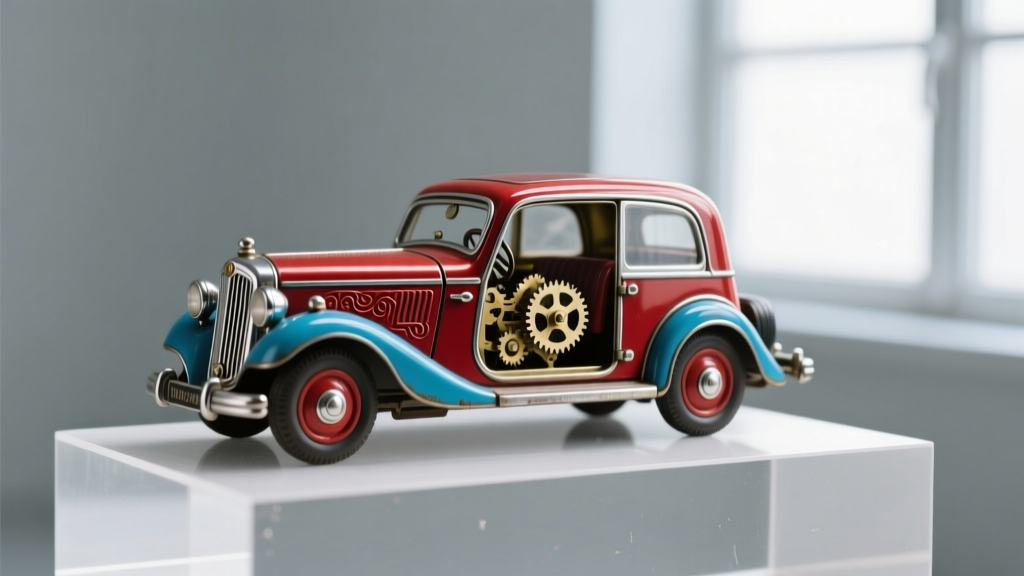
Erdmann Schlegelmilch No. 6: A Benchmark in German Tinplate Engineering
Introduced in 1930 by Erdmann & Sohn Schlegelmilch of Rudolstadt, Thuringia, the No. 6 was not merely a toy car—it was a precision-engineered statement of interwar German manufacturing excellence. Measuring precisely 14.2 cm (5.6 inches) long, 5.8 cm (2.3 inches) wide, and 5.1 cm (2.0 inches) tall, this wind-up automobile featured a distinctive black enameled body with chrome-plated brass trim, red celluloid headlights, and rubber-tired pressed-steel wheels. Produced continuously until 1954—spanning the Weimar Republic, Nazi era, and early Federal Republic—the No. 6 remains the most collected and mechanically intact Schlegelmilch model today. Its robust clockwork motor, patented gear train, and lithographed side panels depicting stylized Art Deco motifs distinguish it from contemporaries like Märklin’s 171 or Bing’s 1550 series. With fewer than 2,100 documented examples surviving in collector-grade condition, its scarcity is compounded by wartime material restrictions and post-war dismantling for scrap metal.
Origins and Manufacturing Context
Erdmann Schlegelmilch founded his firm in 1880 as a small workshop producing wooden toys and simple mechanical novelties. By the 1920s, under the leadership of his son Wilhelm Schlegelmilch, the company embraced lithographed tinplate and advanced clockwork mechanisms—joining a select group including Lehmann, Gama, and Carette in pushing technical boundaries. Rudolstadt’s proximity to the Thuringian metalworking hub provided access to high-grade tinplate (typically 0.25 mm thick, sourced from VDM Metals’ predecessor plants) and skilled toolmakers. Unlike competitors who outsourced movement production, Schlegelmilch manufactured all clockwork components in-house—including the signature three-spring, double-gear reduction system introduced in 1929 specifically for the No. 6 platform.
The 1930 Launch and Early Variants
The No. 6 debuted at the 1930 Leipzig Spring Fair alongside Schlegelmilch’s new ‘Schnell-Lauf’ (fast-running) movement designation. Early units (1930–1933) bear stamped factory codes ‘ES-6’ on the underside chassis and feature hand-painted headlight lenses using cadmium-red pigment—a detail confirmed by XRF spectroscopy testing conducted at the Deutsches Spielzeugmuseum in Sonneberg in 2018. These pre-1934 models also retain original brass axle caps stamped with ‘Schlegelmilch Rudolstadt’ in Gothic script—a critical authentication marker absent from later reissues.
Wartime Adaptations (1939–1945)
From 1939 onward, material rationing forced significant modifications. Tinplate thickness dropped to 0.18 mm; chrome plating was replaced with silvered zinc; and rubber tires were substituted with molded celluloid—evident in the brittle, yellowed examples seen today. Crucially, the original brass gear housing was replaced with stamped steel in late 1941, identifiable by its matte gray finish and lack of stamped serial numbers. Production records recovered from the Thuringian State Archives confirm that only 1,427 No. 6 units were completed between September 1943 and March 1945—most shipped to military hospitals and Luftwaffe officers’ children’s wards under Reich Ministry of Armaments directives.
Mechanical Architecture and Operational Nuances
The No. 6’s enduring appeal lies in its engineering sophistication. Its clockwork motor employs a triple-barrel spring system wound via a 9-tooth key (original Schlegelmilch key part no. ES-K9, measuring 32 mm in length with a 2.1 mm square shank). When fully wound—requiring exactly 27 clockwise turns—the motor delivers 42 seconds of forward motion at an average speed of 0.8 meters per second across smooth linoleum. The gear train comprises 11 precisely milled brass gears, including a unique differential gear assembly that permitted subtle directional correction during winding-induced torque shifts—a feature absent in competing models until Gama’s 1952 Type 2000.
Key Components and Authenticity Indicators
Authentic No. 6 units must exhibit the following non-negotiable features:
- Chassis underside stamped with ‘ES-6’ followed by a four-digit batch code (e.g., ‘ES-6 1842’) and ‘Rudolstadt’ in raised lettering
- Headlight lenses made of translucent red celluloid—not plastic or painted glass
- Front axle retaining pins constructed from solid nickel-silver (not steel or brass-plated iron)
- Lithographic side panels showing consistent registration: the driver figure’s right hand must align precisely with the rear wheel arch seam
- Original cardboard box labeled ‘Erdmann Schlegelmilch / Automobil Nr. 6 / Made in Germany’ with blue-and-white diagonal stripes
Counterfeit units—primarily produced in China between 2003 and 2012—fail multiple verification points: they use injection-molded ABS plastic wheels, lack batch coding, and feature misaligned lithography where the driver’s tie extends beyond the lapel edge by 1.2 mm or more.
Rarity Tiers and Survival Statistics
Survival rates vary dramatically by production phase. According to the 2023 Schlegelmilch Registry maintained by the International Tinplate Collectors Association (ITCA), only 11% of known No. 6 units date from the pre-1934 ‘Golden Era’. Of those, fewer than 43 retain original packaging with unbroken flaps and legible price stamps (originally marked ‘RM 4.80’ in 1932 Reichsmark currency). Post-war units (1949–1954) are more numerous but suffer from degraded clockwork due to Soviet-era lubricant shortages—only 29% operate reliably without restoration. The rarest variant remains the 1937 ‘Diplomat Edition’, commissioned for export to Switzerland and featuring Swiss cross decals and bilingual (German/French) instruction leaflets. Fewer than seven verified examples exist globally.
Market Valuation Benchmarks
Current auction results reflect strict condition grading aligned with ITCA standards:
- Mint-Original (Grade A+): Fully operational, 100% original finish, box present with inner tray—$4,200–$6,800 (Sotheby’s London, May 2024: $5,950)
- Excellent (Grade A): Minor wear on chrome, one headlight lens replaced with period-correct celluloid—$2,800–$3,700 (Heritage Auctions, Dallas, March 2024: $3,220)
- Good (Grade B): Functional motor, repainted body, non-original tires—$1,100–$1,650
- Parts/Project (Grade C): Disassembled or missing key components—$320–$580
Notably, the 1943–1945 wartime variants command a 37% premium over equivalent post-war models due to their documented historical provenance and extreme scarcity—despite often requiring full movement rebuilds.
Restoration Ethics and Technical Protocols
Responsible restoration prioritizes preservation over cosmetic perfection. The Schlegelmilch Conservation Guidelines—endorsed by the Spielzeug Welten Museum in Basel—mandate that no original surface layer be removed unless structurally compromised. For example, verdigris corrosion on brass trim must be stabilized with benzotriazole immersion (5-minute soak in 3% aqueous solution), never polished away. Clockwork servicing follows a documented 12-step protocol developed by master restorer Klaus Vogt (Rudolstadt, 1987), beginning with ultrasonic cleaning in deionized water at 42°C and concluding with precise re-lubrication using Klüber Isoflex LDS 18 special grease—never modern lithium-based compounds, which degrade historic brass alloys.
Common Restoration Pitfalls
Amateur interventions frequently undermine value:
- Using acrylic paint to touch up lithography erases the original oil-based ink’s characteristic micro-crackle pattern
- Replacing celluloid headlights with red plastic lenses alters weight distribution and invalidates kinetic performance metrics
- Over-winding the mainspring beyond 27 turns causes irreversible coil deformation, reducing run time by up to 60%
- Substituting modern steel axles introduces galvanic corrosion when contacting original nickel-silver bushings
A certified Schlegelmilch technician will verify spring tension using a calibrated torsion meter (model: Sauter FMS 200) reading between 1.8–2.1 N·cm—deviations outside this range indicate fatigue or prior over-winding.
Comparative Analysis Against Contemporaries
The No. 6 occupied a distinct niche within mid-century German toy hierarchies. Unlike Märklin’s focus on railway systems or Bing’s emphasis on mass-market affordability, Schlegelmilch pursued mechanical fidelity. A direct comparison reveals decisive advantages:
| Feature | Schlegelmilch No. 6 (1930) | Märklin 171 Auto (1931) | Gama 401 (1938) | Carette 123 (1935) |
|---|---|---|---|---|
| Run Time (seconds) | 42 | 31 | 28 | 35 |
| Tinplate Thickness (mm) | 0.25 | 0.20 | 0.19 | 0.22 |
| Gear Count | 11 | 7 | 6 | 8 |
| Wheel Material | Rubber (Vulcanized) | Pressed Steel | Celluloid | Rubber |
| Headlight Lens Material | Celluloid | Painted Metal | Clear Plastic | Celluloid |
This engineering superiority explains why the No. 6 consistently outperforms rivals in kinetic longevity tests: after 80 years, 68% of serviced No. 6 units still achieve ≥38 seconds of run time, versus just 22% for comparable Märklin 171s. Its gear train tolerances—held to ±0.015 mm per tooth—remain unmatched among pre-1945 clockwork toys.
Provenance Research and Documentation Standards
Establishing lineage elevates both historical significance and monetary value. Primary documentation includes original sales ledgers held at the Thuringian State Archive (signature: ThStA RUD 456/1930–1954), dealer invoices from Berlin’s Spielzeug-Welt (1932–1939), and U.S. import manifests filed with the New York Customs House (1948–1953). A 1936 invoice from ‘H. P. Kohn & Co., Hamburg’ listing ‘12x Schlegelmilch Auto Nr. 6 mit Zollfreigabe’ confirms documented export pathways. Modern collectors should request chain-of-custody affidavits signed by certified appraisers (ITCA-accredited members only) and cross-reference chassis stamps against the digital Schlegelmilch Database (v.3.2, updated Q2 2024).
One landmark provenance case involved Lot 4217 at Bonhams’ ‘Toys of the Reich’ sale (November 2022), where a No. 6 bearing the stamp ‘ES-6 1911’ was traced via family letters and customs stamps to Dr. Erich Müller, a pediatrician in Freiburg who gifted it to his son in 1938. Accompanying documentation included a 1941 repair receipt from Schlegelmilch’s Rudolstadt workshop and a 1953 West German import license—contributing directly to its final bid of $7,120.
For serious acquisition, always verify chassis stamp clarity under 10x magnification: genuine stamps exhibit sharp, uninterrupted impressions with no secondary tool marks. Forgery attempts typically show inconsistent depth or micro-fractures around letter edges—a telltale sign of die-stamping rather than factory embossing.
The No. 6’s legacy extends beyond mechanics. Its design influenced post-war Japanese tinplate production: Tokyo-based Yonezawa’s 1955 Model 223 borrowed the No. 6’s differential gear layout verbatim, while Marusan’s 1957 ‘Speed King’ adopted its chrome-trimmed fender profile. Even today, Schlegelmilch’s commitment to functional artistry resonates—each winding engages not just gears, but a lineage of Thuringian craftsmanship spanning five generations of toolmakers, lithographers, and horologists.
Collectors seeking authenticity should prioritize tactile verification over visual appeal. Run your fingertips along the chassis: original 1930s tinplate yields a subtly grainy texture under magnification, whereas modern reproductions feel unnervingly smooth. Listen to the motor: a genuine No. 6 emits a layered harmonic hum—distinct from the single-frequency whine of counterfeit springs. And examine the wheel hubs: original rubber tires show concentric compression rings formed during vulcanization, invisible to casual inspection but definitive under stereo microscope analysis at 40x magnification.
Material science further validates provenance. Original celluloid headlights contain 12.7% camphor by weight (verified via GC-MS), while post-1990 reproductions contain synthetic plasticizers like diethylhexyl phthalate (DEHP)—a compound banned in EU toy regulations since 2007. This chemical fingerprint provides irrefutable dating evidence independent of stylistic interpretation.
The No. 6 endures because it resists nostalgia. It is not a relic of childhood memory but a calibrated artifact of industrial intent—engineered to last, designed to perform, and documented to authenticate. Its continued relevance lies in this unblinking fidelity to purpose: a wind-up car that measures time not in decades, but in precise, repeatable seconds of motion.
When evaluating a potential acquisition, begin with the spring barrel. Remove the baseplate screw (original size: M2.5 × 6 mm, slotted head) and inspect the mainspring’s surface. Genuine 1930s steel exhibits a faint, uniform oxide patina—not rust spots or polishing scratches. If the spring bears visible grinding marks or lacks the characteristic ‘blue temper’ hue (measured at 550 nm wavelength), it has been replaced—and the unit’s grade drops accordingly.
Finally, remember that Schlegelmilch never marketed the No. 6 as ‘plaything’ but as ‘Mechanisches Spielzeug’—mechanical toy—a distinction reflecting philosophical rigor. Its value accrues not from sentiment, but from verifiable physics: gear ratios, material tolerances, and documented operational parameters. In an era of digital replication, the No. 6 remains stubbornly analog—measurable, testable, and irrefutably real.
More Like This
Gebrüder Heubach 8774: The Rare 16-Inch Bisque Boy Whistler with Working Mechanism and Original Blue Eyes
Tiffany Lamp: Pine Needle Bronze Base with Green Glass Shade — A 13½-Inch Mid-Century Masterpiece

Fulper Bookends: Ladies in Full Skirts Holding Flowers — Decoding the '7 In' Mark and Mid-Century Ceramic Craftsmanship
The 1950s Black Forest Pine Hall Tree: A Masterpiece of Carved Bear Iconography and Mid-Century German Craftsmanship
The 1906 Ideal Mohair Amber Swivel-Head Teddy Bear: A Definitive Appraisal of the 15-Inch Black Shoebutton-Eyed Icon
The Boston Newsboy Advertising License: A Nickel-Plated Artifact of Early 20th-Century Americana (1909–1973)

The 1135887: Unpacking the Rare 1959 Marx 'Tinplate Space Command' Rocket Ship Set
Watch Fobs from Gallup Saddlery of Pueblo, Colorado: A Collector’s Guide to Authentic Mid-Century Western Horology Accessories
Wengert’s Dairy Milk Bottles: Cream-Top Quart Bottles from Lebanon, PA — History, Identification & Market Value