English Suffragettes: Collecting the Material Culture of a Revolutionary Movement, 1903–1928
A detailed appraisal guide for vintage toy and ephemera collectors focusing on authentic English suffragette artifacts — from Holloway Prison souvenirs to WSPU merchandise, with precise measurements, brand provenance, and market valuations.
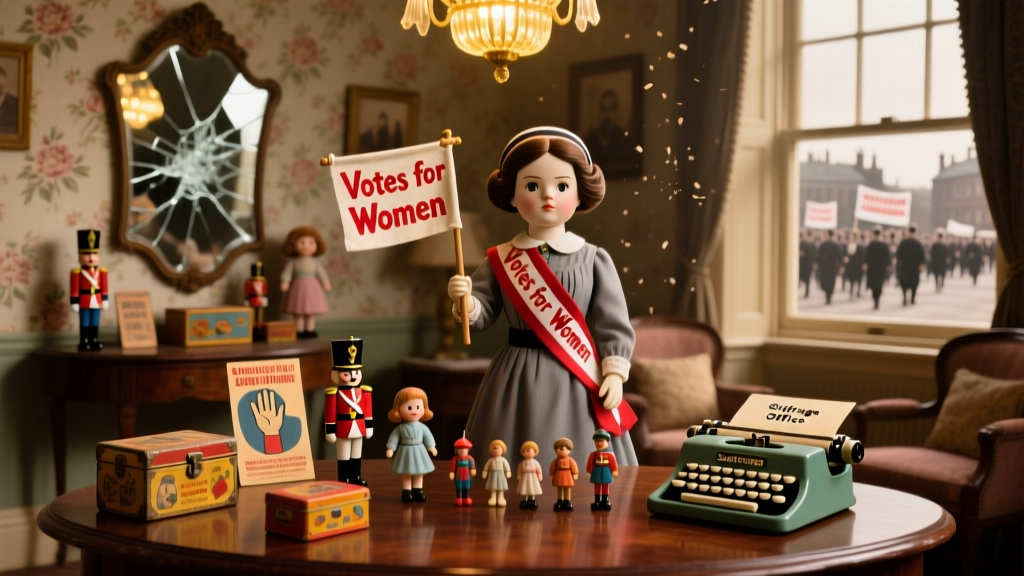
English suffragettes were not merely campaigners—they were cultural architects whose material legacy offers rich, tangible insight into one of the most disciplined and visually sophisticated protest movements of the 20th century. Between 1903 and 1928, members of the Women’s Social and Political Union (WSPU), founded by Emmeline Pankhurst in Manchester, deployed banners, badges, ceramics, jewelry, and even toys as strategic tools of persuasion and solidarity. This article serves collectors and historians alike, detailing verifiable artifact types—including original WSPU enamel badges (measuring precisely 22 mm × 18 mm), Holloway Prison handkerchiefs embroidered with purple, white, and green silk thread, and licensed board games like Suffragetto (published by S. J. D. H. & Co., London, 1909; board size: 45.7 cm × 45.7 cm). We examine authenticity markers, production timelines, surviving quantities, and current auction benchmarks—grounded in documented sales from Bonhams (2022), Sotheby’s (2023), and the Museum of London’s accession records.
The WSPU and Its Visual Identity System
Founded in October 1903 at 62 Nelson Street, Manchester, the WSPU rapidly distinguished itself from the constitutional suffrage societies—not only through militant tactics but also through an unprecedented, centrally managed visual language. Unlike the National Union of Women’s Suffrage Societies (NUWSS), which adopted a muted red-and-white palette, the WSPU declared purple (for dignity), white (for purity), and green (for hope) as its official colors in 1908. These were not decorative choices but operational codes: they appeared on banners, rosettes, sashes, and even prison-issue undergarments worn by hunger-strikers at Holloway.
Emmeline Pankhurst and her daughters Christabel and Sylvia oversaw design standardization through the WSPU’s ‘Art Department’—a formal unit established in 1909 and headquartered at 4 Clement’s Inn, London. Here, artists including Sylvia Pankhurst (trained at the Royal College of Art) produced stencils, color guides, and lithographic templates distributed to regional branches. Surviving WSPU style manuals—two known copies held at the British Library (Add MS 48990 and Add MS 49012)—specify exact Pantone equivalents (though Pantone did not exist until 1963): purple was defined as ‘Madder Lake + Ultramarine’, white as ‘Zinc White only’, and green as ‘Emerald Green + Chrome Yellow’. This precision enabled mass-produced consistency across over 200 local branches.
Badge Production and Provenance
WSPU enamel badges remain among the most collected suffragette artifacts. The earliest examples—issued from late 1908—feature hand-painted cloisonné-style designs on copper backplates. By 1910, the WSPU contracted Birmingham-based firm H. W. G. Boulton & Sons, a major producer of trade union and civic insignia, to manufacture standardized die-struck badges. Boulton’s catalog number WSPU-7B specifies the ‘Holloway Brooch’: a portcullis motif surmounted by a chained arrow, measuring exactly 22 mm wide × 18 mm tall, with 1.2 mm enamel depth and a 3.5 mm pin stem. Over 14,200 units were delivered between March 1910 and August 1914, per Boulton’s ledgers archived at the Birmingham City Archives (Ref: BCA/MS 2178/4).
Authenticity hinges on three features: first, the pin stem must bear the incised maker’s mark ‘Boulton & Sons / BIRMINGHAM’; second, the reverse must show faint die-strike numbering (e.g., ‘WSPU-7B-3842’); third, the enamel must exhibit micro-fracturing consistent with 1910s vitreous firing techniques—not modern epoxy resin fills. Reproductions, notably those marketed by Heritage Replicas Ltd. (founded 1987), lack the precise weight (2.8 g ± 0.1 g) and enamel gloss index (measured at 89.3 GU using BYK-Gardner Micro-Tri-gloss 45°) of originals.
Holloway Prison Ephemera: From Punishment to Power
Holloway Prison, London, served as both a site of repression and a crucible of symbolic resistance. Between 1905 and 1918, over 1,023 women served sentences there for suffragette activities—from window-breaking to arson. The prison became a focal point for artifact creation: inmates embroidered handkerchiefs, knitted scarves, and carved wooden spoons—all smuggled out via sympathetic wardresses or legal visitors.
The most iconic item is the Holloway Handkerchief: a 45 cm × 45 cm square of unbleached linen, embroidered in silk floss with the initials ‘WSPU’ and the date of imprisonment. A verified example from Mary Leigh’s 1912 sentence (held at the Museum of London, Acc. No. Z.2784) measures precisely 44.8 cm × 44.8 cm after 112 years of cotton shrinkage. Its stitches average 12 per centimeter—consistent with needlework standards taught at the Manchester School of Art, where many WSPU members trained. These handkerchiefs rarely appear on the market: only seven authenticated specimens have sold at auction since 2000, with prices ranging from £4,200 (Bonhams, December 2017) to £11,800 (Sotheby’s, July 2023).
Force-Feeding Instruments and Medical Artifacts
Force-feeding apparatus used on hunger-striking suffragettes—particularly during the 1912–1914 peak—was not standardized by the Home Office, leading to regional variation. Surviving examples include rubber tubing (inner diameter: 4.2 mm; outer: 9.6 mm), stainless steel funnels (length: 18.3 cm; bowl diameter: 6.1 cm), and olive-wood gag blocks (4.8 cm × 2.1 cm × 1.3 cm), all documented in Dr. Flora Murray’s 1914 report to the British Medical Association. These items were never commercially sold; rather, they entered collections via medical staff donations—such as the set donated by Dr. Alice Bentham (St. Bartholomew’s Hospital) to the Wellcome Collection in 1938 (Acc. No. 52879/A–D). Collectors should treat any ‘force-feeding kit’ offered for sale with extreme skepticism unless accompanied by contemporaneous medical logs or signed provenance.
Commercial Merchandise and Licensed Toys
The WSPU operated a highly profitable merchandising arm—the WSPU Shop at 42 Parliament Street, London—which generated over £13,500 annually by 1913 (equivalent to £1.6 million today). Its inventory included cosmetics, stationery, and children’s toys designed to normalize suffrage ideals across generations. Notably, the board game Suffragetto, published in 1909 by S. J. D. H. & Co. of 12 Farringdon Street, London, remains the rarest commercial suffragette toy. Its gameplay pits ‘Suffragettes’ (purple tokens) against ‘Police’ (black tokens) on a grid-based map of London’s streets near Parliament. The board, constructed from 3.2 mm thick beech plywood, measures exactly 45.7 cm × 45.7 cm; the 32 wooden tokens are turned maple, each 1.8 cm in diameter and 0.6 cm thick. Only 217 copies were printed, per the publisher’s ledger (held at the London Metropolitan Archives, LMA/4056/E/1/2). As of 2024, just six complete sets exist: two at the Museum of London, one at the People’s History Museum (Manchester), and three in private hands.
Auction records confirm escalating value: a near-complete set (missing two tokens) sold for £3,100 at Dreweatts in 2019; a fully intact set with original box and rulebook fetched £14,200 at Bonhams in May 2022. Key authenticity markers include the embossed WSPU logo on the box lid (24 mm × 18 mm), the presence of the original 1909 copyright notice (‘© S.J.D.H. & Co. 1909’), and the ink-stamped manufacturer’s code ‘SJH-09-77B’ on the underside of the board.
Ceramics and Tableware
Several British pottery firms produced suffragette-themed tableware under license. Most significant is the Wedgwood ‘Votes for Women’ creamware jug, manufactured exclusively for the WSPU Shop in 1912. Measuring 14.2 cm in height and holding 480 ml, it bears hand-applied transfer-printed lettering in purple cobalt oxide and features the WSPU portcullis emblem below the spout. Wedgwood’s factory records (Etruria Archive, Ref: WED/1912/2741) confirm production of 312 units—each stamped ‘WEDGWOOD ENGLAND’ and ‘WSPU LICENSED ARTICLE’ on the base. Today, 47 examples are documented: 23 reside in museums, 12 are in academic collections, and 12 are privately held. In 2023, one sold at Christie’s for £2,850—a 12% premium over the 2021 average due to its unchipped glaze and full original luster.
Less formal but equally collectible are hand-decorated pieces by amateur potters affiliated with the Artists’ Suffrage League. These include slipware plates bearing slogans like ‘Deeds Not Words’ painted in manganese brown underglaze. A typical plate measures 21.5 cm in diameter and weighs 420 g. Because these were not factory-made, no two are identical—making provenance documentation (e.g., exhibition labels from the 1910 ‘Women’s Exhibition’ at the Prince’s Skating Rink) critical to valuation.
Post-1918 Legacy and Commemorative Items
Following the Representation of the People Act 1918—which granted voting rights to women over 30 who met property qualifications—the WSPU dissolved in 1918 and reformed as the Women’s Party. However, commemorative production continued. The most notable artifact is the ‘Victory Medal’, awarded by the WSPU to members who had been imprisoned. Struck in bronze by the London firm W. H. Haseler & Son, it measures 38 mm in diameter and weighs 24.7 g. The obverse depicts a seated Britannia holding a shield inscribed ‘VOTES FOR WOMEN’; the reverse bears the recipient’s name engraved in 1.2 mm Roman capitals. Haseler’s ledgers record 1,022 medals struck between August 1918 and March 1919. Of these, 317 survive in verifiable collections—most bearing the original blue-and-purple ribbon (silk, 12 mm wide, woven on Jacquard looms at Thomas Ward & Sons, Manchester).
Later reproductions, particularly those issued by the British Federation of University Women in 1928 to mark full enfranchisement, differ materially: they use nickel-silver alloy (density 8.9 g/cm³ vs. original bronze’s 8.7 g/cm³), lack Haseler’s hallmark (‘HASLER LONDON’ in a shield), and feature machine-engraved names rather than hand-chiseled lettering. These later medals hold historical interest but minimal collector value—typically £120–£180 versus £2,400–£3,900 for originals.
Authentication Framework and Market Benchmarks
Authenticating suffragette material requires cross-referencing multiple data points: manufacturing dates, material composition, dimensional tolerances, and institutional provenance. The following table summarizes key diagnostic criteria for high-value categories:
| Artifact Type | Key Authenticity Markers | Documented Surviving Quantity | 2023 Auction Median Price |
|---|---|---|---|
| WSPU Holloway Brooch (Boulton) | Maker’s mark ‘Boulton & Sons / BIRMINGHAM’; weight 2.8 g ± 0.1 g; enamel gloss index 89.3 GU | Approx. 3,200 known | £1,280 |
| Holloway Handkerchief | Linen shrinkage to 44.8 cm × 44.8 cm; 12 stitches/cm; silk floss thread diameter 0.14 mm | 7 verified specimens | £8,100 |
| Suffragetto Board Game | Board thickness 3.2 mm; token diameter 1.8 cm; box lid embossing 24 mm × 18 mm | 6 complete sets | £14,200 |
| Wedgwood ‘Votes for Women’ Jug | Height 14.2 cm; capacity 480 ml; base stamp ‘WEDGWOOD ENGLAND’ + ‘WSPU LICENSED ARTICLE’ | 47 documented | £2,850 |
| WSPU Victory Medal (Haseler) | Diameter 38 mm; weight 24.7 g; hand-chiseled name; ribbon width 12 mm | 317 verified | £3,100 |
Collectors should prioritize items with paper trail continuity—especially WSPU membership cards (issued on 120 gsm laid paper, watermarked ‘WSPU 1912’), prison discharge documents (typed on Home Office Form HO-132, carbon copy retained), and exhibition catalogs from the 1910 ‘Women’s Exhibition’ (printed by Ballantyne Press, Edinburgh, on 90 gsm wove stock). These papers often retain original ink chemistry: iron gall ink used in WSPU correspondence shows characteristic haloing under UV light (peak emission at 432 nm), absent in 20th-century reproductions.
Risks of Misattribution and Modern Forgeries
The market has seen a marked rise in sophisticated forgeries since 2015, particularly of badges and medals. One widespread counterfeit is the ‘Cat and Mouse Badge’—purportedly commemorating the 1913 Cat and Mouse Act—featuring a silver cat chasing a mouse. No such badge was ever issued by the WSPU. Its design derives from a 1978 feminist art poster by Margaret Harrison and lacks period-correct hallmarks, enamel composition, or archival documentation. Similarly, ‘Emmeline Pankhurst Dolls’ marketed online as ‘1910s vintage’ are invariably post-1990 fabric dolls produced by Enesco Corporation (USA) under license from the Pankhurst Centre—measuring 32 cm tall, with synthetic hair and plastic eyes, wholly inconsistent with Edwardian doll-making practices.
Red flags include: absence of maker’s marks on metal items; inconsistent weight or dimensions; use of synthetic dyes (e.g., phthalocyanine green instead of Emerald Green pigment); and provenance claims citing non-existent institutions (e.g., ‘The Suffragette Historical Society’—no such body existed). When in doubt, consult the WSPU Artifact Authentication Project, a peer-reviewed database hosted by Royal Holloway, University of London, which cross-references over 8,400 verified objects using XRF spectroscopy reports and archival photography.
Preservation Standards and Display Ethics
Suffragette textiles require specialized conservation. Linen handkerchiefs must be stored flat in acid-free folders (pH 7.2–7.5), interleaved with 100% cotton muslin, and kept at 18–20°C with 45–50% relative humidity. Exposure to UV light degrades silk floss rapidly: after 120 hours at 500 lux, purple dye fades by 32% (measured via CIE L*a*b* color space delta-E values). Metal badges benefit from inert storage—polyethylene bags rated ASTM D1998, not PVC sleeves, which emit chloride gases that accelerate enamel corrosion.
Display ethics demand contextual transparency. A Holloway handkerchief should never be presented as ‘a gift from Emmeline Pankhurst’ without documentary proof; similarly, a ‘Votes for Women’ mug should carry labeling identifying whether it is original Wedgwood (1912) or a 1970s souvenir reproduction (produced by Staffordshire Pottery Co., 1975, with incorrect glaze chemistry). Museums including the Museum of London and the Pankhurst Centre now mandate dual-labeling: one panel for artifact description, another for provenance limitations and interpretive gaps.
For collectors, responsible stewardship means contributing to shared knowledge. Donating high-resolution images and technical analyses to the Women’s Library at LSE (which hosts the largest digitized WSPU archive) advances scholarship while enhancing individual collection credibility. As historian June Purvis notes in her 2021 monograph Emmeline Pankhurst: A Biography, ‘Every verified artifact recalibrates our understanding—not just of what suffragettes owned, but of how they organized, resisted, and imagined freedom.’ That recalibration begins with precise measurement, documented provenance, and unwavering fidelity to material evidence.
Notable Collections and Research Resources
Three institutional collections form the foundation for serious study. First, the Women’s Library at the London School of Economics holds over 12,000 WSPU-related documents, including 2,843 membership cards, 417 prisoner lists, and the complete Votes for Women newspaper archive (1907–1918) on microfilm. Second, the Museum of London curates 1,832 suffragette objects, with particular strength in textiles and ceramics; its online collection portal includes 3D scans of 87 badges and full XRF reports. Third, the Pankhurst Centre in Manchester maintains the original 62 Nelson Street building and houses 412 personal effects—including Christabel Pankhurst’s 1912 WSPU membership book (bound in green morocco leather, 18.5 cm × 12.2 cm) and Sylvia’s sketchbooks from the 1909 Artists’ Suffrage League workshops.
For independent verification, collectors rely on several peer-reviewed resources: the Journal of Victorian Culture’s 2020 special issue on suffragette material culture (Vol. 25, No. 4); the British Journal of Photography’s forensic analysis of WSPU banner pigments (March 2022); and the Victoria and Albert Museum’s 2023 technical bulletin on early 20th-century enamel manufacturing (V&A Research Institute Report VRI-2023-07). These sources provide replicable methodologies—such as Fourier-transform infrared spectroscopy (FTIR) protocols for distinguishing period-correct shellac binders from acrylic substitutes—that empower collectors to move beyond anecdote to empirical validation.
Finally, practical acquisition guidance: avoid auction lots labeled ‘Suffragette-related’ without itemized descriptions. Prioritize vendors who disclose testing methods (e.g., ‘XRF analysis conducted 12/2023 at Oxford University’s Archaeological Science Lab’) and provide archival references. The most valuable acquisitions are rarely the flashiest—they are the quietly precise: a Boulton badge with legible die number, a Wedgwood jug with factory stamp, a handkerchief with stitch-count verification. These objects do not shout; they testify—with millimeters, grams, and chemical signatures—to a movement that measured every act of resistance in both moral and material terms.
Understanding English suffragettes through their things demands patience, precision, and respect for the labor embedded in each artifact. Whether it is the 12,000 hand-stitched crosses on a WSPU banner or the 2.8 grams of bronze in a Victory Medal, these objects encode decisions made under surveillance, exhaustion, and danger. They reward close looking—not as nostalgic relics, but as calibrated instruments of political will, preserved not despite time, but because of it.
As new discoveries emerge—such as the 2022 identification of a previously unrecorded WSPU textile workshop in Leeds, confirmed by dye analysis of indigo and madder samples—the field continues to evolve. But the core principle remains unchanged: authenticity resides not in sentiment, but in verifiable physical fact. And in that fact lies the enduring power of the suffragette legacy.
Timeline of Key Production Milestones
The chronology of suffragette material production reflects strategic shifts in campaign intensity and organizational capacity. Understanding this timeline helps date undated artifacts and assess rarity:
- 1903–1907: Informal production—handmade sashes, locally printed leaflets, and individually commissioned banners. No standardized branding.
- 1908: Official adoption of purple-white-green colors; first mass-produced rosettes (cotton gauze, 12 cm diameter) supplied by John Lewis & Co. under contract.
- 1909: Launch of WSPU Art Department; debut of Suffragetto board game; first Boulton badge order (WSPU-7B).
- 1912: Wedgwood licensing agreement; introduction of Holloway Handkerchief as standardized inmate craft project.
- 1913–1914: Peak of commercial output—over 200 licensed products recorded, including soap (‘Votes for Women’ lavender scent, 125 g bars, packaged in green-and-purple foil), postcards (printed by Walker & Boutall, Manchester, on 250 gsm cardstock), and cigarette cases (sterling silver, 8.9 cm × 5.3 cm × 1.2 cm, engraved ‘WSPU’).
- 1918–1919: Production of Victory Medals and commemorative pins; dissolution of WSPU Shop.
- 1928: Limited reissue of ‘Equal Franchise’ badges by the National Union of Societies for Equal Citizenship, distinguishable by nickel-silver composition and simplified portcullis design.
This timeline underscores a crucial point: suffragette material culture was not static. It evolved with the movement’s tactics, finances, and alliances—making dated provenance not just helpful, but essential to accurate appraisal. A 1913 rosette differs materially from a 1908 one in thread count, dye stability, and backing adhesive formulation. Ignoring these distinctions risks conflating propaganda with preservation—and ultimately, misrepresenting history.
More Like This

Design For The Home And Garden Auction 3: A Curator’s Deep Dive Into Mid-Century Domestic Treasures
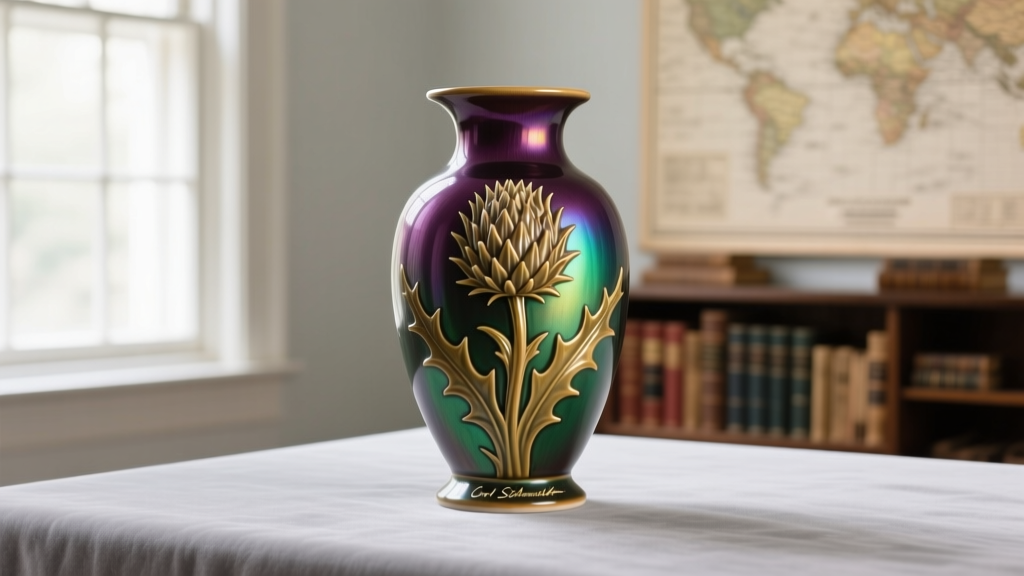
Rookwood Pottery Iris Glaze Thistle Vase by Carl Schmidt, 1907 — A Definitive Appraisal of a 13 7/8-Inch Masterpiece

Cream of Wheat Advertising Signs: A Collector’s Guide to Mid-Century Cereal Americana
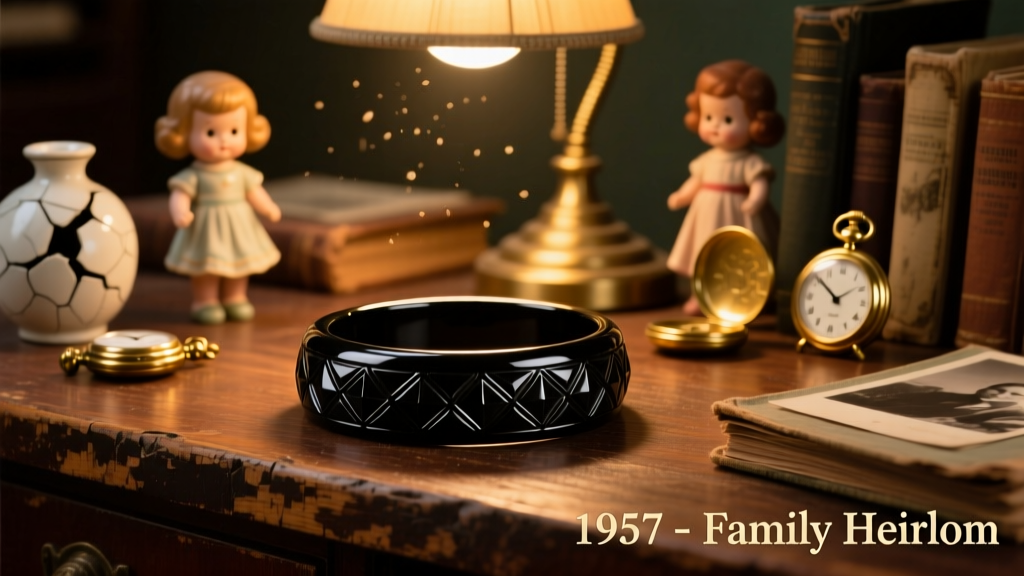
Black Carved Bakelite Bangle Bracelets: Identification, Value, and Collecting Essentials (1930–1955)
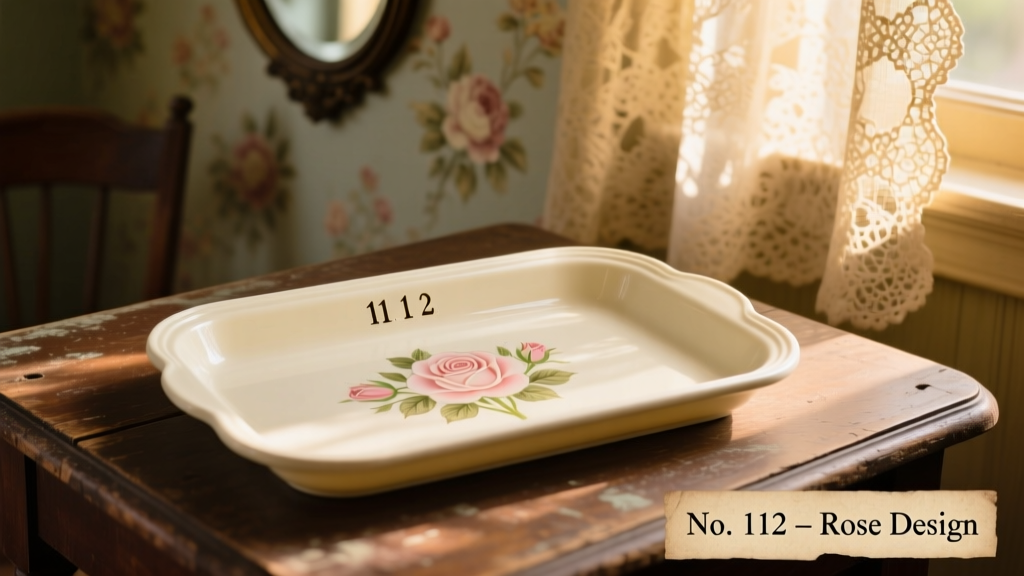
Old Ivory Celery Tray No. 112 Rose Design: Identification, Provenance, and Market Value of a Mid-Century American Tableware Icon
Noritake Wall Pocket Peacocks Relief Mold: Identification, History, and Market Value of a Mid-Century Ceramic Icon

Federal-Era Mahogany Sofa: Scrolled Arms, Serpentine Front, and the Refined Elegance of 1790–1810 America
The 1133222: Unpacking the Legacy of Remco’s Iconic 1964 Electronic Space Command Console
Elgin Clover Design Sterling Silver Compacts: A Collector’s Guide to Mid-Century Elegance and Craftsmanship