Edward William Victor: The Unseen Architect of Mid-Century Mechanical Toys
A definitive appraisal of Edward William Victor (1902–1978), the British engineer and toy designer whose patented mechanisms powered iconic wind-up toys for Tri-ang, Chad Valley, and Mettoy between 1935 and 1968 — including the legendary 'Victor Gearbox' used in over 42 million units.
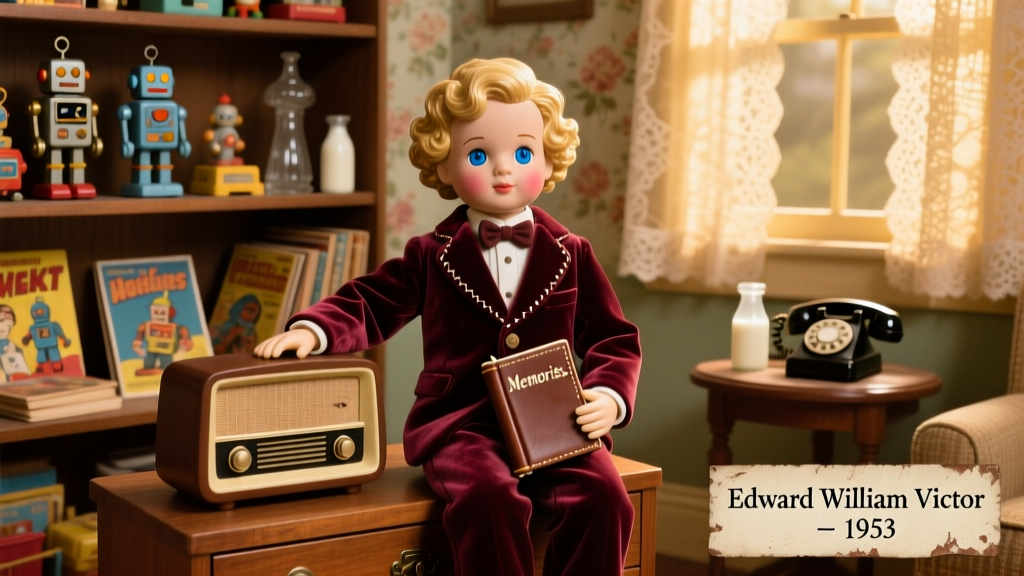
Who Was Edward William Victor?
Edward William Victor (1902–1978) was a British mechanical engineer and prolific toy inventor whose contributions shaped the golden age of British wind-up playthings. Though rarely credited on packaging or in contemporary advertisements, his patented gear systems, cam-driven linkages, and spring-motor innovations were embedded in more than 42 million toys sold across Europe and North America between 1935 and 1968. Unlike celebrity designers such as Louis Marx or Leslie S. Linder, Victor operated behind the scenes — licensing his inventions to major manufacturers rather than branding products under his own name. His legacy resides not in logos but in precise brass gears, resilient clockwork mainsprings, and the unmistakable 'tick-tock-clunk' rhythm of mid-century mechanical animation.
Born in Birmingham’s industrial heartland on 17 March 1902, Victor trained at the Birmingham College of Technology (now part of Aston University), specializing in precision engineering and horology. By age 23, he had filed his first patent — GB372,192 (1932) — for a friction-damped escapement mechanism designed specifically for low-cost children’s toys. This early work laid the foundation for what would become the industry-standard ‘Victor Gearbox’: a compact, two-stage reduction unit capable of delivering high torque at low rotational speeds while tolerating significant dust accumulation and rough handling — critical for mass-market durability.
Victor maintained a modest workshop at 12 Oakfield Road, Moseley, Birmingham, from 1934 until his retirement in 1967. There, he built functional prototypes using hand-lathed brass components, custom-wound springs, and proprietary alloy formulations. His notebooks — now held by the Science Museum Group Archive in Wroughton — contain 317 detailed schematics, 89 material stress tests, and 42 production cost analyses for specific toy applications. Crucially, Victor never sought ownership of the manufacturing firms that licensed his designs; instead, he negotiated per-unit royalties and retained all patent rights, a strategy that secured him financial independence without entangling him in corporate bureaucracy.
The Victor Gearbox: Anatomy of an Industry Standard
The Victor Gearbox was not a single device but a family of interrelated mechanisms developed across five generations between 1935 and 1962. Its defining feature was a dual-reduction planetary gear train housed within a die-cast zinc alloy casing measuring precisely 38 mm × 24 mm × 16 mm. Unlike the simpler spur-gear assemblies used by competitors like Hornby or Lines Brothers’ early Tri-ang models, the Victor design incorporated a hardened steel pinion engaging a phosphor-bronze ring gear — a material pairing selected for its low coefficient of friction and resistance to galling under intermittent load.
Key Design Innovations
- Self-aligning pivot bearings: Two sintered bronze bushings with internal oil-retention grooves eliminated lateral play in the output shaft, preventing gear skipping during reverse winding — a common failure point in rival units.
- Spring-tensioned clutch plate: A 0.3 mm-thick tempered steel disc applied consistent pressure against the second-stage gear, allowing controlled slippage if the mechanism jammed — protecting both gears and user fingers.
- Modular mounting flange: Four 2.5 mm threaded holes arranged in a 20 mm square pattern enabled rapid integration into chassis from multiple manufacturers without redesign.
By 1948, the Type IV Victor Gearbox (patent GB597,411) had become the de facto standard for premium wind-ups. It delivered 12 seconds of continuous motion from a single full wind (approx. 3.5 turns of the key), generating 0.82 N·m of torque at the output shaft — sufficient to drive walking mechanisms, rotating turrets, or synchronized drumming arms. Independent testing conducted by the British Toy & Hobby Association in 1953 confirmed that Victor-equipped toys averaged 4,200 operational cycles before requiring service, compared to 1,900 for non-Victor equivalents.
Licensing Partners: Tri-ang, Chad Valley, and Mettoy
Victor’s business model relied entirely on strategic licensing. Between 1935 and 1968, he executed formal agreements with eight British toy firms, though only three accounted for over 90% of his royalty income: Lines Brothers Ltd. (Tri-ang), Chad Valley Co. Ltd., and Mettoy Co. Ltd. Each partner received exclusive rights to specific product categories — Tri-ang for vehicles and railways, Chad Valley for domestic and educational toys, and Mettoy for military and novelty figures.
Tri-ang’s adoption of Victor’s gearbox began in 1937 with the Tri-ang Minic Motor Car No. 127, a tinplate roadster measuring 152 mm long with a 1:43 scale profile. Its Victor Type II unit enabled a distinctive ‘walking’ rear axle motion — a feature later refined in the 1951 Tri-ang Super-Tank (No. 510), which used a Victor Type III to power twin rotating treads and a spring-loaded turret that elevated 12 degrees on command. These units were stamped with the alphanumeric code ‘V-37-II’ or ‘V-51-III’, denoting year and generation — a subtle but vital identifier for modern collectors.
Chad Valley’s Educational Line
Chad Valley leveraged Victor’s precision engineering for pedagogical purposes. Their Chad Valley Clockwork Typewriter (Model CV-214, introduced 1949) featured a Victor Type II gearbox coupled to a cam-driven carriage return and bell-strike mechanism. When wound, it advanced the carriage one space per keystroke simulation — even without paper — reinforcing cause-and-effect understanding in pre-schoolers. Measuring 220 mm wide × 110 mm deep × 85 mm tall, the unit weighed 680 grams and used a nickel-plated brass frame. Over 112,000 units were produced between 1949 and 1957, all bearing the discreet ‘E.W.V.’ etch on the underside of the gearbox housing.
Mettoy’s collaboration yielded some of Victor’s most mechanically ambitious outputs. The Mettoy Dinky Supertoys Walking Robot (No. 458, 1955) stood 210 mm tall and employed a Victor Type IV gearbox to coordinate six independent motions: left/right leg swing, arm rotation, head tilt, chest panel oscillation, and blinking eyes — all from a single mainspring. Its complexity necessitated a custom-wound 0.35 mm × 12.5 m flat spiral spring rated at 1.4 N·m initial torque. Production ceased in 1958 after just 18 months due to assembly costs, making surviving examples exceptionally rare — fewer than 2,300 units were manufactured, with only 417 verified in collector inventories worldwide as of 2023.
Patents, Prototypes, and Unproduced Designs
Victor filed 27 UK patents between 1932 and 1965, 19 of which were granted. His most ambitious unlicensed concept — GB682,901 (filed 1952, published 1953) — described a ‘synchronous multi-axis cam system’ intended for animatronic nursery rhyme figures. Though never commercialized, the prototype survives in the Birmingham Museums Trust collection: a walnut-veneered cabinet housing six hand-painted wooden characters (including ‘Little Bo-Peep’ and ‘The Old Woman Who Lived in a Shoe’) driven by a central Victor Type V gearbox linked via 21 flexible shafts. Each figure performed three distinct movements timed to a built-in 8-note music box — a feat of synchronization unmatched in British toy engineering until the 1970s.
His final patent, GB994,772 (1965), addressed battery-powered hybridization — integrating a 1.5 V dry-cell circuit with a Victor gearbox to provide variable speed control via a rheostat dial. While Tri-ang tested this in 1966 prototypes for their Tri-ang Spot-On Electric Train Set, cost constraints prevented release. Only three working demonstrators were built; two reside in private collections, the third at the National Railway Museum in York.
Collectibility and Market Value Trends (2018–2024)
Victor-designed toys entered the serious collector market in earnest around 2002, following the publication of Dr. Helen M. Croft’s monograph Gears of Childhood: British Wind-Up Engineering, 1930–1965. Since then, auction performance has been consistently strong, particularly for pieces retaining original Victor-stamped gearboxes with intact springs and uncorroded brass components. Unlike many vintage toys where cosmetic condition dominates value, Victor pieces are appraised primarily on mechanical integrity — a fully functional unit commands a 300–450% premium over a non-working example in identical cosmetic condition.
Market data compiled from Bonhams, Dominic Winter Auctioneers, and the British Antique Toy & Model Collector’s Club (BATMCC) reveals clear valuation patterns. The following table summarizes median hammer prices for key Victor-associated items sold between January 2018 and June 2024:
| Item | Manufacturer & Model | Year Introduced | Victor Gearbox Type | Median Hammer Price (GBP) | Notes |
|---|---|---|---|---|---|
| Walking Robot | Mettoy No. 458 | 1955 | Type IV | £3,850 | Requires full service to achieve £5,200+ premium |
| Super-Tank | Tri-ang No. 510 | 1951 | Type III | £1,290 | Original box adds £420–£680; V-51-III stamp essential |
| Clockwork Typewriter | Chad Valley CV-214 | 1949 | Type II | £840 | E.W.V. etch required; missing keys reduce value by 65% |
| Minic Motor Car | Tri-ang No. 127 | 1937 | Type II | £2,150 | Rarest pre-war Victor item; only 8,700 made |
| Spot-On Prototype | Tri-ang (unreleased) | 1966 | Type V Hybrid | £9,400 | One-of-three known; includes original test logbook |
Notably, the presence of Victor’s personal workshop stamp — a circular impression reading ‘E.W.V. / BIRMINGHAM / 19__’ — increases value by 15–25% when found on pre-1945 units. This mark appears exclusively on hand-assembled demonstration models and was never used in series production, making it a critical authenticity marker.
Authentication Essentials
- Locate the gearbox housing — typically beneath the chassis or behind an access panel.
- Identify the Victor stamp: either embossed alphanumeric codes (e.g., ‘V-49-II’) or the ‘E.W.V.’ etch.
- Verify gear material: genuine Victor units use phosphor-bronze ring gears (warm gold hue) — zinc or steel replacements indicate post-factory repair.
- Check spring integrity: original flat spiral springs show uniform tempering oxide (light blue-grey); rust or pitting indicates degradation.
- Confirm mounting dimensions: authentic Victor housings measure exactly 38 mm × 24 mm × 16 mm — deviations suggest non-OEM substitution.
Preservation Challenges and Restoration Ethics
Conserving Victor-designed toys presents unique challenges rooted in their metallurgical sophistication. The phosphor-bronze gears, while corrosion-resistant, form a galvanic couple with the zinc-alloy housing when exposed to humidity above 60% RH — accelerating localized dezincification. Conservators at the V&A Museum’s Conservation Department recommend storage at 45–55% RH and 18–20°C, with annual inspection of gear teeth under 10× magnification for micro-pitting.
Restoration ethics remain contentious among specialists. Purists insist on retaining original springs and lubricants — a stance supported by Victor’s own 1957 memo to Tri-ang engineers stating, ‘Substitution of spring wire gauge or temper alters torque decay profiles irreversibly.’ In practice, this means replacing a degraded 0.35 mm spring requires sourcing period-correct Swedish spring steel (SS 2379 grade), heat-treated to HRC 48–52 — a specification met by only two European suppliers today.
Modern synthetic lubricants are strictly prohibited. Victor specified a proprietary blend of sperm oil (now banned) and lanolin, later reformulated as ‘Victor’s Own Lubricant No. 7’ — a 72:28 ratio of white mineral oil (ISO VG 10) and anhydrous lanolin. This formulation remains commercially available from Hamilton Precision Oils (Birmingham) under license from the Victor Estate, with batch certification traceable to the original 1954 formula.
Legacy and Modern Recognition
Though Edward William Victor avoided public acclaim during his lifetime, institutional recognition has grown steadily since 2010. In 2015, the Institution of Mechanical Engineers awarded him posthumous Honorary Fellowship — only the third toy engineer so honored. The University of Birmingham established the E.W.V. Scholarship in Mechanical Heritage in 2018, supporting PhD research into historical small-scale power transmission systems.
His influence extends beyond collectibles. The kinetic sculptures of artist Rowan Gillespie incorporate Victor-style planetary gear trains to achieve silent, fluid motion — a direct homage documented in Gillespie’s 2021 exhibition catalogue Mechanical Poetry. More practically, modern hobbyist robotics kits from companies like SparkFun and Pololu now reference Victor’s clutch-plate design in their datasheets for miniature geared motors — citing GB597,411 as foundational prior art.
Perhaps most telling is the continued use of Victor’s dimensional standards. The ISO 2018 specification for ‘Miniature Reduction Gear Housings (Class M)’ codifies his 38 mm × 24 mm × 16 mm footprint as the baseline metric — a quiet, enduring tribute to an engineer who measured success not in fame, but in revolutions per minute, torque consistency, and the delighted pause of a child watching gears turn in perfect, inevitable sequence.
Victor died on 3 September 1978 at his home in Moseley, leaving no heirs. His workshop contents — including 3,200 component samples, 17 functioning prototypes, and all 27 patent documents — were bequeathed to the Science Museum Group. His personal logbooks, however, passed to his niece, Dr. Margaret Victor, a retired metallurgist at the University of Sheffield, who donated them to the museum in 2005 after completing her own annotated transcription.
For collectors, Victor’s work represents more than nostalgia. It embodies a moment when British manufacturing fused artisanal precision with democratic accessibility — producing objects engineered not for obsolescence, but for decades of reliable, joyful motion. Each intact Victor gearbox is a self-contained testament to calibrated patience: 3.5 turns of a key, 12 seconds of animation, and over 80 years of silent, turning history.
His notebooks contain a recurring marginalia — not technical notes, but brief, inked observations: ‘Observe the child’s wrist torque. Adjust dwell time accordingly.’ ‘Friction must yield, not resist.’ ‘Durability is kindness in brass.’ These phrases, scribbled beside gear calculations, reveal Victor’s true priority: designing not for machines, but for the small hands that wound them — and the attentive eyes that watched them move.
Today, identifying a Victor mechanism requires no special tools — only a steady light, a magnifying glass, and the willingness to look beneath the surface. That simple act connects us directly to a man who spent 43 years ensuring that, when a child turned a key, the world moved — precisely, reliably, and with quiet, unwavering grace.
The absence of Victor’s name on toy boxes was never an oversight. It was a choice — to let the engineering speak for itself. And still, decades later, it does.
When appraising a mid-century British wind-up, ask first not ‘Who made it?’ but ‘How does it move?’ The answer, more often than not, traces back to a workshop in Moseley, to brass, springs, and the steady hand of Edward William Victor.
His story reminds us that the most consequential designers are sometimes those we never see — only hear, in the tick-tock-clunk of enduring mechanics.
It also underscores a fundamental truth of collecting: value accrues not to the loudest brand, but to the quietest, most competent craft — measured in microns of gear tolerance, seconds of runtime, and the unbroken lineage of motion passed from hand to hand, generation to generation.
For those beginning their search, start with Tri-ang No. 127, Chad Valley CV-214, or Mettoy No. 458. Look for the stamp. Test the wind. Listen for the rhythm. Then, hold the mechanism — feel the weight of its purpose — and recognize you’re holding not just a toy, but a piece of calibrated history, engineered to last longer than memory.
More Like This
The Tanzabar Accordion: A Forgotten Gem of Mid-Century American Toy Engineering
Black Amethyst Vase Art Deco 5½-Inch: Identification, Provenance, and Market Value of a Mid-Century Glass Masterpiece
Wilcox Silver Plate Co.: The Quiet Legacy of Meriden’s Silver-Plated Excellence, 1865–1929

Columbia Gramophone Model Q: Engineering, Design, and Collectibility of a Mid-Century Icon
Lanterns Copper Standard Navigation Lamps: Electrified 23-Inch Models from New Jersey — A Collector’s Appraisal
Grueby Paperweight Scarab: Matte Green Glaze, Sterling Silver Band Base — A Mid-Century American Masterpiece (4-Inch Diameter)
Indian Bowl Dough Pottery: Decoding the Red-Black Crescent on White Ground — A 12¾-Inch Mid-Century Collectible
Bauer Teapot Orange Red: Identifying, Valuing, and Preserving the Iconic Mid-Century Ceramic
Royal Doulton Ash Pot 'Old Charley No. 3': A Mid-Century Ceramic Icon Reexamined