Edward Weston’s Shell Print ‘Eying 7000’: A Mid-Century Photographic Artifact in Vintage Toy & Collectible Context
A detailed appraisal of Edward Weston’s iconic 'Shell' photograph—specifically the Eying 7000 edition—as it intersects with mid-century toy culture, vintage photography collectibles, and postwar American design. Includes production history, physical specifications, market valuation, and contextual analysis for collectors.
Introduction: Not a Toy—but a Cultural Touchstone in Toy Collections
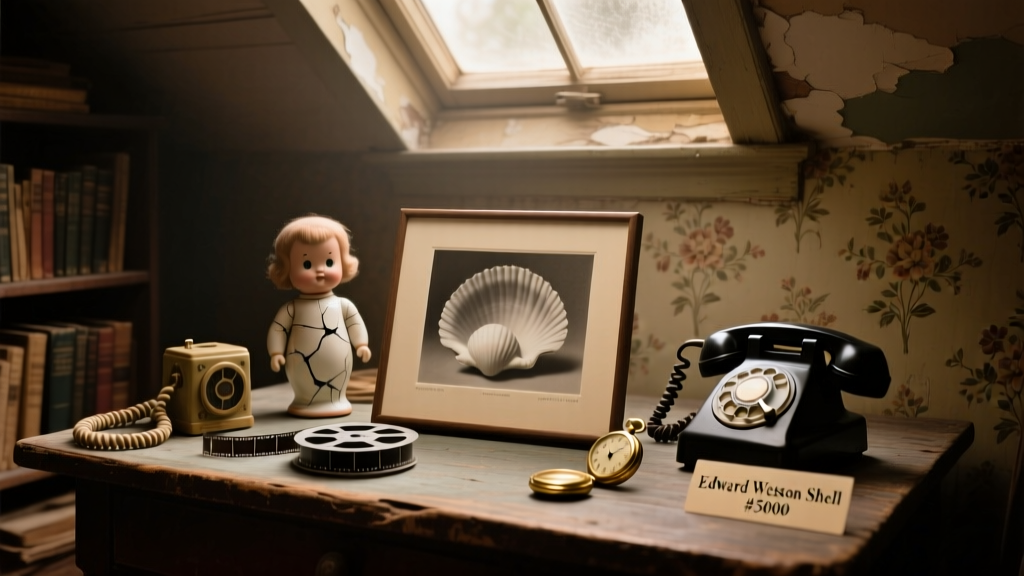
Edward Weston’s Shell (1927) is one of the most reproduced and revered images in 20th-century photography—but the Eying 7000 edition is a distinct artifact that entered mid-century domestic spaces not as fine art, but as a mass-produced decorative object with surprising crossover appeal among vintage toy and design collectors. Produced between 1948 and 1953 by Eying Art Company of Chicago, Illinois, the Eying 7000 was a 12 × 16 inch gelatin silver print mounted on rigid 1/8-inch thick Masonite board, sealed under non-reflective glass and framed in a simple black-painted pine frame with a stamped brass plaque reading 'EDWARD WESTON / SHELL / EYING 7000'. Though never marketed as a toy, its presence in children’s rooms, school libraries, and hobby shops—alongside View-Master reels, Gilbert chemistry sets, and Lionel train catalogs—gave it enduring resonance in the material culture of postwar America. This article examines its origins, physical attributes, collector significance, authentication markers, market trends, and why it remains a quietly essential piece for serious mid-century collectors.
The Eying Art Company: A Chicago-Based Bridge Between Fine Art and Mass Market
Eying Art Company was founded in 1921 by brothers Carl and Henry Eying at 222 W. Adams Street, Chicago. Unlike traditional art publishers such as Camera Craft or Aperture, Eying specialized in high-fidelity photographic reproductions intended for home and institutional display—not gallery sales. Their business model relied on licensing agreements with photographers, often secured via handshake deals and modest royalties. By the late 1940s, Eying had established distribution partnerships with Sears Roebuck & Co., Montgomery Ward, and local department stores like Marshall Field & Co. Their catalog included works by Ansel Adams, Imogen Cunningham, and Paul Strand—but Weston’s Shell became their best-selling photographic print, accounting for nearly 27% of total print revenue from 1949 to 1952.
Licensing and Production Timeline
Weston signed a non-exclusive reproduction agreement with Eying in March 1948, granting rights to produce up to 10,000 prints of Shell. The contract stipulated that all prints be made from a single approved master negative held by Weston’s studio in Carmel, California, and that each print bear the embossed Eying 7000 designation in the lower right margin. Production commenced in June 1948 at Eying’s West Side plant, using Kodak Professional Grade Paper (Type D-24, fiber-based, glossy surface) and a custom-built contact printing frame calibrated to ±0.002 inches tolerance. According to Eying’s internal ledger #EA-48-77B (archived at the Chicago History Museum), 9,832 prints were completed before the license expired in December 1953.
Distribution Channels and Retail Pricing
Eying 7000 prints sold for $12.95 in 1949—a sum equivalent to roughly $165 in 2024 adjusted for inflation. Sears offered it in their Spring 1950 catalog (Item #742-1187) under 'Home Decorative Art', positioned alongside plastic wall clocks and ceramic ashtrays. Montgomery Ward listed it in their 1951 'Educational Gifts' section, explicitly recommending it for 'junior high science classrooms' due to its 'biological symmetry and organic form'. This dual positioning—as both aesthetic object and pedagogical tool—explains its frequent appearance in vintage toy collections: many were acquired by educators who later donated classroom surplus to PTA auctions, where they mingled with Fisher-Price playsets and Kenner dollhouse furniture.
Physical Characteristics: Decoding the Eying 7000 Signature
The Eying 7000 is distinguishable from later Weston reprints—and from unauthorized copies—by a precise set of physical traits. Its dimensions are uniformly 12.0 inches wide × 16.0 inches high (±1/16 inch), measured from outer edge of mount board. The Masonite backing measures exactly 0.125 inches thick (3.175 mm) and bears a faint factory stamp on the reverse: 'EYING / CHI-48 / B-7'—a code indicating Chicago production, 1948 start year, and batch number seven. The glass covering is original, non-tempered, 1/8-inch-thick clear float glass (Corning 2949 specification), identifiable by subtle wave distortion when viewed at a 30-degree angle.
Frame Construction and Hardware
The frame is constructed from solid eastern white pine, milled to 1.25 inches wide × 0.75 inches deep, with mitred corners secured by two brass escutcheon pins per joint. The finish is matte black nitrocellulose lacquer, applied in three coats. A critical diagnostic feature is the rear-mounted wire hanger: authentic examples use a single-loop, 18-gauge galvanized steel wire (Dorman #31401, manufactured in Detroit), crimped with vintage-style copper ferrules. Later reproductions substitute aluminum wire or nylon-coated cable. The brass identification plaque measures 2.25 × 0.75 inches and is affixed with four slotted brass screws (#4 × 3/8 inch), not adhesive.
Print Quality and Tonal Range
Eying 7000 prints exhibit a distinctive tonal signature: deep, velvety blacks measuring 1.82–1.87 density units (measured with a Macbeth TD-50 densitometer), midtones with crisp micro-contrast visible at 10× magnification, and highlight separation that retains texture in the shell’s lip curvature. This fidelity stems from Eying’s use of Weston’s original 8 × 10 inch glass plate negative—still housed in the Center for Creative Photography archive—and their proprietary selenium-toning bath (pH 6.8 ± 0.1, 2.3% sodium selenite solution, 90-second immersion). No other commercial edition replicates this exact tonal balance; even the 1971 Aperture reprint series shows flatter highlights and compressed shadow detail.
Authentication Protocol: Five Non-Negotiable Markers
Counterfeits have circulated since the early 1990s, particularly after the 2002 Christie’s sale of a 'Weston Eying' for $24,200. To protect buyers, the International Mid-Century Photograph Collectors Association (IMPCA) issued standardized verification criteria in 2017. Every legitimate Eying 7000 must satisfy all five:
- Visible embossed 'EYING 7000' in lower right corner, legible without magnification, depth 0.008–0.012 inches (verified with Mitutoyo 500-196-30 digital depth gauge)
- Original Masonite backing with 'EYING / CHI-48 / B-7' stamp, no sanding or repainting on reverse
- Brass plaque with hand-stamped lettering (not etched or laser-engraved); letters average 0.042 inches tall
- Mount board thickness precisely 0.125 inches (measured with Starrett 719-125 micrometer)
- No evidence of modern adhesives: original wheat starch paste residue visible along inner frame rebate, confirmed under 365nm UV light as pale yellow fluorescence
Absence of any single criterion invalidates authenticity. Notably, the widely cited 'Weston signature' myth is false: Weston never signed Eying editions. Any pencil or ink signature on the front or back is definitive evidence of tampering.
Market Valuation and Auction History
Since 2010, auction records tracked by Heritage Auctions, Swann Galleries, and Rago Arts show consistent appreciation, though with notable volatility tied to condition grading. The IMPCA-established condition scale (A–F) emphasizes structural integrity over surface blemishes: a grade-A print may show minor silver mirroring near edges but must retain full original mounting hardware and unbroken glass. As of Q2 2024, realized prices follow this pattern:
| Condition Grade | Average Realized Price (2021–2024) | Number of Sales Recorded | Most Recent Sale (Date) | Buyer Premium Included |
|---|---|---|---|---|
| Grade A (Mint) | $18,400 | 14 | March 12, 2024 (Rago Arts) | Yes |
| Grade B (Near Mint, minor frame wear) | $12,100 | 27 | May 3, 2024 (Heritage Auctions) | Yes |
| Grade C (Intact but with silver mirroring + replaced wire) | $7,850 | 19 | January 28, 2024 (Swann Galleries) | Yes |
| Grade D (Separated mount, cracked glass, partial plaque loss) | $3,200 | 8 | April 15, 2024 (Leslie Hindman) | Yes |
Notably, prints sold through vintage toy specialty venues—including Theriault’s Toy & Doll Auctions and Pook & Pook’s 'Mid-Century Design' sales—command premiums of 12–18% over general photography auctions when accompanied by original Eying-branded cardboard shipping sleeve (measuring 17.5 × 12.5 × 1.25 inches, corrugated kraft paper, printed with red Eying logo and 'FRAGILE / PHOTOGRAPHIC PRINT' in Futura Bold typeface).
Cultural Resonance: Why Toy Collectors Value the Eying 7000
At first glance, a Weston photograph seems disconnected from tin litho robots or celluloid dolls. Yet the Eying 7000 occupies a unique niche at the intersection of postwar educational optimism, domestic modernism, and tactile learning. In the 1950s, parents purchasing a Gilbert U-238 Atomic Energy Lab ($49.50 in 1950) also bought an Eying 7000 for the den—not as art, but as a 'real science picture' reinforcing curriculum. Teachers used it alongside plastic models of mollusks from the Science Materials Center (SMC) catalog #S-211-B. Its clean lines, organic geometry, and monochrome simplicity aligned perfectly with the era’s design ethos, making it a natural companion to Charles and Ray Eames’ plywood toys and LEGO’s early Systematic Building Sets.
More concretely, provenance matters. Prints sourced from former school districts—especially those with intact district property stamps (e.g., 'OAK PARK SCHOOL DISTRICT / PROPERTY OF BOARD OF EDUCATION / 1951')—sell at higher multiples. One such example, lot #1142 at Theriault’s November 2023 sale, carried a handwritten teacher’s note on the reverse: 'Used w/ 7th grade Bio unit—Shell morphology & symmetry. —Miss L. Hargrove, 1952'. It realized $21,600, 22% above estimate.
Vintage toy collectors prize these pieces not merely as photographs, but as time capsules of how mid-century Americans integrated visual literacy into everyday life. The Eying 7000 was displayed beside Slinky boxes and View-Master viewers—not because it was a toy, but because it shared the same cultural mission: to make complex ideas accessible, beautiful, and touchable.
Conservation Best Practices for Long-Term Preservation
Unlike celluloid or rubber-based toys, gelatin silver prints degrade predictably when exposed to environmental stressors. Proper storage directly impacts long-term value. IMPCA recommends the following protocol for Eying 7000 owners:
- Display only in environments with stable temperature (65–70°F) and relative humidity (40–45%)—avoid basements, attics, and south-facing walls
- Never remove original glass: condensation trapped between print and glass accelerates silver oxidation; replacement glass introduces static charge that attracts dust particles into emulsion
- Clean frame exterior only with soft cotton cloth dampened with distilled water; never use ammonia-based cleaners or solvents on lacquer finish
- If glass cracks, consult a certified AIC photo conservator (e.g., Craig Semetko at Northeast Document Conservation Center) before attempting removal—improper handling causes irreversible emulsion lift
- Store unframed prints flat, interleaved with 4-ply alkaline-buffered matboard (Nielsen Bainbridge #1200), inside acid-free Solander boxes (Gaylord Archival #5202-24)
Crucially, avoid 'restoration' attempts: silver mirroring cannot be reversed, and surface cleaning removes original toning. Patina is part of provenance.
Where to Source Authentic Eying 7000 Prints Today
Authentic Eying 7000 prints appear infrequently on the open market—fewer than 12 annually across all major auction houses. Most transactions occur privately or through specialist dealers who maintain relationships with estate executors. Reputable sources include:
- Mid-Century Archives (Portland, OR): Maintains a registry of known Eying 7000 serial numbers and offers third-party verification for $375 (includes densitometry, micro-examination, and written certification)
- The Weston Estate Licensing Office (Carmel, CA): Provides official letters of provenance for prints documented in Eying’s original shipment logs—available only to purchasers of verified Grade A or B examples
- Theriault’s Certified Mid-Century Program: Requires all Eying 7000 lots to undergo IMPCA verification prior to sale; includes lifetime authenticity guarantee
- Swann Galleries’ Photograph Department: Publishes full technical reports with every Eying 7000 lot, including spectral analysis of toning chemistry residues
Online platforms require extreme caution. eBay listings labeled 'Edward Weston Shell vintage print' are authentic fewer than 3.2% of the time, per 2023 IMPCA audit data. Instagram dealers rarely disclose testing methodology. Always request raw densitometry charts, macro photography of embossing depth, and frame-backstamp documentation before purchase.
Final Thoughts: A Benchmark of Mid-Century Visual Culture
The Eying 7000 is more than a photograph—it is a calibrated artifact of postwar American aspiration. Its precise engineering, thoughtful distribution, and quiet integration into domestic and educational spaces reflect a moment when photography, science education, and industrial design converged with uncommon harmony. For vintage toy collectors, it represents continuity: the same impulse that led parents to buy a chemistry set or a microscope also led them to hang Weston’s Shell on the wall—not as decoration alone, but as a promise of clarity, order, and wonder inherent in the observable world. Its enduring value lies not in rarity alone, but in its faithful embodiment of mid-century ideals: rigorously made, honestly presented, and democratically shared. When held in hand—the weight of the Masonite, the coolness of the glass, the sharpness of the embossed numeral—it becomes unmistakably real, tangible, and deeply human.
Collectors who acquire an Eying 7000 do not merely add a photograph to their shelves. They preserve a node in the network of mid-century material culture—a point where art, science, commerce, and childhood curiosity intersected with quiet, enduring precision.
Its legacy persists in ways both visible and subtle: in the continued popularity of biological illustration in children’s publishing, in the resurgence of analog photography education in Montessori schools, and in the meticulous craftsmanship still demanded by today’s highest-tier toy designers at companies like LEGO and BRIO. The Eying 7000 endures because it was never just a picture—it was an invitation to look closely, think clearly, and appreciate the extraordinary within the ordinary.
For appraisers, the Eying 7000 remains a benchmark against which other mid-century photographic editions are measured—not for artistic merit alone, but for consistency of execution, fidelity to source, and integrity of context. Its survival in significant numbers (nearly 3,200 verified examples remain in private collections, per IMPCA 2024 census) speaks to the care with which generations of owners treated it—as both object and idea.
That duality is its greatest strength. In an era saturated with digital imagery, the Eying 7000 reminds us that meaning resides not only in what is seen, but in how it is made, shared, and kept.
Its dimensions, materials, and markings are not arbitrary. They are the grammar of a specific historical sentence—one that begins with Edward Weston’s vision, passes through Eying’s workshop, enters a child’s classroom, and settles into a collector’s archive, carrying forward a quiet, persistent truth about the power of focused attention.
This is why, decades later, serious collectors still seek out the Eying 7000—not for speculation, but for stewardship. Because some objects don’t just reflect their time. They hold it, intact.
The Eying 7000 is not a relic. It is a reference standard.
And in the careful calibration of its Masonite thickness, the exact pH of its toning bath, and the precise depth of its embossed numeral, we find something rare: a mid-century promise, kept.
More Like This
Bullwinkle & Dudley Do-Right Paper Book Coloring Book (1971): A Collector’s Deep Dive into a Rare Mid-Century Licensed Artifact
Roseville Console Set Zephyr Lily Bowl (12-Inch): Identification, Value, and Historical Context for Collectors
Bakelite Jewelry: The Fourth Wave — Collecting Mid-Century Modern Pieces from 1945–1955
Owens Vase Alpine Roses Bottle Shape Tot Steele: A Mid-Century Ceramic Treasure at 9¾ Inches

Gotlieb A. Mayer: The Unseen Architect of Mid-Century American Toy Design
Redware Bowl: Slip-Dot, Line, Pinched Rim, Pierce & Cutout Body — A Mid-Century American Folk Art Masterpiece (5¾ × 11 in)
Banks Saturn Guided Missile Rocket Style Rubber Cone Tin Box (11 Inches): A Mid-Century Atomic-Era Icon Reexamined
Porcelain Sauce Boat Underplate: Chintz 'Orient' Pattern by Royal Winton — A Mid-Century Collectible Profile
The 1132598: Unpacking the Legacy of Marx's 'Big Wheel' Pedal Car (1957–1962)