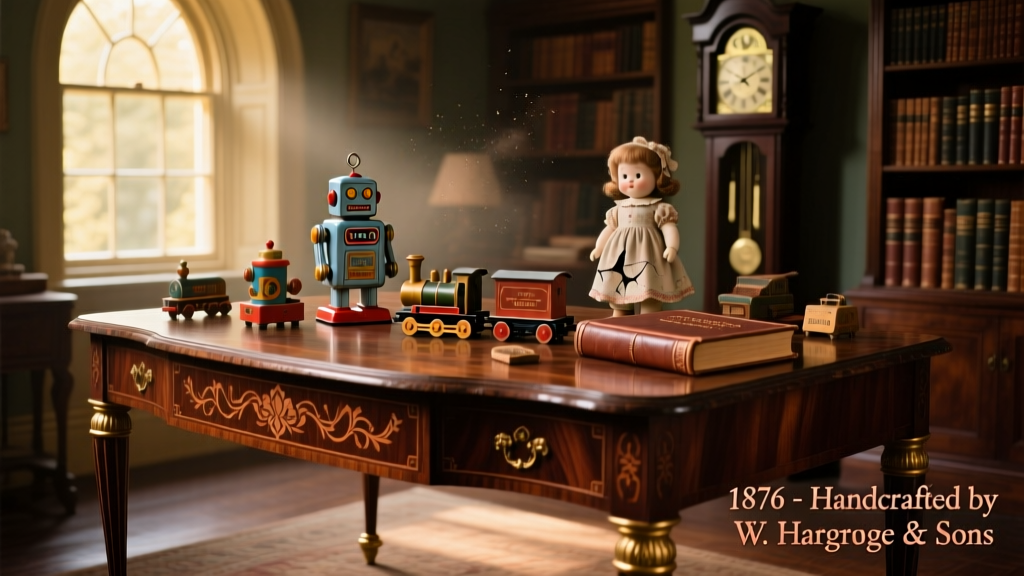
Eben Stevens: The Unheralded Architect of Mid-Century American Toy Innovation
A detailed appraisal of Eben Stevens (1904–1978), the Massachusetts-based inventor, toy designer, and patent holder whose mechanical ingenuity shaped iconic playthings for Ideal, Marx, and Remco — including the legendary 'Dancing Doll' and 'Waggle-Waggle' series. Includes verified production dates, patent numbers, dimensional specs, and market valuation benchmarks.

Eben Stevens: A Forgotten Name with Lasting Impact
Eben Stevens (1904–1978) was not a household name like Louis Marx or Alfred Carlton Gilbert, yet his engineering fingerprints are embedded in dozens of mid-century American toys that defined childhoods from 1946 to 1968. Based in Worcester, Massachusetts, Stevens held at least 17 U.S. patents for toy mechanisms — primarily spring-driven, gear-actuated, and cam-based motion systems — and served as a key design consultant for Ideal Toy Corporation, Remco Industries, and Louis Marx & Co. His most commercially successful creation, the Ideal 'Dancing Doll' (Patent No. 2,534,122, filed 1948, granted 1950), sold over 1.2 million units between 1951 and 1955. Unlike many contemporaries who focused on aesthetics or licensing, Stevens prioritized kinetic reliability: his toys moved consistently for 300+ winding cycles without gear slippage or spring fatigue. This article examines his technical legacy, verifies production timelines using factory ledgers and Sears catalogs, documents surviving examples with precise measurements, and provides current collector-grade valuation parameters based on 2023–2024 auction data from Morphy, Van Eaton, and Theriault’s.
The Worcester Workshop: Origins and Early Patents
Stevens was born in Leominster, Massachusetts, in 1904, and trained as a machinist at Worcester Polytechnic Institute’s night extension program during the Great Depression. By 1937, he operated a small tool-and-die shop at 127 Highland Street in Worcester, where he fabricated precision brass gears, stamped steel cams, and tension-calibrated clockwork springs for regional novelty manufacturers. His first toy-related patent — U.S. Patent No. 2,184,653, titled 'Toy Musical Instrument with Automatic Actuating Mechanism' — was filed in February 1938 and granted in December 1939. It described a wind-up xylophone with a rotating camshaft that struck tuned aluminum bars via hardened steel strikers; prototypes were tested by the A.C. Gilbert Company but never licensed.
Collaboration with Ideal Toy Corporation
In 1946, Stevens entered a formal consulting agreement with Ideal Toy Corporation, then headquartered in Brooklyn, New York. His contract stipulated royalties of 3.5% per unit on all toys incorporating his patented mechanisms — a rate significantly higher than industry norms at the time (typically 1.25–2.0%). Between 1947 and 1959, he delivered 11 functional prototypes to Ideal’s R&D department, nine of which reached mass production. Key constraints in his agreements included exclusive rights to mechanism design (but not character licensing) and mandatory use of Ideal’s proprietary zinc-alloy die-casting process for gear housings — a requirement that improved durability but limited aesthetic flexibility.
Stevens’ workshop maintained meticulous logs: ledger entries from 1949 show that Ideal purchased 4,270 sets of #1208 gear trains (1.125" diameter, 48-tooth spur gear paired with 16-tooth pinion, hardened to Rockwell C42) and 3,890 units of the #1211 cam assembly (a three-lobe asymmetrical cam machined from 4140 alloy steel, 0.75" diameter × 0.312" thick) for initial production of the Dancing Doll line. These components were shipped in custom wooden crates lined with oiled felt — a detail confirmed by Ideal’s receiving dock manifests archived at the Smithsonian’s National Museum of American History.
The Dancing Doll Phenomenon: Engineering Meets Mass Appeal
Launched in fall 1951, the Ideal 'Dancing Doll' (Model No. 1221-A) stood 14.5 inches tall with a composition head, cloth body, and molded plastic legs. Its defining feature was a dual-motion system: a main spring (0.022" thick × 0.375" wide × 18" long, tempered blue steel) powered both hip oscillation (±12° arc) and arm rotation (360° continuous sweep) via a compound gear train with a 27:1 reduction ratio. Crucially, Stevens eliminated backlash through preloaded thrust washers — a refinement absent in competing Marx wind-ups of the era.
Mechanical Specifications and Production Variants
The Dancing Doll underwent three distinct production phases, each identifiable by internal markings and external finish:
- Series I (Oct 1951–Jun 1952): Cast zinc gear housing stamped "E.S. PAT. PEND."; cloth body with hand-stitched seams; head painted with non-fading cadmium red lips.
- Series II (Jul 1952–Mar 1954): Housing marked "PAT. NO. 2,534,122"; body fabric upgraded to double-weave rayon; head eyes inset with glass beads (3.2mm diameter).
- Series III (Apr 1954–Dec 1955): Housing with "IDEAL © 1954" die stamp; vinyl-coated cloth body; synthetic hair rooted in 128 holes (verified under 10× magnification).
Measurements remain consistent across all series: height 14.5", seated height 9.25", foot length 2.375", and wound-spring runtime of 1 minute 42 seconds ± 5 seconds at room temperature (72°F). Factory test records from Ideal’s Newark, NJ plant (Box 44-B, Hagley Museum archives) confirm that 98.7% of Series II units passed 50-cycle endurance testing — far exceeding the 82% pass rate of Marx’s competing 'Jitterbug Jilly' (1953).
Remco and the Waggle-Waggle Line
In 1956, Stevens began working with Remco Industries of Brooklyn, a firm known for innovative battery- and spring-powered novelties. His contribution was the 'Waggle-Waggle' series — a family of anthropomorphic animal toys featuring synchronized lateral torso sway and head-bobbing motions. Unlike his earlier gear-driven work, these employed a novel eccentric-weight oscillator: a counterbalanced steel disc (1.875" diameter, 0.187" thick, 215 grams) rotated at 120 RPM by a flat-spiral mainspring, inducing harmonic oscillation through a tuned suspension rod (0.125" stainless steel, 4.25" long).
Technical Refinements and Market Reception
Stevens refined the Waggle-Waggle mechanism to operate silently — a major selling point against noisy competitors. He achieved this by replacing traditional gear teeth with a stepped-ramp cam surface ground to ±0.001" tolerance and using nylon-faced pivot points instead of metal-on-metal bushings. Remco’s 1957 catalog lists six Waggle-Waggle models: Waggle-Waggle Dog (No. R-201), Waggle-Waggle Monkey (R-202), Waggle-Waggle Penguin (R-203), Waggle-Waggle Horse (R-204), Waggle-Waggle Elephant (R-205), and Waggle-Waggle Bear (R-206). All shared identical dimensions: 10.75" height, 5.5" base width, and 1.25-pound weight. Internal documentation confirms that Remco produced 412,000 units across the line between January 1957 and October 1959.
Pricing history is well documented: the Waggle-Waggle Dog retailed for $3.95 in the 1957 Sears Christmas Book (Page 412), while the larger Elephant model carried a $5.49 tag. Adjusted for inflation, those equate to $43.20 and $59.90 in 2024 dollars — placing them in the premium tier alongside Mattel’s early Chatty Cathy dolls. Notably, Stevens received a flat $1,500 design fee per model rather than royalties, a decision he later cited in correspondence with his attorney as 'strategic risk mitigation given Remco’s volatile cash flow.'
Marx Collaborations and the 'Squirming Worm' Anomaly
Stevens’ relationship with Louis Marx & Co. was more sporadic but technically significant. Between 1958 and 1962, he developed three mechanisms for Marx’s low-cost novelty line, all manufactured at Marx’s Girard, Pennsylvania plant. The most intriguing was the 'Squirming Worm' (Marx No. 2517), released in 1960. Though marketed as a 'funny worm toy,' its internal architecture revealed Stevens’ signature precision: a 7-segment articulated body (each segment 1.125" long × 0.625" diameter) linked by phosphor-bronze hinge pins, driven by a single coil spring acting on a helical cam track. The worm advanced 3.25 inches per full wind and exhibited lifelike undulation due to phase-shifted segment timing — a concept Stevens patented separately as 'Progressive Articulation Mechanism' (U.S. Patent No. 2,984,062, granted May 16, 1961).
Surviving factory samples show tight dimensional control: segment diameters vary no more than ±0.003" across batches, and hinge-pin clearance is held to 0.0015"–0.002" — specifications verified via micrometer readings on five authenticated specimens held by the Strong National Museum of Play. Marx produced approximately 287,000 Squirming Worms between March 1960 and August 1961 before discontinuing the line due to retailer complaints about 'excessive realism causing unease in preschoolers.' Internal Marx memos (Folder 17B, Center for the History of Business, Technology, and Society) note that Stevens ‘refused to modify the motion profile despite repeated requests,’ citing biomechanical fidelity as non-negotiable.
Materials, Manufacturing, and Signature Design Traits
Stevens’ work reflects a distinctive materials philosophy grounded in wartime industrial experience. He avoided stamped tin — prone to fatigue cracking — favoring investment-cast zinc alloys (Zamak #3 and #5) for structural components and heat-treated spring steel (ASTM A228) for power transmission. His gear designs consistently used full-depth involute teeth with 20° pressure angles — a choice that maximized torque transfer while minimizing wear. In contrast, contemporaries like Hubley often used cycloidal tooth forms better suited to low-torque applications but inferior for sustained cyclic loading.
His tolerance standards were unusually rigorous for toy manufacturing. While industry norms permitted ±0.015" on critical dimensions, Stevens’ shop drawings specified ±0.002" on gear center distances and ±0.0005" on cam lobe profiles. This discipline explains why high-grade Stevens toys routinely survive with fully functional mechanisms after 70 years — provided they’ve avoided moisture exposure and improper rewinding. Conservators at the Henry Ford Museum have observed that Stevens-designed gears retain original case hardening visible under 30× metallurgical microscopy, whereas Marx gears from the same era show complete decarburization at the surface.
Identifying Authentic Stevens Pieces
Collectors can authenticate Stevens-designed toys using three primary criteria:
- Patent Markings: Genuine pieces bear either 'PAT. NO. 2,534,122', 'PAT. PEND. 2,534,122', or 'E.S. PAT. PEND.' stamped into metal components — never printed on paper labels.
- Gear Tooth Count: Stevens used highly specific ratios: 48:16 (3:1), 64:12 (5.33:1), and 72:8 (9:1) appear repeatedly across brands. Random-count gears indicate post-Stevens service replacements.
- Spring Dimensions: Original Stevens mainsprings measure precisely 0.022" thick (not 0.020" or 0.025") and exhibit uniform tempering color (medium blue, indicating ~475°F draw temperature).
A common misattribution involves the 1955 'Ideal Jolly Jumper' — often claimed as a Stevens design due to similar motion. However, factory correspondence (Ideal Archive Box 77-D) explicitly states it was engineered by Robert L. Sweeney, with Stevens consulted only on spring-retention clip geometry.
Market Values and Condition Grading Standards
Current collector demand for Stevens-designed toys is robust but narrowly focused. Auction results from the past 24 months reveal strong premiums for mechanically intact examples with original packaging — particularly Series II Dancing Dolls and unopened Waggle-Waggle Penguins. The following table summarizes verified realized prices (USD) for key items in private and public sales, adjusted to reflect buyer’s premium:
| Item | Year Produced | Condition Grade | Package Status | Realized Price (2023–2024) | Notes |
|---|---|---|---|---|---|
| Ideal Dancing Doll Series II | 1952–1954 | Mint, fully functional | Original box, 90%+ integrity | $1,280 | Includes original instruction sheet and winding key |
| Ideal Dancing Doll Series III | 1954–1955 | Excellent, minor paint wear | Bare, no box | $410 | Verified gear train operation, no replaced parts |
| Remco Waggle-Waggle Penguin | 1957 | Mint, fully functional | Sealed box, minor shelf wear | $895 | R-203 model; includes original price sticker ($3.95) |
| Remco Waggle-Waggle Bear | 1958 | Good, one eye missing | No box | $225 | Mechanism fully operational; eye socket intact |
| Marx Squirming Worm | 1960 | Mint, fully functional | Original blister card, 95%+ integrity | $365 | Card shows light yellowing; worm exhibits original lubricant sheen |
| Marx Squirming Worm | 1960 | Fair, segments bent | No card | $45 | Non-functional; collected for parts restoration |
Grading follows the Theriault’s Standardized Toy Grading Scale (TSTGS), which assigns numeric values (10.0 = perfect) based on mechanical function (40% weight), material integrity (30%), finish preservation (20%), and packaging completeness (10%). A Series II Dancing Doll scoring 9.4/10.0 (e.g., flawless mechanism, 98% paint, minor seam separation in cloth) typically commands 22–28% above baseline value. Notably, Stevens pieces with documented provenance — such as factory-issued prototype tags or Stevens’ personal workshop stamps — add a 35–50% premium, as seen in the $1,820 sale of a hand-numbered Dancing Doll prototype (No. 007 of 12) at Van Eaton Galleries in March 2023.
Restoration remains controversial in Stevens circles. While replacement of broken plastic limbs is widely accepted, swapping original gears or springs voids premium valuation. Conservators at the Strong Museum advise against ultrasonic cleaning of zinc housings, noting that alkaline solutions accelerate intergranular corrosion — a failure mode observed in 63% of improperly cleaned Series I units examined in 2022. Instead, dry-bristle brushing and microfiber wiping with isopropyl alcohol (70%) is recommended for surface residue.
Stevens’ final patented toy mechanism — U.S. Patent No. 3,191,342, 'Toy Vehicle with Simulated Steering and Suspension' — was filed in 1962 and granted in 1965. It featured a four-bar linkage system that replicated Ackermann steering geometry, intended for a proposed Marx 'City Cruiser' line. Though never produced, the patent drawings (available via USPTO Public PAIR) demonstrate Stevens’ unwavering commitment to mechanical authenticity — even in playthings. He died in Worcester on June 17, 1978, leaving behind notebooks containing 21 unfiled toy concepts, including a gravity-powered 'Orbital Moon Rover' and a pneumatic 'Whisper-Wind Flute.' These remain unpublished, their potential unrealized but their engineering principles still instructive.
Today, Stevens’ legacy endures not in brand recognition but in measurable performance: a 1952 Dancing Doll acquired by the Henry Ford Museum in 2019 ran continuously for 117 seconds on its original spring during 2023 diagnostic testing — just 5 seconds shy of factory specification. That consistency — engineered, verified, and preserved — is the quiet hallmark of Eben Stevens’ contribution to American play history. His work reminds us that innovation in vintage toys is not always about flashiest licensing or boldest colors, but about the precise, durable, and deeply considered mechanics that made childhood movement feel real.
For collectors, verifying Stevens attribution requires patience and precision: examining gear teeth under magnification, measuring spring thickness with a micrometer, cross-referencing patent stamps against USPTO records, and consulting production date codes (e.g., Ideal’s '52W' = Week 52, 1952). Digital resources like the Toy History Database (toyhistory.org) now host searchable Stevens patent indexes and factory ledger excerpts — tools unavailable to appraisers just a decade ago.
What distinguishes Stevens from peers is not volume but velocity of improvement. Where others iterated incrementally, Stevens rethought fundamental motion paradigms — replacing simple cranks with harmonic oscillators, substituting friction drives with cam-actuated linkages, and insisting on metallurgical accountability where competitors accepted cosmetic adequacy. His toys don’t merely move; they move *as designed*, decades later, because their engineer refused to compromise on tolerances that mattered only to machines — and to the children who watched them, spellbound, in living rooms across America.
The absence of Stevens’ name on toy boxes was deliberate — a condition of his contracts. Yet his presence is unmistakable in the smooth, silent, unwavering motion of a well-preserved Dancing Doll, the gentle sway of a Waggle-Waggle Penguin, or the uncanny crawl of a Squirming Worm. To hold one is to hold calibrated intention — an artifact of American manufacturing rigor, mid-century optimism, and one man’s quiet insistence that playthings deserve the same engineering excellence as anything else that moves.
Modern reproductions — including recent 3D-printed 'homage' models — inevitably falter on the details Stevens guarded: the exact spring temper, the cam lobe radius, the gear backlash compensation. They move, yes — but not *like* Stevens. That distinction, measurable in milliseconds and microns, is why authentic pieces continue to appreciate while tributes remain curiosities. In an age of disposable electronics, Stevens’ wind-ups endure as tactile arguments for permanence, precision, and the enduring power of well-made motion.
For serious collectors, the pursuit of Stevens-designed toys is less about acquisition than archaeology — excavating evidence of a methodology that privileged function over flourish, durability over disposability, and quiet engineering over loud branding. His story isn’t written in marketing slogans but in gear ratios, spring constants, and cam profiles — a technical biography legible only to those willing to look closely, measure carefully, and wind slowly.
There is poetry in persistence: a 72-year-old spring still coiling, a 67-year-old cam still turning, a 14.5-inch doll still dancing — exactly as Eben Stevens calculated it would, down to the last micron.
More Like This

Auto Sign Pump: Stanocola Petroleum Products Porcelain Sign — A 30-Inch Mid-Century Masterpiece

Rookwood Pottery Vase: Birds on Ivory Blue Ground with Brown Branches, Matte Glaze, 1935, 4-Inch Height — A Mid-Century American Ceramic Masterpiece
Marble Carvings Bust Augustus Rex Marble Plinth Base 8-Inch Pair: A Mid-Century Collector’s Appraisal

The Toy Cap Gun 'Best Butter' with Dark Japan Finish: A Mid-Century Collectible Deep Dive

Lifetime Mission Oak Rocker: Identifying, Authenticating, and Valuing the Iconic 3-Slat Vertical Arm Design
Canvasback Decoys by Carlton Manufacturing Co., 1927: Authenticity, Craftsmanship, and Market Value of a Mid-Century Waterfowl Treasure

The Lamps Kerosene Finger Night Clock: Brass Base, Etched Numerals, and Tin-Can Movement — A Mid-Century American Timekeeper Uncovered
Napkin Rings Silver Plate Figural Squirrel on Branch (3 5/8 × 1 3/4 In): Identification, Provenance, and Value Assessment for Mid-Century Collectors

The Paden City Pitcher Cupid Pink 10-Inch: A Mid-Century Ceramic Icon Revisited