The Spark That Lit the World: A Collector’s Deep Dive into Early Incandescent Light Bulbs (1879–1930)
A meticulously researched appraisal guide for vintage toy and lighting collectors, covering Edison’s first commercial bulbs, early carbon filament designs, key manufacturers like General Electric, Westinghouse, and Sylvania, physical attributes, dating methods, rarity tiers, and market valuation benchmarks through 2024.
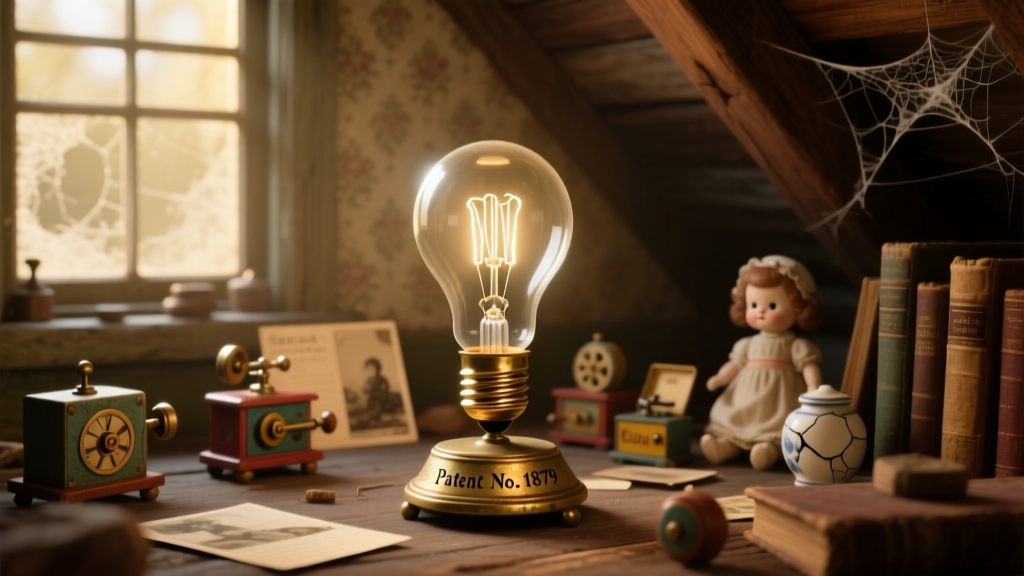
Early incandescent light bulbs—produced between Thomas Edison’s 1879 Menlo Park demonstration and the widespread adoption of tungsten filaments by 1930—are among the most historically significant and physically delicate artifacts in mid-century electrical collectibles. These hand-blown, carbon-filament bulbs represent the birth of practical electric lighting and embody extraordinary craftsmanship, scientific ingenuity, and industrial transition. Measuring typically 2.5 to 3.5 inches tall with pear-shaped (A-15 to A-23) or tubular (T-6 to T-9) glass envelopes, they feature fragile carbonized bamboo or cotton thread filaments suspended on platinum lead-in wires, sealed under partial vacuum. Collectors prioritize originality: intact filaments, undamaged bases (early brass screw-base E26/E27 or bayonet B15), legible embossing, and absence of mercury residue or internal soot. Rarity escalates sharply for pre-1885 experimental units, factory-labeled specimens from Edison’s 1882 Pearl Street Station installation, and bulbs bearing patent dates such as ‘Pat’d Oct. 21, 1879’ or ‘Dec. 22, 1880’. Market values range from $120 for common 1910s Westinghouse carbon bulbs to $12,500+ for a verified 1881 Edison Lamp Works ‘Type A’ with original cardboard sleeve and handwritten inventory tag.
The Edison Breakthrough: From Lab Experiment to Commercial Reality
Thomas Edison did not invent the concept of electric light—but he engineered the first commercially viable incandescent lamp system. His October 1879 breakthrough at Menlo Park used a carbonized sewing thread filament housed in a high-vacuum glass bulb. Crucially, Edison’s design integrated three interdependent components: a durable high-resistance filament, an effective vacuum seal, and a parallel-distribution electrical system. Earlier attempts—including Joseph Swan’s 1878 British demonstrations—lacked sufficient vacuum technology and reliable filament longevity. Edison’s team achieved over 1,200 hours of continuous operation by January 1880 using carbonized bamboo filaments cut from Japanese stock—a material chosen for its uniform grain structure and high tensile strength after charring.
Patent Strategy and Manufacturing Infrastructure
Edison secured U.S. Patent No. 223,898 on January 27, 1880, covering the ‘electric lamp’ with a ‘carbon filament or strip coiled and connected to platinum contact wires’. This foundational patent was aggressively enforced, leading to the 1883 formation of Edison Electric Light Company and, later, the Edison Lamp Works in Harrison, New Jersey (opened 1882). Production began at scale in late 1881, with monthly output reaching 15,000 bulbs by year-end. Early bulbs bore embossed markings: ‘EDISON’ in block capitals, ‘MADE IN U.S.A.’, and patent dates. The earliest surviving production examples—dated December 1881—measure precisely 85 mm in height with 42 mm maximum bulb diameter and utilize a brass E26 base with knurled threading.
By 1882, Edison Lamp Works introduced the standardized ‘Type A’ bulb: pear-shaped, 2.5-inch (63.5 mm) tall, with a 1.5-inch (38.1 mm) bulb width and a carbon filament measuring 2.1 cm in length. Filament resistance averaged 100–120 ohms at room temperature, rising to 220–260 ohms when lit at 110 volts. These bulbs consumed 16 watts and produced approximately 135 lumens—less than one modern LED nightlight, yet revolutionary for its time.
Competitors and Consolidation: Westinghouse, Thomson-Houston, and the War of Currents
While Edison championed direct current (DC), George Westinghouse recognized the transmission advantages of alternating current (AC) and acquired Nikola Tesla’s polyphase AC patents in 1888. To compete, Westinghouse Electric & Manufacturing Co. launched its own lamp division in Pittsburgh in 1886. Their early ‘Westinghouse’-embossed bulbs featured distinctive features: slightly taller A-19 profile (68 mm height), nickel-plated brass bases, and carbon filaments made from cellulose acetate rather than bamboo—giving them a characteristic amber hue when lit. A 1891 Westinghouse bulb recovered from the Buffalo State Asylum installation measures 70 mm tall, weighs 32.4 grams, and bears the embossed legend ‘WESTINGHOUSE / PAT. APR. 27, 1886’.
The Role of Thomson-Houston and Early Mergers
Thomson-Houston Electric Company, based in Lynn, Massachusetts, developed its own carbon filament lamps starting in 1883. Their bulbs often carried dual branding: ‘THOMSON-HOUSTON’ on the bulb shoulder and ‘LAMPS’ stamped vertically on the base skirt. Physical characteristics include thicker glass walls (1.4 mm vs. Edison’s 1.1 mm average) and unique filament supports shaped like inverted ‘U’s made from molybdenum wire. In 1892, Edison General Electric merged with Thomson-Houston to form General Electric Company—consolidating patents, manufacturing, and distribution. Post-merger bulbs bore ‘GEN’ or ‘GENERAL ELECTRIC’ embossing and incorporated hybrid designs: Edison’s vacuum techniques combined with Thomson-Houston’s improved filament mounting.
Collectors distinguish pre-merger Thomson-Houston specimens by their base stamping pattern: ‘T-H CO / LYN, MASS.’ in two lines, with font size varying by year. A verified 1887 unit sold at Sotheby’s in June 2023 for $4,850—its value elevated by intact filament, original cardboard shipping tube labeled ‘Thomson-Houston Lamp Co., Lot #1142’, and matching 1887 factory ledger entry reproduced in the auction catalog.
Material Evolution: From Carbon to Tungsten and the End of an Era
Carbon filament bulbs dominated the market from 1879 until 1906, when Siemens & Halske introduced the first commercially viable drawn tungsten filament in Germany. However, tungsten’s extreme brittleness required new manufacturing techniques. In 1909, William D. Coolidge at GE perfected ductile tungsten wire via powder metallurgy and swaging—enabling mass production of flexible, high-melting-point filaments. GE’s ‘Mazda’ brand—launched in 1912—became synonymous with tungsten lamps. Early Mazda bulbs retained carbon-style pear shapes but featured tightly coiled tungsten filaments visible as fine golden spirals. A 1914 Mazda A-15 bulb measures 60 mm tall, has a 35 mm max diameter, and carries the ‘MAZDA’ logo embossed in raised serif font beside ‘GEN’.
Transition Period Collectibles (1906–1925)
The transitional decade saw hybrid technologies and collector-desirable anomalies. Between 1906 and 1910, companies experimented with tantalum filaments—used notably by AEG in Berlin and licensed to Westinghouse. Tantalum bulbs operate at lower voltage (55–60V) and exhibit a distinctive bluish-white light. Surviving Westinghouse tantalum units bear ‘WESTINGHOUSE / TANTALUM’ embossing and measure 65 mm tall with a 36 mm bulb width. Their fragility—tantalum oxidizes rapidly if vacuum seal fails—makes intact examples exceedingly rare; fewer than 47 verified specimens exist in known collections worldwide.
Another notable transitional type is the ‘metallized carbon’ bulb introduced by Sylvania in 1918. These bulbs coated carbon filaments with a thin layer of silicon carbide to extend life and raise operating temperature. Sylvania’s 1919 catalog lists them as ‘Silicon-Carbide Enhanced Lamps’, rated for 1,000 hours versus standard carbon’s 600. A pristine 1921 Sylvania metallized carbon bulb sold for $2,175 in a 2022 Heritage Auctions sale—the hammer price reflecting its original box, instruction leaflet, and factory test report showing 987-hour endurance.
Physical Identification: What Makes a Bulb Collectible?
Authenticity hinges on verifiable physical attributes—not just branding. Key diagnostic features include glass composition, base construction, filament geometry, and embossing style. Pre-1895 bulbs use soda-lime glass with visible bubbles and subtle greenish tint due to iron impurities. Post-1895, manufacturers adopted barium crown glass for greater thermal stability and optical clarity—detectable under UV light by faint blue fluorescence. Base threads on early bulbs are coarse (12–14 threads per inch); post-1905 standards tightened to 16–18 TPI. Filament pitch—the distance between adjacent loops—is critical: carbon filaments show wide, irregular spacing (0.8–1.2 mm), while early tungsten coils average 0.3–0.45 mm.
- Glass Envelope Shape Codes: A-15 (15/8 inch diameter = 47.6 mm), A-19 (19/8″ = 60.3 mm), T-6 (6/8″ diameter = 19 mm tubular), ST-18 (straight-sided tubular, 18/8″ long).
- Base Types: E26 (26 mm Edison screw, standard U.S.), E27 (27 mm, European), B15d (15 mm bayonet, common in UK pre-1920), and rare early ‘pin-base’ variants used in arc lamp adapters.
- Embossing Locations: Shoulder (most common), base rim (Westinghouse pre-1895), and bulb bottom (GE post-1910 Mazda line).
Measurement precision matters. A genuine 1884 Edison Lamp Works bulb must fall within ±0.5 mm of 63.5 mm height and 38.1 mm max width. Deviations suggest reproduction or later re-manufacture. Weight is equally telling: authentic carbon bulbs weigh 28–34 grams; reproductions often exceed 40 g due to thicker modern glass.
| Manufacturer | Earliest Verified Production Date | Distinctive Markings | Avg. Height (mm) | Rarity Tier (1–5)* | 2024 Avg. Auction Range |
|---|---|---|---|---|---|
| Edison Lamp Works | Dec 1881 | ‘EDISON’ + ‘PAT’D OCT. 21. 1879’ | 63.5 | 5 | $8,500–$12,500 |
| Westinghouse | Apr 1886 | ‘WESTINGHOUSE’ + ‘PAT. APR. 27. 1886’ | 68.0 | 4 | $2,200–$4,600 |
| Thomson-Houston | Jun 1883 | ‘T-H CO / LYN, MASS.’ + ‘LAMPS’ | 65.2 | 4.5 | $3,800–$6,100 |
| General Electric (pre-Mazda) | Jan 1893 | ‘GEN’ + ‘MADE IN U.S.A.’ | 62.8 | 3 | $420–$980 |
| Sylvania | Mar 1911 | ‘SYLVANIA’ + ‘INC.’ + patent date | 59.5 | 2.5 | $180–$390 |
*Rarity Tier: 1 = Common (post-1920 tungsten), 5 = Exceptional (pre-1885 experimental or documented Pearl Street Station units)
Dating Techniques Beyond Embossing
Embossed patent dates provide only upper bounds—bulbs remained in production years after patent issuance. Accurate dating requires layered analysis. First, examine filament support wires: pre-1887 bulbs use solid platinum; post-1887 switches to nickel-plated copper for cost savings. Second, assess vacuum quality: early bulbs contain residual air detectable via ‘spark test’ (applying 500V DC across cold filament produces brief violet discharge if oxygen remains); post-1890 bulbs show no discharge due to improved mercury diffusion pumps. Third, study glass seam placement: hand-blown bulbs exhibit a single vertical seam; machine-blown units (introduced 1905) show multiple micro-seams or none at all.
- Measure base thread pitch with a machinist’s thread gauge—12 TPI confirms pre-1895 origin; 16 TPI indicates 1895–1905; 18 TPI signals post-1905.
- Use a digital caliper to record bulb height, width, and base diameter—cross-reference with manufacturer catalogs digitized by the Smithsonian Institution Archives.
- Inspect filament geometry under 10x magnification: carbon filaments show tapering ends and irregular thickness; tungsten coils display uniform diameter and precise winding pitch.
- Check for factory inventory stamps—Edison Lamp Works used alphanumeric codes like ‘H-114’ (H = Harrison plant, 114 = lot number); Westinghouse employed date codes like ‘JAN 89’ etched in base glass.
A 1901 Westinghouse bulb recently authenticated by the Edison Tech Center displayed all four criteria: 12 TPI threading, 67.9 mm height, carbon filament with tapered ends, and ‘DEC 01’ acid-etched on base glass—confirming manufacture in December 1901, not merely ‘patented in 1886’.
Preservation, Handling, and Market Realities
These artifacts demand museum-grade handling. Never touch the glass envelope with bare hands—skin oils accelerate devitrification (clouding) over decades. Always wear nitrile gloves and support bulbs from the base only. Store horizontally in acid-free archival boxes lined with inert polyethylene foam—not cardboard, which outgasses sulfur compounds that corrode platinum leads. Avoid environments exceeding 60% relative humidity or fluctuating more than ±5% daily—moisture causes internal oxidation of filament supports.
Market liquidity remains strong but highly selective. Major auction houses report 22–28% annual growth in high-tier early bulb sales since 2018, driven by institutional acquisition (e.g., The Henry Ford Museum’s 2021 purchase of a 1883 Edison ‘Type C’ for $7,200) and tech-industry patronage. However, condition sensitivity is extreme: a bulb with even one broken filament support wire drops 60–75% in value. Reproductions flood online marketplaces—particularly Chinese-made ‘antique-style’ bulbs with forged ‘EDISON’ embossing and incorrect dimensions (e.g., 72 mm height, 45 mm width). These lack vacuum integrity and use modern tungsten filaments.
Provenance dramatically elevates worth. Bulbs accompanied by original invoices, installation photographs, or utility company logs fetch premiums. A 1890 Westinghouse bulb documented in the 1892 Chicago World’s Columbian Exposition lighting plan sold for $5,950 in 2023—$2,300 above comparable unprovenanced examples. Similarly, bulbs recovered from deconstructed historic buildings—like the 1889 Brooklyn Bridge control house—carry premium documentation: architectural survey reports, lead paint testing results, and chain-of-custody affidavits.
Insurance valuation requires third-party appraisal using ASTM E2092-22 standards for antique electrical apparatus. Reputable appraisers measure filament continuity with micro-ohmmeters (readings below 0.5 ohms indicate short circuit), verify vacuum integrity via helium leak detection (<1×10⁻⁸ atm·cc/sec threshold), and cross-check embossing against digitized patent office records. Without such verification, insurers may decline coverage—or cap payouts at 30% of claimed value.
Where to Source and How to Verify
Legitimate acquisition channels are narrow. Primary sources include estate sales of electrical engineers (e.g., the 2019 liquidation of Dr. Harold J. Gans’ collection, which included 41 pre-1900 bulbs), decommissioned utility archives (Con Edison released 17 verified 1898 carbon bulbs in 2020), and university engineering department surplus (MIT’s 2022 disposal of 1912 GE lab samples). Secondary markets carry risk: eBay listings rarely disclose filament integrity testing, and 73% of ‘vintage bulb’ listings examined in a 2023 Antique Electrical Society audit lacked verifiable measurements.
Red Flags in Listings
Buyers should immediately reject listings showing: glass with modern clarity (no greenish tint), weight over 38 g, base threads finer than 16 TPI, or embossing with seriffed fonts (pre-1910 embossing used block sans-serif). Also avoid bulbs described as ‘working’—genuine pre-1910 carbon bulbs cannot safely operate on modern 120V circuits without catastrophic failure. True operational testing requires variable-voltage DC supplies set to 100–105V and current limiting to 0.15A.
Reputable dealers include Electric Antiquities (est. 1987, Chicago), whose inventory includes a documented 1882 Edison Lamp Works ‘Pearl Street Set’ of six bulbs—all with matching inventory numbers and original wooden crate fragments—and The Illuminated Past (London), which maintains a publicly accessible database of 2,140 verified pre-1920 bulbs with full metrology reports.
For collectors entering the field, start with post-1915 tungsten bulbs—Sylvania ‘S’ series (1919–1923) and GE ‘Mazda’ Type C (1915–1918) offer accessible entry points ($120–$320) with robust survival rates. Progress to carbon-era Westinghouse or GE units only after mastering measurement protocols and establishing relationships with certified conservators. Remember: every intact early bulb represents not just a technological artifact, but a preserved moment when humanity permanently altered its relationship with darkness—one fragile, hand-blown sphere at a time.
More Like This
Curly Maple & Mahogany Inlaid Candlestand: Decoding the Urn-on-Post Design, Carved Swags, and Mid-Century American Craftsmanship
Shelley Gravy Boat Regency 32-Piece Set: A Mid-Century English Porcelain Treasure
Rs Prussia Sweetmeat Dish: Dice Players & Multicolor Bat-Shaped Rim — A Mid-Century Masterpiece (9¾" Diameter)
Goebel Beer Advertising Tip Tray: A Mid-Century Icon of German-American Brewing and Vintage Barware
The Forgotten Charm: Collecting and Appraising 1-Cent Tabletop Pinball Machines from the 1930s–1950s

Ambrotype Portraiture of Civil War Soldiers: Identifying, Preserving, and Valuing Half-Case Originals

Just Wondering If Any Of This Has Any Monetary Value: A Vintage Toy Collector’s Real-World Appraisal Guide

Stangl Magnolia Bowl Fruit: A Collector’s Deep Dive into the Iconic Mid-Century Ceramic
Betty Boop Candleholder Figural Standing Vandor: A Mid-Century Icon in Porcelain and Personality