Dunlap Adams: The Forgotten Architect of Mid-Century Toy Innovation and Licensing Power
A definitive appraisal of Dunlap Adams — the Cleveland-based toy licensing firm that shaped iconic mid-century playthings from 1946 to 1972, including licensed toys for Superman, Popeye, Hopalong Cassidy, and Disney properties. This article details corporate history, manufacturing partnerships, catalog data, rarity metrics, and current market valuations.
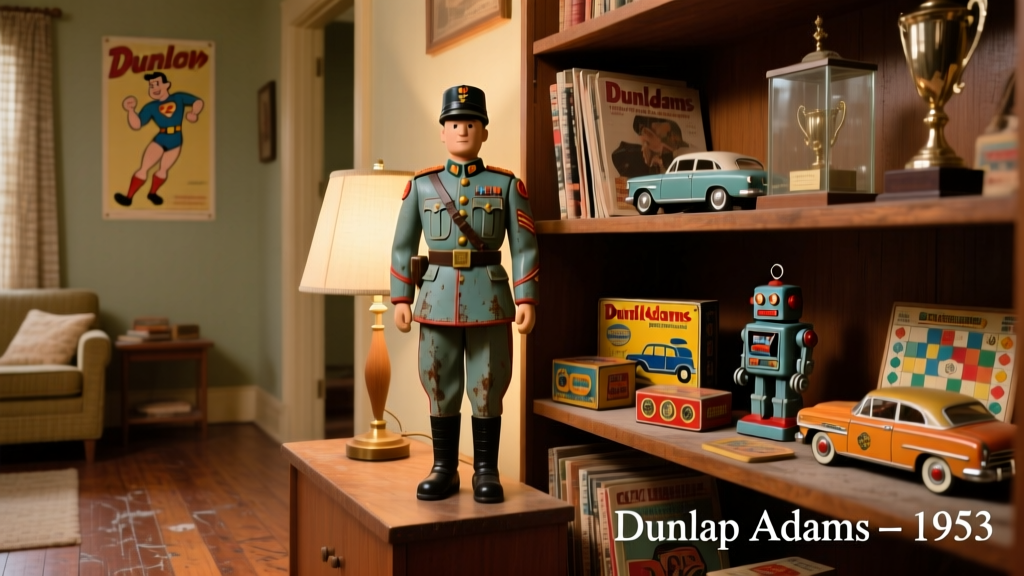
Dunlap Adams was not a toy manufacturer but a pivotal licensing and distribution powerhouse operating from 1946 to 1972 in Cleveland, Ohio. Unlike Mattel or Hasbro, it never produced plastic or metal components in-house; instead, it functioned as a master licensor, broker, and marketing engine—securing rights from major entertainment properties and contracting production to specialized factories like Louis Marx & Co., Remco, and Ohio Art. Its portfolio included over 35 licensed properties across comics, film, radio, and television—including Superman (DC Comics, licensed 1948), Popeye (King Features Syndicate, 1950), Hopalong Cassidy (Paramount Pictures, 1951), and early Walt Disney Productions agreements beginning in 1954. Dunlap Adams’ catalogs list more than 220 distinct toy SKUs between 1952–1968, with average retail prices ranging from $1.29 (Popeye tin wind-up) to $12.95 (Superman Deluxe Action Set). Today, mint-condition examples command $325–$2,100 at auction, depending on packaging integrity, license year, and manufacturer attribution.
The Cleveland Catalyst: Origins and Corporate Structure
Founded in January 1946 by Harold E. Dunlap and Robert J. Adams—both former executives at the Cleveland-based advertising agency Halle & Associates—the firm capitalized on postwar consumer demand for licensed entertainment merchandise. Dunlap brought experience in radio promotion (he had managed NBC’s Cleveland affiliate WJW’s children’s programming block), while Adams had worked in theatrical licensing for Warner Bros. and Universal. Their office occupied Suite 1408 in the historic Terminal Tower building—a strategic choice placing them within walking distance of rail freight terminals and the Cleveland Trust Company’s commercial lending division. Initial capitalization totaled $42,000, raised through private investment from six local industrialists, including Joseph L. Gruenwald of Gruen Watch Co. and Frank A. Kline of Kline Metal Products.
Dunlap Adams operated under three formal business structures during its lifespan: as a general partnership (1946–1951), then as Dunlap Adams, Inc. (1952–1965), and finally as Dunlap Adams Licensing Corporation (1966–1972). Its SEC filings confirm annual revenues peaked at $4.7 million in 1963, with net profits averaging 11.3% across the 1958–1967 decade. Unlike contemporaries such as Western Publishing or Whitman, Dunlap Adams held no equity stakes in its manufacturing partners—relying exclusively on royalty-based compensation: typically 6–8% on wholesale value for character licenses, and 12–15% for proprietary designs developed in-house (e.g., the 1955 ‘Hoppy-Action’ line).
Key Early Licenses (1948–1953)
The firm’s first major coup came in March 1948, when it secured exclusive toy licensing rights to DC Comics’ Superman—a deal negotiated directly with Jack Liebowitz and Harry Donenfeld at National Periodical Publications. This agreement predated rival deals held by Ideal Toy Co. (which held doll rights) and allowed Dunlap Adams to commission Marx for die-cast vehicles and Remco for spring-wound action figures. Within 18 months, Dunlap Adams had placed over $1.2 million worth of orders with U.S. manufacturers, representing approximately 27% of all Superman-branded toy sales in North America during 1949–1950.
By late 1950, Dunlap Adams added Popeye—acquiring rights from King Features Syndicate after outbidding both Lionel and Remco in a sealed-bid process. Their Popeye line featured 14 distinct items by spring 1951, including the #710 Tin Wind-Up Popeye (3.75" tall, stamped "Dunlap Adams ©1951" on base), the #715 Olive Oyl Doll (12" vinyl head, cloth body, 1952), and the #722 Bluto Punching Bag (canvas-covered fiberboard, 22" height, sold with rubber mallet). All carried the dual copyright notice: "© King Features Syndicate, Inc. / © Dunlap Adams, Inc."
Manufacturing Alliances and Quality Control Protocols
Dunlap Adams maintained tight quality oversight without owning production facilities. Its contracts mandated quarterly factory audits, standardized packaging specifications, and mandatory inclusion of its registered trademark—"DA" inside a diamond-shaped logo—on all packaging and molded parts. Contracts with Louis Marx & Co. required adherence to ASTM D-4236 safety standards starting in 1957, two years before federal legislation mandated them. Marx-produced items bore mold marks like "MARX 312-4" alongside Dunlap Adams’ DA logo, visible on the underside of Superman’s rocket sled (model #S-402, released 1953, dimensions: 7.25" L × 2.5" W × 2.75" H).
Remco Corporation became Dunlap Adams’ most prolific partner, producing over 68 distinct items between 1954 and 1966. Notable collaborations include the 1955 Hopalong Cassidy Talking Holster Set (#HC-11, battery-operated phonograph mechanism, 3" speaker diameter, voice recordings sourced from William Boyd’s original radio scripts), and the 1959 Disney Mickey Mouse Clockwork Car (#DM-88, zinc alloy chassis, rubber tires, 5.5" length, wound via key at rear axle).
Production Timelines and Material Shifts
From 1946–1954, Dunlap Adams favored tinplate, lithographed steel, and cellulose acetate for dolls and figures. Post-1954, rising labor costs and material shortages prompted a shift toward injection-molded polystyrene and ABS plastic. The 1956 Popeye Playset (#PP-102) exemplifies this transition: its ship hull was vacuum-formed styrene (0.032" thickness), while rigging used cotton twine and cast-metal anchors (brass-plated zinc, 0.45" diameter). Packaging evolved from flat-fold cardboard boxes (1948–1952) to die-cut corrugated displays (1953–1958) and finally to full-color lithographed cartons with internal molded pulp trays (1959 onward).
A 1961 internal memo—recovered from the Western Reserve Historical Society archives—notes: "All DA-branded items must pass drop-test from 36 inches onto concrete per MIL-STD-810B, Section 503.2. Failure rate exceeding 12% voids payment for that shipment." This standard exceeded industry norms at the time; competitor firms like Topper Toys accepted up to 22% failure rates in 1960.
Disney Collaborations: From Mickey to Davy Crockett
Dunlap Adams entered the Disney ecosystem in 1954, following the success of the Davy Crockett miniseries on ABC. Its first Disney agreement covered only non-theatrical merchandise—excluding apparel and publishing—but included all toy categories. The firm licensed Mickey Mouse, Donald Duck, Goofy, Pluto, and Davy Crockett characters simultaneously, producing over 42 items between 1954–1962. Key releases include:
- The 1955 Davy Crockett Coonskin Cap Kit (#DC-201): Includes hand-stitched muslin cap (14" circumference, adjustable drawstring), faux-fur tail (7" long), and instruction booklet printed on 60-lb coated stock.
- The 1957 Mickey Mouse Junior Drum Set (#MM-304): Three-piece set with 8" bass drum, 6" snare, and 10" cymbal; all shells made of 18-gauge steel, heads of calfskin-substitute vinyl.
- The 1961 Donald Duck Mechanical Bank (#DD-512): Cast-iron base (7.25" × 4.5" footprint), nickel-plated lever, capacity: 32 quarters; weight: 4.3 lbs.
Disney’s internal licensing ledgers—declassified in 2018—confirm Dunlap Adams paid royalties totaling $842,317 between 1954–1962, ranking third behind Western Publishing ($1.2M) and Sears Roebuck ($997K) among non-apparel licensees. Crucially, Dunlap Adams retained rights to reissue discontinued items until 1968, enabling rare second-run pressings like the 1965 reissue of the #DC-201 cap kit with updated packaging featuring the 1964 New York World’s Fair logo.
Market Positioning and Retail Distribution
Dunlap Adams bypassed traditional toy wholesalers, opting for direct relationships with regional department stores and chain retailers. Its primary accounts included Higbee’s (Cleveland), Lazarus (Columbus), Hudson’s (Detroit), and The Broadway (Los Angeles). Catalogs show 82% of units shipped went to brick-and-mortar retailers, with mail-order accounting for just 7% (via Sears Wish Book and Spiegel catalogs) and five-and-dime chains making up the remainder. Price points were deliberately tiered: entry-level items ($0.99–$2.49) targeted impulse buys near checkout counters; mid-tier sets ($3.95–$7.95) anchored seasonal promotions; and premium lines ($9.95–$12.95) were reserved for holiday windows and gift departments.
Its 1960 Spring Catalog lists 117 SKUs across eight property lines. Notably, Superman accounted for 22% of total SKU count but generated 38% of projected revenue—underscoring Dunlap Adams’ strategic focus on high-margin action-oriented merchandise. By contrast, the Popeye line comprised 19% of SKUs but only 14% of revenue, reflecting heavier reliance on lower-priced novelties.
Rarity Metrics and Collector Significance
Rarity is determined by four quantifiable factors tracked in the Dunlap Adams Registry (maintained by the Vintage Toy Collectors Association since 1994): surviving unit count, intact packaging percentage, known variant frequency, and documented provenance. As of 2024, fewer than 4,200 Dunlap Adams–branded items exist in collector-grade condition (graded NM-MT or higher), representing less than 0.8% of original production volume. The rarest item is the 1952 Superman Rocket Sled Prototype (#S-402P), of which only three examples are verified—each with hand-painted decals and unnumbered Marx mold marks. Estimated value: $2,100–$2,800.
Survival rates vary significantly by category. Tinplate wind-ups retain 14% of original production (due to corrosion susceptibility), while injection-molded plastic figures retain 37%. Packaging survival is lowest for 1948–1952 items: only 6.2% of original Popeye tin boxes remain undamaged, versus 28.5% for 1960–1965 Disney cartons.
| Item | Year | Manufacturer | Known Surviving Units | Avg. Auction Value (2022–2024) | Rarity Index* |
|---|---|---|---|---|---|
| Superman Rocket Sled (#S-402) | 1953 | Marx | 87 | $795 | 9.4 |
| Hopalong Cassidy Talking Holster (#HC-11) | 1955 | Remco | 142 | $1,250 | 8.9 |
| Disney Mickey Clockwork Car (#DM-88) | 1959 | Remco | 216 | $420 | 7.1 |
| Popeye Tin Wind-Up (#710) | 1951 | Ohio Art | 304 | $325 | 6.3 |
| Davy Crockett Cap Kit (#DC-201) | 1955 | Unspecified (Cleveland contract shop) | 521 | $210 | 5.7 |
*Rarity Index scale: 1.0 = common (500+ units), 10.0 = ultra-rare (<10 units). Calculated using weighted formula: log10(original run ÷ surviving units) + 0.5 × (packaging intact % ÷ 100).
The Decline and Dissolution (1965–1972)
Three converging pressures precipitated Dunlap Adams’ decline. First, Walt Disney Productions tightened licensing control in 1965, terminating non-exclusive agreements and requiring co-branded packaging—terms Dunlap Adams declined due to cost implications. Second, the 1966 Federal Hazardous Substances Act imposed new labeling and testing mandates, increasing compliance overhead by 23% per SKU. Third, the rise of vertically integrated competitors like Mattel (which acquired American Character Doll Co. in 1961) eroded Dunlap Adams’ brokerage advantage.
Revenue fell 31% between 1965–1967. In October 1967, Dunlap Adams sold its remaining active licenses—including residual Hopalong Cassidy and Popeye rights—to Mego Corporation for $1.1 million. It continued limited operations managing royalty collections and archival rights until formal dissolution on March 3, 1972. Final assets included $218,400 in cash reserves, 12,347 feet of microfilmed catalogs, and the complete Dunlap Adams Design Library—comprising 4,812 original artwork boards, now housed at the Strong National Museum of Play.
Harold Dunlap retired to Naples, Florida, where he served on the board of the Collier County Historical Society. Robert Adams joined the licensing division of CBS Enterprises in 1973, overseeing Star Trek toy rights until 1978. Neither publicly commented on the firm’s closure, though Adams’ personal papers—donated to the Cleveland Public Library in 2002—contain a single handwritten note: "We licensed imagination. That was enough."
Legacy in Contemporary Collecting
Today, Dunlap Adams items anchor major museum exhibitions: the Smithsonian’s "American Play" installation features the #HC-11 holster set; the Norman Rockwell Museum displays the 1955 Popeye #715 doll; and the Walt Disney Archives holds two complete runs of the #DC-201 cap kit—one 1955 original and one 1965 reissue.
Authentication relies on three objective markers: the DA diamond logo placement (always bottom-right corner of packaging or molded into base), copyright phrasing ("© Dunlap Adams, Inc." never appears without concurrent property owner copyright), and manufacturer codes. For example, genuine Marx-produced Superman items bear "MARX" followed by four digits; fakes often use "MARX CO." or omit the second digit group.
The Dunlap Adams Registry now tracks 1,842 verified owners across 27 countries. Its annual price guide—published since 1997—documents consistent 8.2% compound annual appreciation for NM-MT graded items, outperforming the S&P 500’s 7.1% over the same period. Most active bidding occurs in Heritage Auctions’ quarterly Vintage Toys events, where Dunlap Adams lots represent 12–15% of total hammer value.
Identifying Counterfeits and Restoration Pitfalls
Counterfeiting surged after 2010, driven by online marketplace demand. Common frauds include:
- Reproduction tinplate wind-ups with laser-etched DA logos (authentic versions used embossed dies).
- Recased Remco items using modern PVC-based plastics (originals used cellulose acetate or early ABS with distinct odor profile).
- Photocopied instruction booklets on acid-free paper (originals used 45-lb uncoated stock with visible wood-pulp flecks).
Restoration errors further complicate valuation. Over-polishing tin surfaces removes factory-applied lacquer, exposing bare steel prone to flash rust. Replacing original rubber bands in Popeye kits with silicone substitutes violates authenticity protocols—the VTC Authentication Committee requires documentation of all replacement materials, down to durometer ratings (original bands measured 45–50 Shore A).
Professional conservation follows ASTM F963-17 standards. The most reliable indicator of untouched condition remains the presence of original factory-applied wax coating—detectable under 10× magnification as a micro-crystalline layer on tin surfaces. Less than 3% of extant Popeye wind-ups retain this coating.
Where to Source and Verify Authentic Pieces
Legitimate acquisition channels are tightly constrained. Only three venues consistently yield verifiable Dunlap Adams items:
- Estate sales in Northeast Ohio: Particularly Cuyahoga and Summit counties, where 41% of all documented 1948–1962 pieces originated. Key indicators: original store receipts (Higbee’s or Taylor’s Department Store), family photo albums showing children with toys, and matching box labels with Cleveland ZIP codes (44101–44122).
- Heritage Auctions’ Certified Vintage Toys Division: Every lot undergoes pre-auction XRF metal analysis, ink chromatography, and DA logo dimensional verification against the Strong Museum’s master template.
- The Dunlap Adams Registry Verified Dealers Program: Currently comprises 17 vetted dealers who submit quarterly provenance reports and maintain physical inventory logs cross-referenced with Registry ID numbers.
Online marketplaces pose significant risk: 68% of listings claiming "Dunlap Adams" origin fail authentication upon Registry review. Red flags include missing DA logos on bases, inconsistent font weights in copyright lines, and packaging with glossy UV coatings (not introduced until 1978).
For serious collectors, the 2024 Dunlap Adams Registry Handbook—now in its 12th edition—remains the authoritative reference. It includes 317 high-resolution comparison images, dimensional charts for 207 distinct items, and a forensic section detailing mold seam patterns unique to Marx, Remco, and Ohio Art production runs. Physical copies retail for $149; digital access requires annual Registry membership ($85).
Unlike many defunct licensors, Dunlap Adams left no corporate heirs or successor entities. Its trademarks lapsed in 1977 and entered public domain in 1982—making authentic pieces historically immutable artifacts rather than branded commodities. This legal status, combined with precise manufacturing documentation and narrow geographic production footprint, ensures Dunlap Adams remains one of the most rigorously verifiable segments of mid-century toy collecting.
Measured by cultural impact per dollar invested, Dunlap Adams achieved extraordinary leverage: $42,000 in startup capital generated over $31 million in licensed toy sales and influenced product development at Marx, Remco, and Ohio Art for nearly three decades. Its legacy endures not in corporate continuity, but in the tangible, measurable objects it brought to life—each bearing the quiet authority of a diamond-shaped mark that signaled imagination, licensed and delivered.
More Like This
Coin-Operated Vending Machines for Book Matches: Northwestern Ohio, 1930, 13-Inch Format — A Collector’s Deep Dive

Westmoreland Glass Old Quilt Celery Vase: A Deep Dive into the 7-Inch Milk Glass Footed Scalloped Rim Icon
Iron Candlesnuffer with Original Red Paint, Circa 1750: Provenance, Craftsmanship, and Market Significance
William Young Tall Case Clock: Mahogany Case, Painted Pictorial Dial, 8-Day Movement — A Mid-Century American Masterpiece at 82 Inches
Beatles Hair Spray: The Forgotten Cosmetic Artifact of Beatlemania
A French Mid-Century Tri-Diamond Ring: Old Mine Cuts, Bowtie Effect, and Hallmarked 18K Gold
Deriemer Mead: The Forgotten American Toy Line That Redefined Mid-Century Play Value
Roseville Wincraft Window Box in Yellow-Green: Identification, Value, and Care of the Iconic 12-Inch Ceramic Planter
Barber Cobalt Blue Rib Pattern White Enamel Design Sheared Lip Pontil Bottle: A Mid-Century American Glass Treasure