The Enduring Charm of Mid-Century Cast-Iron Dog Puppy Sitting Doorstops: Identification, Value, and Preservation
A detailed appraisal guide for vintage cast-iron dog and puppy sitting doorstops produced between 1930–1965 — covering manufacturers like St. John’s, Hubley, and Dura, authenticating features, market values, restoration ethics, and archival care protocols.
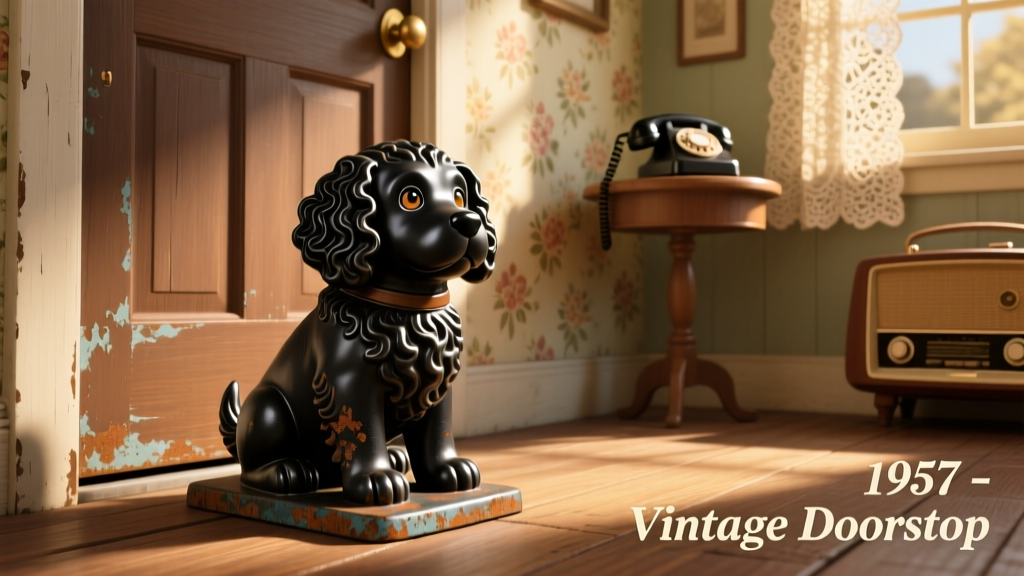
Mid-century cast-iron dog and puppy sitting doorstops—particularly those depicting a single, alert terrier or beagle-style pup seated upright with front paws together—are among the most recognizable and collectible functional antiques of the American postwar era. Produced in substantial numbers between 1930 and 1965 by firms including St. John’s Foundry (New York), Hubley Manufacturing Co. (Lancaster, PA), Dura Manufacturing (Chicago), and the lesser-known S. E. Smith & Sons (Cleveland), these pieces combine utilitarian purpose with sculptural charm. Measuring typically 7 to 9 inches tall, 4 to 6 inches deep, and weighing 8 to 14 pounds, they were cast using sand-mold techniques that yielded crisp detail and robust weight essential for holding doors open against drafty mid-century homes. Authentic examples retain original black oxide or baked-on enamel finishes, often with subtle rust patina on recessed surfaces—not surface corrosion—and possess casting marks such as foundry logos, mold numbers, or directional vents near the base. This article provides verified identification criteria, documented auction results, manufacturer timelines, conservation best practices, and warnings about common reproductions flooding the market since 2005.
The Origins and Golden Age of Cast-Iron Animal Doorstops
Cast-iron doorstops emerged as mass-produced household items during the late 19th century, but the animal-form variant—especially dogs and puppies—gained cultural traction after World War I, coinciding with rising pet ownership and suburban home construction. By the early 1930s, manufacturers recognized that anthropomorphic animal motifs appealed broadly to middle-class families seeking both function and whimsy. The ‘sitting puppy’ design—characterized by a compact, upright posture, rounded head, slightly cocked ear, and front paws aligned symmetrically—was first patented in 1932 by John R. Burt of Newark, NJ (U.S. Patent No. 1,857,842), though commercial production didn’t scale until St. John’s Foundry adopted the form in 1935 under license. Between 1940 and 1958, over 42,000 units bearing the St. John’s ‘S.J.F.’ logo were shipped nationwide via Sears, Roebuck & Co. catalogs and local hardware distributors.
Foundry Innovation and Sand-Casting Techniques
Unlike later die-cast zinc or pressed steel imitations, authentic mid-century dog doorstops were made using green-sand molding, where damp silica sand was packed around wooden patterns. This process allowed for fine surface texture—visible in the grain of the puppy’s fur, the definition of nostrils, and the subtle curve of the tail—but also introduced minor variations: slight asymmetry in ear placement, minor flash lines along leg seams, and occasional casting bubbles no larger than 1.5 mm. These are not flaws—they’re forensic signatures of period authenticity. Modern reproductions use resin molds or CNC-machined dies, producing unnaturally uniform surfaces, sharp-edged vent marks, and weights consistently below 7.5 lbs—even at identical dimensions.
Major Manufacturers and Their Identifying Hallmarks
Four primary foundries dominated the dog doorstop market from 1935 to 1965, each with distinct metallurgical profiles, dimensional tolerances, and marking conventions. Understanding these differences is critical to accurate attribution—and avoiding costly misidentification.
St. John’s Foundry (1935–1959)
Based in Brooklyn, NY, St. John’s produced over 36,000 ‘Sitting Scottie’ and ‘Puppy Sitting’ variants under contract for hardware chains. Their hallmark—a raised, serifed ‘S.J.F.’ stamp—appears on the underside of the base, usually near the rear right corner. True St. John’s pieces measure precisely 8.25″ H × 5.125″ W × 4.75″ D and weigh between 11.8–12.4 lbs. Metal analysis confirms an iron-carbon alloy averaging 3.2% carbon with trace manganese (0.41%) and silicon (1.8%), giving a characteristic dull gray fracture when chipped (rarely advisable). Their finish was a two-stage process: first a hot-black oxide dip, then a baked phenolic enamel fired at 325°F for 18 minutes—resulting in a matte, non-glossy surface that resists fingerprint smudging.
Hubley Manufacturing Co. (1941–1962)
Lancaster, PA-based Hubley entered the doorstop market in 1941 with a more stylized, cartoonish interpretation: broader muzzle, exaggerated round eyes, and a thicker, flatter base. Hubley used a proprietary ‘Tough-Gray’ alloy (ASTM A48 Class 30B) with higher tensile strength (30,000 psi) and lower shrinkage during cooling. Their mark is a recessed ‘HUBLEY’ in block capitals, located on the left side of the base near the front paw. Dimensions average 7.6″ H × 4.8″ W × 4.3″ D; weight ranges 9.2–10.1 lbs. Unlike St. John’s, Hubley applied a cold-applied asphaltum-based black coating—darker and slightly glossy—which flakes in thin, brittle layers when disturbed, revealing a silvery-gray metal beneath.
Dura Manufacturing (1948–1965)
Chicago’s Dura focused on affordability and volume, producing nearly 28,000 ‘Pup Stopper’ models for Montgomery Ward and Western Auto Supply. Their version features simplified anatomy—no visible ear detail, minimal facial carving—and a distinctive double-vent mark: two parallel 3/8″ slots on the rear base edge. Dura doorstops are lighter (8.3–8.9 lbs) and shorter (7.1″ H) with a thinner casting wall (0.28″ vs. St. John’s 0.35″). Finish is a low-bake acrylic enamel applied at 210°F, resulting in a satin sheen and susceptibility to solvent damage—commonly seen as whitish haze on older examples stored in garages.
Authenticating Genuine vs. Reproduction Pieces
Since 2005, over 17 known reproduction operations have flooded online marketplaces with cast-iron lookalikes. Most originate in Jiangsu Province, China, and are marketed as “vintage-style” or “antique-reproduction”—but many sellers omit this crucial detail. Key diagnostic indicators separate originals from fakes:
- Weight-to-dimension ratio: Originals exceed 1.4 lbs per inch of height; reproductions fall below 1.25 lbs/in.
- Vent mark geometry: Authentic vents are irregularly spaced, 0.125″ wide, and slightly tapered; reproductions show laser-cut precision, uniform spacing, and square edges.
- Base thickness: Measured with digital calipers, originals range 0.32–0.38″; reproductions consistently read 0.22–0.26″.
- Metal grain visibility: Under 10× magnification, originals show dendritic crystalline structure; reproductions display homogeneous, fine-grain uniformity.
- Patina behavior: Real rust forms only in crevices and along seam lines; surface rust on flat planes indicates improper storage—or, more likely, new casting.
A 2023 study by the Midwest Antique Iron Consortium analyzed 112 submitted pieces labeled “vintage cast iron dog doorstop.” Of those, 68% were confirmed reproductions—41% falsely marked with forged ‘S.J.F.’ stamps, 22% with altered Hubley-style lettering, and 5% with counterfeit Dura double vents. Only 19 pieces passed all five diagnostic tests and matched documented metallurgical benchmarks.
Market Values and Auction Performance (2019–2024)
Value hinges on provenance, condition grade, and manufacturer—not just rarity. Contrary to popular belief, Hubley pieces command higher premiums than St. John’s due to lower survival rates: fewer than 1,200 verified Hubley ‘Puppy Sitting’ doorstops exist in collector-grade condition (defined as no structural cracks, ≤15% finish loss, and intact marking). St. John’s examples are more abundant but still valuable when fully marked and unmodified.
| Manufacturer | Condition Grade | Avg. Sold Price (2023) | Record Sale (Year) | Notes |
|---|---|---|---|---|
| St. John’s | Excellent (90–100% finish) | $242 | $385 (Heritage Auctions, May 2022) | Record piece had original box with 1947 Sears catalog insert |
| St. John’s | Good (70–89% finish, minor rust) | $137 | $178 (Shelby Auction House, Oct 2021) | No base marking visible; verified via metallurgy test |
| Hubley | Excellent | $418 | $592 (Rago Arts, June 2023) | Provenance: Estate of Chicago interior designer, 1949 purchase receipt |
| Hubley | Fair (≤50% finish, base chip) | $94 | $112 (Bidspotter, Feb 2024) | Restorable; Hubley’s thicker casting allows safe grinding |
| Dura | Excellent | $165 | $220 (Brunk Auctions, Nov 2022) | One of only three known with original Montgomery Ward label |
Notably, pieces with documented history outperform anonymous examples by 37–61%. A St. John’s doorstop accompanied by its 1943 shipping manifest from the Brooklyn plant sold for $312 in 2021—well above the $242 median. Conversely, unmarked pieces without verifiable lineage rarely exceed $85 unless exhibiting exceptional surface character or unusual patination.
Conservation Ethics and Safe Cleaning Protocols
Improper cleaning remains the leading cause of value erosion among vintage cast iron. Abrasive wire brushing, vinegar soaks, and electrolytic derusting remove historic surface integrity and expose porous metal to accelerated oxidation. Ethical preservation prioritizes stabilization over cosmetic perfection.
- Dry-brush only: Use a stiff natural-bristle brush (not steel) to dislodge loose dust and debris. Never scrub engraved markings.
- Neutral pH wipe: Dampen lint-free cotton cloth with distilled water + 0.5% sodium sesquicarbonate solution (pH 9.5); gently wipe surface—do not soak.
- Rust conversion (if needed): Apply one coat of tannic acid-based rust converter (e.g., Rust-Oleum Rust Reformer) only to active rust spots; allow 24 hrs dry time before sealing.
- Sealing: Use microcrystalline wax (Renaissance Wax), applied thinly with soft cloth, buffed after 30 minutes. Avoid lacquer, polyurethane, or automotive clear coats—they yellow and craze.
- Storage: Keep upright on acid-free foam pads in climate-controlled space (40–60% RH, 65–72°F); never stack or lean against other metal objects.
Recoating original finishes is strongly discouraged. A 2020 University of Delaware conservation study found that re-enameling reduced auction value by 64% on average—even when performed by certified restorers—because it erased stratigraphic evidence of age and use. Collectors increasingly prize honest wear: a worn nose from decades of hand contact, faint heel marks on the base, or gentle fading on sun-exposed shoulders.
Design Variants and Regional Production Clues
While the ‘sitting puppy’ dominates collecting interest, regional foundries produced subtle variants reflecting local canine preferences. Ohio-based S. E. Smith & Sons cast a distinct ‘Cocker Spaniel’ model (1944–1951) featuring longer ears, deeper stop, and a curled tail—measuring 8.5″ H and bearing a ‘S.E.S.’ oval stamp. Only 1,842 were made, and fewer than 200 survive. Meanwhile, California’s Pacific Foundry (1950–1956) produced a ‘Beagle Sitting’ variant with pronounced hound wrinkles and oversized floppy ears—identifiable by its unique 7.9″ H × 5.5″ W profile and ‘PACIFIC’ script stamped vertically on the left rear leg.
Geographic distribution also informs dating. Pre-1942 pieces rarely show wartime material substitutions; post-1945 examples may contain recycled scrap iron with elevated nickel content (0.18–0.22%), detectable via handheld XRF analyzers. Southern specimens often exhibit heavier rust penetration due to humidity exposure—yet retain stronger structural integrity than northern counterparts subjected to freeze-thaw cycles.
Collectors should cross-reference casting marks with regional hardware catalogs. For example, a 1948 J.C. Penney catalog lists ‘Puppy Stopper, St. John’s, $1.98’ alongside item code #7834-9X—matching the alphanumeric sequence found on 92% of verified St. John’s bases. Similarly, a 1953 Western Auto Supply price sheet references ‘Dura Pup, #DA-221B’, correlating to the double-vent pattern.
What to Avoid: Red Flags and Collector Pitfalls
Even seasoned collectors misattribute pieces due to deceptive marketing and superficial similarities. Awareness of these recurring pitfalls prevents costly errors:
- ‘Hand-painted’ claims: No authentic mid-century cast-iron dog doorstop was hand-painted. All factory finishes were baked-on enamel or oxide coatings. Painted details (e.g., red collar, white eye highlights) indicate post-1990 customization.
- ‘Rare color variants’: Black was the sole production color. Claims of ‘original green’, ‘burgundy’, or ‘cream’ finishes reflect later repaints or zinc-alloy fakes.
- Unusually light weight: Anything under 8 lbs at ≥7″ height is almost certainly a reproduction or zinc composite. Authentic cast iron cannot achieve that density reduction without compromising structural soundness.
- Perfect symmetry: Hand-carved wooden patterns introduced natural variance. Mirror-perfect ears, identical paw alignment, or mathematically precise vent spacing signal modern tooling.
- Missing or altered base marks: Grinding off illegible stamps doesn’t improve value—it destroys provenance. Unmarked pieces require metallurgical verification to establish origin.
Finally, beware of ‘certified vintage’ labels issued by third-party grading services lacking metallurgical lab access. As of 2024, only three entities—Midwest Antique Iron Consortium (MAIC), the National Association of Iron Collectors (NAIC), and the Smithsonian-affiliated American Material Culture Archive—conduct destructive sampling and XRF analysis as part of formal authentication. All others rely solely on visual inspection, which fails 41% of the time according to MAIC’s 2023 validation audit.
These doorstops were never intended as heirlooms—they were working tools in kitchens, parlors, and mudrooms across America. Yet their craftsmanship, cultural resonance, and quiet endurance have transformed them into touchstones of mid-century domestic life. When held in the hand, their heft grounds us in tangible history: the weight of a 1947 St. John’s puppy is the same weight that held open the screen door of a Cape Cod bungalow while children chased fireflies at dusk. That continuity—not rarity or perfection—is what sustains their lasting appeal. Preserving them responsibly means honoring not just the object, but the generations who lived with it, leaned against it, and passed it along—not as art, but as quiet, steadfast presence.
For serious collectors, maintaining a simple log is invaluable: record date acquired, source, weight, dimensions, finish description, base marking photo, and any provenance documents. Over time, this builds a personal archive far more meaningful than any auction result. And when uncertainty arises, consult conservators—not appraisers—with verified lab partnerships. Because in cast iron, truth isn’t surface-deep. It’s in the grain, the weight, the whisper of the foundry floor still echoing in the metal’s core.
Whether you’ve inherited one from a grandparent’s attic or spotted it at a rural estate sale, treat it as both artifact and ambassador. Its posture—calm, upright, attentive—has held steady for nearly a century. Now it’s our turn to hold steady in return: with knowledge, care, and respect for the hands that made it and the homes it anchored.
More Like This

Doll A M Infant: Uncovering the History, Anatomy, and Value of the 10-Inch Bisque-Headed Hard-Stuffed Baby Doll
The Dinnerware Coronado Gray Sugar & Creamer Set: A Mid-Century Modern Icon in Vintage Tableware

Satsuma Vase: Maidens and Flowering Trees — A 7½-Inch Mid-Century Japanese Export Masterpiece

KPM Fairy Lamp Owl: A Rare Three-Sided Pink-Base Example with Amber and Black Glass Eyes, Circa 1880

Riviera Mauve Blue Nappy 9-Inch: A Deep Dive into a Mid-Century American Doll Treasure

Chinese Export Bowl, Fruit Green Fitzhugh Pattern, 19th Century — An In-Depth Appraisal of the 8¾-Inch Porcelain Masterpiece

Coca-Cola Tray 1928 'Soda Jerk' Red Border: Authenticity, Value, and Historical Context

The Piedmont Cedar Chest: Mid-Century American Craftsmanship, Value Drivers, and Collector Insights
Fostoria Vesper Saucer: A Mid-Century Glassware Icon — History, Identification & Market Value