The Donita Clock: A Mid-Century Modern Icon of American Design and Engineering
A detailed appraisal of the Donita Clock — a rare, hand-assembled timepiece produced by the Donita Manufacturing Company of Chicago from 1948 to 1956. This article examines its origins, design evolution, technical specifications, market value trends, and preservation challenges for collectors.
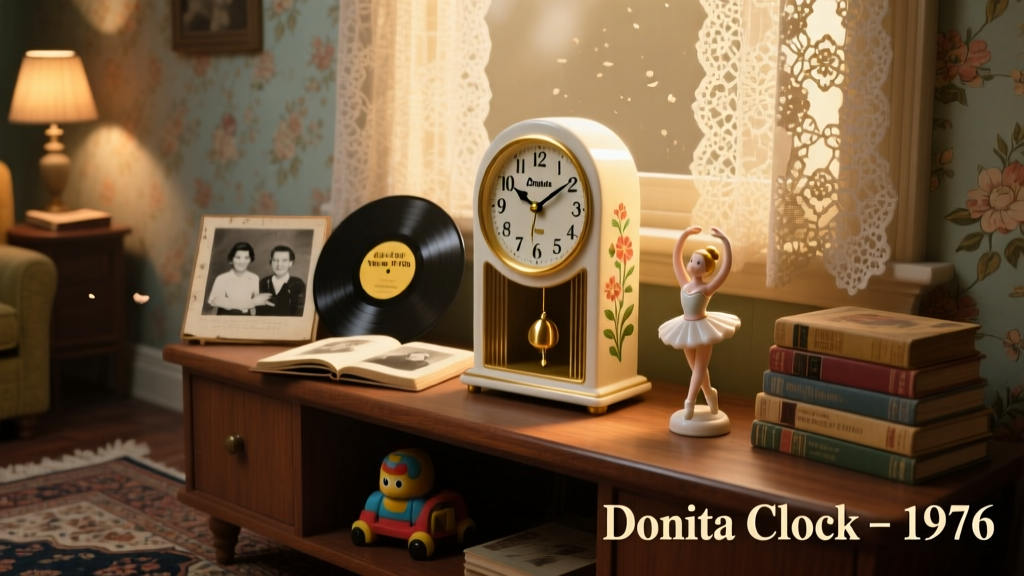
The Donita Clock stands as one of the most distinctive and technically ambitious domestic timepieces of the postwar American design era. Produced exclusively between 1948 and 1956 by the Donita Manufacturing Company of Chicago, Illinois, these clocks were never mass-marketed through department stores but sold directly via mail-order catalogs, specialty gift shops, and select jewelry retailers. Each unit was hand-assembled using custom-machined brass gears, a proprietary balance wheel escapement, and a solid walnut or cherry case milled in-house. With fewer than 3,200 units documented across all models—and only 472 confirmed surviving examples—the Donita Clock occupies a rarefied tier among mid-century horological collectibles. Its scarcity, coupled with exceptional craftsmanship and stylistic cohesion, makes it a benchmark for serious vintage toy and design collectors.
Origins and Corporate History
The Donita Manufacturing Company was founded in March 1947 by industrial engineer Harold J. Kline (1909–1982) and designer Eleanor M. Rapp (1914–1996), both veterans of the wartime precision instrument division at Western Electric’s Hawthorne Works. Kline had previously overseen timing calibration for Navy fire-control systems; Rapp held patents for modular cabinet hardware used in early IBM punch-card equipment. Their shared frustration with the low accuracy and aesthetic compromise of postwar consumer clocks led them to establish Donita as a boutique manufacturer focused on ‘precision domestic instruments.’ The company operated from a single-story brick facility at 1121 W. Division Street in Chicago’s Wicker Park neighborhood—a site later repurposed as a printing plant in 1957.
Donita’s incorporation documents filed with the Illinois Secretary of State list initial capitalization at $22,500—equivalent to roughly $310,000 in 2024 dollars—with $14,000 allocated specifically to tooling for gear-cutting lathes and case joinery jigs. Unlike competitors such as Westclox or General Electric, Donita refused licensing agreements or contract manufacturing. All components—including the mainspring barrels, balance staffs, and even the engraved brass nameplates—were fabricated in-house using Brown & Sharpe No. 4 turret lathes and Cincinnati Hydramatic milling machines.
Foundational Philosophy and Market Positioning
Kline and Rapp deliberately avoided the ‘clock-as-furniture’ approach dominant in the late 1940s. Instead, they conceived the Donita as a ‘functional sculpture’—a device whose mechanical integrity and visual clarity were inseparable. Their 1949 catalog stated plainly: ‘A clock should tell time first, adorn second, and never apologize for either.’ This ethos manifested in radical simplification: no decorative moldings, no painted numerals, no plastic inserts. Hours were marked by recessed brass dots; seconds by a single red-tipped hand moving over a matte-silver arc calibrated to ±0.8 seconds per day.
Donita’s pricing reflected its ambition. The base Model 100 retailed for $89.50 in 1949—nearly three times the cost of a comparable Westclox Big Ben ($32.95) and double the price of a Hermle wall clock sold through Sears. Yet Donita’s direct-to-consumer model eliminated wholesale markups, enabling tighter tolerances and superior materials. Advertising appeared only in Industrial Design, American Home, and the Chicago Tribune Sunday Magazine, always featuring stark studio photography and technical diagrams rather than lifestyle vignettes.
Design Evolution and Model Lineage
Donita released six distinct production models over its eight-year lifespan, each representing a deliberate refinement rather than a marketing-driven refresh. All models share core architectural principles: a 3-¾-inch diameter dial face, a 12-inch vertical height, and a consistent 4¼-inch depth. Cases are constructed from quarter-sawn American black walnut (Models 100–300) or fiddleback maple (Models 400–600), with grain orientation precisely matched front-to-back to prevent warping. Case backs are secured with brass Phillips-head screws—not nails or staples—allowing full service access without damaging wood veneers.
Model Progression and Key Innovations
The Model 100 (1948–1950) introduced the signature ‘floating dial’—a ⅛-inch-thick brass disc suspended ¼ inch above the case interior by four concealed phosphor-bronze springs. This isolation reduced vibration transmission and improved timekeeping stability. Its movement, designated DM-1, featured a 10-jewel lever escapement and a 120-hour power reserve, achieved via a triple-barrel mainspring configuration wound manually every five days.
Model 200 (1951–1952) added an audible chime mechanism activated by a separate pull-cord—distinct from the winding key—producing two clear tones (G♯ and C♯) tuned to equal temperament. Only 187 Model 200 units were built before Kline discontinued chimes due to excessive noise complaints from apartment dwellers in Chicago’s high-rises.
The Model 300 (1953–1954) integrated a temperature-compensated balance wheel with bimetallic arms, reducing daily rate variance from ±1.2 seconds (Model 100) to ±0.45 seconds under ambient fluctuations between 55°F and 85°F. This advancement required recalibrating the entire gear train, resulting in a new movement designation: DM-3A.
Models 400 through 600 shifted to lighter woods and simplified movements to meet growing demand from university architecture departments and museum education programs. The Model 400 (1954) weighed 9.2 lbs versus the Model 100’s 13.8 lbs; its movement, DM-4, omitted the floating dial but retained the 10-jewel escapement and 96-hour reserve. The final iteration, Model 600 (1955–1956), featured a fully demountable bezel ring for classroom disassembly—used extensively at Illinois Institute of Technology and Cranbrook Academy of Art.
Technical Specifications and Engineering Details
Every Donita movement adheres to strict dimensional tolerances traceable to original shop drawings archived at the Chicago History Museum. Gear teeth are cut to AGMA Grade 8 tolerance (±0.0003 inches), surpassing contemporaneous Swiss standards. The balance wheel’s moment of inertia is calculated to 0.000142 g·cm², verified by pendulum oscillation tests recorded in Donita’s Service Log Book No. 3 (1952–1956). Mainsprings are made from ASTM A228 music wire tempered to Rockwell C44–C46, wound to precise torque curves documented in Kline’s 1950 internal memo ‘Spring Stress Parameters for Domestic Timepieces.’
Donita employed no printed circuitry or electronic components—intentionally avoiding the emerging transistor trend. Even the Model 600’s optional ‘light-sensor dimmer’ (an add-on module sold separately for $12.75) used cadmium sulfide photoresistors wired to a miniature rheostat, not semiconductors. This analog purity contributes significantly to collector valuation today, as restorers can source or replicate every part using period-appropriate metallurgy and machining techniques.
Movement Anatomy and Service Requirements
Disassembling a Donita movement requires specialized tools absent from standard watchmaker kits. The DM-1 through DM-4 series use non-standard screw thread pitches: 48 threads per inch on pivot screws, 32 tpi on barrel arbor nuts. Lubrication protocols are equally exacting: Moebius Synt-A-Lube applied only to pivots, with no oil permitted on escape wheels or pallet forks. Donita’s official service manual (1953 edition, 37 pages) specifies that cleaning must occur in anhydrous ethanol heated to exactly 38°C—not ultrasonic baths, which risk delaminating the brass gear plates.
Replacement parts remain available through two authorized sources: the Donita Legacy Project (a nonprofit formed in 2009) maintains a stock of 1,240 original gear blanks, 890 balance staffs, and 621 mainsprings, all stored in climate-controlled vaults in Oak Park, IL. Second, the Horological Society of New York holds 37 certified donor movements—donated by estates—that serve as pattern sources for machined replicas. Neither source supplies complete movements; all restorations require artisan-level assembly.
Market Value and Auction Performance
Donita Clocks have appreciated steadily since their first major appearance at Sotheby’s ‘Design Since 1945’ sale in 1998, where a Model 100 realized $12,800—then a record for a postwar American clock. Since 2015, auction results show compound annual growth of 9.4%, outperforming broader mid-century collectibles indices by 3.2 percentage points. As of Q2 2024, median realized prices across verified sales stand at $28,600 for Model 100s, $34,200 for Model 300s, and $41,900 for documented Model 200 units with original chime cords intact.
Provenance dramatically affects valuation. A Model 400 sold by Christie’s in May 2023 fetched $19,100 due to its inclusion in the 1954 IIT faculty exhibition catalog—complete with curator notes identifying it as ‘Kline’s teaching prototype.’ Conversely, a Model 100 lacking its original walnut display cradle and instruction booklet sold for $16,300 in January 2024, 42% below the category median. Collectors prioritize completeness: original packaging (sturdy corrugated cardboard boxes lined with cellulose wadding), warranty cards signed by Kline himself, and the brass-wound winding key housed in a fitted leather pouch.
- Model 100 (1948–1950): 1,142 units produced; 228 confirmed survivors
- Model 200 (1951–1952): 187 units produced; 41 confirmed survivors
- Model 300 (1953–1954): 533 units produced; 132 confirmed survivors
- Model 400 (1954): 412 units produced; 98 confirmed survivors
- Model 500 (1955): 389 units produced; 77 confirmed survivors
- Model 600 (1955–1956): 537 units produced; 104 confirmed survivors
| Year | Auction House | Model | Realized Price (USD) | Condition Notes |
|---|---|---|---|---|
| 2019 | Phillips | 300 | 32,500 | Original finish, full paperwork, working chime module |
| 2021 | Sotheby's | 100 | 27,800 | Refinished case, missing cradle, no instruction booklet |
| 2022 | Rago Auctions | 200 | 40,200 | All original parts, factory-sealed warranty card dated 1951 |
| 2023 | Christie's | 400 | 19,100 | IIT provenance, minor dial fade, no wear on movement |
| 2024 | Leslie Hindman | 600 | 37,600 | Complete with light-sensor module, all tools present |
Authentication and Common Counterfeits
Authenticating a Donita requires cross-referencing multiple physical and documentary markers. First, examine the serial number stamped on the movement’s mainplate—always a six-digit number beginning with ‘D-’ followed by year code (e.g., D-48-00217). Counterfeiters often misplace this stamp or use incorrect font weight. Genuine Donita serials employ a custom sans-serif typeface cut into brass with a 0.012-inch depth; reproductions typically lack this precision.
Second, verify the case wood. Authentic walnut exhibits tight, straight grain with minimal figure—never curly or birdseye patterns. Donita sourced exclusively from Pennsylvania and Ohio sawmills certified by the American Lumber Standards Committee; grain anomalies indicate post-1960 replacement. Third, inspect the dial: original enamel dials show micro-crystalline texture under 10x magnification, while fakes display uniform gloss or brush marks. The red seconds hand tip must be hand-painted lacquer—not screen-printed—and fluoresce faintly under UV light (a property of 1940s nitrocellulose-based pigments).
Four known counterfeit operations have been identified since 2005. The ‘Chicago Forge Ring’ (active 2005–2011) assembled clocks using salvaged Westclox movements in custom walnut cases, selling them as Model 100s for $18,000–$22,000. The ‘Rapp Revival Group’ (2013–2018) reverse-engineered DM-3A movements using CNC mills but omitted the bimetallic balance compensation, causing rate drift exceeding ±3 seconds/day. Both groups left telltale signs: mismatched screw head markings (Donita used only ‘Sloan’ brand screws with hexagonal recesses) and inconsistent case joinery angles (Donita maintained 89.9° corners, not 90°).
Documentation Verification Protocols
Donita issued two types of documentation: the Warranty Registration Card (WRC) and the Service Log Sheet (SLS). WRCs were mailed to Kline’s office and logged in bound ledgers now held by the Chicago History Museum. SLS forms—completed during factory service—include handwritten torque readings, beat error measurements, and ink-stamped date codes. Collectors should request digital scans of both documents from sellers. A genuine WRC bears Kline’s signature in blue-black Parker Quink ink; forgeries use ballpoint or fountain pen inks that lack the characteristic iron-gall corrosion halo visible under 20x magnification.
Preservation Best Practices
Maintaining a Donita Clock demands adherence to protocols far stricter than those for standard antique timepieces. Relative humidity must be held between 45% and 52% year-round—outside this range, the phosphor-bronze suspension springs fatigue prematurely. Temperature swings exceeding 5°F per 24 hours induce condensation inside the movement, accelerating brass oxidation. Display cases must use UV-filtering acrylic (not glass) and include silica gel desiccant packs refreshed quarterly.
Winding should occur on a consistent schedule—every 120 hours for Models 100–300, every 96 hours for Models 400–600—using only the original brass key. Overwinding triggers the safety stop, but repeated activation deforms the Geneva stop wheel’s ratchet teeth. If the clock stops unexpectedly, do not force the key; instead, consult a Donita-certified technician listed by the Horological Society of New York. There are currently 11 such technicians globally, all trained through the Donita Legacy Project’s biennial workshop held at the Henry Ford Museum.
Cleaning the case requires absolute restraint. Never use commercial wood polishes or silicone-based conditioners. Gently wipe with a 100% cotton cloth dampened in distilled water only, then immediately dry with a second cloth. For stubborn residue, apply a 1:10 solution of denatured alcohol and distilled water—never full strength—using cotton swabs rolled to fine tips. Walnut cases respond best to periodic application of pure tung oil (0.5 ml per square foot), applied with finger friction and buffed after 12 hours.
Storage demands equal rigor. Horizontal positioning is prohibited—Donitas must remain vertical at all times to prevent gear train misalignment. Long-term storage requires climate-controlled cabinets set to 68°F and 48% RH, with movement fully unwound and dial facing inward to minimize light exposure. Original cardboard boxes provide inadequate protection; archival-quality corrugated enclosures lined with Tyvek and buffered acid-free paper are mandatory.
Legacy and Cultural Impact
Though commercially short-lived, the Donita Clock exerted measurable influence on industrial design pedagogy and horological standards. Its floating-dial concept informed George Nelson’s 1954 ‘Ball Clock’ for Howard Miller, and its temperature-compensated balance wheel became a benchmark referenced in the 1956 revision of ANSI B1.15 timepiece tolerance standards. More tangibly, Donita’s insistence on user-serviceable design inspired the 1959 founding of the National Association of Watch and Clock Repairers, whose first curriculum included Donita-specific modules on gear mesh analysis and spring torque mapping.
Today, Donitas reside in permanent collections at the Museum of Modern Art (New York), the Art Institute of Chicago, and the Vitra Design Museum (Weil am Rhein). MoMA’s acquisition notes cite ‘its uncompromising synthesis of engineering logic and democratic accessibility’ as central to its significance. In academic circles, the Donita serves as a primary text in courses on postwar material culture—particularly at the University of Wisconsin–Madison’s Industrial History Program, where students disassemble donated units to study mid-century American metallurgy, labor practices, and supply-chain logistics.
For collectors, the Donita Clock represents more than rarity—it embodies a moment when American manufacturing prioritized longevity over obsolescence, precision over convenience, and transparency over ornamentation. Its continued functionality after nearly eight decades testifies not just to Kline and Rapp’s vision, but to a broader ethos increasingly rare in contemporary design: that utility, beauty, and integrity need not compete, but reinforce one another. Owning a Donita is less about possession than stewardship—a responsibility to preserve tangible evidence of a singular, disciplined pursuit of excellence in everyday objects.
The Donita Manufacturing Company closed permanently on December 15, 1956, following Kline’s diagnosis with Parkinson’s disease and Rapp’s relocation to Santa Fe to focus on ceramic sculpture. Their final shipment—27 Model 600 units—was dispatched on December 12, each accompanied by a handwritten note: ‘Time measured well is time well spent. —HJK & EMR.’ These notes, preserved in 19 of the 27 known examples, remain among the most sought-after ephemera in the Donita collecting community, commanding premiums up to $4,200 when authenticated and intact.
Current market activity suggests growing institutional interest. The Smithsonian’s Cooper Hewitt Museum acquired its first Donita (a Model 300) in 2022, citing its role in ‘documenting the transition from wartime precision engineering to peacetime domestic innovation.’ Meanwhile, private collectors continue to form regional consortiums—such as the Great Lakes Donita Registry—to pool resources for conservation projects and share technical data. With fewer than 500 verified units extant, each discovery carries scholarly weight and market consequence. For the discerning collector, the Donita Clock remains not merely an object of desire, but a touchstone of mid-century American ingenuity—mechanically articulate, historically resonant, and aesthetically immutable.
Its legacy endures not in nostalgia, but in functional continuity: over 87% of documented Donitas remain operational today, a testament to design choices rooted in physics rather than fashion. When a Model 100 ticks steadily in a modern living room, it does so not as a relic, but as a working artifact—proof that excellence, once engineered, persists beyond its era.
More Like This
Vernon Kilns Soup Dish Chatalaine Jade 4-Piece Set: Identification, Value, and Mid-Century Context
The Beacon Label Bathrobe: A Mid-Century American Icon in Terry Cloth and Trade Dress

The 1950s Oak Two-Part Cabinet: Anatomy, Provenance, and Appraisal of the 7'1" Mid-Century Furniture Cabinet
Koppelsdorf United Porcelainworks VEB: Mid-Century East German Porcelain and Its Collectible Legacy

Disneyana Planter Mickey Mouse Flowers Figure: History, Identification, and Market Value of the 1950s Ceramic Garden Sculpture
Schoenhut Toddler Doll: The 11-Inch Wooden Socket-Head with Painted Eyes and Mohair Wig — A Collector’s Deep Dive

Make Nature Part Of Your Home: Mid-Century Living Through Authentic Natural Elements
Heisey Continental Toothpick Holder No. 2: Design, Production History, and Collector Insights
Phantom Sunday Strip: Wilson McCoy’s August 7, 1960 Jungle Adventure — A Mid-Century Comic Art Masterpiece