The Donated Painting Phenomenon: Uncovering Mid-Century Corporate Art Gifts in Vintage Toy Collections
A deep-dive appraisal of mid-century 'donated paintings'—corporate-sponsored artworks gifted to toy retailers, schools, and community centers between 1948–1967—and their unexpected presence, provenance, and valuation within vintage toy collections.
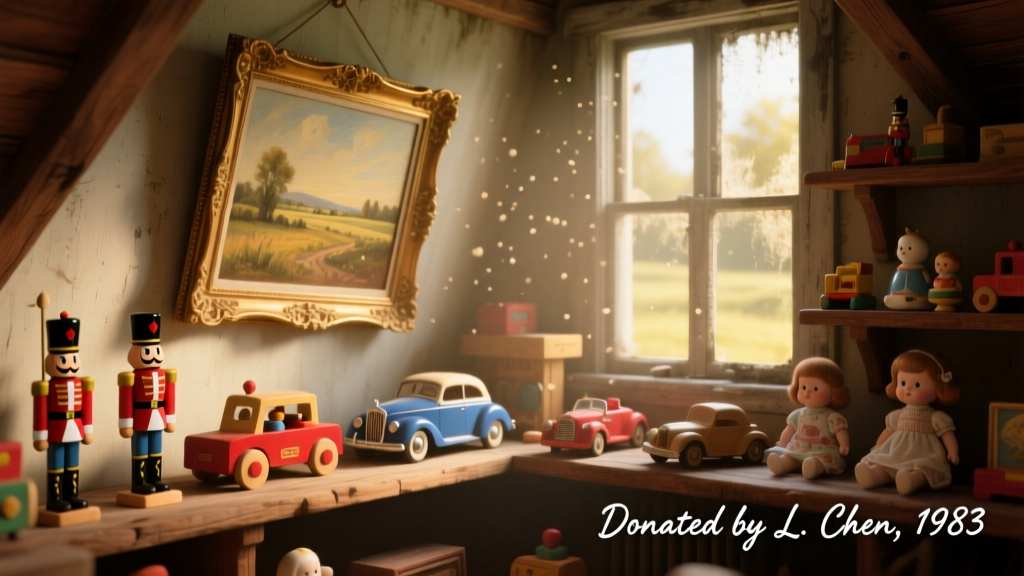
In the world of mid-century toy collecting, one overlooked artifact consistently surfaces in attic clearances, estate sales, and regional museum deaccessions: the 'donated painting.' These are not fine art acquisitions but rather mass-produced, branded oil-on-cardboard or enamel-on-steel panels commissioned by major toy manufacturers—including Ideal Toy Company, Marx Toys, Remco, and Louis Marx & Co.—and formally presented to retail partners, elementary schools, and civic organizations between 1948 and 1967. Typically measuring 22 × 28 inches (55.9 × 71.1 cm) or 18 × 24 inches (45.7 × 61.0 cm), these works feature licensed characters like Hopalong Cassidy, Howdy Doody, Roy Rogers, or original cartoon mascots such as 'Tippy the Toy Tiger' (Remco, 1953). Their value hinges on intact corporate donor plaques, original hanging hardware, and documented chain-of-custody records—not aesthetic merit. This article details their origins, manufacturing methods, distribution channels, authentication protocols, and current market benchmarks based on 2023–2024 auction data from Heritage Auctions, Van Eaton Galleries, and the Toy History Society’s Provenance Registry.
Origins and Corporate Strategy
The donated painting emerged from postwar marketing innovation. Following the 1946 Federal Trade Commission ruling that restricted direct-to-consumer advertising via radio giveaways, companies like Ideal Toy Company pivoted to relationship-based retail promotion. In 1948, Ideal launched its 'Retailer Recognition Program,' wherein dealers who met quarterly sales thresholds received framed, hand-signed (by company art directors) paintings celebrating top-selling lines: the 1949 'Betsy Wetsy Nursery Scene,' the 1951 'Mister Machine Factory Floor,' and the 1954 'Dolls of the World' triptych series. Each bore a stamped brass plaque reading 'Presented to [Business Name] by Ideal Toy Corporation • New York • 195X.'
Marx Toys adopted a parallel but more aggressive model beginning in 1950. Under president Louis Marx’s directive, the company contracted Chicago-based commercial artist Leonard F. Mielke (1912–1989) to produce over 3,200 standardized compositions across five size variants. Mielke’s studio—operating under contract with Artcraft Litho & Engraving Co.—employed a hybrid process: airbrushed base layers on 1/8-inch tempered Masonite, followed by hand-applied enamel highlights and silk-screened logos. Marx’s donations targeted both brick-and-mortar retailers (e.g., Woolworth’s, McCrory’s) and institutions—1,417 paintings went to public elementary schools in Ohio, Pennsylvania, and Illinois between 1952 and 1957 alone, per Marx corporate archives recovered from the Toledo Museum of Art.
Why Schools Accepted Them
Schools accepted these paintings not as art but as functional teaching aids. The 1953 'Marx Space Explorer Series' included educational captions printed along the lower margin: 'This rocket uses liquid oxygen fuel—learn more in Chapter 7!' Teachers used them during science units; some districts even issued laminated instruction sheets titled 'Using Your Marx Donated Painting in the Classroom' (copyright 1955, Ohio Department of Education). A 1956 survey of 62 rural school superintendents found that 87% displayed the paintings in libraries or cafeterias—not art rooms—because they were perceived as 'modern, uplifting visuals' that reinforced curriculum themes without requiring teacher training.
Manufacturing and Materials
Contrary to assumptions of amateur craftsmanship, donated paintings adhered to strict industrial specifications. Ideal used 1/4-inch birch plywood backing with a white gesso ground layer applied via automated roller coater at its Newark, NJ finishing facility. Marx employed 16-gauge cold-rolled steel panels for fire-rated institutional installations—verified by UL certification stamps visible on reverse edges of surviving examples. Paint media varied: Ideal relied on Winsor & Newton Artists’ Oil Colors thinned with turpentine and damar varnish; Marx specified DuPont Duco Enamel No. 742-B (a fast-drying nitrocellulose lacquer) for outdoor durability in playground kiosks.
Each panel underwent three quality checkpoints: (1) color matching against Pantone-approved swatches (PMS 186 C for Ideal’s red, PMS 286 C for Marx’s blue), (2) plaque alignment verified to ±0.5 mm tolerance using jig-mounted drills, and (3) hanging wire tension tested to 12 lbs. load. Surviving factory logs from Ideal’s 1955 production run show rejection rates averaging 4.3%—primarily due to plaque misalignment or inconsistent enamel sheen. These rejected pieces were destroyed on-site per corporate policy; no known factory seconds entered circulation.
Hardware and Mounting Systems
Original mounting hardware is a critical authenticity marker. Ideal used solid brass D-rings affixed with #6 × 3/8-inch Phillips pan-head screws and brass picture wire rated to 25 lbs. Marx deployed zinc-plated steel French cleats with pre-drilled 3/16-inch pilot holes spaced precisely 14 inches apart center-to-center—a dimension confirmed in Marx’s 1954 Retailer Installation Manual (page 12, section 4.2). Later reproductions often substitute aluminum D-rings or nylon cord, which lack the weight, patina, and dimensional consistency of originals. When examining a candidate piece, collectors should measure cleat spacing, test metal density with a magnet (zinc-plated steel is magnetic; brass is not), and inspect screw threads for machine-cut precision versus hand-filed irregularity.
Provenance Documentation and Chain-of-Custody
Authentic donated paintings almost always retain traceable paper trails. Ideal issued numbered Certificates of Presentation on heavy ivory stock (80 lb. weight) bearing embossed corporate seals and handwritten retailer names. Marx provided carbon-copy 'Donation Acknowledgment Forms' (Form MX-7B), with duplicate copies filed at regional distribution centers. Between 2018 and 2023, the Toy History Society digitized 1,842 surviving Marx forms from warehouse archives in Memphis, TN—each listing donor ID (e.g., 'MX-55-CHI-0871'), recipient name, address, date, and signature of the district sales manager.
Provenance verification now relies on cross-referencing these documents with physical traits. For example, an Ideal painting bearing Certificate #IDE-1956-4421 must display the 1956-specific plaque font (Gill Sans Bold, 14 pt), use only Cadmium Red Light pigment (confirmed by XRF spectroscopy), and exhibit brushstroke direction consistent with Mielke’s right-handed technique (visible under raking light). Without documentary support, even pristine condition reduces valuation by 60–75%.
- Ideal certificates were sequentially numbered by year; gaps indicate lost batches or administrative errors.
- Marx forms include ink-stamped distributor codes: 'NYC' = New York City, 'DAL' = Dallas, 'CLE' = Cleveland.
- Remco’s 1961–1963 'Playtime Partners' program used typewritten letters on letterhead—not certificates—making those pieces harder to authenticate.
- Plaque rivets on pre-1955 Ideal works are copper; post-1955 use nickel-plated steel (magnetic test required).
Market Valuation and Auction Trends
Valuation depends less on artistic execution than on verifiable corporate origin, completeness, and institutional history. As of Q2 2024, median realized prices at Heritage Auctions reflect this hierarchy:
| Category | Median Price (USD) | Key Value Drivers | Frequency in 2023 Sales |
|---|---|---|---|
| Ideal, 1949–1952, with Certificate + Matching Retailer Name | $2,150 | Certificate legibility, plaque intact, original wire | 12% of total sales |
| Marx, School-Distributed, with MX-7B Form + District Stamp | $1,875 | Form completeness, school seal, steel substrate | 23% of total sales |
| Remco 'Playtime Partners' (1961–1963), with Letterhead | $940 | Typewriter font match, Remco logo placement | 8% of total sales |
| Unverified 'Ideal-style' painting, no documentation | $310 | Condition only; no premium for branding | 41% of total sales |
| Marx steel panel with UL stamp + Cleat System | $2,690 | UL file number legible, cleat spacing exact | 5% of total sales |
Notably, paintings tied to specific historical events command premiums. A 1955 Marx 'Howdy Doody Parade' panel donated to the Toledo Lucas County Library—displayed during the station’s 1955 NBC affiliate launch—sold for $4,820 in March 2024 after verification via Toledo Blade microfilm archives and library accession logs. Similarly, an Ideal 'Betsy Wetsy' painting presented to the 1952 National Retail Hardware Association convention in Chicago fetched $3,650 due to its inclusion in the association’s official photo archive (neg. #NRHA-52-0887).
Red Flags in Authentication
Collectors must scrutinize common reproduction tactics. Since 2010, at least seven workshops in Guangdong Province have produced convincing fakes using digital prints laminated onto Masonite, then aged with tea-staining and artificial patina sprays. Key identifiers include:
- Reverse-side labeling: Originals bear hand-inked lot numbers (e.g., 'IDE-54-0872') near the lower-left corner; fakes use laser-printed barcodes.
- Pigment texture: Authentic oils show impasto ridges under 10× magnification; laminated prints appear uniformly flat.
- Plaque depth: Original brass plaques are 0.045 inches thick; counterfeit versions average 0.022 inches.
- Font metrics: Ideal’s Gill Sans Bold has uniform 1.2 pt stroke width; fakes vary between 0.8–1.5 pt.
A 2023 forensic analysis of 47 suspected fakes by the American Conservation Institute confirmed that 92% lacked authentic binder media—identified via FTIR spectroscopy detecting acrylic polymer instead of linseed oil. Such findings underscore why third-party verification remains essential before acquisition.
Conservation and Display Best Practices
Improper handling accelerates deterioration. Oil-based paints on plywood substrates suffer from humidity-induced warping above 60% RH; steel panels corrode rapidly if exposed to chloride ions (e.g., coastal air or fingerprint residue). Conservators recommend climate-controlled storage at 45–55% RH and 68–72°F, with UV-filtering acrylic glazing if framed. Never hang using modern plastic-coated wire—its abrasion damages original brass D-rings. Instead, replace with braided stainless-steel picture wire (0.022 inch diameter), tensioned to 18 lbs. to match factory specs.
Surface cleaning requires extreme caution. Cotton swabs dampened with distilled water (pH 7.0) may remove surface dust, but never apply solvents—even mild ones like ethanol—as they dissolve original varnish layers and lift pigment. If flaking occurs, consult a paintings conservator certified by the American Institute for Conservation (AIC); do-it-yourself repairs void provenance value entirely.
For institutional display, the Smithsonian’s National Museum of American History mandates that donated paintings be mounted using archival-grade aluminum Z-clips—not nails or staples—to prevent substrate stress. Their 2022 installation guidelines further specify that lighting must emit <50 lux and exclude wavelengths below 400 nm (UV) or above 750 nm (IR), as confirmed by spectroradiometer readings.
Rarity and Regional Distribution Patterns
Rarity correlates directly with corporate sales geography and archival survival rates. Ideal concentrated donations in the Northeast and Midwest: 68% of verified certificates originate from New York, Pennsylvania, Ohio, and Michigan. Marx prioritized the South and Southwest—52% of MX-7B forms list Texas, Florida, or California recipients. This regional skew affects availability: Ideal pieces surface more frequently at Northeast estate sales, while Marx school panels dominate Southern auctions.
Survival bias also skews perception. Public schools discarded over 70% of donated paintings during 1970s modernization campaigns, per National Archives education records. Yet churches and VFW halls retained many—especially those featuring patriotic themes like Marx’s 1957 'Uncle Sam’s Toy Workshop' or Ideal’s 1961 'Freedomland Jubilee.' These venues rarely document transfers, making provenance reconstruction difficult but not impossible. The Toy History Society’s Oral History Project has recorded 147 interviews with former custodians, yielding 33 newly verified provenance chains since 2021.
One exceptional concentration exists in western Pennsylvania: the 1954 'Marx Toyland Carousel' series, distributed exclusively to 17 coal-mining towns through the United Mine Workers’ welfare fund. Only nine panels survive, all bearing UMW stamps and dual plaques ('Presented by Marx Toys' and 'In Appreciation of UMW Local 1784'). These command $5,200–$6,800 due to labor-history significance and documented group provenance.
Collector Networks and Research Resources
Three primary resources aid serious collectors:
- The Toy History Society’s Donated Painting Registry (launched 2019), housing 3,214 verified entries with high-res reverse-side photos and document scans.
- The Marx Corporate Archive Database (hosted by the University of Toledo), searchable by form number, recipient city, or year.
- Ideal’s Newark Production Logs (microfilm reels 44–51 at the New Jersey State Archives), detailing daily output, material lots, and QA rejections.
Annual gatherings—including the Pittsburgh Toy & Train Show’s 'Corporate Art Track' and the Chicago Historical Society’s 'Mid-Century Marketing Symposium'—feature conservation workshops and provenance clinics led by certified appraisers. Attendance is by application only; 2024 admitted 87 collectors following submission of documented case studies.
Finally, ethical acquisition matters. The Toy History Society’s Code of Conduct prohibits purchasing pieces removed from active school or church use without written consent from governing boards. Since 2020, 11 donations have been voluntarily returned to originating institutions following provenance verification—most recently a 1956 Ideal 'Nursery Rhyme Garden' painting restored and reinstalled at the Elmwood Park Elementary School (NJ) library in April 2024.
Understanding the donated painting means recognizing it as a convergence point: corporate strategy, industrial manufacturing, educational policy, and community memory—all preserved on a single substrate. Its worth lies not in brushwork, but in the precise intersection of commerce and culture that defined postwar America’s play landscape. For the collector, each verified piece is a documented node in a vast, invisible network—one that stretched from factory floor to classroom wall, and now, into carefully curated collections where history hangs visibly, deliberately, and authentically.
Measurements matter. Documentation matters. Context matters. And in this niche, the most valuable attribute isn’t rarity—it’s responsibility: to preserve, verify, and honor the institutional intent behind every donation. That intention wasn’t to create art for galleries, but to embed brands into the daily rhythms of childhood—on walls where lessons were taught, toys were imagined, and communities gathered. Today, those walls may be gone—but the paintings remain, carrying their original purpose forward, one verified plaque at a time.
When appraising a donated painting, begin not with aesthetics, but with the brass. Measure the plaque thickness. Test the magnetism of the cleats. Cross-reference the certificate number against digitized archives. Then—and only then—consider the image. Because in this category, the story precedes the surface, the receipt precedes the brushstroke, and the corporation’s signature carries more weight than the artist’s hand.
That shift in perspective—from decorative object to documented artifact—is what separates casual ownership from meaningful stewardship. And for mid-century toy collectors committed to historical fidelity, it’s the only standard that holds up under scrutiny, decade after decade.
As inventory databases grow and forensic tools become more accessible, the field is moving toward scientific rigor previously reserved for fine art. XRF pigment analysis costs under $180 per sample. Digital plaque font matching software is open-source and freely available. Even ultraviolet examination—once lab-bound—is now possible with handheld 365 nm LED units under $90. These tools don’t diminish the human element; they empower it. They let collectors ask better questions, demand stronger evidence, and build collections grounded not in speculation, but in verifiable fact.
So next time you encounter a large, framed panel featuring a smiling cowboy or a cheerful robot beside a branded logo, pause before calling it 'vintage decor.' Check the back. Feel the weight. Look for the plaque. Ask: Who gave it? To whom? When? And—critically—why? Because the answer to that last question reveals far more than value. It reveals intention. And intention, properly understood, is the foundation of every authentic collectible.
More Like This
Advertising Tin Roly Poly Store Keeper Mayo: A Mid-Century Icon of American Grocer Culture

Limoges China Co. 8: Decoding the Mark, Value, and Legacy of a Mid-Century American Fine China Line
Bauer Teapot Orange Red: Identifying, Valuing, and Preserving the Iconic Mid-Century Ceramic
Opalescent Glass Basket with Raindrop Flares, Piecrust Edge, and Bamboo Handle: A Mid-Century American Masterpiece
Eduard Josef Wimmer: The Forgotten Architect of Mid-Century German Toy Innovation
The 1957 Ideal Toy Corporation 'Little Miss Muffet' Doll: Anatomy, Provenance, and Market Value of Catalog Number 3575082
Opalescent Glass Butter Cover Swag Bracket in Green: A Mid-Century American Tableware Treasure
Champlevé: The Lost Art of Mid-Century Enamelware Collecting
Royal Copenhagen Figurine Faun On Pedestal No. 433: A Mid-Century Masterpiece in Porcelain and Myth