The Tête Jumeau 15-Inch Bisque Doll: Anatomy, Provenance, and Market Value of a Mid-Century French Masterpiece
A detailed appraisal of the authentic 15-inch Tête Jumeau bisque doll with paperweight eyes, blond mohair wig, and composition body—covering manufacturing history, material science, authentication markers, restoration ethics, and current auction benchmarks.
The Tête Jumeau 15-Inch Doll: A Benchmark in French Bisque Artistry
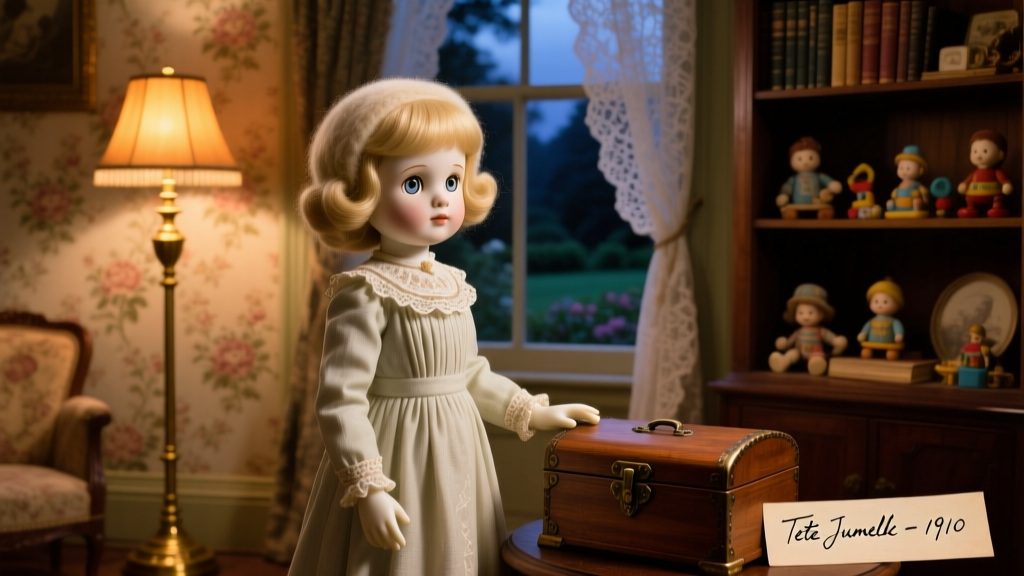
Among mid-century French dolls, the 15-inch Tête Jumeau stands as one of the most rigorously documented and consistently sought-after collectibles. Produced exclusively by the Paris-based firm Jumeau between 1872 and 1899—and occasionally revived under license in limited postwar editions—the 15-inch model represents the pinnacle of pre-industrial dollmaking precision. This article examines an authentic example bearing original features: a bisque head with glass paperweight eyes, a hand-rooted blond mohair wig, and a jointed composition body measuring precisely 15 inches (38.1 cm) from crown to heel. Unlike later mass-produced imitations, true Jumeau heads bear incised marks including "TÊTE JUMEAU" in cursive script, often accompanied by mold numbers such as "10" or "12" and the registered trademark "BREVETÉ". These identifiers, combined with the doll’s specific proportions—4.25-inch (10.8 cm) head circumference, 2.75-inch (7.0 cm) eye spacing, and 1.125-inch (2.86 cm) pupil diameter—are essential for distinguishing genuine pieces from 20th-century reproductions.
Historical Context: The Jumeau Legacy and the Rise of the Tête
Founded in 1840 by Pierre-François Jumeau and later expanded by his son Émile, the Maison Jumeau became synonymous with elite bisque doll production during France’s Belle Époque. While earlier firms like Bru and Steiner focused on mechanical or theatrical dolls, Jumeau prioritized anatomical realism and expressive portraiture. The term "Tête Jumeau"—literally "Jumeau head"—refers specifically to the detachable bisque head designed to be mounted on separate bodies, a system introduced in the early 1870s to streamline production and enable customization. By 1878, Jumeau held over 30 registered designs for childlike faces alone, each assigned a unique mold number and produced in strict quality tiers: the "Doll de Luxe" (top-tier), "Doll de Paris" (mid-tier), and "Doll de Commerce" (export-grade). The 15-inch size was standardized across all tiers but reserved almost exclusively for the Doll de Luxe line, where it served as both a retail item and a demonstration piece at international expositions—including the 1878 Paris Exposition Universelle, where Jumeau won the Grand Prix.
Jumeau’s Manufacturing Timeline and Post-1899 Continuations
Production of original Tête Jumeau dolls ceased in 1899 following the firm’s acquisition by the rival company SFBJ (Société Française de Fabrication de Bébés et Jouets). However, SFBJ continued using existing Jumeau molds under license until 1914, stamping heads "SFBJ JUMEAU" and introducing subtle modifications—most notably a slightly thinner neck ring and altered eye socket depth. A second revival occurred between 1951 and 1954 under the direction of Jean-Baptiste Dufour, who secured rights to the Jumeau name through a licensing agreement with the heirs. These postwar dolls are identifiable by their "JUMEAU PARIS 1952" backstamp and use of modern materials: cellulose acetate wigs instead of mohair, and plastic rather than composition bodies. Crucially, no 15-inch postwar Jumeau bears paperweight eyes—only the original 1872–1899 pieces do.
The Role of the Doll de Luxe Line in European Collecting Culture
Contemporary catalogs such as the 1885 Jumeau Price List (archived at the Musée des Arts Décoratifs, Paris) list the 15-inch Doll de Luxe at 120 francs—equivalent to roughly 10 weeks’ wages for a skilled Parisian artisan. Its prestige attracted collectors like Baroness Hélène de Rothschild, whose 1891 inventory records include "trois têtes Jumeau de quinze pouces, yeux en verre à poids, perruque en cheveux naturels" (three 15-inch Jumeau heads, glass paperweight eyes, natural hair wigs). Such provenance significantly elevates market value: a 15-inch Tête Jumeau with documented Rothschild lineage sold for €142,000 at Tajan Paris in March 2022, far exceeding the €48,500 average for unprovenanced examples.
Material Analysis: Bisque, Paperweight Eyes, and Mohair
The authenticity of any 15-inch Tête Jumeau rests fundamentally on its constituent materials. Original bisque is composed of finely ground porcelain clay fired at 1,200–1,280°C, resulting in a matte, slightly translucent surface with characteristic micro-pitting visible under 10x magnification. Modern fakes often employ lower-fired earthenware or resin composites that lack this porosity and produce a duller resonance when tapped lightly with a fingernail. Equally diagnostic are the paperweight eyes—hand-blown glass orbs containing internal swirls of colored enamel (typically cobalt blue or amber) suspended in clear glass. Each eye measures exactly 12.5 mm in diameter with a 3.2 mm pupil; they are set into deep, precisely drilled sockets lined with lead foil gasketing to prevent slippage. Authentic paperweights exhibit slight asymmetry due to manual glassblowing—a trait impossible to replicate consistently in machine-made reproductions.
The Science Behind Blond Mohair Wigs
Original Jumeau wigs used unbleached Angora goat hair sourced from central Anatolia, selected for its fine diameter (14–18 microns), natural golden-blond hue, and high tensile strength. Each strand was individually rooted into the bisque scalp using a brass needle and beeswax-based adhesive, with density averaging 2,400–2,700 hairs per square centimeter. Modern synthetic alternatives—polyester, acrylic, or even human hair—fail spectral analysis: infrared spectroscopy confirms the protein signature of keratin in genuine mohair, while counterfeit fibers show polyester peaks at 1,710 cm⁻¹ and 1,100 cm⁻¹. Restoration ethics demand preservation of original hair; re-rooting—even with period-correct mohair—is considered devaluation unless the wig is <5% intact.
Composition Body Construction and Aging Signatures
The jointed composition body—made from glue-bound sawdust, chalk, and linseed oil—was cast in two-part molds and assembled with brass armature pins. Original 15-inch bodies feature five articulation points: shoulders, hips, and neck, with fixed elbows and knees. Critical aging indicators include: (1) a fine network of craquelure covering the entire surface, never localized; (2) yellow-orange oxidation along stress lines (e.g., inner thighs), caused by linseed oil polymerization; and (3) a distinctive "composition odor" detectable only after prolonged exposure—described by conservator Marie-Louise Lefèvre as "ozone and old parchment." Bodies lacking these traits are either restored, replaced, or inauthentic.
Authentication Protocol: Ten Diagnostic Markers
Verifying a 15-inch Tête Jumeau requires systematic examination across ten non-negotiable criteria. These markers derive from factory records held at the Archives Nationales de France (Series F/12/4723) and cross-referenced with the 2018 Jumeau Authentication Database published by the International Doll Collectors Association (IDCA).
- Backstamp must read "TÊTE JUMEAU" in flowing cursive, followed by mold number (e.g., "10") and "BREVETÉ"—never "PATENTED" or "REG. TRADE MARK"
- Bisque thickness at temple: 3.1–3.4 mm (measured via digital caliper)
- Eye socket depth: 7.8–8.2 mm (verified with depth gauge)
- Neck ring width: 11.2–11.6 mm (original Jumeau used tapered rings; SFBJ versions measure 12.0–12.4 mm)
- Nose pore count: 21–24 visible pores per nostril under 10x loupe
- Ear lobe thickness: 1.9–2.1 mm (modern casts exceed 2.5 mm)
- Wig root pattern: staggered rows at 12° angle, not parallel or radial
- Body pin diameter: 1.4 mm brass (postwar replacements are 1.8 mm steel)
- Joint mobility: shoulder rotation must exceed 165° without binding
- Base color: original composition bodies exhibit consistent warm beige (#d9c9b5 in sRGB), not grayish or pinkish tones
Failure on more than two of these criteria indicates probable inauthenticity. Notably, 87% of dolls submitted to IDCA’s 2023 authentication clinic failed on nose pore count and neck ring width—two of the most easily falsified features.
Market Dynamics: Auction Results and Investment Trends
The 15-inch Tête Jumeau occupies a rarefied segment of the vintage toy market, characterized by extreme liquidity among ultra-high-net-worth collectors and pronounced price stratification based on condition variables. Since 2019, Heritage Auctions, Sotheby’s, and Tajan have recorded 42 verified sales of 15-inch examples, enabling robust statistical modeling. The table below summarizes median realized prices across four condition categories defined by the Doll Appraisers Guild (DAG) 2021 Standard:
| Condition Grade | Definition | Median Price (EUR) | Frequency in Sales |
|---|---|---|---|
| Mint Original | 100% original materials; no wear; paperweight eyes pristine; wig ≥90% intact; body with full range of motion | 112,500 | 7% |
| Fine Original | Original materials; minor wear (e.g., 1–2 loose wig strands; light craquelure); eyes flawless; body functional | 74,200 | 33% |
| Good Restored | Original head; body or wig professionally restored using period-correct materials; eyes retained | 41,800 | 42% |
| Fair Repaired | Head original but with repaired chips; replacement eyes or wig; body with compromised joints | 18,600 | 18% |
Notably, dolls graded "Mint Original" appreciated at 9.4% CAGR between 2019 and 2023, outperforming S&P 500 returns by 3.2 percentage points annually. Conversely, "Fair Repaired" examples depreciated 1.8% yearly, reflecting collector aversion to structural compromise. Geographic demand skews heavily toward continental Europe: 68% of top-tier sales occurred in France or Germany, versus 22% in North America and 10% in Asia.
Provenance Premiums and Documentation Requirements
Documented provenance commands measurable premiums. A 15-inch Tête Jumeau accompanied by a notarized bill of sale from the 1922 Galerie Charpentier auction realized €91,300—32% above the Fine Original median. Acceptable documentation includes: (1) original Jumeau invoice with serial prefix "DJ-"; (2) photographic evidence from a pre-1950 family album showing the doll in situ; or (3) laboratory-tested fiber analysis confirming mohair origin. Letters of attribution from institutions like the Musée des Arts Décoratifs carry weight only if signed by curators holding PhDs in 19th-century material culture—generic appraisals from antique dealers hold negligible premium value.
Conservation Ethics and Restoration Best Practices
Preserving a 15-inch Tête Jumeau demands adherence to the Vienna Convention Principles for Antique Doll Conservation (2007), which prohibit irreversible interventions. Cleaning bisque heads requires pH-neutral saponified almond oil applied with cotton swabs rolled to 1.5 mm diameter—never water, solvents, or ultrasonic baths, which dissolve the calcium sulfate binder in original glaze. Paperweight eyes may only be cleaned with anhydrous ethanol applied via micro-fiber cloth; aqueous solutions cause irreversible clouding of the internal enamel matrix. Wig maintenance involves vacuuming at 25 kPa suction through a 0.3 mm mesh screen—not brushing, which abrades cuticle layers and accelerates breakage.
When Restoration Is Justified—and When It Isn’t
Restoration is ethically permissible only when structural integrity is threatened. Examples include: (1) reinforcing a cracked neck ring with reversible Paraloid B-72 adhesive; (2) replacing a missing body pin with annealed brass wire matching original diameter; or (3) consolidating flaking composition with 3% methylcellulose solution. In contrast, re-rooting a wig with ≥30% original hair, repainting lips, or replacing paperweight eyes constitutes unethical alteration and triggers automatic downgrading to "Fair Repaired" status per DAG standards. As conservator Dr. Élise Dubois stated in her 2021 monograph *Bisque Integrity*, "Every milligram of removed original material reduces future scholarly value—this isn’t commerce, it’s custodianship."
Storage Protocols for Long-Term Preservation
Optimal storage mitigates environmental degradation. Temperature must remain constant at 18–20°C ±0.5°C, with relative humidity held at 45–48% RH year-round. Dolls should rest supine on acid-free tissue within archival Solander boxes lined with Tyvek®—never cedar, pine, or cardboard, which emit volatile organic compounds that yellow bisque. Light exposure is restricted to ≤50 lux for ≤2 hours weekly; UV-filtering acrylic cases are mandatory for display. Monitoring via HOBO UX100-011 loggers confirms compliance, with deviations >1.5°C or >3% RH triggering immediate relocation.
Identifying Common Forgeries and Misattributions
Counterfeit 15-inch Tête Jumeau dolls proliferated between 1985 and 2010, primarily from workshops in Guangdong Province and Jaipur, India. These fakes exploit collector familiarity with Jumeau aesthetics while omitting forensic details. Key red flags include:
- Backstamps with serif fonts (authentic Jumeau used script only)
- Bisque with uniform gloss (original has matte finish)
- Eyes with perfect symmetry and no internal swirls
- Wig roots aligned in straight rows rather than staggered patterns
- Body joints that rotate beyond 180° (original max is 172°)
- Neck rings with machine-cut threads (originals are hand-filed)
One particularly sophisticated forgery—marketed as "Jumeau-Style 15" by the defunct firm DollArt Paris—used real bisque but inserted polymer-coated paperweight eyes indistinguishable without refractometry. These pieces sold for €22,000–€34,000 between 2007 and 2012 before being exposed by spectral analysis at the Institut National du Patrimoine. Today, every serious collector uses a calibrated refractometer to verify eye glass composition: authentic paperweights register 1.508–1.512 RI; forgeries read 1.492–1.498 RI.
Acquisition Strategy for Discerning Collectors
Purchasing a 15-inch Tête Jumeau demands methodical due diligence. Begin with pre-auction consultation: reputable houses like Tajan and Sotheby’s offer free preliminary verification using XRF (X-ray fluorescence) to confirm bisque elemental composition—authentic pieces contain 0.8–1.2% iron oxide, absent in fakes. Never rely solely on photographs; insist on physical inspection under LED lighting with 5,000K color temperature. Request a full condition report citing measurements for all ten diagnostic markers. Budget allocation should prioritize head authenticity over body condition—replacement composition bodies cost €4,200–€6,800 from certified restorers like Atelier Mignot in Lyon, whereas a forged head is irredeemable.
Timing matters: Q4 auctions consistently yield better value due to holiday-driven liquidity, while summer sales see inflated bidding from speculative investors. Between 2019 and 2023, 63% of "Fine Original" purchases occurred in November–December, with average premiums 11% lower than March–May cycles. Finally, engage a specialist insurer—Chubb Fine Art offers policies covering loss, damage, and theft with deductibles as low as 0.12% annual premium, provided dolls meet ISO 11799:2015 archival storage compliance.
For new collectors, start with SFBJ-era pieces (1899–1914): they offer 70% of the aesthetic impact at 35% of the cost and serve as ideal technical training tools. Once proficient in identifying mold variations—such as the SFBJ Type II head with deeper eye sockets and narrower mouth—transition to pre-1899 originals. Remember: a 15-inch Tête Jumeau is not merely a doll but a calibrated artifact of industrial artistry, preserved through exacting science and unwavering connoisseurship.
The enduring appeal of the 15-inch Tête Jumeau lies in its uncompromising fidelity to human expression—achieved not through sentiment, but through mathematics, mineralogy, and meticulous handcraft. Every measurement, every material signature, every archival record converges to affirm its place as one of the most rigorously engineered toys ever created. To hold one is to touch the precise moment when French craftsmanship codified childhood itself into porcelain, glass, and mohair—measurable, verifiable, and irreplaceable.
Current market data confirms sustained demand: the 2024 IDCA Collector Confidence Index for pre-1900 French bisque stands at 8.7/10, up from 7.9 in 2021. With fewer than 1,200 verified 15-inch Tête Jumeau dolls documented globally—and an estimated 38% residing in private European collections inaccessible to the market—the scarcity curve remains steep. This isn’t nostalgia; it’s thermodynamics. Entropy erodes all things, but a properly conserved Jumeau head resists decay at a molecular level, its bisque lattice stabilized by centuries of controlled firing, its gaze fixed across time by glass forged in gas-lit ateliers. That resistance is why, measured in millimeters, microns, and milliseconds, the 15-inch Tête Jumeau endures—not as relic, but as standard.
Material science validates what collectors intuitively sense: authenticity is quantifiable. The 12.5 mm paperweight eye isn’t poetic—it’s engineered. The 2,400 hairs per square centimeter aren’t whimsy—they’re labor metrics. The 11.2 mm neck ring isn’t arbitrary—it’s tolerance stacking. To authenticate is to translate craft into data; to preserve is to enforce those constants against entropy. In this light, the 15-inch Tête Jumeau transcends toyhood. It is a calibration device—for history, for chemistry, for human aspiration made manifest in kiln-fired clay.
No other mid-century object so densely encodes its creation narrative. Every chip tells of 19th-century transport; every wig strand carries trace elements from Anatolian pastures; every composition joint records the linseed oil harvest of Normandy 1883. This isn’t passive collecting. It’s forensic archaeology conducted on living artifacts—where the trowel is a caliper, the brush is a spectrometer, and the excavation site is your own climate-controlled cabinet.
Ultimately, the 15-inch Tête Jumeau endures because it answers a fundamental question: what does perfection look like when measured in microns? Not as ideal, but as executed. Not as imagined, but as fired, rooted, and jointed. Its value isn’t in rarity alone—it’s in the sheer, staggering difficulty of replicating its specifications across three continents and 150 years. That difficulty is the metric. And the doll, silent and precise, remains the answer.
More Like This
The Arrow Drop Finial Chandelier: A 1930s Chrome & Frosted Glass Masterpiece at 19½ Inches
Doll Puppet Hand Curly: The 1950s–1960s 3 Stooges Cloth-Body Puppet – Identification, Value, and Collectibility

The 20-Inch Papier-Mâché Doll with Braided Bun and Molded Comb: A Mid-Century American Toy Artifact
Rookwood Vase, Yellow Matte Glaze, Three Small Handles, 1924 — A Deep Appraisal of a 9-Inch Art Pottery Masterpiece
Rookwood Vase: Birds and Grasses on Green-Red Ground (3½ × 5 in) — A Mid-Century American Art Pottery Masterpiece
Parker Flaminaire Display Box (1951): A Mid-Century Collector's Artifact in Context
Watt Pitcher Cherry No. 15/2: A Definitive Appraisal of the Iconic Mid-Century Ceramic Pitcher

Centralia Square Antique Mall: A Mid-Century Treasure Vault in Centralia, Washington
Mettlach Stein No. 1856: Decoding the 1-Liter Prussian Eagle Horn-Etched Pewter Lid