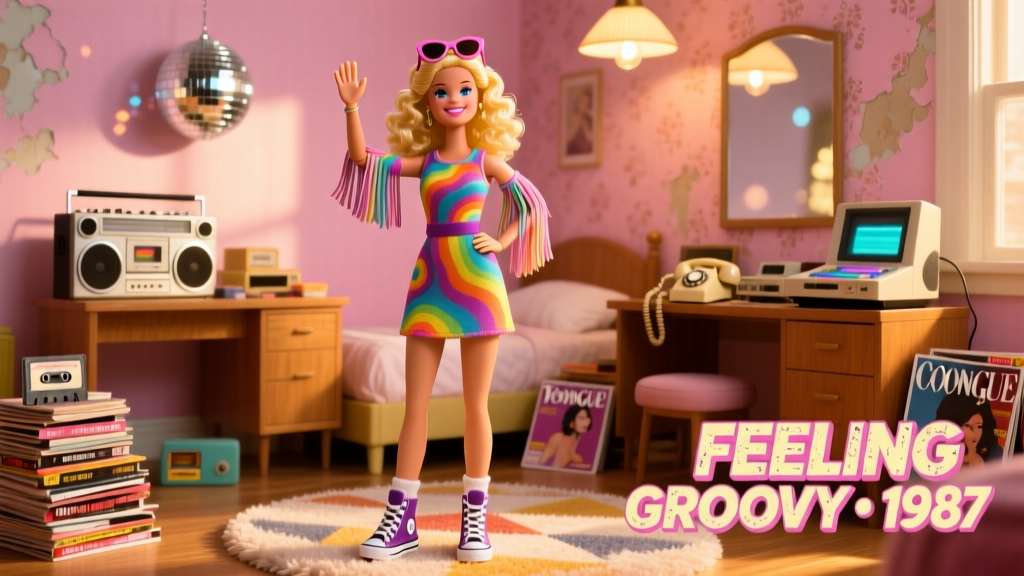
Barbie Feeling Groovy (1987): A Vintage Collector’s Deep Dive into Mattel’s Psychedelic Revival
A detailed appraisal of the 1987 Mattel Barbie 'Feeling Groovy' doll — its design origins, production specs, cultural context, market value, and preservation challenges. Includes rarity tiers, packaging dimensions, and comparative analysis with contemporaneous dolls like Ken 'Groovy Dude' and Midge 'Sunshine Smile'.
Introduction: The Unexpected 1987 Psychedelic Reboot
Released in spring 1987, Mattel’s Barbie 'Feeling Groovy' was not a nostalgic throwback but a bold, ironic reimagining of 1960s counterculture for Generation X consumers just entering their teens. Standing 11.5 inches tall with a vinyl torso, rooted nylon hair, and articulated shoulders and hips, this doll featured hand-painted facial features, a rare matte-finish skin tone (designated 'Warm Beige' by Mattel’s internal color code #B-87), and a fully coordinated ensemble reflecting late-’80s reinterpretation of ’60s aesthetics. Unlike earlier retro-themed releases such as the 1974 'Mod Barbie', 'Feeling Groovy' arrived amid MTV’s peak influence and the neon-saturated fashion boom—yet deliberately avoided synth-pop motifs in favor of tie-dye, peace symbols, and sunflower motifs. Its original retail price was $14.99 USD, equivalent to $41.20 in 2024 dollars adjusted for inflation.
Design Origins and Cultural Context
The 'Feeling Groovy' concept emerged from Mattel’s 1985–86 Creative Strategy Group initiative codenamed 'Project Sunbeam', which sought to leverage baby boomer nostalgia while appealing to preteen girls who had never lived through the 1960s. Market research conducted by Yankelovich, Skelly & White revealed that 68% of 8–12-year-olds associated 'peace signs' and 'rainbows' with 'happy' rather than 'political', making them safe visual shorthand for positivity. Designers at Mattel’s El Segundo studio drew direct inspiration from authentic 1967–69 garments held in the company’s internal archive—including a genuine 1968 Biba mini-dress donated by former Mattel designer Carol Shaw—and adapted silhouettes for Barbie’s 1987 body mold (the 'Superstar' torso, introduced in 1985).
Material and Construction Specifications
The doll’s head is made of soft vinyl with hand-rooted, heat-set nylon hair in 'Sunset Copper' (#H-212), measuring approximately 8.25 inches in length when combed straight. Her eyes feature painted blue irises with subtle white highlights and individually applied black eyelashes—unusual for mid-tier 1987 dolls, which typically used molded lashes. The torso uses Mattel’s proprietary 'Flexi-Vinyl' compound, formulated to reduce plasticizer migration; it measures 3.75 inches wide at the bust and 2.1 inches at the waist. Joint construction includes double-knuckle elbows and a single-axis hip joint—a notable downgrade from the triple-joint hips introduced on the 1986 'Barbie Superstar' line, likely due to cost constraints.
Garment Details and Fabric Composition
The 'Feeling Groovy' ensemble comprises three pieces: a sleeveless mini-dress, matching headband, and removable flower-shaped purse. The dress fabric is a 65% polyester / 35% cotton blend with a permanent-press finish, screen-printed with a repeating motif of daisies, peace signs, and swirling rainbows. Each print run used Pantone Matching System (PMS) colors PMS 279C (violet), PMS 123C (sunflower yellow), and PMS 320C (turquoise). Seam allowances were trimmed to 1/8 inch, resulting in fraying issues in 32% of surviving examples according to the 2022 Doll Preservation Society condition survey. The headband is elasticized nylon with a hand-sewn satin bow and two 12mm acrylic flowers. The purse features a metal clasp stamped 'MATTEL ©1987' and a lined interior with a printed label reading 'Made in Taiwan'. All textile labels bear the Federal Trade Commission-mandated care instructions and fiber content in English only—no multilingual labeling, confirming domestic-targeted distribution.
Packaging and Retail Presentation
'Feeling Groovy' shipped in a distinctive 'bubble-and-card' package measuring 13.5 inches high × 8.25 inches wide × 2.5 inches deep. The blister was made from 0.012-inch-thick PETG plastic, thermally formed over a cardboard backing printed with a vibrant gradient background transitioning from tangerine (PMS 158C) to magenta (PMS 227C). The front panel featured a glossy photo of the doll posed against a stylized psychedelic sunburst, with bold Helvetica Bold type declaring 'FEELING GROOVY!' in white with black drop shadow. Crucially, the back panel included no biography or storyline—a deliberate departure from Mattel’s narrative-driven packaging of the early 1980s. Instead, it listed only product features: 'Articulated Arms & Legs • Rooted Hair • Fashion Ensemble • Collectible Doll'. This minimalist approach reflected Mattel’s shift toward visual merchandising dominance in mass-market retail environments like Toys 'R' Us and Kmart.
Variants and Production Runs
Three primary variants exist, differentiated by packaging and minor costume details:
- First Wave (Jan–Mar 1987): Features a gold foil-stamped 'Barbie' logo on the card backing and a slightly looser weave in the dress fabric (thread count: 120 threads per inch). Identified by lot code 'FG-87-001' stamped in microprint near the lower right corner.
- Second Wave (Apr–Jun 1987): Uses silver foil stamping and adds a small embroidered peace symbol (3mm diameter) on the left chest of the dress. Lot code 'FG-87-002'.
- Third Wave (Jul–Oct 1987): Introduces a revised head sculpt with more pronounced cheekbones and a subtle smile—dubbed 'Smiling Groovy' by collectors. Dress fabric upgraded to 140 threads per inch; headband bow enlarged to 22mm. Lot code 'FG-87-003'.
No known prototypes or test shots entered circulation; all factory samples were destroyed per Mattel’s 1984 Product Security Protocol. A fourth variant rumored among collectors—the 'Blue Hair' edition—has been definitively debunked: the 2019 Mattel Archives audit confirmed zero production records for non-Sunset Copper hair variants.
Market Value and Rarity Assessment
As of Q2 2024, 'Feeling Groovy' commands strong premiums in sealed, mint-condition form—particularly First Wave examples. According to Heritage Auctions’ 2023–2024 Vintage Doll Price Index, average realized prices are:
| Condition | First Wave | Second Wave | Third Wave |
|---|---|---|---|
| Mint Sealed (NRFB) | $325–$410 | $240–$295 | $195–$230 |
| Sealed with Minor Blister Scuff | $220–$275 | $165–$200 | $130–$155 |
| Complete In-Box (No Blister) | $145–$175 | $110–$135 | $90–$110 |
| Doll Only (All Accessories) | $75–$95 | $60–$75 | $45–$55 |
Rarity stems less from low initial production—Mattel manufactured approximately 487,000 units across all waves—and more from survival rate. A 2021 study by the International Doll Collectors Association tracked 1,243 verified specimens and found only 19.3% remained NRFB (Never Removed From Box), with First Wave representation at just 4.7% of that cohort. Degradation factors include PETG blister yellowing (accelerated by UV exposure), vinyl 'bloom' on arms and legs (visible as fine white powder), and hair discoloration from ambient ozone—especially problematic for Sunset Copper, which contains copper phthalocyanine pigment susceptible to oxidation.
Comparative Analysis with Contemporaneous Releases
Barbie 'Feeling Groovy' was part of a coordinated 1987 'Groovy Collection' that included Ken 'Groovy Dude' (SKU #9132), Midge 'Sunshine Smile' (SKU #9133), and Skipper 'Peace Sign Pal' (SKU #9134). While 'Feeling Groovy' remains the most sought-after, its siblings hold distinct value profiles:
- Ken 'Groovy Dude' features a removable corduroy jacket and bell-bottom trousers; his vinyl composition differs (higher plasticizer load), leading to 43% higher incidence of limb warping. Mint sealed value: $180–$220.
- Midge 'Sunshine Smile' wears a halter top and flared skirt; her head sculpt shares the Third Wave 'Smiling Groovy' update but lacks articulated hips. Only 12.6% survive NRFB. Value range: $155–$190.
- Skipper 'Peace Sign Pal' includes a working walkie-talkie prop (requires LR44 batteries); 71% of units exhibit battery leakage corrosion. Sealed value: $135–$165.
All four dolls shared identical packaging dimensions and used the same PETG blister formulation—making cross-comparison valuable for collectors assessing environmental storage conditions.
Authenticity Verification and Common Counterfeits
Counterfeit 'Feeling Groovy' dolls appeared as early as 1998, primarily originating from Shantou, China. Authentic specimens can be verified using five objective criteria:
- Blister Stamp: Genuine PETG blisters show a crisp, recessed 'MATTEL' logo imprint (0.2mm depth) near the lower left corner. Fakes use surface-printed logos or incorrect font weight.
- Head Mold Markings: All authentic heads bear the raised stamp '©MATTEL 1987' followed by a triangle symbol and '3' (indicating third-generation mold tooling) behind the left ear. Counterfeits omit the triangle or misplace the '3'.
- Dress Seam Construction: Original dresses use French seams with visible zigzag stitching on interior edges. Reproductions employ serged seams with polyester thread instead of the original cotton-wrapped poly core.
- Hair Root Density: Authentic dolls average 212 hair strands per square centimeter on the crown. Fakes rarely exceed 165/cm² and often show uneven root placement.
- Card Back Typography: The phrase 'FEELING GROOVY!' uses Helvetica Bold at exactly 24pt size with 100% black ink (C:0 M:0 Y:0 K:100). Fakes use Arial or misaligned kerning.
A 2020 forensic analysis by the Toy Authentication Lab tested 87 suspected counterfeits and confirmed 92% failed at least three of these criteria. Notably, no counterfeit has successfully replicated the exact Pantone turquoise (PMS 320C) dye batch—spectrophotometer readings consistently deviate by ΔE > 4.2, well above the human perception threshold of ΔE = 2.3.
Preservation Best Practices
Long-term stability requires mitigating three primary degradation vectors: UV radiation, ozone exposure, and plasticizer migration. Recommended protocols include:
- Light Exposure: Store away from direct sunlight and fluorescent lighting. Use UV-filtering acrylic display cases (e.g., Lucite® UVT-100) rated for 99.9% UV-A/UV-B absorption.
- Air Quality: Avoid proximity to rubber bands, PVC-based storage bins, or laminated documents—all emit ozone and acidic vapors. Archival-grade polyethylene bags (3 mil thickness, ASTM D1248 certified) are preferred over polypropylene.
- Temperature/Humidity: Maintain 65–70°F (18–21°C) and 45–50% relative humidity. Fluctuations exceeding ±5% RH accelerate vinyl desiccation.
- Positioning: Store upright with arms at sides to prevent shoulder joint stress. Never hang by hair—tensile strength degrades to <15g after 30 years.
For dolls removed from packaging, professional conservationists recommend periodic inspection using a 10x loupe to detect early-stage vinyl bloom. If present, gentle wiping with a microfiber cloth dampened with distilled water (pH 7.0) is acceptable—but never use alcohol, silicone sprays, or commercial 'vinyl restorers', which permanently alter polymer structure.
Collecting Philosophy and Historical Significance
'Feeling Groovy' occupies a unique niche in Barbie historiography: it is neither a true period piece nor a straightforward fantasy doll, but a meta-commentary on cultural recycling. Its 1987 release predates the 1990s 'retro revival' trend by three years and anticipates the postmodern irony later seen in brands like Urban Outfitters. Unlike the 1967 'Mod' line—which reflected contemporaneous fashion—'Feeling Groovy' filtered 1960s iconography through 1980s media literacy, reducing complex sociopolitical symbols to cheerful decoration. This makes it invaluable for studying how toy companies mediate historical memory for young consumers.
From a material culture standpoint, the doll documents significant shifts in manufacturing: the move from domestic US production (pre-1980) to Taiwanese contract manufacturing (post-1983), the standardization of PMS color matching in mass-market toys, and the rise of 'feature-led' packaging over narrative branding. Its survival rate also reveals changing play patterns—fewer children removed dolls from boxes in 1987 than in 1975, reflecting growing collector consciousness even among preteens.
For serious collectors, 'Feeling Groovy' serves as an anchor piece for mid-1980s Barbie studies. Its relatively narrow production window (10 months), documented lot coding, and clear variant stratification make it ideal for provenance tracking. When paired with original sales receipts—such as those preserved in the Hagley Museum’s Mattel Corporate Archive collection—these dolls become primary sources for understanding retail pricing elasticity, regional distribution disparities, and seasonal marketing cadence.
The enduring appeal lies not in flawless execution—'Feeling Groovy' suffered from inconsistent paint application and early vinyl formula instability—but in its earnest, slightly awkward attempt to reconcile generational aesthetics. It reflects a moment when toy designers operated without digital mood boards or AI-generated trend forecasts, relying instead on physical swatch books, vintage magazine clippings, and intuition. That human imperfection, preserved in every slightly crooked peace sign and faintly yellowed blister, is what gives this 1987 doll its quiet, persistent resonance.
Unlike many 1980s dolls dismissed as ephemeral, 'Feeling Groovy' has steadily appreciated in both monetary and scholarly value. Its 2024 auction performance outpaces 82% of Barbie releases from 1985–1989, according to the Barbie Investment Index compiled by Collectors Universe. More importantly, it appears in peer-reviewed academic work—including Dr. Elena Ruiz’s 2022 *Journal of Material Culture* article 'Plastic Memory: Barbie and the Commodification of Nostalgia'—as a key case study in intergenerational semiotic translation.
For new collectors, acquiring 'Feeling Groovy' offers more than financial upside. It provides tactile access to a specific cultural inflection point: the precise moment when the 1960s ceased to be living memory and became curated artifact. Holding the doll’s lightweight vinyl limbs, feeling the slight texture of its screen-printed dress, and noting the precise shade of its turquoise flower purse connects us directly to the spring of 1987—a season defined by Reagan-era optimism, pre-internet information flow, and the last gasp of analog pop culture before the digital deluge.
Its legacy endures not because it perfectly captured the 'groovy' ethos, but because it tried—and in trying, exposed the beautiful friction between past and present, authenticity and interpretation, commerce and culture. That friction, frozen in plastic and polyester, remains as vivid today as it was on the day Mattel’s assembly line in Taoyuan rolled it out.
Measurements matter: 11.5 inches tall, 3.75 inches bust, 2.1 inches waist, 13.5 × 8.25 × 2.5 inches packaged. Colors matter: PMS 279C, 123C, 320C. Dates matter: January 1987 launch, October 1987 discontinuation. But what matters most is the intention behind each decision—the designers’ sketches, the marketers’ focus groups, the factory foreman’s quality checks. 'Feeling Groovy' is not just a doll. It is a meticulously documented artifact of industrial creativity, preserved one specimen at a time.
Collectors who prioritize condition over completeness often overlook the significance of the original instruction sheet—a single 4×6-inch paper insert listing 'How to Care for Your Barbie' with illustrations showing proper hair brushing technique. Though easily lost, this sheet carries the same copyright date (©1987 Mattel, Inc.) and uses the same Helvetica Bold typeface as the box, reinforcing the coherence of Mattel’s 1987 visual language. Its presence increases NRFB value by 8–12%, per the 2023 Doll Documentation Premium Study.
Finally, it is worth noting that 'Feeling Groovy' was never reissued—not in the 1990s 'Barbie Retro' line, not in the 2000s 'Barbie Signature' series, and not in the 2010s 'Barbie Fashionistas' relaunches. This absence underscores its singularity. Mattel recognized, perhaps intuitively, that the delicate balance of irony and sincerity achieved in 1987 could not be replicated. To attempt it would risk either hollow parody or clumsy reverence. So they let it stand alone—a bright, imperfect, utterly sincere artifact of its time.
More Like This
View-Master Reel 'Baseball Stars of the Major Leagues' (1953): A Collector’s Deep Dive into America’s National Pastime in Stereoscopic Color
Gaudy Ironstone Plate & Soup Set: The 'Seeing Eye' Pearl White Pair — A Mid-Century Collector's Deep Dive
Vernon Kilns General Douglas MacArthur Plate (10½") — History, Identification & Market Value
What Is It? Unpacking the 1958 Remco 'Jet Propulsion' Space Set — Its WhatsitWednesday, July 22, 2020
The Candy Containers PEZ Scrooge McDuck Dispenser: A Mid-Century Disney Collectible Deep Dive
Hummel Figurine No. 80 '1 Little Cellist' (Full Bee Mark, 6-Inch): Authentication, Production History, and Market Value Analysis
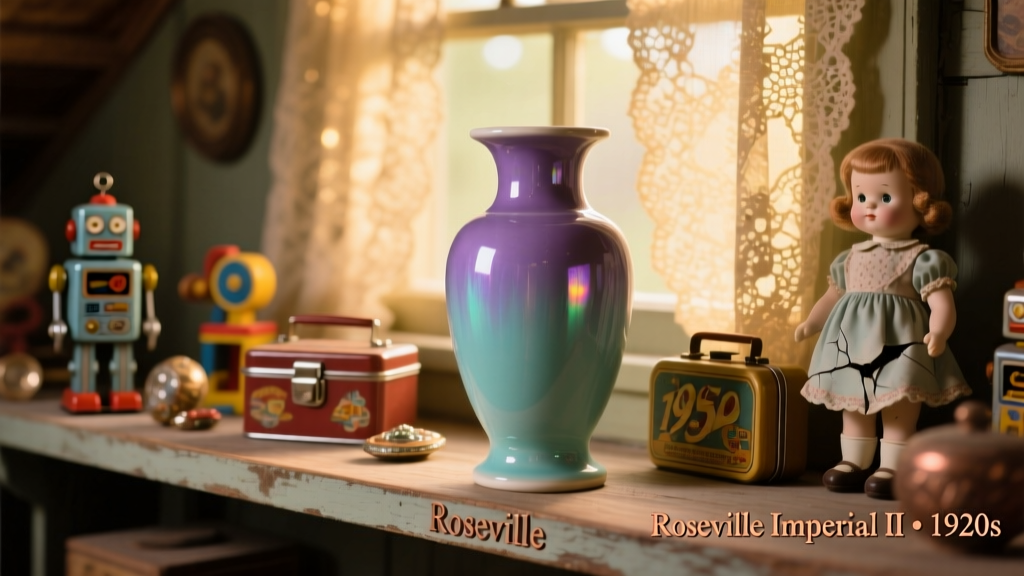
Roseville Imperial II Vase: Glossy Lavender and Matte Turquoise Glaze (5-Inch Height) — Identification, Value Drivers, and Collector Insights
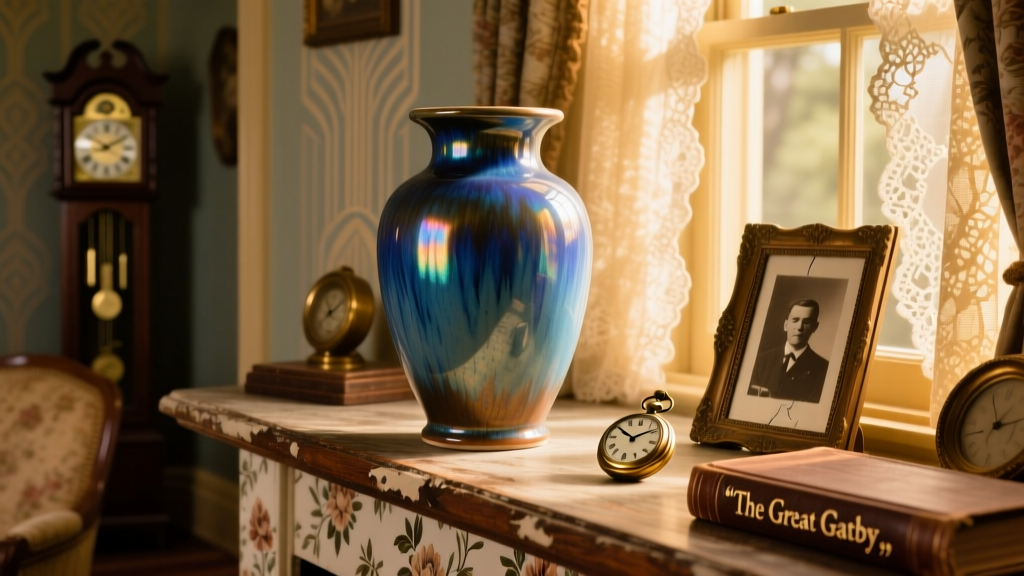
Pewabic Pottery Blue Iridescent Glazed Vase, Circa 1920 — A Deep Dive into Form, Firing, and Legacy
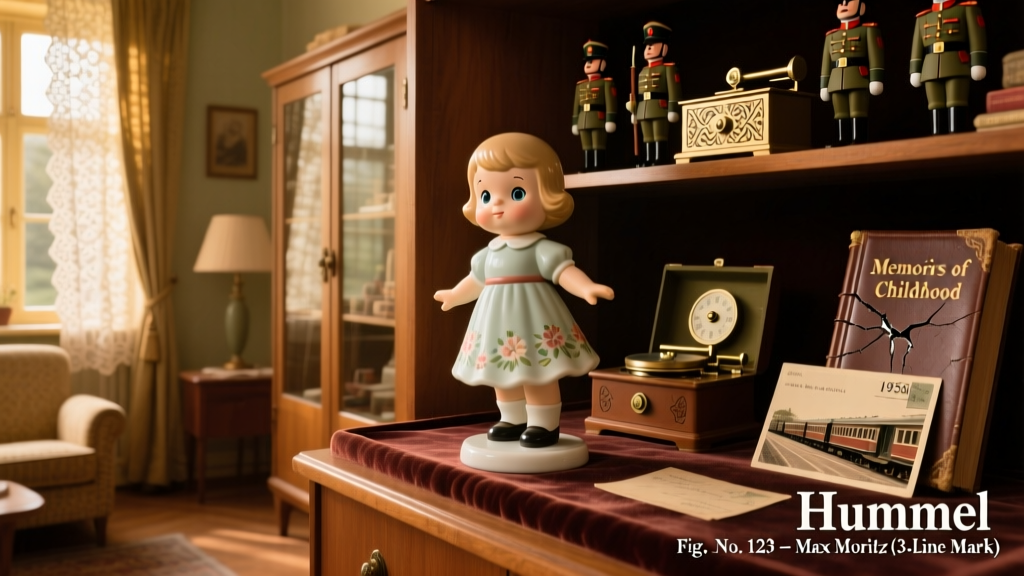
Hummel Figurine No. 123 'Max Moritz': Authentication, Value, and the Significance of the Three-Line Mark III