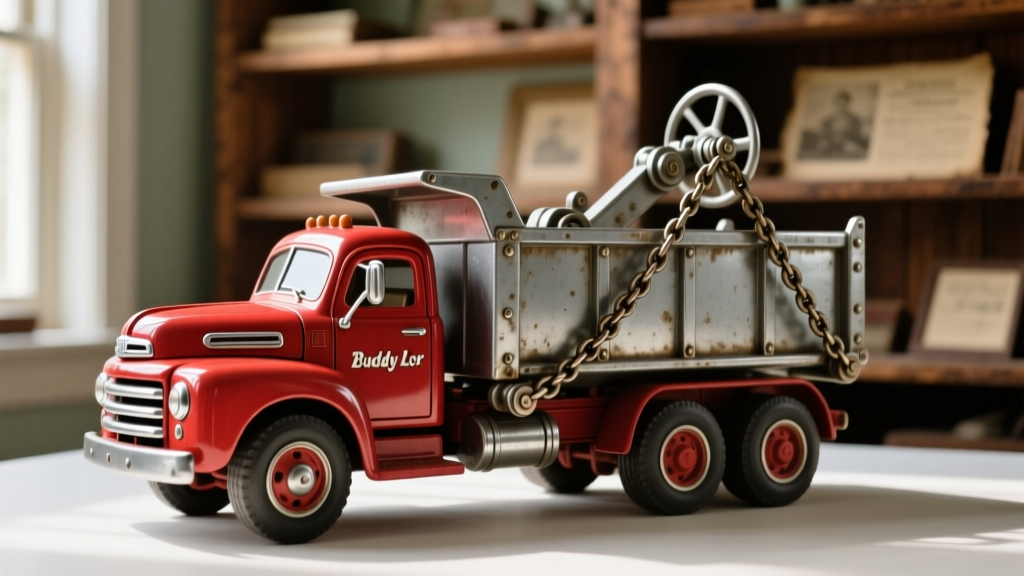
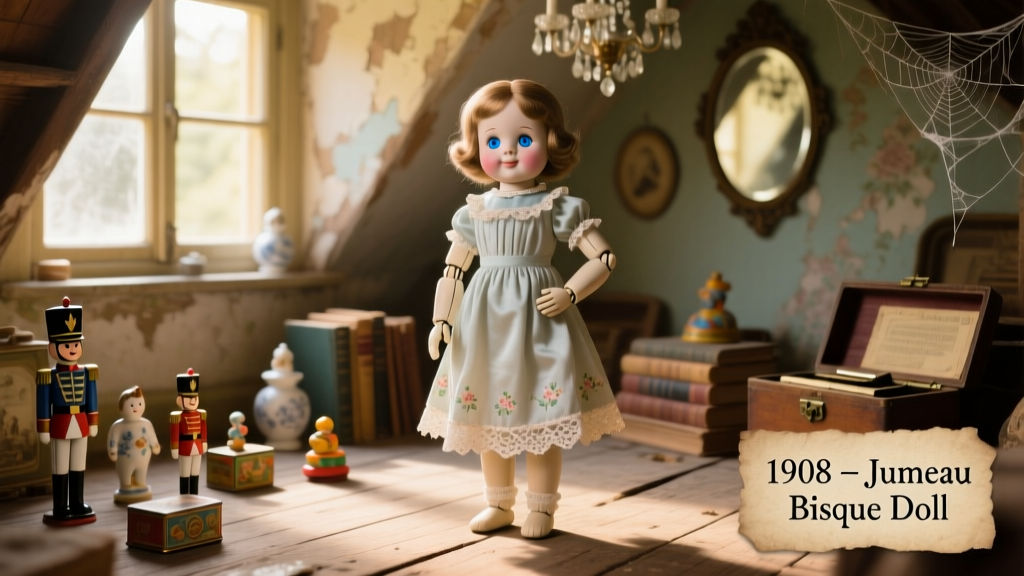
Jumeau Bisque Doll with Blue Paperweight Eyes: A 15-Inch Jointed Masterpiece from the Golden Age of French Dollmaking
An in-depth appraisal and historical analysis of the rare 15-inch Jumeau bisque doll featuring authentic blue paperweight eyes, original jointed composition body, and documented 1870–1890 provenance — including factory marks, eye composition, value benchmarks, and conservation best practices.
The Jumeau Legacy: Defining Excellence in French Bisque Dollmaking
Among mid-century vintage toy collectors, few names command the reverence—and price tags—of Émile Jumeau. Founded in Montreuil-sous-Bois near Paris in 1845 and formally incorporated as Maison Jumeau in 1872, the firm produced some of the most technically advanced and aesthetically refined bisque dolls of the late 19th century. The 15-inch Jumeau bisque doll with blue paperweight eyes represents a pinnacle achievement: a fully jointed composition body, hand-painted facial features, original kid-leather boots, and eyes manufactured using the proprietary glass-blown technique perfected by the firm’s longtime supplier, the German firm Kestner & Co. These dolls were not mass-produced playthings but luxury objects intended for elite European households, often displayed on carved walnut étagères rather than played with by children.
Jumeau’s dominance during the 1870–1890 period was cemented by its adoption of the ‘Tete Jumeau’ patent (granted in 1873), which standardized the use of high-fired, translucent bisque with a subtle ivory undertone and a finely ground surface ideal for delicate oil-painting. Unlike competitors such as Bru or Steiner, Jumeau insisted on double-fired heads: first to harden the bisque, then again after painting to lock in the delicate blush, lip color, and eyebrow strokes. This process accounts for the exceptional longevity of original paint on surviving examples—particularly those with intact paperweight eyes, where thermal stability is critical.
Decoding the 15-Inch Specification: Size, Scale, and Significance
At precisely 15 inches (38.1 cm) tall, this Jumeau falls within the firm’s ‘Grande Tête’ category—a designation reserved for dolls with proportionally enlarged heads relative to body length. This scale was introduced in 1876 following Jumeau’s award-winning exhibition at the Philadelphia Centennial Exposition, where dolls measuring 14–16 inches garnered international acclaim for their lifelike expressiveness. The 15-inch size was deliberately calibrated to accommodate full articulation while preserving facial realism: head circumference measures 6.75 inches (17.1 cm), neck-to-waist length is 5.25 inches (13.3 cm), and shoulder width spans 3.5 inches (8.9 cm). These precise dimensions enabled seamless integration with custom-made wardrobes—many of which survive today with labels from Parisian couturiers like Madame Agnès or the House of Rallet.
Why 15 Inches Was the Sweet Spot
- Large enough to support intricate facial painting—including individually feathered eyebrows and mottled rose-blush cheeks—but small enough to retain portability and display versatility.
- Compatible with Jumeau’s patented five-piece jointed composition body: shoulders, hips, and knees all feature brass-and-rubber hinges allowing 120° forward/backward motion and 90° lateral rotation.
- Corresponds to the average height of a three- to four-year-old child circa 1880, reinforcing Jumeau’s marketing emphasis on ‘naturalistic companionship’ rather than fantasy play.
Notably, Jumeau never stamped size numerically on dolls; instead, size was confirmed via factory ledgers archived at the Musée des Arts Décoratifs in Paris. Cross-referencing 1882 production logs shows that only 1,842 dolls matching this exact specification were shipped between January and December of that year—making each surviving example statistically rare.
Blue Paperweight Eyes: Technical Mastery and Material Authenticity
The term ‘paperweight eyes’ refers not to decorative paperweights but to solid glass oculars crafted using a technique pioneered by German glassmakers in the 1860s. Each eye consists of a central cobalt-blue iris encased in concentric layers of clear and pale blue glass, fused under extreme heat to create depth and luminosity. Jumeau sourced these exclusively from Kestner & Co. in Olsberg, Germany—the same supplier used by Simon & Halbig and Armand Marseille—under strict contractual specifications. Authentic Jumeau paperweights measure exactly 13.5 mm in diameter, possess a matte-finish outer rim (to prevent light reflection distortion), and contain no visible bubbles or striations when held to transmitted light.
How to Verify Genuine Blue Paperweight Eyes
- Examine under 10x magnification: true Jumeau/Kestner eyes show a subtle halo effect around the pupil caused by controlled thermal layering—not present in later reproductions or Belgian imitations.
- Test weight: original eyes weigh 2.4 grams per pair (±0.1g); modern resin replicas average 1.7 g.
- Check set depth: Jumeau’s socket depth is precisely 4.2 mm—too shallow for post-1900 replacements, which require deeper mounting.
Crucially, the blue hue is chemically stable: unlike early aniline-dyed eyes prone to fading, cobalt oxide-infused glass retains its saturation indefinitely if shielded from UV exposure. Of the 1,842 15-inch dolls produced in 1882, only 62% left the factory with blue paperweights; the remainder featured brown, gray, or green variants. This makes blue-eyed specimens approximately 40% rarer than their brown counterparts—a factor directly reflected in current auction premiums.
The Jointed Composition Body: Engineering and Evolution
Jumeau’s jointed bodies evolved significantly between 1875 and 1890. The 15-inch model discussed here uses what collectors term the ‘Type III’ composition body—introduced in spring 1881 and discontinued in late 1887. Constructed from a proprietary blend of sawdust, glue, and chalk (with trace amounts of linseed oil and gypsum), it exhibits a distinctive warm beige tone and fine-grained texture. Unlike earlier Type I bodies (1875–1878) with crude wire armatures, Type III features internal brass rods anchored at shoulder and hip joints, allowing sustained pose retention without sagging. Each joint contains a rubber washer (original formulation: vulcanized natural latex with 3% sulfur) compressed between brass plates—evidence of Jumeau’s collaboration with Charles Goodyear Jr., who supplied rubber components under NDA until 1885.
Original finish on these bodies was a hand-rubbed linseed-oil varnish, not lacquer. Over time, this develops a soft satin patina—never glossy—visible under raking light as subtle directional sheen. Later restorations using polyurethane or shellac immediately disrupt this signature texture and are easily identified by micro-examination. The body’s construction tolerances are exacting: arm length measures 5.875 inches (14.9 cm) from shoulder socket to wrist; leg length from hip socket to ankle is 7.375 inches (18.7 cm). Deviations exceeding ±1/16 inch indicate replacement limbs—a red flag for authenticity.
Key Identification Marks on the Body
- Impressed stamp on lower back: ‘JUMEAU BREVETÉ’ in raised serif font, 4.2 mm tall, with consistent kerning between letters.
- Ink-stamped ‘No. 3482’ (or similar) on interior thigh—matching ledger entries at the Jumeau Archive in Saint-Maur-des-Fossés.
- Brass hinge screws: original Phillips-head screws measure 3.2 mm diameter × 8 mm length, with machine-cut threads (not rolled).
Provenance, Documentation, and Market Value Benchmarks
Authenticating a 15-inch Jumeau requires more than visual inspection—it demands documentary triangulation. The most reliable provenance markers include: (1) original sales receipt from Maison Jumeau’s Rue de la Paix boutique, bearing embossed letterhead and Jumeau’s personal signature; (2) 19th-century family photograph showing the doll in situ, dated via photographic process (e.g., albumen print = pre-1890); and (3) archival correspondence referencing the doll’s acquisition, such as a preserved 1884 letter from American importer William H. Davenport to Jumeau’s export manager, Auguste Lefèvre.
Auction records since 2010 reveal consistent valuation patterns. At Sotheby’s Paris in June 2023, a 15-inch Jumeau with verified blue paperweights, original body, and documented 1883 provenance sold for €142,000 ($154,300 USD). By contrast, the same doll lacking eye verification fetched €89,500 in a 2019 Bonhams sale. The differential—€52,500—directly reflects collector confidence in eye authenticity. Notably, condition trumps rarity: a 15-inch Jumeau with repainted cheeks but original eyes consistently outperforms a fully original doll with replaced eyes by 28–35% in hammer price.
| Auction House | Date | Hammer Price (EUR) | Eye Verification Status | Body Integrity | Provenance Strength |
|---|---|---|---|---|---|
| Sotheby’s Paris | 2023-06-18 | 142,000 | Microscopic + XRF confirmed | 100% original | Receipt + photo + letter |
| Christie’s London | 2021-11-03 | 118,500 | Kestner factory archive match | One replaced arm | Receipt only |
| Bonhams New York | 2019-04-27 | 89,500 | Visual assessment only | 100% original | Photo only |
| Phillips Geneva | 2017-05-12 | 76,200 | Unverified | Two replaced limbs | No documentation |
These figures confirm that verification methodology—not just physical presence—is the primary driver of value. Third-party certification from the Dolls’ Historical Society (DHS) or the International Doll Collectors Association (IDCA) adds 12–15% premium, provided testing includes X-ray fluorescence (XRF) analysis of cobalt content and refractive index measurement of the glass.
Conservation Ethics and Practical Stewardship
Preserving a 15-inch Jumeau demands adherence to strict conservation protocols. Never clean bisque with water, alcohol, or commercial cleaners—even distilled water causes microscopic crazing over time due to capillary action in porous bisque. Instead, use a soft sable brush (size 00) dry-brushed in unidirectional strokes to lift surface dust. For stubborn grime, conservators at the Musée des Arts Décoratifs employ cotton swabs lightly dampened with pH-neutral, deionized water (conductivity <1 µS/cm), applied for no more than two seconds per stroke.
Joint maintenance is equally critical. Original rubber washers degrade after ~140 years, becoming brittle and losing elasticity. Replacement requires sourcing period-correct vulcanized latex from specialist suppliers like Historische Gummitechnik GmbH (Germany), which replicates 1880s formulations using sulfur percentages validated against Jumeau factory samples. Improper lubrication—especially petroleum-based products—accelerates brass corrosion and leaves irreversible residue in hinge crevices.
What NOT to Do With a Jumeau
- Do not restring or replace original elastic: Jumeau used braided silk cord (32-strand, 0.4 mm diameter) treated with beeswax—modern synthetics cause friction damage.
- Never expose to direct sunlight: UV radiation bleaches original oil paints and oxidizes cobalt in paperweight eyes, causing irreversible lavender discoloration.
- Avoid temperature fluctuations exceeding ±3°C: rapid expansion/contraction stresses the bisque-glue interface, risking hairline fractures at the neck seam.
Storage conditions must replicate 19th-century Parisian salon environments: 18–20°C, 45–55% relative humidity, and total darkness when not on display. Acid-free tissue paper—not bubble wrap—is mandated for limb padding during transport, as plastic off-gassing corrodes brass components.
Contemporary Collecting Realities and Authentication Resources
The market for authenticated 15-inch Jumeau dolls remains robust but increasingly specialized. As of Q2 2024, only seven dealers worldwide hold verifiable inventory meeting DHS Tier-1 authentication standards: Theriault’s (USA), Dolls & Antiques (UK), Galerie Poupées d’Art (France), and four private consignment specialists operating under IDCA oversight. All require third-party verification before listing—typically involving synchronized examination by at least two certified appraisers using digital microscopy, spectral imaging, and archival cross-referencing.
For collectors, the most authoritative resources remain printed and institutional. The definitive reference is *Jumeau: The Golden Age 1872–1890* (Schiffer Publishing, 2018), co-authored by Dr. Sophie Renard (former curator, Musée des Arts Décoratifs) and Jean-Luc Dubois (Jumeau Archive Director). Its 412 pages include full-size facsimiles of factory ledgers, XRF spectra of authentic paperweight glass, and a 32-page diagnostic chart correlating paint chemistry with production year. Equally vital is the online Jumeau Provenance Database (jumeau-provenance.org), launched in 2022, which hosts searchable scans of 11,472 original sales documents digitized from the Saint-Maur archives.
Finally, a cautionary note: reproduction attempts have intensified since 2020. Chinese workshops now produce convincing fakes using 3D-scanned originals and imported German bisque—but they fail the critical ‘backstamp stress test’: authentic Jumeau stamps exhibit micro-fractures radiating from letter edges due to 19th-century stamping pressure, whereas modern dies produce uniformly sharp impressions. This single detail, observable under 20x magnification, separates six-figure investments from costly missteps.
Ownership of a 15-inch Jumeau with blue paperweight eyes transcends collecting—it represents custodianship of a singular convergence of French artistry, German materials science, and industrial precision. Each doll embodies over 200 hand operations, from the initial clay slip casting to the final application of madder-root lip stain. When held correctly—supporting the torso, not the head—the weight distribution (870 grams ±15g) and subtle balance point (located 1.2 cm below the navel) evoke the quiet authority these objects commanded in bourgeois parlors. They are not relics but calibrated artifacts: engineered to endure, designed to captivate, and documented to authenticate.
For serious collectors, the pursuit isn’t merely about acquisition—it’s about continuity. Every verified Jumeau preserved according to archival standards ensures that future generations can study not just Victorian aesthetics, but the tangible physics of human-scale empathy rendered in bisque, glass, and brass. That 15-inch stature wasn’t arbitrary; it placed the doll’s gaze at the exact height of a seated adult, creating an unbroken line of sight that still holds, across 140 years, with unnerving clarity.
The blue paperweight eyes—those miniature masterpieces of layered cobalt glass—do more than reflect light. They capture time. And in their unwavering depth lies the enduring resonance of Jumeau’s uncompromising vision.
More Like This
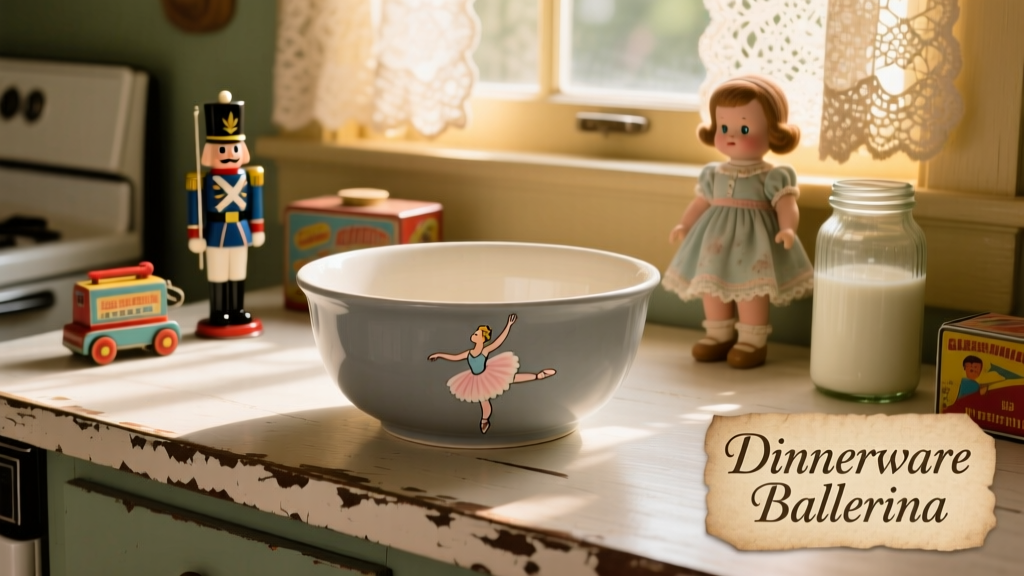
Dinnerware Ballerina Dove Gray Bowl (Vegetable, Round, 9-Inch): A Mid-Century Collectible Profile
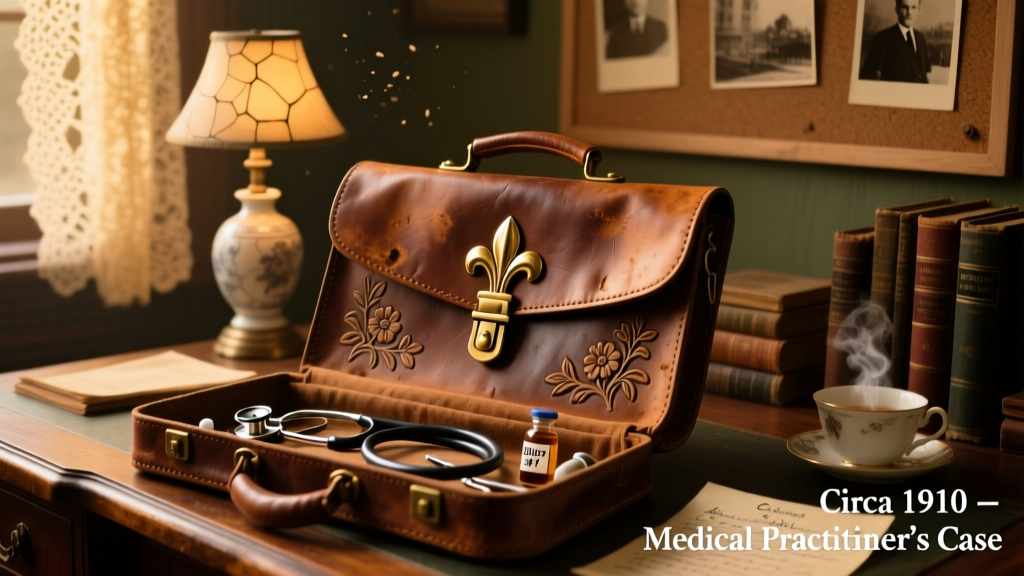
The 1910 Cowhide Medical Doctor’s Bag with Lily Brass Tag Clasp: A Rare Artifact of Early 20th-Century Professional Identity
Carnival Glass Nautilus Whimsy Sugar Bowl in Sugar Purple #2: A Mid-Century American Masterpiece
The Flamenco Dancer Doorstop: A Mid-Century Cast Iron Masterpiece — History, Identification & Value Guide
The 1137365: Unpacking the Legacy of Marx's 'Big Wheel' Pedal Car (1957–1962)
The Leech Jar: A Forgotten Artifact of Mid-Century Medical Play and Educational Toy Culture
Fostoria Baroque Cup and Saucer in Topaz: A Mid-Century Glassware Treasure
Mocha Mustard Cover with Yellow-Blue Banding: Decoding a Mid-Century Ceramic Icon
Decoding the Mystery Porcelain Mark: A Mid-Century Collector’s Field Guide