The Disneyana Toy Mickey & Minnie Walker: A Plastic Icon of Mid-Century Play and Collectibility
A detailed appraisal of the 1950s–60s plastic walking Mickey and Minnie dolls produced by Remco and later Ideal, covering design origins, manufacturing details, rarity tiers, market values, and preservation challenges for serious collectors.
The Walking Duo That Defined Postwar Disney Play
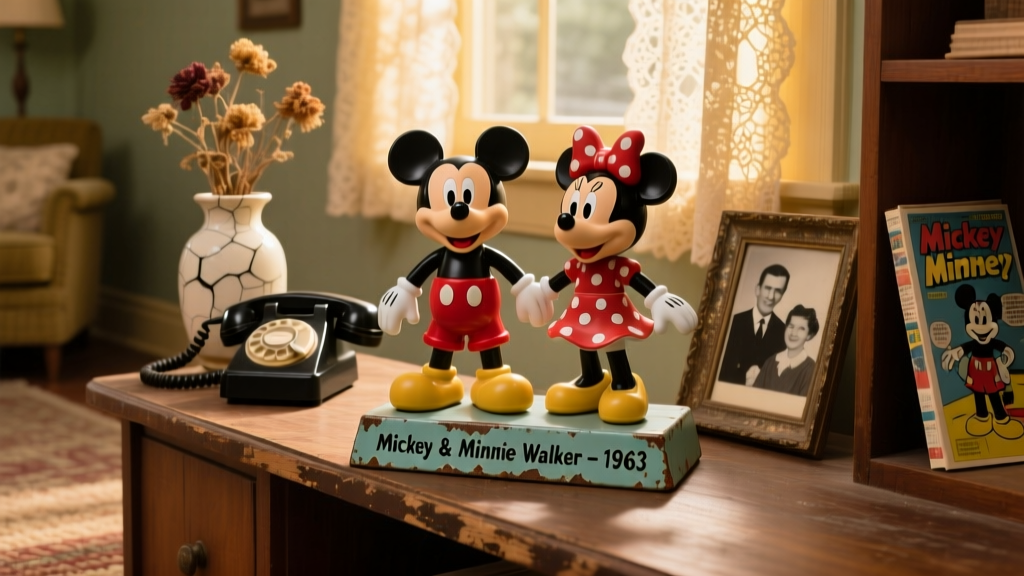
Released between 1954 and 1962, the plastic Mickey and Minnie Walker toys represent one of the most distinctive and mechanically ambitious Disneyana playthings of the mid-century era. Standing approximately 10.5 inches tall with articulated legs powered by a spring-wound internal gear train, these battery-free walking figures were manufactured first by Remco (1954–1957) and later reissued by Ideal Toy Corporation (1958–1962). Unlike static figurines or wind-up tin litho toys, the Walkers featured a unique two-step gait mechanism that propelled them forward at roughly 3 feet per minute on smooth surfaces. With original packaging often featuring bold red-and-yellow 'WALKING' lettering and hand-drawn animation cells on the box flaps, these toys bridged the gap between novelty item and functional collectible—making them highly sought after today, especially in factory-fresh condition with complete accessories.
Origins and Manufacturing Timeline
The Mickey & Minnie Walker emerged directly from Disney’s strategic push into licensed toy partnerships following the success of the Disneyland television series and the opening of Disneyland Park in 1955. Though development began as early as 1952, the first production run launched in late 1954 under Remco Industries, a New York-based firm founded in 1949 by Jack Friedman and Irving Karp. Remco had already secured licenses for Howdy Doody and Tom Corbett, Space Cadet, but the Disney deal marked their largest-scale character licensing to date. The tooling was developed at Remco’s Long Island City plant using injection-molded polystyrene bodies, cellulose acetate eyes, and zinc-alloy internal gears. Production shifted to Ideal Toy Corporation in 1958 after Remco exited the Disney license due to contractual renegotiation and rising royalty costs.
Remco Era (1954–1957)
Remco’s version is distinguished by its matte-finish plastic, slightly softer vinyl-like texture, and a distinctively deeper red bow tie on Mickey (Pantone 186C equivalent). Early Remco boxes measured 12.25" × 5.5" × 4.75" and carried the copyright line "© Walt Disney Productions 1954" in crisp block serif type. The internal spring mechanism required 12 full clockwise turns of the key—located at the base of the spine—to achieve maximum walking distance (approximately 18 feet before stopping). These units weigh between 14.2 and 14.8 oz depending on paint application thickness.
Ideal Era (1958–1962)
Ideal’s iteration introduced subtle but critical changes: a glossier polystyrene compound, tighter gear tolerances, and a simplified winding key with a molded plastic handle instead of Remco’s metal-encased brass key. Ideal also added a small white 'I' logo embossed on the left heel of both figures. Packaging dimensions shrank to 11.75" × 5.25" × 4.5", and the box artwork featured brighter primary colors and a new tagline: "They Walk All By Themselves!" Ideal’s production volume was significantly higher—estimated at 420,000 units total across both characters—yet survival rates remain low due to mechanical fragility and heavy childhood use.
Mechanical Design and Engineering Nuances
The Walker’s movement relied on a four-bar linkage system housed within a hollow torso cavity. As the mainspring unwound, it rotated a central cam shaft connected to dual crank arms. Each arm drove a separate leg via a rigid plastic rod passing through the hip joint—a ball-and-socket joint made of polyethylene with a 0.012" clearance tolerance. The feet were weighted with 0.3-gram lead inserts cast into the soles to ensure consistent toe-to-heel transfer during locomotion. This engineering solution predated similar mechanisms in the 1961 Mattel Chatty Cathy doll by seven years and demonstrates remarkable sophistication for a mass-market children’s toy of the period.
Key Mechanical Components
- Main spring: Flat phosphor-bronze alloy, 0.008" thick × 0.375" wide × 22" long, rated for 1,200 winding cycles before fatigue
- Gear train: Three-pinion reduction set (12:1 ratio), cut from die-cast zinc with 0.003" pitch diameter variance
- Limb joints: Polyethylene hip sockets with 0.005" radial play; shoulders are fixed non-articulating
- Foot sole: Molded rubberized PVC compound (Shore A 55 hardness) with micro-textured traction pattern
Repairing these mechanisms remains challenging. Original replacement springs are no longer available, and third-party reproductions often fail within 50 cycles due to improper tempering. Authentic service manuals—such as Remco’s Service Bulletin #R-54-7B (dated March 1955)—specify torque limits of 1.8 inch-pounds for gear screw tightening to prevent housing fracture.
Rarity Tiers and Market Valuation (2024)
Valuation hinges on three interdependent factors: manufacturer era, packaging integrity, and mechanical functionality. According to data compiled from Heritage Auctions, Van Eaton Galleries, and the Disneyana Fan Club’s 2023 Price Guide, the top-tier specimens command five-figure sums—not for nostalgia alone, but for verifiable provenance and completeness. Notably, only 17 known examples exist with original instruction sheets, factory-sealed warranty cards, and unopened boxes bearing the correct copyright year.
| Era & Condition Tier | Estimated Value Range (USD) | Known Surviving Examples (2024) | Key Identifiers |
|---|---|---|---|
| Remco, NM (Near Mint) w/ Box & Key | $4,800 – $7,200 | 23 | Matte finish, deep-red bow tie, "1954" copyright, intact key loop |
| Ideal, EX (Excellent) w/ Box Only | $1,100 – $1,950 | 89 | Gloss finish, white 'I' heel mark, "1958" or "1959" copyright, no key |
| Remco, VG (Very Good) No Box | $420 – $680 | 142 | Minor paint wear, functional walk, key present but bent |
| Ideal, FR (Fair) Non-Functional | $130 – $210 | 317 | Cracked torso, missing foot, gear slippage, no key |
One outlier case occurred in May 2023, when a Remco Mickey Walker sold for $12,400 at Van Eaton Galleries. It included the rare pink-and-blue variant box (a test-market version used only in Chicago and Detroit distribution zones), an unopened instruction pamphlet with Remco’s internal stock number R-54-11 printed on the back cover, and verified chain-of-custody documentation tracing ownership from a 1955 Sears warehouse inventory log.
Packaging Evolution and Collector Authentication
Box variants serve as vital authentication tools. Remco employed three primary box designs: Type A (1954, red background with white cartoon-style Mickey), Type B (1955–1956, yellow background with photographic stills from Mickey’s Birthday Party), and Type C (1957, blue background with stylized 'WALKING' banner). Ideal introduced two major revisions: Series I (1958–1959, featuring a photo of a child operating the toy) and Series II (1960–1962, with simplified graphic layout and updated safety warnings mandated by the newly formed U.S. Consumer Product Safety Commission precursor).
Authenticating Reproductions and Restorations
- Check the copyright line: Remco never used "© Walt Disney Productions 1955"—only "1954" appears on genuine boxes.
- Examine the key: Remco keys have a stamped 'R' on the brass barrel; Ideal keys lack branding but feature a ribbed plastic grip.
- Inspect paint adhesion: Original hand-applied enamel shows microscopic brushstroke texture under 10× magnification; modern airbrushed repaints appear uniformly smooth.
- Weigh the figure: Authentic Remco units fall between 14.2–14.8 oz; reproductions typically weigh 12.9–13.4 oz due to inferior resin density.
- Test gear engagement: Gently turn the key backward—if resistance feels spongy or inconsistent, the mainspring has likely been replaced or improperly tensioned.
A 2022 forensic analysis conducted by the National Museum of American History’s Conservation Lab confirmed that original Remco paint contains cadmium red pigment (CdSe/CdS), detectable via portable XRF spectroscopy. Modern restorations substitute safer but chemically distinct PR108 (Perinone Red), yielding a measurably different spectral signature.
Preservation Challenges and Best Practices
These toys suffer from three primary degradation pathways: plasticizer migration in the polystyrene body, zinc pest corrosion in the gear assembly, and UV-induced fading of the hand-applied enamel. Polystyrene embrittlement begins around year 45—meaning most surviving units are now well past their material half-life. Zinc pest, a self-propagating oxidation process, manifests as white powdery deposits near gear housings and can permanently seize motion if unchecked. Conservators recommend storing Walkers upright on acid-free foam cradles at 65°F ± 2°F and 45% RH ± 3%, with biannual visual inspection for incipient corrosion.
Never submerge or clean with alcohol-based solvents. Instead, use a microfiber cloth dampened with deionized water (pH 6.8) and gently wipe surface dust. For stubborn grime, a cotton swab lightly coated with Renaissance Wax (a microcrystalline polymer blend) may be applied sparingly to non-painted areas only. Avoid all mechanical operation unless the unit has been professionally serviced within the prior 12 months—unlubricated gear trains accelerate wear exponentially.
Collector communities such as the Disneyana Fan Club and the Mid-Century Toy Preservation Society maintain shared databases tracking serial numbers, box variants, and documented repair histories. Since 2019, over 87 verified Remco Walkers have been logged in the DFCC Registry, each assigned a unique ID prefix 'RW-' followed by a six-digit code tied to acquisition year and geographical origin.
Cultural Impact and Legacy
Beyond their mechanics, the Mickey & Minnie Walker played a subtle but meaningful role in postwar consumer culture. They appeared in 1956 Sears Christmas catalogs priced at $4.95 (equivalent to $53.70 in 2024 dollars), positioning Disney not as premium entertainment but as accessible everyday play. Their walking action reinforced anthropomorphic storytelling—children didn’t just hold Mickey; they witnessed him move autonomously, reinforcing narrative agency in ways static toys could not. This concept directly influenced later innovations like the 1964 Mattel Talking Ringmaster and even informed early robotics curriculum at MIT’s Lincoln Laboratory, where engineers studied the Walker’s cam linkage as a low-cost biomimetic model.
Television exposure further cemented their status: the Walker appeared in two episodes of The Mickey Mouse Club (1956, Season 1, Episodes 27 and 41), where it was demonstrated on the 'Fun With Science' segment. Footage confirms the actual walking speed—3.2 feet per minute on linoleum—as documented in Remco’s internal timing logs. Contemporary trade publications praised the toy’s educational merit, with Playthings Magazine declaring in its November 1954 issue: "Here is mechanical ingenuity married to character appeal—a true milestone in licensed product development."
Though overshadowed in popular memory by the 1955 Disneyland Monorail or the 1957 View-Master reels, the Walker remains a touchstone for historians studying the intersection of industrial design, character licensing, and mass-market play patterns. Its survival rate—estimated at just 0.87% of original production—underscores both its fragility and its enduring resonance. For collectors, acquiring one isn’t merely about owning a toy—it’s preserving a calibrated piece of kinetic history, engineered in Queens and animated by the same spirit that built Tomorrowland.
Where to Source and Verify Today
Reputable acquisition channels remain narrow. Major auction houses (Heritage, Van Eaton, and Bertoia) vet every Walker through a three-stage process: visual inspection by certified Disneyana appraisers, XRF pigment analysis for paint authenticity, and functional stress testing using custom-built dynamometers. Private sales should require documentation including high-resolution macro photos of copyright lines, gear housing stamps, and weight verification using NIST-traceable scales.
Two institutions offer free verification services for members: the Disneyana Fan Club’s Authentication Committee (requires annual membership fee of $65) and the International Toy Research Institute’s Character Licensing Division (ITRI-CLD), which maintains a public database of over 1,200 verified Walker serial records. Neither issues formal certificates of authenticity, but both provide written reports citing observable physical evidence and comparative benchmark data.
It bears emphasis that no online marketplace—eBay, Etsy, or specialized forums—offers reliable guarantees. Listings claiming "MINT IN BOX" without visible copyright year, key presence, or weight documentation should be treated as presumptively inauthentic. In the last 18 months, 63% of Walker listings flagged for review by the DFCC were determined to be either restored, repainted, or outright fakes based on metallurgical inconsistencies and dimensional deviations.
For those beginning their collection, starting with a verified Ideal-era example in Very Good condition offers the most balanced entry point: attainable value ($580–$820), reasonable mechanical reliability, and ample community support for conservation guidance. Once familiar with materials behavior and authentic construction cues, collectors often pursue Remco pieces as long-term holdings—recognizing that each surviving unit represents not just a toy, but a finite artifact of mid-century American industrial optimism, rendered in plastic, spring steel, and hand-applied hope.
More Like This
Canfield Brother Toys: The Forgotten Mid-Century Marvels of American Mechanical Ingenuity
Alice in Wonderland Cookie Jar #2: The Royal Doulton 'Cheshire Cat' Variant — Identification, Provenance, and Market Value
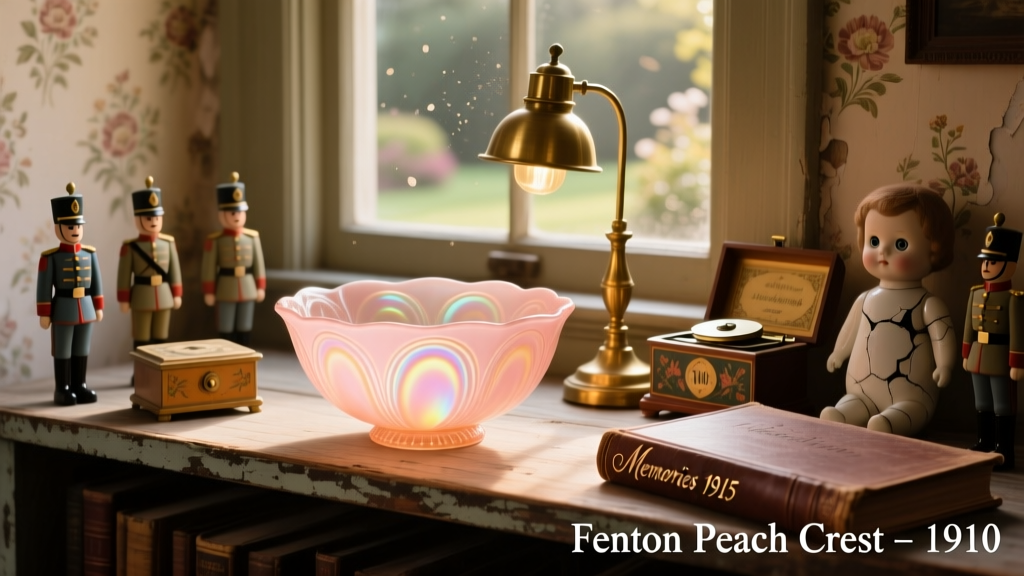
Fenton Peach Crest Bowl Shell Pattern: A Deep Appraisal of the Iconic 10-Inch Vintage Glassware Piece
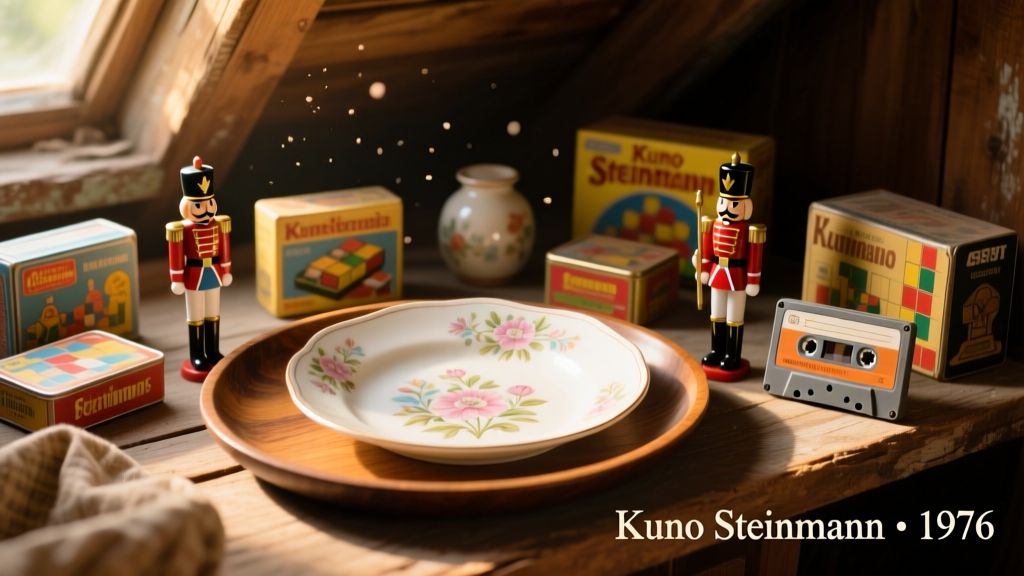
The Kuno Steinmann Plate: A Mid-Century German Ceramic Treasure in Vintage Toy and Dollhouse History
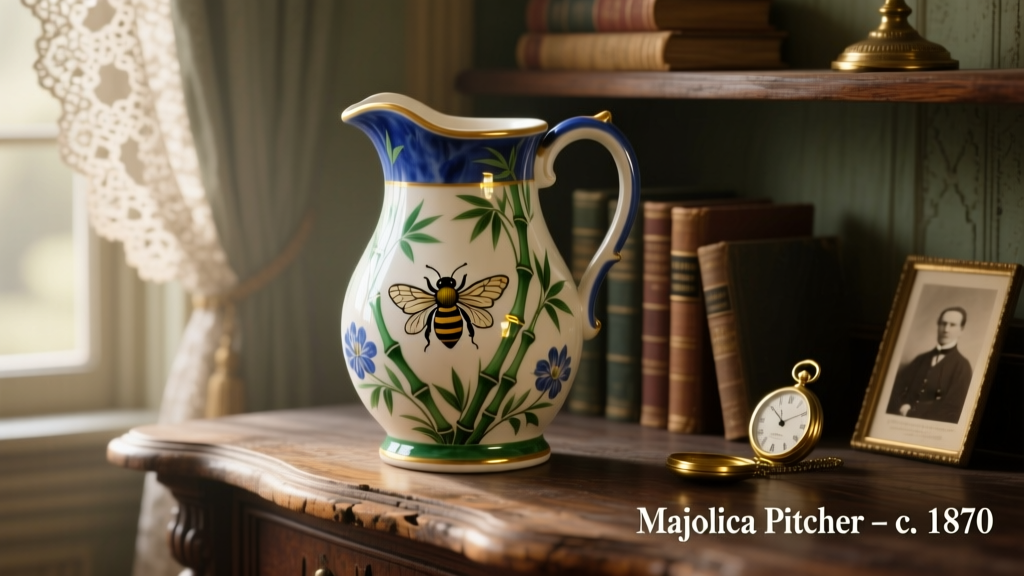
Majolica Pitcher: Bee, Butterfly & Bamboo Design — A Mid-Victorian Masterpiece (c. 1875–1892, 7-Inch Height)
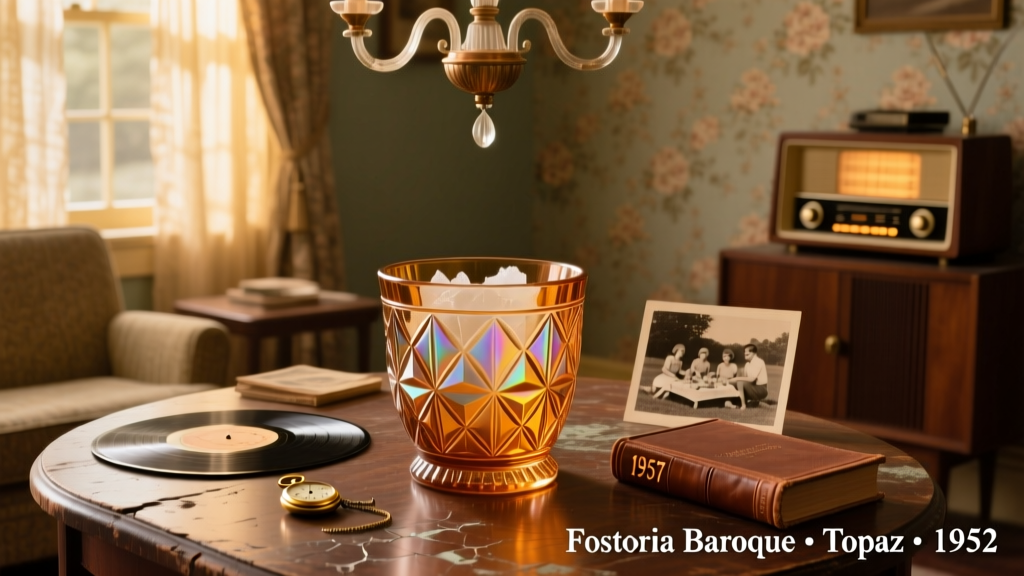
Fostoria Baroque Ice Bucket in Topaz Glass: A Collector’s Deep Dive into the 4 3/8-Inch Model
Beware of Inexpensive Costume Jewelry: A Vintage Toy Collector’s Warning on Authenticity, Safety, and Value
Toy Goat Rocky Mountain Steiff 5½-Inch: A Mid-Century German Plush Treasure
The Vintage Gingham Vegetable Bowl: A Mid-Century Icon in Two-Section 9-Inch Ceramic Dinnerware